Silicon Valley Technology Commentary & Archives · Est. 2006 3,045 Posts · 2006–2026
Showing posts from January 2009 (73 posts). Show all posts

January 31, 2009

January 31, 2009 · 1 MIN READ · BY LOUIS GRAY

Vote for Your Favorite Super Bowl Ad on Twitter Using SocialToo

Vote for Your Favorite Super Bowl Ad on Twitter Using SocialToo


Watching and judging the best Super Bowl advertisements each year has become as traditional as the game itself. While the Pittsburgh Steelers and Arizona Cardinals will be battling it out on the field for the Vince Lombardi trophy, companies and advertising agencies themselves are looking for their own big prize - tremendous visibility in front of one of the world's biggest audiences.

Tomorrow, thanks to an idea spawned by Brian Solis, carrying on a tradition run by Jeremiah Owyang last year, we will be holding a Twitter-wide survey, using SocialToo, to get the opinions of thousands of people, live, during and after the big game. (Also see: Jeremiah's post)

To participate in tomorrow's big survey, and say which Super Bowl commercial was the big one, go to: http://socialtoo.com/survey/view/1221 and vote.

You can also discuss the ads, as they happen, just by posting your thoughts to Twitter and adding the hashtag: #superbowlads. When you use that hashtag, your comment will be added below the survey on SocialToo.

The results will be tabulated after the game. Participating to help spread the word are Brian Solis, Jeremiah Owyang, Guy Kawasaki, Jesse Stay, Chris Heuer, and others.


DISCLOSURE: I am an advisor to SocialToo.
January 31, 2009 · 4 MIN READ · BY LOUIS GRAY

Who Does Apple Think They Are?

Who Does Apple Think They Are?

By Mona Nomura of Pixel Bits (FriendFeed/Twitter)


I can't believe it's barely been a month since we were crammed in stores filled with irate last-minute shoppers. If you've forgotten, close your eyes, think back to the few days before Christmas and how brutal the holiday shopping crowd and all the stores are - even the grocery stores.

Now imagine, combining the tiring experience with raining glass. What a nightmare. I would not wish that on my biggest enemy but that is what happened to a couple from Kansas.

Last December, an Apple retail store's glass doors shattered shut from strong Midwestern winds and showered glass all over two shoppers. Luckily, the couple only sustained minor cuts with no major injuries, but the fact remains: Glass. Exploded. On them. In our country where everyone and their pets are quick to yell LAWSUIT, Apple got lucky, as the couple chose not to sue.

Instead, the couple's son wrote to Steve Jobs and Ron Johnson (VP of Apple Retail) about the incident, and the only response they got was a call from Apple Claims in Seattle, to verify that Andrew's parents decided to pass on taking the company to court.

There was nothing from Ron Johnson VP of Apple retail, or his office.
There was no press release from Katie Cotton VP of PR, or her office.
Of course, there was nothing from Steve Jobs (obviously it won't be from the man himself, since he is in no condition to do so) but not even an Out of Office reply?

Unacceptable.
Below is the letter, taken from Gizmodo:
"On Sunday December 21st, my parents were shopping in the Leawood, KS Apple Retail Store. After making their purchases they found a design flaw in the elegant stores of Apple. Glass does not hold up well in Midwest winters As they were leaving the store, a gust of wind caught the front glass door, the door slammed all the way around into the front of the building and shattered all over them. After many apologetic conversations with the employees of the store, they left and my father noticed he had sustained a cut on his hand. To make it home, they had to stop at the local grocery store to get bandages. Upon coming home, my mother discovered she had also sustained cuts.

This all seemed like a lot of trouble and trauma for just adding to the number of Apple products in our family (We have the new Macbook, Macbook Air, 2 iPhones, time capsule, Apple TV, airport extreme, countless iPods, etc.).

THE END RESULT: I emailed this information to Steve Jobs himself, as well as Ron Johnson VP of Apple Retail. My family has not heard from either of them. We did however get a call from an Apple Claims representative in Seattle to make sure my parents didn't keel over on the car ride home and probably trying to find out if we were planning any litigation. My parents took the high road on this one out of respect for the company of Apple which they know I greatly admire. I am an Apple shareholder as well as the Vice-President of the Mac Users Society at my University.

THE BOTTOM LINE: Our family LOVES Apple. We have all been to Cupertino and have seen Steve in person. It's just funny that all Apple did to rectify a retail door shattering on my parents was to make sure we weren't suing. It's ironic that people who get horrible service and whine about it walk out of stores with brand new macbook pros and whatever they cry for. Yet people like my family have taken the high road because we respect companies that give 1st class service to customers and deliver innovative products.

I've Attached a Photo of the Damage to the Store. My heart goes out to all the Apple Employees who braved the cold and stayed until the store closed."
I love Apple, I do. But Apple's course of action - or lack thereof, makes me sick to my stomach. Who does Apple think they are? Have they forgotten why a company succeeds? It is the paying customers. And from the letter, it sounds like Andrew and his parents are loyal Apple customers. To not even extend a written apology from the corporate offices is completely unacceptable - especially since Andrew and his parents handled the incident with class. The least Apple could've done was offered the nice couple a free year of MobileMe, since no one wants to pay for it anyway. Completely unacceptable.

Am I overreacting? What do you think Apple should've done? Do you have any nightmare Apple customer service experiences?

Read more by Mona Nomura at Pixel Bits
January 31, 2009 · 2 MIN READ · BY LOUIS GRAY

Lima Sky's Crazy Frog iPhone Game Teaches You Not to Eat Bees

Lima Sky's Crazy Frog iPhone Game Teaches You Not to Eat Bees

While there's a trend to make video games more complex, taking on special effects and twists more commonly seen in feature films on the big screen, other game developers are taking a simplified route, focusing on fun gameplay and entertaining animation that means even the video game novice can enjoy an app. Crazy Frog by Lima Sky is one of those straight-forward games that is silly, and fun, and yet hard enough that you'll be playing over and over, not just to get a high score, but because you can't believe you lost so fast.


The Crazy Frog Jumps to Get His Meal

The goal of Crazy Frog, which debuted on the iTunes store on January 29th, is simple: You're a frog, and your goal is to jump and eat the flying bugs the buzz around your head above you. But don't accidentally eat a bee - that hurts!


The Crazy Frog Dodges Bees, Eyes His Food

To control your Crazy Frog, you can use the accelerometer of the iPhone, tilting left and right to slide him along the lily pads, and when you're ready to strike, just tap the screen, at which point the frog will jump into the air. Should the frog come in contact with the bug - well, yum! You can even tilt the phone while in the air to change your trajectory and get a better angle at one of the flying vermin.


The Crazy Frog Expresses His Pleasure and Pain

The game has fifteen levels, starting with a mere two bugs to get you acquainted with the frog's antics, and then piling on a seeming unfair share of malicious bees. Try as you might to avoid the bees, but you will get stung. And sometimes, just to make things difficult, your one target might be flying just above the bee, meaning you have to catch it on your way down, tilting to and fro in the air with your frog.

If that doesn't confirm to you that the game is silly and fun enough, you should see the frog's antics and facial expressions, and hear him cry out in pain after getting stung. It's tame enough that yes, we would add it to our list of great games for kids, but there's no doubt I'll be playing it as well. You can grab it from the iTunes store for only $.99 for a limited time, before it goes to its regular price of $1.99.

January 30, 2009

January 30, 2009 · 2 MIN READ · BY LOUIS GRAY

With Pownce Out of Commission, Schmownce Fills the Gap

With Pownce Out of Commission, Schmownce Fills the Gap

Despite Twitter's having practically owned the microblogging market for the better part of the last two years, the lesser-known Pownce had its share of loyal users, who liked the product's broader feature set, including the sharing of images and events and embedded replies. But when Pownce shut down last month, having been absorbed into Six Apart, refugees were faced with a choice - join the popular Twitter and lose functionality, or try and find Pownce clone. Though the name is silly, Schmownce, as in "Pownce Schmownce" offers the functionality of the now deceased service, and if you were a Pownce user, you can import your Pownce data by synching up your user name, or uploading a file with your history, assuming you got it downloaded in time.

I never got into Pownce, so its loss was no skin off my back, but I can see how its users could grow accustomed to doing more than Twitter's razor-thin feature set. Much like services including FriendFeed have grown their user base with a diversity of options, Schmownce shows some potential, especially when it comes to sharing messages with a small subset of your friends, with "groups", and seeing a reply stream in one place.


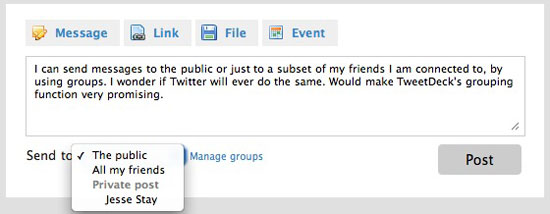
After being introduced to the service by Ajit D'Sa, who works for TRNSFR, the company behind Schmownce and other products, including TweetShrink, I checked out Schmownce, and found it to look like a quieter version of Twitter, but the major thing you'll note is instead of a simple "What are you doing?" prompt, you see a box with four options: "Message", "Link", "File" and "Event".

A message works like it does in Twitter. You write a note, without a 140 character limit, and send it, either to the general public, to an individual friend, or, in a new twist, to a group you may have created. Like in TweetDeck, you can select a subset of your followers and place them in a group, but unlike TweetDeck, you can actually message some of your followers, rather than the "blast all" option Twitter prefers.


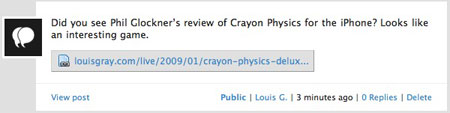
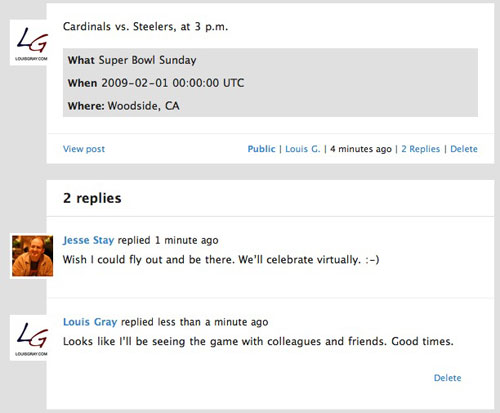
A link adds a hyperlink to an external site. Adding a file, such as an image, either displays the graphic, or posts the file for follower's access. With a limit of 100 megabytes, that's fairly robust, though I didn't test it. You can also post an event, with a location and a date, though you can't pick an hour during the day, or a duration, so it's no replacement for Outlook - just a good way to let your followers know something's upcoming.


Unlike Twitter, Schmownce lets you have threaded replies, so I can reply to specific messages on any of my friends' accounts, see the total number of replies, and get e-mail notifications from said replies. Nothing tremendously Earth-shattering, but still... a potential future direction for Twitter, should it be interested.

Given the best benefits of Twitter are the vast community and its interlocking with developers on third-party services, Schmownce doesn't exactly have the Fail Whale provider shaking in its boots, but if you find these functions interesting and miss your Pownce, go check it out. As always, you can find me at: http://schmownce.com/louisgray.
January 30, 2009 · 4 MIN READ · BY LOUIS GRAY

Crayon Physics Deluxe Lands on the iPhone

Crayon Physics Deluxe Lands on the iPhone

By Phil Glockner of Scribkin (FriendFeed/Twitter)

It seems like genuinely new video game concepts happen infrequently at best. Usually, the industry is perfectly content to watch how a certain gameplay mechanic does in the marketplace, and if it works, diligently copy and iterate on the concept until it doesn't sell any more.

It has traditionally been the domain of the independent (or Indie) game developers, usually 1 to 3 people working intensively together, to really push the 'state of the art' in the industry. They have always been willing to try something new without the expectation of having to sell a minimum number of units in order to pay their salaries and materials costs.

Crayon Physics Deluxe

Petri Purho (Twitter) is one of those indie developers. The game play mechanic he developed is deceptively simple: Take the equivalent of a child's crayon masterpiece, figure out what sort of things might actually have mass, like a boulder, add pivot points and strings, and then apply gravity and force!

He entered his idea into the 2008 Independent Games Festival and ended up winning the grand price and $20,000 for his idea. He quickly refined his prototype into a game he could sell via his Web site and licensed the rights for the game to be ported to the iPhone.

The Game


For comparison purposes, I am going to hold up the PC version of Crayon Physics Deluxe to be the 'gold standard.' That said, let's see how it holds up.

First, it's not surprising that the unique but fairly elaborate "Mario World"-style level navigation from the PC version is absent on the iPhone. The game starts off with a pretty straightforward-looking intro screen (drawn in Crayon, of course) lets you drive right in to the game.


There are 50 levels, and you can either play them in order, stopping and resuming at any time (it remembers where you left off) or you can go directly to any of the 50 levels you want to practice on from the main menu.

When playing the first level, the first thing I noticed is that the animation did not feel as smooth and effortless as on the PC version. This game definitely gives the iPhone a workout. Once the level is completely drawn in and the game can focus on only animating the puzzle parts of the level, it seems to run a bit more smoothly.

The gameplay mechanics are almost identical to the PC version, if you play in 'tablet PC mode' (with a stylus instead of a mouse), with one big difference: in order to remove something, you double-tap on it instead of right-clicking. This actually proves to be quite a bit more frustrating as the interface seems to fight your efforts to recognize what you are double-tapping on.

Another frustration comes from the relative size of the iPhone screen and a finger. On the PC version, a stylus obscures very little of the screen, and a mouse pointer even less. However, especially with me, I have relatively large fingers and the screen is tiny. This means drawing in a relatively small detail such as a pivot point that requires precise placement is harder than it should be.

Perhaps in recognition of this fact, the iPhone version lets you zoom in on portions of the play field with the familiar gesture of placing two fingers on the screen and dragging them apart (or pinching to zoom out). You can also drag the viewable area around by using two fingers instead of one. Finally, 'resetting' a level to its original position is as easy as giving your iPhone a shake.


The game comes with a level editor, where you can create your own puzzle to play later. Unfortunately, the level editor doesn't seem to have any documentation, and has a lot of shortcomings. For example, drawing a section of 'ground level' is extremely difficult.. there are some little drag-able Xs that are there to identify different geographic features, but they don't seem to work reliably. Usually, any lines that are created just fall off the level immediately once the play buttin is hit. Plus, if a level is somehow miraculously playable and you save it, you can only play it on that iPhone. There isn't any way to export or share the level with someone else.

The translation of the experience over to the small screen is surprisingly complete; I still get the same rush and feeling of satisfaction when I manage to get the ball to touch the strategically-placed star (the winning condition for each level). However, a host of problems plague the release as well. Perhaps in recognition of that fact, the game is currently listed for $4.99 on the iTunes Store.

Even at that price, I would have difficulty recommending the game until the developer manages to address some of the issues I've covered here, such as the generally laggy feeling and the useless level editor. On the other hand, the PC version at $19.95 is definitely worth it.

Read more by Phil Glockner at Scribkin.com.

January 29, 2009

January 29, 2009 · 4 MIN READ · BY LOUIS GRAY

Admiring Companies That Don't Blink

Admiring Companies That Don't Blink

It's tempting to run with the mantra that every company must be transparent. With so many ways companies can communicate to us in real-time, we practically expect every single one to respond to our blog posts, our tweets, and our product demands. We find ourselves publicly lauding those developers who show up in our blog comments and promise change. We celebrate those companies whose founders we know on a first-name basis, and whose Twitter handle we have memorized. But there's also a part of us that finds the silence from companies in the tech space who choose not to be as transparent alluring, as it both adds to the mystery in terms of what they have planned, and gives a sense of confidence on their end that they don't have to change their product to match my every whim.

Apple is one of the best examples of a company whose vast wall of silence and secrecy spawns a vast network of rumor-seekers and speculation. Once limited to the dark recesses of the Web, guessing the Cupertino company's next move has practically become an industry tradition. You won't find an official Apple Twitter account. You won't find an official Apple blog either (though the Hot News page is pretty close). And you most definitely won't find an Apple representative in the comments of users' blogs, saying what features they will or won't add to the next release.

You could say the same, on various levels for many companies. What's going on at Google? Despite their many blogs and the ever-present Matt Cutts, it's not all that transparent. Most Google employees don't blog about their at-work exploits, and product development isn't usually that give and take. Microsoft? A different animal altogether. You could argue Microsoft never really understood the Web, and is a full generation behind the true Valley, so maybe they'll get it in the next five years, but they too represent a company that doesn't exactly kowtow to its users.

There are some smaller companies in the Valley that elicit the same kind of respect, because it looks like they are more willing to focus on improving their product than they are shouting down every naysayer, or responding to critics - as tempting as it may be, no doubt. Some of that can come from the founders' previous experiences, if they have grown up in companies where the focus was more on quarterly earnings and shipping product iterations than it was on asking their customer base for product roadmap ideas.

You can see different approaches in terms of how the strong companies respond to criticism, warranted or otherwise. The bad ones will try and shout you down, posting multiple negative comments in response, and might even post on their own blog saying how you are wrong. The good ones might instead say thanks for the advice, or quietly see your input and tuck the advice away for a rainy day.

Some people think I talk too much about Twitter and FriendFeed here, which is fine, but the reason they get so much attention is because we so clearly see their potential, and we use both services a lot. Of course, with high potential comes high expectations, and I have a tendency to want to push them both further faster, whether that makes good business sense or not. You might remember how at the beginning of this month I posted a long item practically begging FriendFeed to work harder at attracting new users. I stated my concerns that too many people were finding the system hard to use. The team could have done a few things - including saying I don't know what I'm talking about, or the reverse, saying I was right and starting to do all I said right away. Instead, Paul Buchheit explained the team's long-term view. His measured, quiet response was respectful and insightful, but didn't blink. My comments and those of others didn't phase him. He and the team quietly kept working. Twitter, in light of recent criticism as to how they've interacted with the developer community, has similar gone back to work and focused on their business. And I respect that. While I'd love to wave a magic wand to push these companies around, or see how closely their plans match my ideas, their focus is to be admired.

Companies like Apple and Google, for the most part, are "above the fray", and don't seemingly need to kowtow to their users in the way that struggling startups or smaller businesses do. So long as both companies, and Microsoft for that matter, continue to push out high-quality products, and grow their business revenues and profits, playing tit for tat on the blogs and Twitter isn't necessary. And they are a special case, in that their mere silence on a topic can stir even more discussion than a clear answer could. If some of the stronger Web 2.0 companies can cross the chasm to that level, thanks to their unceasing focus, then they have made the right choice. I may pound the table for answers, but secretly like it when they don't say a word.
January 29, 2009 · 1 MIN READ · BY LOUIS GRAY

Twitter to Stop Accepting GIF Images as Your Avatar

Twitter to Stop Accepting GIF Images as Your Avatar

By Jesse Stay of Stay N' Alive (Twitter/FriendFeed)

In a last minute e-mail from Matt Sanford, an Engineer on the API Development team at Twitter, he announced that in the next week, Twitter will stop accepting GIF images as user profile images on Twitter. The change comes after a flaw, which I pointed out earlier on LouisGray.com, that enabled users to post animated GIF images, some times in very large sizes, as their Twitter profile image.

Previously, when uploading GIF images to Twitter, it would take several tries and multiple uploads to finally get it to stick on Twitter's end. The resulting image often did not resize, leaving the image in a much larger format, allowing your profile image to stand out in search results with the other profile images on Twitter (why they don't just put a width and height limit on profile images throughout the site is beside me). Sanford states that with GIF images it is difficult to detect problems with the image, as compared with other image formats.

Users like iJustine and many others (including myself) were able to take advantage of this around Christmas, adding animated graphics (as we showed earlier), and much larger than usual profile pictures. (It should be noted that iJustine now has a normal-sized profile image)

Sanford says that users that have already uploaded GIF images as their profile avatars will get to keep them, but moving forward GIF images will not be allowed to be uploaded, both on the Twitter Web site itself and via the API. The change is expected to take place within the next week.

Read more by Jesse Stay at Stay N' Alive.

January 28, 2009

January 28, 2009 · 3 MIN READ · BY LOUIS GRAY

BuzzGain Launches In Beta, Enabling "Do It Yourself PR", Monitoring

BuzzGain Launches In Beta, Enabling "Do It Yourself PR", Monitoring

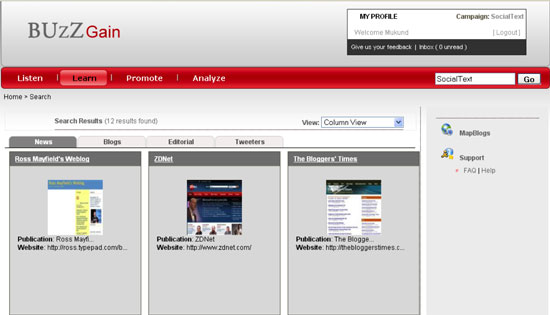
Just yesterday morning, we were talking about the friction that can arise between bloggers and Public Relations teams, who in theory should be working together, but often find themselves battling, largely due to a lack of understanding of one's goals, or even if they have the right targets. Today, BuzzGain, a small startup I've been helping to advise since March of 2008, is opening up in beta, with a goal of helping companies' service, communications and product teams work with bloggers and social media in a better way - through improved monitoring and outreach tools.

Most companies these days are waking up to the fact that they are going to have a hard time controlling their message and brand reputation online, with so many voices out there watching and reporting on their every move. Be they competitors, customers or partners, people are talking about you online, on blogs, on Twitter, on FriendFeed, YouTube, Flickr and other sites. BuzzGain is looking to start out by offering a set of robust social media monitoring tools, but also help companies get to the next level, and better understand who has influence, and where conversations are taking place, so they can better listen and learn from those who can offer beneficial relationships.


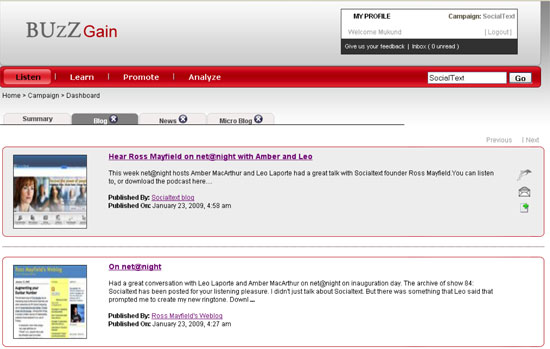
BuzzGain Shows Blogs Relevant to Your Company

In the ten months I have worked with Mukund Mohan and watched the site grow, it has taken tremendous evolutionary steps forward, growing its data base, and making it easier for corporate or PR teams to run campaigns that follow keywords. With time, it could be that BuzzGain would be operated by PR teams in the way Salesforce.com is run by Sales teams in a wide range of industries. And like Salesforce.com, BuzzGain launches with a real revenue strategy, pricing at $99 a month for companies below $100 million in revenue, and rising to $500 a month to those up to $1 billion in revenue, and $1,000 a month for $1 billion+ companies.


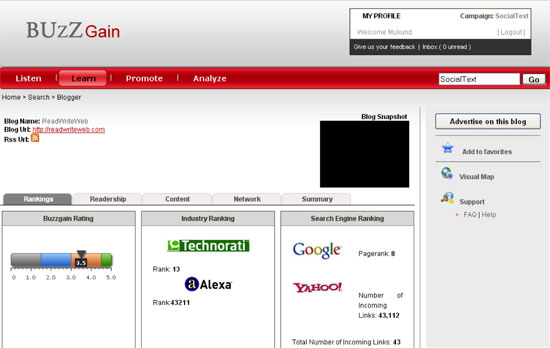
BuzzGain Can Rank Influencers By Authority, Frequency

BuzzGain doesn't operate in isolation. Its data is pulled from popular Web sources, including Technorati, which helps determine sites' influence in terms of external link activity, and Compete.com for estimated traffic. Essentially, as a PR person, if you wanted to find out who the authority was for your company or a set of keywords, you could learn through BuzzGain who mentions those topics most frequently, see how often they do, and whether they reach 500 readers or 500,000.


BuzzGain Can Show Details On Specific Sources

Given the site is in very early beta, there is some work still left to be done when it comes to optimizing the user experience and speeding up time for queries and results, and continued efforts to remove duplication of data, but BuzzGain has developed a one-stop tool for agencies and corporate marketers to get, in a single glance, a barometer for what is happening to their brand on the Web. Mukund and the team call it "Do-It-Yourself PR". The site is currently tracking 150 million different sources of influence, and helps to make some sense of the noise.

You can sign up for the private beta on their Web site, or let me know if you're interested. I just might have some invites and have hopes that these humble beginnings will be the start of something very interesting in the world of PR and brand monitoring.


DISCLOSURE: I am an advisor to BuzzGain.
January 28, 2009 · 4 MIN READ · BY LOUIS GRAY

The Time is Right to Kill Google (If They Don’t Kill Themselves First)

The Time is Right to Kill Google (If They Don’t Kill Themselves First)

Guest Post By Matt Dickman of Techno//Marketer (FriendFeed/Twitter)


In your opinion, what is Google’s differentiator as a company? Can you remember when you switched from Yahoo! to the new, fresh upstart Google? For me, it was seamless. One day I woke up and was just using it. I do, however, remember why I started using it. Google put users at the center of their business. They added value to the search experience by cleaning up the interface and presenting information in a clean, concise manner. They learned early that search was a replacement for the directory-based engine that Yahoo (still) hangs on to, not a supplement.

For the past two years I have written a blog post about the ways that Google attaches itself to my life on a daily basis (here is last year’s version). I’ve welcomed this life-integration with the company because I felt they were adding value. They weren’t doing any evil.

Lately, however I’ve felt a disturbance in the force. I still use all of the same Google products that I mentioned in the post, but something had changed. The company that innovated search by focusing on the user has lost its focus on the user. Here are two examples that you may, or may not, have noticed and I welcome your feedback.

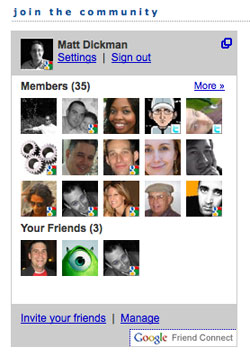
First, Friend Connect. *sigh* This really was my tipping point with Google. (You’ll notice there are common threads between this example and the next one.) Back in mid-December I came across a blog post on this new Google platform extension. On the surface, I liked the idea. Everyone with a Google profile (most of us) could join the site and engage with each other through what Google calls “social gadgets”. My plan was to add ratings at the end of each post, however I ran (and continue to run) into a problem.

The initial set up was cake. I added the community widget to the side of my blog and waited for people to join.

My initial experience with that module was poor. The invite function wouldn’t let me add new users. Actually, I just checked and it still won’t. Worse yet when I tried to invite my friends and the page gave me the error, something weird happened. All of my Gmail chat contacts disappeared. My Google reader contacts as well. Not cool. I’ve been rebuilding this over time, but some people I have been permanently severed from. To add fuel to the fire, when I try to add the social widget to the post, I get the image below where the widget should be. I have everything set up right, it just doesn’t work.

You would think that, upon launching a new platform extension, Google would be all over the support site. Not the case. From when I submitted my post to the next Google rep to answer any questions was about three weeks (and they didn’t answer my question).

Scenario #2, FeedBurner. I think the entire blogosphere has a love/hate relationship with this service. From the time Google acquired the Chicago company until now it has been a rollercoaster. FeedBurner started out with a narrow focus and they executed well. Google acquired them to extend their advertising/analytics offering. However, subscriber stats would often fluctuate wildly, dropping to zero on some days, bouncing back if you were lucky. Google always claimed that they were “working on it”, but I didn’t believe it until a while back when I saw that they were transitioning to the Google platform.

In theory, this is a good thing. More scale, more stability, more happy people. Wrong. The transition was not explained well and I saw a wave of panic slowly crushing the blogosphere. A couple of us took the plunge and made the move (I even recorded a video to help people understand the process). In the process, my subscribers dropped by half. No explanation. Hundreds of posts to the support forum and no replies from Google. My stats did bounce back, but the service’s reputation is shaky now. People use this as a key metric, companies track it and people get paid based on it. Sadly there is no alternative (yet).

Google has lost sight of the user. They have neglected us for too long, concentrating instead on advertising. I get that it is their lifeblood, but what good is an ad that nobody sees because you alienate your community. I think that a company that attacks with the right mission and focus on users could make a dent in Google’s armor. Killer customer service powered by social platforms could allow a new set of players to emerge.

I would love to get your take on this. Have you seen the same trend? What would you do if you were Google to stand up and put your foot down?

Read more by Matt Dickman at Techno//Marketer.

January 27, 2009

January 27, 2009 · 3 MIN READ · BY LOUIS GRAY

Trackbacks Are Still Dead. Could Tweetbacks Take Their Place?

Trackbacks Are Still Dead. Could Tweetbacks Take Their Place?

By Phil Glockner of Scribkin (FriendFeed/Twitter)


The Trackback Problem

Today, as I was visiting different blogs reading the news of the day, I made a special note on how many comments each post had and if trackbacks and pingbacks were listed.

Trackbacks and Pingbacks are two of three types of linkback, defined by Wikipedia as "... a method for Web authors to obtain notifications when other authors link to one of their documents."

What I'm coming to realize is that, in terms of showing buzz around a post, trackbacks and pingbacks are dead. Worse, they just show how many spam blogs (splogs) are out there, hanging off of an RSS feed and republishing part or entire posts in order to artificially inflate their Google rank numbers.

(See Also: Did Trackbacks Die, and Who Killed Them? from July 2007)

Take this Inquisitr post, for example. If you scroll down to the bottom, you will see 6 or more trackback links, most of them with the same block of quoted text. After quick inspection, it appears all but one of these links go to blogs that are either partially or completely ripping off the Inquisitr's content.

In essence, instead of showing relative popularity and linking to further discussion, this has become an avenue that is not only exploited by spambots but flaunted right under the noses of the content creators.

One Option: Tweetbacks

As news blogs increasingly extend into social networks, they are looking for a way to register their reach on those social networks. A good example of this is Digg. One of the reasons Digg got so popular so quickly was due to it allowing blogs to display how many times a Digg user had submitted (or Dugg) the article. This provided a fine synergy between the blog and Digg, and in theory both services benefited.

However, even solutions like Digg, Mixx and Sphinn seem to be losing clout, as people turn to using Twitter instead to highlight items of interest.

With that in mind, it seems only natural for blogs to want to show how their posts have legs on Twitter. To that end, several WordPress plugins have been created that attempt to serve this need, such as TweetSuite, TweetBacks, and to a lesser extent, TwitterTools.

From these three, I would say TweetSuite is the most stylish and functional. However, TweetBacks is a solid framework and with a little skill can be integrated much more cleanly into a blog theme.

FriendFeed..Backs? FriendBacks?

FriendFeed may not be as popular or as well-known as Twitter, nor have as much reach, yet, but because of its unique ability to aggregate RSS streams and simultaneously act as a community hub, with the addition of a powerful and flexible open API, there has been a significant amount of development around it as well.

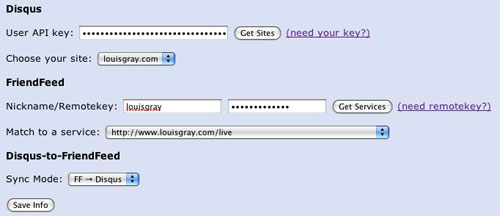
Recently, there was news that Disqus turned on two-way integration with FriendFeed (after also enabling Track- and Pingback support and more recently, Facebook Connect). However, there are already at least two other good solutions, including FriendFeed Comments WordPress plugin and FriendFeed-to-Disqus Sync, a cloud-based synchronization utility that Disqus itself wrote about here.

What's Next?

Buzz and reach are always going to be things that blogs strive for, especially blogs that employ multiple bloggers and are ad-supported. Are tweetbacks and 'friendbacks' going to keep them going indefinitely into the future? Absolutely not. Something new will appear and, if it has an API, people are going to figure out how to tie their blog to it.

Read more by Phil Glockner at Scribkin.com.
January 27, 2009 · 7 MIN READ · BY LOUIS GRAY

Bloggers and PR Are Not Enemies, But Quality Efforts Are Needed

Bloggers and PR Are Not Enemies, But Quality Efforts Are Needed

When it comes to the issue of how bloggers should work with companies' public relations teams, I sit in an interesting intersection. From 9 to 5, I help administer my company's public relations strategy, working on customer announcements, product releases and relations with media, analysts and customers. It's only part of my role, but a significant one - to help raise the company's visibility and awareness in key target publications and communities. But outside of work hours, when it comes to the blog, I often find myself solicited by companies' PR teams who are hoping their announcements will hit a sweet spot for the site and its readers. And the two roles can be very conflicting. At the office, my goal can be for many people to write about one thing. At home, often, if I think others have already covered the story, I'll skip it. But that doesn't make PR the enemy - even as I get press release submissions that I never would have requested, see people set unrealistic embargoes that are clearly broken by someone else, or watch double standards be applied.

Yesterday, Jeremy Toeman of Stage Two Consulting, and a strong blogger in his own right at LiveDigitally, asked if bloggers were simply underutilizing PR people. He, very accurately in my opinion, highlighted how many bloggers are choosing speed over correctness, not checking with PR teams to get background data, or even turning down the opportunity to speak with company representatives to gain quotes and other facts behind the standard release.

Simply stated, a good number of bloggers, many without traditional journalism training, are not taking extra effort needed to make their stories more robust, with company input. Some of that is due to a lack of experience. Some of that is due to a lack of time. Other factors may include a lack of interest, and especially, reward. What many have found, including me, is that the traditional ways bloggers measure themselves, with page views, external links and the number of comments, "likes", Diggs or what have you, are usually not impacted in a positive way through the additional work.

In my comments to Jeremy, I said I do reach out to developers behind a service, especially on longer-lead items, where the company has made a personal effort to reach out to me, instead of just seeing my name on an e-mail list. If, instead, I can tell it's practically a form e-mail, the additional effort to get background data, quotes and an interview is essentially lost, as my story will be just one of many that hit the Web at the same time - so it'd be just as useful to simply get a login to the site and start making screenshots. Marshall Kirkpatrick of ReadWriteWeb concurred, saying there is "little incentive in terms of pageviews" to do the additional research. Robert Scoble, who does some of the most-direct reporting with videos of entrepreneurs in his work for FastCompany, said there is "not much homework being done, just a lot of repurposing press releases," adding it's not just bloggers who err this way, but many in traditional media as well.

Putting my work/PR hat on, I can see the trends as well. Just a few years ago, the best way to distribute a message was to set up a series of conference calls and analyst visits weeks ahead of a launch, and provide customer references. Now, given the dramatic reduction in media outlets, and rise in people vying for attention, it could be just as effective to send an early version of the press release out and pick a date for folks to write about it. Some will want the executive interviews and customer quotes, but not all. There are just too many stories to be written and not any more hours in the day, and as with bloggers, the media wants to be first. Provide a date, and some will post at midnight Pacific. Others will post at midnight Eastern time, meaning their story lands up to six hours before the official press release and Web site updates.

So yes, things are changing - and with change comes strife.

Not every public relations firm is an expert in dealing with bloggers. Some are waking up to the blogging phenomenon and, guessing at the influencers, are simply adding blogger e-mail addresses to their distribution lists, without taking the time needed to se what it is each blogger covers, learning their focus areas, or personalizing an angle. Others are aggressively hustling the top two to five names and ignoring the second layer - which creates stress for those pursued, and resentment for those who are ignored.

But the issue is a two-way street. Bloggers often want the respect given to traditional media, and want to be counted as journalists, but it is a select few who are leveraging the resources available - taking time to ask questions of the company and getting quotes from executives. Is it because executives aren't trusted? Is it because bloggers don't want to look biased in favor of the company, but instead, neutral? It can't possibly be because they didn't think to ask, or are lazy, or just wanted to get a post out the door before moving on to the next one, right?

On LouisGray.com, there are definitely times when we get the chance to speak to the developers of a service to gain quotes and their take on the news. You saw that with the launches of Plinky and PeopleBrowsr, Scrapplet, Gnip, Glue and many others. You've also seen launches of new products where we've been trading e-mails with the companies for weeks or months, like with Feedly, Toluu and Socialmedian. But we don't do this every time. Sometimes, it's because we never got the chance. Other times, it's because all we got was a press release and a launch date, and not being overly impressed with the product, it didn't seem worth the effort.

For me, much of the traditional public relations activity, owned by a PR firm, is being done by the founders of the companies I talk to themselves. Instead of asking a PR person for help, I'm going straight to Jason Goldberg or Bret Taylor, Caleb Elston or Alex Iskold. The traditional PR function of shaping a message, choosing targets and scheduling interviews is often done solo - but the rules still apply. Bloggers want to get a unique story, and companies want to reach as many people as possible - so yes, there is a conflict.

The solution is for bloggers to understand the goals of the PR firm and company, and for PR firms and companies to understand the goals of the blogger. It would behoove PR firms to learn how to reach out to bloggers as individuals and tailor a message, even if it is a simple feature enhancement or milestone. It would behoove bloggers to go beyond the headlines and try to really understand a product - to kick the tires, providing feedback, positive and negative. Bloggers don't like feeling like a number, and PR people don't like being ignored if they have made an executive available.

As bloggers, taking the time to speak with an executive and getting a customer example or a use case can be not only a good way to get a unique story, but also to get a personal relationship that goes well beyond a press release. Truth is - the more you know about a product, the more likely you are to end up using it yourself anyway.

As PR reps, understand many bloggers have day jobs, and they don't always have the flexibility to answer you in your 9 to 5 window, so you will need to be open for calls at 10 p.m. as much as 10 a.m. Trade e-mails with me at 1 a.m., and you've practically got a partner for life. And do your homework. It's just as important for you to know what it is that I write about as it is for us to know what it is that you do and where you used to work. The blogging community can be your best mouthpiece for getting the message out quickly, and your worst enemy, should you end up ticking them off.

There has got to be a move to quality on the blogging side. I would much rather have longer-length posts from me and the team than quick hits that get out 15 minutes before the next guy. And companies should reward bloggers who take the extra effort by highlighting the reports on their site as they do traditional media reports. But there has also got to be a move toward quality from PR firms, who in stressful times these days, are scrambling to make headway in a very tough environment. PR companies and bloggers could work together as partners to deliver their readers stories that are relevant, sourced, and robust.

Or... we could continue to ignore each other and point fingers, and from that, nobody will grow.

January 26, 2009

January 26, 2009 · 5 MIN READ · BY LOUIS GRAY

Missing a Conference? Find a Local Meetup Instead.

Missing a Conference? Find a Local Meetup Instead.

By Daniel J. Pritchett of Sharing at Work (FriendFeed/Twitter)

Which professional conferences are you planning to attend in 2009?

If your answer is none, don't worry too much because you're not alone. It's easy to feel left out when reading a sea of tweets about 2009 conference calendars: The big destination this week is the World Economic Forum in Davos, Switzerland. Our own Louis Gray will soon be moderating a South by Southwest panel on content aggregation. Mark Hopkins is looking for a sponsor to send him (and a team of assistants!) to SXSW in Texas.

I won't try to tell you that these conferences aren't tremendously valuable for people in the right jobs at the right companies, but they aren't all going to make it into the budget. Of chief concern here is the fact that many social media enthusiasts aren't in marketing, purchasing, or recruiting positions. We're in jobs like programming, management, writing, tech support, and other careers. While our jobs are undeniably aided by social media it is difficult for us to defend a need for bleeding-edge updates and networking at the cost of a month's salary.

Plenty of companies took a look at their 2009 budgets and decided that conferences and other networking activities weren't going to be their top priority this year. It can be hard to justify spending $5000 or more to send one employee to a show for a week when the boss is trying to figure out how to avoid laying people off. Those conference bills add up if you start sending multiple teammates to a few conferences each year.

Fear not, there are inexpensive local events!Even though you might not have the money to make it to the national conference or tradeshow this year there are still plenty of ways for you to connect with like-minded professionals in your area. I've gathered a list of the networking events that have been the most useful for me in the last year. You might be lucky enough to have some of these in your area. If you can't find one local to you, you've got a great opportunity to start the local events you'd like to be attending!

The tweetup: as powerful as it is simple

Readers of this blog are no doubt familiar with the idea of a "tweetup". Quite simply, a tweetup is a meetup organized and/or publicized on Twitter. This can be a purely entertaining trip to a movie, a professionally-oriented dinner, or even a few Twitter users deciding at the last minute to attend an already scheduled event as a group. The most intriguing tweetup concept I've seen lately was organized by blogger/analyst Jeremiah Owyang in the Silicon Valley area. Jeremiah hosted a mixer where recent re-entrants to the labor market could meet each other as well as some local hiring managers.

My first meetup? Social Media Breakfast

The Social Media Breakfast series was started by @BryanPerson in 2007 as "an event where social media experts and newbies alike come together to eat, meet, share, and learn." I've been enjoying these here in Memphis since last August, and the event keeps growing and growing thanks to positive feedback from the blogosphere and good writeups in the local press. The breakfast format provides a great opportunity for one-on-one conversations as well as some informative presentations and round-table discussions.

What's happening lately:

Mr. Person has recently taken his SMB leadership from Boston to Austin and continues to build a great community both locally and online. Just up the road from Memphis you'll find a similar event in the Nashville Geek Breakfast series. Our own Social Media Breakfast is breaking new ground and morphing into the Social Media Expedition. This Expedition branches out from its solid base in technology and networking to include cultural appreciation and community involvement.

No, not that kind of bar

The BarCamp concept has been a driver behind the "unconference" ideal since 2005. Formed as a more inclusive alternative to Tim O'Reilly's invite-only Foo Camps, a BarCamp is usually open to all comers and features a schedule driven by the participants. You'll typically find sessions on technology, new media, business, and general web interests. Everyone who attends is asked to offer a presentation or two on topics they are interested in. Attendees vote on the day of the event to determine which sessions will be given. On top of the fluid schedule, BarCampers are encouraged to come and go from sessions as they please in order to get the most out of their time. This format has proven to be so accessible that there are now hundreds of BarCamps every year.

What has been happening lately:

BarCamp spinoffs like WordCamp and PodCamp are gathering momentum. In my area we saw the first Memphis BarCamp last November. Unconferences of all kinds should be big in 2009 as an alternative to big-budget trade shows.

Social Media Club wants to start a monthly event in your area!

The Social Media Club has been on a mission since 2006 to "help people find all the relevant communities of interest in which they want to participate". While I haven't yet had the pleasure of attending an SMC-affiliate event they have a highly visible presence on Twitter and can boast nearly 40 chapters worldwide with thousands of participants.

What other events are out there for you?

If you're hoping for a local event with a bit of a different flavor from the ones listed above, head to some popular online meeting coordination services and see what you can find in your area. Meetup and Upcoming are both solid resources for listing and locating the events you might enjoy. Meetup's "waiting for a meetup" counters are a particularly good way to see how many other people are already interested in a new meeting concept you'd like to lead. I'd like to encourage our readers to share tips and success stories in the comments below: Which local events have been most meaningful to you? What are your ideas on finding or hosting interesting events?

Master marketer and blogger Seth Godin insists throughout his latest book Tribes that you too can lead your own movement thanks to the connecting powers of the web. You may not feel like a born organizer, but once you realize that others in your area are just waiting for someone to call them or tweet them with an invitation to an exciting new session you'll see what Godin's talking about. Whether you're smarting over a shortfall in your travel budget or you just want a way to connect with your community, the time to act is now!

Image by Rob Lee

Read more by Daniel at Sharing at Work.
January 26, 2009 · 2 MIN READ · BY LOUIS GRAY

Twtapps: A Suite Of Five Simple And Unique Twitter Apps

Twtapps: A Suite Of Five Simple And Unique Twitter Apps

By Mike Fruchter of MichaelFruchter.com (Twitter/FriendFeed)

When it comes to Twitter, there are hundreds, if not thousands, of applications built off its API. Back in November, I highlighted 15 unique and useful Twitter tools for your Twitter toolbox. Today, I ran across a company called twtapps. They develop simple, fun and useful twitter applications, and have a total of five developed. These applications do not post directly to Twitter, but instead they give you the links to share them on Twitter, Facebook, e-mail or any other social network of your choosing. This post profiles their five Twitter applications.

1) Twtcard.com


twtcard is a simple greeting card for Twitter. Simply type your message, enter your Twitter user id, and select from one of the fifty square-head graphics. After you create the card, you have the option to Tweet it, or share to Facebook. You are also given a URL for your card. Here is what one looks like.

2) Twtvite.com


twtvite allows you to create and notify your Twitter friends of an upcoming event. Create the event, enter the location, date, time and the events details, and share it/ manage RSVPs. This is an application that will come in handy. The invite updates in real time as people respond with either, yes, no or a maybe. As with the rest of these applications, you have the option to Tweet it, or share to Facebook. You can also embed it on a website.


3) Twtpoll.com


twtpoll is similar to socialtoo.com, it allows you to create a very simple survey. Simply type your survey question, fill in the choice answers, and embed/share it. Survey participants can even leave comments after they have completed it. Here is what one looks like.

4) Twtpets.com


twtpets is a twitter game for pet lovers. To play the game, enter your pet's name, upload a picture, and add a description of the image. Then your pet does battle against other Twitter user's pets. It's a one on one battle with random images displayed for your pet's competitor. Refresh the page and your pet does battle with a new victim. Tyson, my boxer, pictured below did battle with Sadie the Shih Tzu. Here is what the battle page looks like. You also get a pet scoreboard to see how good your furry friend is doing.


5) Twtwlst.com


twtwlst is a gift registry twitter app. This is an Amazon wish list for Twitter. You can create a simple wish list for whatever the occasion is, and send it to your Twitter friends. Enter the occasion for your wish list, the products you want, along with a link to where they can be purchased. Tweet it, share it, and embed it on your site. Your friends now can"t say they forgot the occasion. Here is what a live one looks like.


Read more by Mike Fruchter at MichaelFruchter.com.

January 25, 2009

January 25, 2009 · 3 MIN READ · BY LOUIS GRAY

Watch for the Telephone Game in Your Short Attention Span World

Watch for the Telephone Game in Your Short Attention Span World


One of the recurring themes on this blog has been how to handle a seeming overflow of information. We've discussed creating a social media consumption workflow. I addressed a new concept I called continuous parallel attention. I said how you handle the information overload Is up to you and later said there is no social media overload and cautioned bloggers to relax, because nobody is keeping score. But we still see problems crop up when a story gets passed from person to person and details get lost. It's the modern equivalent of the popular "Telephone" game we all played as kids, where the last phrase was never close to how it started.

Take a look at an example from this weekend, after Erick Schonfeld of TechCrunch wrote a piece saying FriendFeed had seen site growth that reached almost 1 million visitors in December of 2008.

Seems straight forward enough. The data came from Comscore, which shows a higher growth rate for FriendFeed than do other services, including Quantcast and Compete.com. Compete reports 700,000 visitors or so to FriendFeed in December, by the way.

But then, Robert Scoble, a good friend, good blogger, and fellow FriendFeed user relayed the story a little differently, saying that the report said FriendFeed had surpassed a million user accounts.

Using that as the baseline, Robert stated the 26,000 or so subscribers to his feed represented one of every 39 users. (See the FriendFeed thread here) But that only exacerbated the flub. Having used the site myself for quite some time, I'd be shocked if there were more than a million registered accounts, and FFHolic estimates the number to be closer to 200,000 total accounts, one fifth of a million. This of course makes Robert's penetration even higher, as that means one of every eight users follows him, but that's not the major issue.

If you're FriendFeed, and you know your actual user count, you can't exactly issue a correction saying that you "only" have a quarter million users. And if they did announce such data, which they don't, it might seem to be a letdown now that the higher, incorrect number has been released.

The service is now becoming a destination site as users share links on Twitter, their blogs, Facebook and elsewhere, so it's no surprise that the unique visitor count is higher than the number of users. After all, if I visit from home and on my wife's laptop and the office, doesn't that count as three unique visitors?

This is but one example, and I know practically all of us have made the mistake of reading stories too quickly, or coming to conclusions and extrapolations based on only partial data. For example, Stowe Boyd wrote a great piece tonight saying I was "Wrong About Twitter Funding", but he had only seen one of the two posts, which had taken point/counterpoint positions. That's not a victim of the telephone game, but he is a busy guy, like the rest of us, and no doubt overlooked one of the items.

When we're reacting to other items, or relaying them, we should be careful that we're not making new stories based on data that's not true. We're all going fast, and maybe reading a ton of RSS feeds, seeing thousands of Twitter updates, and rushing in an effort to post quickly. But there's something to be said for watching for the telephone game.
January 25, 2009 · 3 MIN READ · BY LOUIS GRAY

There's No Way Twitter Is Worth $250 Million Today

There's No Way Twitter Is Worth $250 Million Today

See Also: Twitter Is Worth A Lot More Than $250 Million

In the Web 2.0 space, it would be extremely difficult to find a more-successful, faster-growing service than Twitter, who has carved out a significant niche for itself in the microupdates space, as people from around the world tell you what they're doing, right now, even if you didn't ask. The service has an estimated 6 million active users, and recently surpassed the 1 billion "Tweet" mark, if you count all updates. But the company hasn't yet made a buck in traditional revenues. (Although I can't claim to be privy to their books, and they just might have recognized something somewhere) Word comes this weekend, via TechCrunch and others, that Twitter is embarking on a new funding round that could see the company valued at $250 million. And while I already made the case that Twitter will get its funding, and could end up being worth a lot more than that number in short order, it is pretty easy to also poke holes in that analysis.

Quite simply, now is a very difficult time to attain a high valuation. Venture funding is dropping dramatically, and positive exits for companies are rare. Practically nobody is talking about going public, so to make money, you would have to do it the old fashioned way, through profits. And Twitter has grown its user base rapidly, but has done so on the backs of users who are used to getting something for nothing. We've already seen users revolt when Magpie launched with the possibility of inserting ads in one's tweets, and you could expect to see the user base shudder when being asked to shoulder any of the revenue themselves - so you can practically forget about monthly fees. Given that scenario, site ads and ads inserted in third party applications, like TweetDeck, would have to be one option, but an unattractive one, as the ad market itself is tailing downward.

Additionally, what Twitter does is incredibly basic. It's sole functionality is one that it is easily replicated. You can provide status updates on Facebook, on GMail, on FriendFeed, and the whole process rolls back to AOL instant Messenger, when you would set an "Away" status to say you were "At Lunch" or "In a Meeting". So that's not hard.

A recent post by Paul Buchheit of FriendFeed, called Communicating with Code, showcased a prototype offering of FriendFeed that borrowed heavily from the look and feel of Twitter. Given FriendFeed updates include those from Twitter, and then build on with additional services, it can be considered a superset, while Twitter is simply one service of many. So the barrier to entry to compete with Twitter is not that hard, leaving the company's major assets as the community and its developers.

But communities are incredibly fickle. None of Twitter's six million users were using the service five years ago, and maybe, five years from now, they will be doing something else. If people use Twitter for conversation, they can replace that with e-mail, with IM, with FriendFeed, Facebook or other social destinations. I've talked about the five stages of being an early adopter before. One of the final stages is when you grow tired of an environment, and leave, begging your followers to come along. It happens with news groups. It happens with e-mail lists, and it just might happen with social networking tools, including Facebook, FriendFeed, Twitter and others.

Today, Twitter is among the hottest, fastest-growing brands out there. But no matter how you multiply its current revenue to try and guess at a market capitalization, the answer is still zero. At a time when real brick and mortar businesses are seeing their own valuations decimated, how can a virtual company with a free user base and a low barrier to competition expect to be valued so richly? Whoever does invest should exercise extreme caution.
January 25, 2009 · 3 MIN READ · BY LOUIS GRAY

Twitter Is Worth A Lot More Than $250 Million

Twitter Is Worth A Lot More Than $250 Million

See Also: There's No Way Twitter Is Worth $250 Million Today

Michael Arrington of TechCrunch led the weekend news cycle Saturday evening after revealing Twitter is in the middle of a funding round that could see the still pre-revenue company valued a cool quarter-billion dollars. Not only do I believe the company will end up getting the money they are looking for, but whatever investors choose to pony up could eventually be seen as having gotten a bargain - because Twitter, with the increased investment, looks prepared to 'double down' and become a must-use utility in our increasingly realtime, increasingly connected, digital world.

Despite the company's many failings, be it with uptime, developer relations, or seemingly blaming its most active users for aggressive activity, Twitter has, over the space of 24 months, cemented itself in a position where it is a critical part of the way we share information, communicate with others, and in times of news and change, can learn from the firehose of tweets from all corners of the world.

Twitter's rise to prominence has been largely in part due to its simplicity. It does two things - let you send short updates to followers, and let you see updates from those you follow. The addition of many third party services, including the since-acquired search capabilities, and scads of desktop or Web tools, have only served to let people consume and distribute the data as they wish, as Tweets can be issued automatically from mobile phones broadcasting location info, sent from blogs using RSS, or from a host of updating services, including Ping.fm and FriendFeed.

Twitter, amid pressure from users and developers to add the ability to display photos and video, to extend the number of characters to beyond 140, to add threaded comments, and to find a business model - any business model - has simply continued doing what it does, even as competition has faltered. Pownce shut down altogether. Jaiku disappeared into the Google black hole. And FriendFeed dances to its own drummer, acting as a great complement for Twitter even as people occasionally say it could knock Twitter off its pedestal. Facebook's status updates are probably the closest thing to being a head to head fighter to Twitter out there today, and many simply pull their updates from Twitter to the social network, as I do.

Twitter will find a business model. It will very likely include some form of advertising, even in a tough economy for ads. It may also charge for premium options to users, and might find a way to break into the enterprise, eliminating the need for Yammer and other copies. And investing in Twitter today means you're buying into a company that already is #1, by a long shot, in its self-built market, before it has truly hit the mainstream, and among the Web 2.0 set, Twitter is the closest to do so - being featured frequently on CNN and used by prominent figures, including the new president's team as part of his social Web strategy.

And don't be fooled into thinking Twitter is just for consumers. Savvy business users are recognizing that Twitter is a vital audience to be communicated to and to listen to, for product mentions, feedback and competitive updates. Twitter is part of the noise, and you can either embrace it, or ignore it, to your own peril.

How can Twitter be worth 1/4 billion today without any revenue? Take a look at the market capitalizations of Web companies today, even after the stock market blowout. Yahoo! is worth nearly $16 billion. Google is worth more than $100 billion. And in traditional media, even the very damaged New York Times is worth more than $800 million at its current price. As I have mentioned many times on this blog, I find Twitter's search capability to be even more important than that of Google for breaking news. Given the company's incredible momentum, and inability to get knocked off its pedestal, we would be foolish to think Twitter can't continue to grow and increase its user base and offerings, and be worth more than $1 billion in very short order.

If I had cash sitting around to put into Twitter and they came knocking on my door, I would ask plenty of questions, but at the end of the day, I would be investing. This will be a deal to watch for sure.
January 25, 2009 · 3 MIN READ · BY LOUIS GRAY

Socialtwist's Widget Puts New Twist On Social Content Sharing

Socialtwist's Widget Puts New Twist On Social Content Sharing

By Eric Berlin of Online Media Cultist (FriendFeed/Twitter)

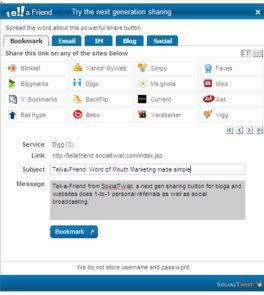
When reading a blog post, it's not uncommon that you will see a "Share This!" button at the bottom that you allows you to do such things as share it with friends or to publish it on your own blog or social media profile. A new Tell-a-Friend widget, produced by SocialTwist, aims to expand on that idea by enabling distribution to such communications platforms as instant messaging services and by allowing easy selection of contacts through e-mail and social networking address books. Here's how they describe it:
Unlike other sharing utilities, Tell-a-Friend stands unique to give you a single button which enables both one-to-one personal recommendations and social broadcasting. Tell-a-Friend is the only sharing widget to support Instant Messengers (chat) and personal messages to friends on social networks. That's clearly the best of word of mouth marketing rolled in one.
The idea is that the widget is easily installable, highly customizable, supports more than 80 services, and comes packed with analytics so that you can monitor your "viral campaigns." With support for all major instant messenger services and social media services spanning from Bebo to Yardbarker, it's hard to think of a place that you can't use Tell-a-Friend to send to. And the fact that Tell-a-Friend displays as a pop-up within the Web page that you're visiting makes for a seamless and easy user experience. I also really like the tabbed interface that allows you to easily select that type of service you'd like to use to distribute the content.


It's a pretty cool and timely service as it builds upon already available services and aims to please publishers who are always eager to enable the distribution of their content. And the ability to track the metrics of that distribution is potentially important in quantifying the ever elusive notion of "influence."

So if everything about the Tell-a-Friend widget makes sense and is looking good, I think the challenge will be to make it as easy as possible for publishers to understand and install. The Web site showcases a really cute and well produced explainer video:


But I was left wondering, "Where's the Tell-a-Friend widget?" I realized that I didn't know what it looked like! To be fair, a sample version of it is sitting in the middle of the homepage, but it took me some time to track it down.


And so if that leaves room for argument that I'm slow on the uptake, keep that in mind while I explain that I had some trouble getting the widget installed and running. I began by trying to install Tell-a-Friend on a Blogger site, figuring that would be the easiest way to test it out.

However, I couldn't get the widget to publish. I followed the step-by-step instructions that were provided, but could not get the widget to appear.


Even though there were several screenshots given to help me, there was no final screenshot showing the widget displayed on a "live website" so that publishers can see what the widget is supposed to look like on a published webpage. Translated, I did not see any written or visual instruction that tips the audience off that Tell-a-Friend is supposed to appear directly beneath the bottom of each article.

After trying to "hack" the Blogger template in a few different ways, I gave up and moved onto a WordPress site. That one proved to be successful, though it does take a little bit of technical knowhow to get it running: You have to download a .zip file with the widget code, FTP it to your WordPress plug-ins folder, and then go into your WP management tools to activate it.

Overall, I believe that there's a market for widgets that are truly useful to both publishers and Web site visitors, and Tell-a-Friend is certainly a part of that conversation.

Read more by Eric Berlin at Online Media Cultist

January 24, 2009

January 24, 2009 · 3 MIN READ · BY LOUIS GRAY

Learn More About Who You Follow With TweepSearch

Learn More About Who You Follow With TweepSearch

By Jesse Stay of Stay N' Alive (Twitter/FriendFeed)

Damon Cortesi, the man behind TweetStats, DM Whacker, and First Follow, has just made my life a whole lot easier by allowing me to learn more about the people I follow through search. The service, called TweepSearch, aims to allow you to search for specific people you want to find amongst the people you follow.

Back when I joined Twitter, tracking those I follow was an easy task. I knew almost every person in my network, and was able to easily learn more about them by reviewing each of their profiles and seeing what they did through their Bios. In the beginning I was religious about this - I really care about my followers, and I really enjoy learning who is following me, and what they're interested in. However, as my network has grown from hundreds, to thousands, to now approaching tens of thousands, it has become increasingly difficult to know every single person that is following me. There are days I get in the hundreds of new followers - I think every account on Twitter has this potential. It was actually for this reason that I created my own service, SocialToo. TweepSearch complements SocialToo by letting you now search amongst the people we follow for you.


Are you in HR?

One potential application I could see for this is a way for HR professionals to find people in particular fields. What a better way to find employees than through the people already interested in your brand who are already following you? Jeremiah Owyang did a study recently in which he suggested (based on early data) most people with jobs currently found those jobs through a friend. Through TweepSearch, you can do just that, by searching for people with the skills you need amongst your Twitter friends.


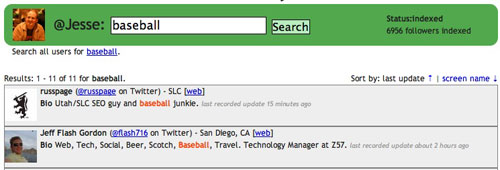
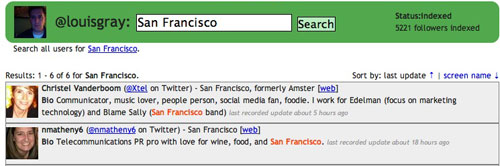
I decided to, as an experiment, try this amongst my followers. I did a search for "Perl" (we are a Perl shop at SocialToo), and was surprised to find people listing Perl experience in their Twitter profile. I did a search for "Social Media", and found several Social Media experts. Searching for "marketing" revealed a whole slew of people with a focus in marketing. You can actually search this amongst the friends of any person they are indexing!

Search all of Twitter

The amazing part of TweepSearch is that it not only works amongst your followers, but you can also search through all indexed profiles on the service. If you don't specify a Twitter username, it will search for all the terms I mentioned above across a large sample of the Twitter user-base.

Damon listed several future plans for the site, which include the ability to search by proximity, meaning you can search for specific terms amongst people within a certain distance from your current location. He also plans for the ability to follow directly from the results of people you just searched. Currently, you can already search for people in a given location based on the "Location" field in their Twitter profile.

While TweepSearch comes amongst a large base of People searches around Twitter, including MrTweet, which matches people to you, and Twitter's own people search which suggests people to you and allows you to search by name, TweepSearch fills a void in that space by showing you who the people are that are following you. Give it a whirl and see what you can learn about your Tweeps!

Read more by Jesse Stay at Stay N' Alive.
January 24, 2009 · 2 MIN READ · BY LOUIS GRAY

419 Scammers Set Up Roost on Facebook

419 Scammers Set Up Roost on Facebook

The art of the largely Nigerian-based '419' e-mail scam is a unique one, but a familiar one. Anybody who has had an active e-mail account for any amount of time has seen the heartfelt pleas for assistance and funding to help safeguard huge amounts of assets that need to be moved, allegedly due to a stressful situation, be it a political coup, a horrific accident or simply death, followed by inheritance. The scams themselves have migrated from snail mail to fax machines, e-mail, and most recently Facebook, as noted by Network World back in November.

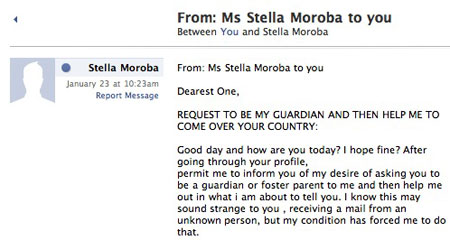
Yesterday, I got a note from a Stella Moroba via Facebook. Stella and I are not friends, so far as I can tell, which makes sense, as I doubt she is connected to anyone at all. Stella, in the most ardent way she knew how, told me she has access to "the sum of Two million Five hundred thousand United State Dollars", which I could gain a portion of on two conditions: that I "serve as a guardian to me and then assist me transfer the money into your bank account" and second, "make arrangement for me to come over to your country to further my education and then settle there parmanently". (sic)


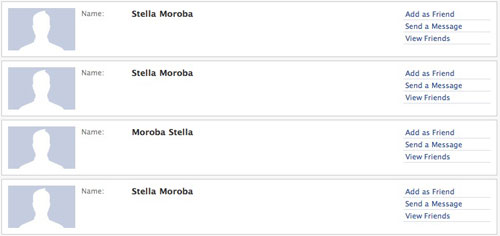
Unfortunately for Stella, what with working full time, twins and all this online nonsense, I don't have too many cycles to pass her way to ensure her financal and personal freedom. But I did have a few, so I did a quick search on Facebook and found 214 different results for Stella Moroba, including the occasional Moroba Stella. Unsurprisingly, none of the handful I checked out had any friends, or even bothered to put up a profile picture. So disappointing!


Facebook has taken aggressive measures to ban members who violate the network's terms of service. Seemingly every day we hear about new people who believe they have been unnecessarily booted - and we covered one of those issues last summer. Before any unsuspecting victims rise from Ms. Moraba and her clones, don't you think Facebook would notice the creation of more than 200 identical accounts, and the inevitable onslaught of spam within the system? I certainly didn't accept Ms. Moroba as a friend, and don't believe she should be sending me messages. Isn't that the purpose of friending in Facebook, so you can avoid getting messages from people you don't really know?

If you are interested in helping Ms. Moroba and her family with their strife, e-mail me. I can hook you up. Even if Facebook does eventually delete her account, she helpfully provided her e-mail address and phone number.
January 24, 2009 · 2 MIN READ · BY LOUIS GRAY

Skyworks' iPhone Games Decrease My Need for Dave & Busters

Skyworks' iPhone Games Decrease My Need for Dave & Busters

The local Dave & Busters at the Great Mall in Milpitas can practically be called Chuck E Cheese for adults. Combine a sports bar with pool tables, and add a sit-down restaurant with rows and rows of arcade games, ranging from shoot 'em ups to racing games, slots and even simulation bowling, golf or boxing, and you start to get the idea. But no matter how amazing the graphics and simulation of some of the more top-line arcades, I have always found myself gravitating to a pair of old mainstays: Skeeball and Hoops. Both involve multiple balls, simplistic scoring, and the incredibly annoying feeling that you should do better, but you never quite master it.

As with practically all good things these days, Skyworks has moved both games to my iPhone, meaning I can now find myself rolling balls up the ramp in a futile attempt to hit the ever-elusive 100 point hole, or shooting ball after ball, and racking up the bricks.


The Familiar Skeeball In an Unfamiliar Place

Arcade Bowling, for a mere $1.99 will see you playing a lot more on your iPhone than 4 cheap 50 cent tokens at the real thing. The game offers two modes: Classic and Progressive. The Classic mode tabulates your 9 rolls, with points from 10 to 100 on each. The Progressive mode sets a goal of 200 points in the first round, and if you reach it, you go to the next round, and a new goal, as your points accumulate. Also, a fun wrinkle for Progressive has it so one ring is randomly selected for five times its point value - meaning if you need 130 points to get to the next round and the 30 point ring is flashing, you've got to be precise.


You Can Score Big Points in Progressive Mode

Arcade Bowling eggs you on as you make trick shots, saying "Nice Shot" or admiring your "Mad Skillz". It's a trip. And no matter if you nail the highest score, you always want to play again now that you think you've got the hang of it. But you'll never be fully satisfied with a "perfect" game.

Arcade Hoops Basketball, also only $1.99 replicates the rapid-fire feeling one has when they have to make as many baskets as possible in a sixty second period. As with Arcade Bowling, you have the option for Classic Mode, or you can do Progressive, which moves the basket forward and back, giving you the chance to nail some long-range shots for 3, but largely making you feel like a dork as you swipe your finger up and down the iPhone repeatedly.


Make All Your Shots Before Time Runs Out

Dave & Busters still trumps the iPhone when it comes to delivering healthy portions of unhealthy food, so until the iPhone can add to my waistline and not just hang on my belt, it does have that advantage. But when it comes to games, I'm finding I can leave the D&B behind.

January 23, 2009

January 23, 2009 · 3 MIN READ · BY LOUIS GRAY

The Danger of Changing The Baseline

The Danger of Changing The Baseline

By Rob Diana of Regular Geek (Twitter/FriendFeed)


There has been a lot of discussion regarding the recent announcement about Twitter's API limiting. The SocialToo blog has a very good overview of the situation. Granted I am not a fan of the limitations, but that is not the reason for this post. Changing the limits is the real problem.

The baseline for any application is when it is released. Any updates or new features added to an application reset the baseline to a higher level. The user and developer community are your best friends during this cycle. It can be argued that Twitter would not be nearly as popular if there was no API or third party applications for it. However, if you decide to change something in an application, and the net effect is a decrease in functionality, it feels like you have taken something away. For example, Jesse Stay, the founder of SocialToo, realizes that these limits now change the way applications can use the API:
Many of the services you have come to love for Twitter, including those of our competitors, and many other Twitter-based services are in jeopardy. This is scary news as an entrepreneur and Twitter developer. Twitter has basically just limited how big any Twitter-based business can grow.
Changing The Baseline

The real problem is that these limits appeared long after the API was released. Twitter has consistently removed functionality during peak traffic periods as well. Things like deleting direct messages or viewing older messages often gets disabled. This does not provide a good user experience.

Twitter is not the only one doing this either. Google has also recently done this for their Google Apps product.
When Google Apps first launched up to 200 user accounts could be created for each business under the free version. But that limit was quietly reduced to just 100 user accounts. And then when the reseller program was announced earlier this month, the limit was cut in half again, to just 50 accounts.
Obviously, this is bad for the users and good for Google. However, lowering this limit is devaluing the service that Google is supplying. Sometimes a company will have a promotion when first launched where the account limit is temporarily raised, but it is also known that it is temporary. In Google's case, the Apps offering has been around as long as Twitter has. So, it is not the case of a quick change, it has been changing over the course of years.

The Danger

The real danger appears after the changes take effect. If the changes or limits are drastic enough, the popularity of the application could decrease rapidly. In some instances, your users could rebel or even start building an alternative product. The idea is that the application must always move forward. In some cases, moving forward may mean a small step back, like a little used feature that is poorly implemented gets removed until a rebuild of the feature is ready.

For startups, losing popularity or even a small decrease in users or hype could mean the end of the line. In the case of Google Apps, lowering the number of free users may actually drive small companies away from them. Many small companies may be using Google Apps because it is free, and they can grow with the service. Now, with a limit of 50 free users, companies need to make decisions on Google Apps or other online application suites shortly after hiring employees.

In reality, you want to push change for the better. You want to keep your customers as happy as possible. Enforcing new limits long after releasing features can just alienate your users. Some level of trust will be lost because it feels like they were tricked by your earlier kindness.

Read more by Rob Diana at RegularGeek.com.
January 23, 2009 · 4 MIN READ · BY LOUIS GRAY

Feedscrub: Cleanse The Dirt From Your RSS Feeds

Feedscrub: Cleanse The Dirt From Your RSS Feeds

By Mike Fruchter of MichaelFruchter.com (Twitter/FriendFeed)


Last week I touched upon RSS overload and how it's starting to become a problem for a lot of people. That post mainly reflected on how to get the most out of your Google Reader in terms of organization and productivity. The overload part for many, comes down to feed management. In the past I suggested unsubscribing from feeds that bring you little value, or update with too much frequency.

That eliminates the problem, but also poses the risk that you might miss something valuable mixed in with all the clutter. I recently found a better solution, which I have been testing for about 24 hours now, it's call Feedscrub.com.

What is Feedscrub?

Feedscrub is a clever filtering system for your RSS feeds. It acts as a spam filter for your RSS feeds. With this system, you train it based on your content preferences. This application now allows me to still stay subscribed to the feeds I otherwise would have unsubscribed from ages ago. I'm always weary that I will miss something of importance if I abandon the feed completely. For instance, I'm subscribed to quite a few technology blogs, so the first thing I did with Feedscrub was train it to scrub posts that have anything to do with Apple.

The training filter is like an email filter that is based off words. I'm not an Apple consumer and quite frankly I'm overwhelmed with feed after feed pertaining to Steve Job's health or the iPhone. By scrubbing the posts in my feeds that have any mention of Apple, I'm training the system with my dislikes and hopefully I will never have to see another post relating to Apple in my Google Reader.

Getting started:

Getting started with the service is pretty straight forward. You have the ability to enter up to three feeds for scrubbing. Because the service is still in beta, and they are still working out the kinks behind the scenes, three should be suffice to get you going and to take it for a test drive. My advice for you is to test the service out with your feeds that update quite often throughout the day. This will show you the power of the filtering faster compared to feeds with less frequent updates. Don't worry,for power users they offer a PRO account which gives you unlimited feeds plus OPML import & export.


After you input your selected feed for scrubbing, they are displayed and stored under the "Manage Feeds" tab in the control panel. From here, you will also see three feed reader subscribe buttons under each feed. In order to train the system, you must subscribe to the Feedscrub feeds, replacing the original one in your feed reader. Here is what the Feedscrub feed looks like. It basically adds two buttons to the feed, one called "scrub it", the other called "save it". These are what you will use to train the system. If you like the article of content on the feed, you click save it, dislike it, click scrub it. Simple enough.

Training is not limited to the Feedscrub site:

You can train the system a variety of ways. When logged into the control panel you can click the corresponding feed. That will launch a new window with the feed as outlined in the below screen shot. The save it and scrub it buttons are located on the feed. Train away!


Power users will prefer training inside the comfort of Google Reader:

If you are using Google Reader, the feeds that you have selected for scrubbing, appear with the save it, and scrub it buttons. This is how I'm currently training the system. It's handy and convenient, and what better place for them to appear than in your RSS vehicle. This makes it even easier to train the system. Once you have your selected feeds into the Feedscrub system, you will not have to be logged into the control panel often to train and filter your feeds.


That concludes part one of a two-part post:

In order for me to give a fair review of the application, 24 hours was not enough time for me to make a full assessment of the filtering system. Feedscrub was courteous enough to supply me with a PRO account for testing purposes. I unloaded some 600+ feeds into the system last night, so it was a time consuming process. Out of the 600+ feeds, I'm selecting approx 50 of them for scrubbing. One week should be ample time to train the filters, and the data set should be rather interesting. I will share the results of my findings in about a weeks time.

Take the service for a test drive. We have beta invites!

Feedscrub graciously supplied us with 150 beta invites. These will go fast. Don't hesitate to sign up. Use invite code "louisgray" at the sign up process.

Read more by Mike Fruchter at MichaelFruchter.com.

January 22, 2009

January 22, 2009 · 4 MIN READ · BY LOUIS GRAY

Our Doings: You Upload The Moment, They Organize It By Date

Our Doings: You Upload The Moment, They Organize It By Date

By Mike Fruchter of MichaelFruchter.com (Twitter/FriendFeed)

Our Doings is a simple and unique photo sharing service. While it may not have the lengthy feature set and large community of a Flickr or Picasa, that's okay, as it's primarily a much smaller operation, and the feature set built into the service leaves it standing in a league of its own, in my opinion.

Getting started with Our Doings takes less then five minutes. Once you register for an account, you have the option of creating a custom URL for your photos, such as the one I created for testing purposes, or you can let the system automatically generate one for you. Both URLs can be viewed by the public. The key difference is the indexing option, which you can select on or off. If you select "no indexing", search engines are advised not to index your URL.


Uploading is made easy. Give it everything you can throw at it!


The service gives you a multitude of ways to send photos into the system.
  • e-mail to publish
  • Web Publishing Wizard lets you upload straight from Windows XP or Vista
  • Picasa photo albums button
  • Web form to upload individual photos
  • Ability to upload a zip archive of up to 100MB
Why do I like this service so much? Automatic organization of your photos by date!

While the service has plenty of nook and crannies, this is by far the best feature yet. There is not one service out there that I could find that automatically organizes and sorts your photos by date. This is not a feature currently offered by any of the other major photo sharing services currently on the market.


For someone like me, who is not meticulous with organizing my photos, this feature is a godsend. I have dozens of folders on my desktop with random images taken at any given time. The images from a specific occasion in time, such as a birthday party or wedding are easy to organize. It's simply a matter of creating a photo album titled "someones wedding" and dumping all the correlating images into that album. The other hundreds of photos are taken on random occasions, random days and so forth. Most recently, with the birth of my daughter, my wife or I will grab the camera at any given time to capture that perfect Kodak moment of our daughter doing something that warrants a digital snap. It's these Kodak moments that I specifically would like to know the day that it had happened and reflected on the photo album. Now with this service, I can begin to upload the hundreds of images that I have stored on my desktop, and have them chronologically organized by the date that they were taken. This core feature will keep me using the service hands down.

It gets better. Site integration with your favorite Web 2.0 services:


Ourdoings.com offers integration with a lot of the popular Web 2.0 services, such as Disqus. Oh, and did you see FriendFeed is on that list too? They implemented SUP, which means if you configure it for FriendFeed, your images will appear on the site in real time. I configured mine to import my images into FriendFeed, you can see my feed here. It took no longer than 15 seconds for the images to import onto my feed. Without the implementation of SUP, you would be waiting anywhere from 30 minutes to an hour for photos from other photo sharing services to import into FriendFeed. You could always uses the manual refresh link, but that defeats the whole purpose.

You also get a Media RSS URL for all of your photo albums:

Media RSS is a special type of RSS feed that contains rich media assets like video, audio and imagery. Many media sharing and news sites publish content using Media RSS. This is an added bonus, and one feature I'm sure the bigger competitors in the space do not currently offer. Do you have a wireless photo frame? Without getting too technical, it solves the nagging problem of photo orientation.This explains it in more depth. This is something I will use for my wireless photo frame that I have been eyeing for purchase for some time now.

In closing:
I'm thoroughly impressed with this service. It's the simplicity of it, along with the automatic organization of my photos by date, that has sold me. I don't need all the fancy bells and whistles that some of the other bigger name services offer. I have a Picasa account that suits me just fine as a backup. Will this be a replacement for Picasa? It's strongly looking like it. I have not made the switch yet, as I only have tested the service out for less than an hour or so. I would like to see some photo editing features such as cropping and red eye reduction added, but in the meantime this service is something worth looking into.

Read more by Mike Fruchter at MichaelFruchter.com.
January 22, 2009 · 2 MIN READ · BY LOUIS GRAY

Feedly Mini Adds Buzz to Browsing, Goes Beyond Google Reader

Feedly Mini Adds Buzz to Browsing, Goes Beyond Google Reader

By Phil Glockner of Scribkin (FriendFeed/Twitter)

Feedly has announced a new feature today, the latest in a series of mostly behind-the-scenes refinements and improvements to Google Reader companion service which launched back in June. The new feature is intriguing, as it can appear on any web page that has a corresponding URL to one found in your Google Reader list.

It's called Feedly Mini. And while it's small, it's a big deal.

Technically, a feature similar to this was tested out before, in the form of a dark sidebar (mentioned here). But this new iteration is lighter, faster, and in my opinion, much cooler.

Feedly MiniHere you can see the new mini bar in action, on a recent post here on this blog. The default configuration is for the mini bar to only appear on URLs that are also in your Google Reader blog and 'hot topics' on FriendFeed and and Digg, but you will be able to use the Feedly preferences settings to change the scope later.

As you can see, the Feedly Mini bar has three main areas:
  1. A status area that shows how many times the article has been shared on Google Reader, shares on FriendFeed, and number of Diggs. And yes, that's conversations on FriendFeed, not comments. I checked.
  2. An area to add a note, just like you can when sharing an article in Google Reader.
  3. Action links to perform on the current article. You can share, save for later (or star), or hide the post in Feedly.
Next BookmarkletThis feature reminds me a lot of the much more rudimentary feature in Google Reader where you could use a bookmarklet to navigate to the next article in your subscription list. However, Feedly Mini throws in some great buzz numbers and the ability to share with a comment.

In fact, you could probably use these two technologies together! In theory, if you use the next bookmarklet, Feedly Mini will pop up on each article, allowing additional options. Nice! You can find the next bookmarklet in the goodies tab of Google Reader's settings area.

If you're not already checking out Feedly, and you're a Firefox user, you owe it to yourself to see what Edwin and team are doing in the world of feeds and content discovery. Check out Feedly at http://www.feedly.com.

Read more by Phil Glockner at Scribkin.com.
January 22, 2009 · 3 MIN READ · BY LOUIS GRAY

Plinky Launches With Prompts to Spur Stuck Bloggers

Plinky Launches With Prompts to Spur Stuck Bloggers

Starting a blog can be daunting for a lot of people. Jason Shellen, a key member of the original team that started Blogger, says that many people easily get disenchanted, asking "what do I do?", when viewing a blank page. His new service, Plinky, launches today, with hooks that not only help to connect friends, like many other social media tools, but also help to provide new discussion points, with an engaging tool called "prompts".

I spoke with Shellen today, in advance of this afternoon's launch, and he said he felt that while many different social media tools have focused on aggregation and developing rich media, less attention has been spent on the creation experience itself. As a result, many of these services have grown outside of the mainstream, limiting their potential market.

"I didn't think for the average user, there was really much work being done," Shellen said. "We wanted to develop something that was really fun, and I wanted to see answers to things I wanted to know from my friends. Plinky is to inspire people, and make them create content and look good doing it."


You Can Answer Plinky's Multiple Choice Questions


An Example Answer from Me On My First Paycheck

One of the quickest routes to creating interesting content through Plinky is answering one of the prompts, seen on the front page of the site. When you answer one of the prompts on Plinky, your answer is shown alongside other users of the service, and you can send the data out to any of third party services the product supports on day one - ranging from Blogger, to Twitter and Facebook, for starters.


Plinky Grabs Album Data from Amazon for My Mix Tape


I Can Send My Plinky Notifications to Twitter or Facebook

Plinky, which is starting off with a team of seven, based in Lafayette in the East Bay, also features many of the friend connection aspects you have seen in other products. You can browse all the users of the site, and choose to follow them, like making friends or followers in Twitter, FriendFeed and Facebook. By following them, you can go to the drop-down of Answers and see "Followed Answers", giving you all the answers to prompts from those friends you following on Plinky.


I Can Choose to Follow Other Plinky Users

And like Twitter, you can even make answers to prompts as your favorites. So if a friend of yours says he has an awesome answer to songs he would keep on his mix tape, one of the prompts this week, you can click Favorite and see it in your favorites list.

If you think you are a social media guru and power user, or you're one of those bloggers who is posting stuff every day, Plinky might seem a little light for you, but for the much larger audience who gets writers' block and can go weeks without updating their blog, or maybe they posted a picture of their kid once and never came back, after sending a mass e-mail to their friends and family, Plinky is a fun way to get re-engaged with new ideas, as you answer prompts, see what other friends have said to the same questions, and can pass that data out to the rest of your online presence.

In a world of social media when so many things are about how many places you're signed up and everything you're doing, Plinky gets back and focuses on the social. Now, I just might find out whether you change clothes when you get home, what your favorite venue is to catch a concert and how you got started in your career. You can, as always, find me with the ID of "louisgray", here: http://www.plinky.com/people/louisgray.

January 21, 2009

January 21, 2009 · 2 MIN READ · BY LOUIS GRAY

Five Blogs to Start Off Your 2009 Feed Reading

Five Blogs to Start Off Your 2009 Feed Reading

Part Eleven In a Monthly Series

Even if you are an avid news watcher, social media addict or feed reader, your library can seem repetitive, and you can get into a rut or cliquey. I do it. We all do it. But over the last year, I've tried to keep my eyes open to new voices who have hit the blogging scene, captured my attention, or simply don't have the readership I think they should. This month is no different. And in case you think I don't stand by my picks, it's worth noting that every single author on louisgray.com was previously highlighted in this series, so when I find someone I like, I stick with it. If this is your first time running into our "Five New Blogs" series, please do check out any from the prior year.

Each of the bloggers highlighted over this time period has been added to my Google Reader list, via Toluu, and has, to date, been consistently informative, interesting or entertaining. Prior months' entries can be found for March, April, May, June, July, August, September, October, November and December.

This month's entries...

1) Chris Charabaruk (www.coldacid.net)

Focus: Windows, Drupal, Social Media
Three Recent Posts:RSS Feed: Subscribe Now

2) Know the Network (www.knowthenetwork.com)

Focus: Technology, Internet, Google
Three Recent Posts:RSS Feed: Subscribe Now

3) Andy Brudtkuhl (www.getanewbrowser.com)

Focus: Gadgets, Technology, Business, Media
Three Recent Posts:RSS Feed: Subscribe Now

4) 140Char (www.140char.com)

Focus: Microblogging, Twitter, Seesmic, Yammer
Three Recent Posts:RSS Feed: Subscribe Now

5) Eric Friedman (www.marketing.fm)

Focus: Google, Web services
Three Recent Posts:RSS Feed: Subscribe Now

Want to be on this list? You can catch my eye by posting great information in the field of technology, social media, blogging and the Web. I'll be more likely to highlight you if you blog almost every day, and bring new stories to the table that don't repeat discussions launched elsewhere. And if you have more than 1,000 subscribers, you're probably too big for this.

To see even more new blogs I'm adding to my reader, or get a sneak peek for next month's highlighted blogs, follow my activity on Toluu. If you don't have a login to Toluu, send me an e-mail to louisgray@mac.com and I'll get that set up right away.
January 21, 2009 · 3 MIN READ · BY LOUIS GRAY

Every Time I Try To Embrace Twitter, They Push Us Away

Every Time I Try To Embrace Twitter, They Push Us Away

As an advisor to SocialToo, Jesse Stay, the developer of the service, and I trade a lot of e-mail... we also talk on the phone and exchange direct messages via Twitter on how to improve his service. Some of the ideas I've had already have made a small impact on the service, while other pieces will come much later. But last night, Jesse sounded an alarm that the service itself could be in jeopardy, thanks to proposed changes from Twitter's API team that would set limits which essentially cripple SocialToo's capability. And as much as I want to champion the immediacy of Twitter, the real-time aspects of the service, the community, and its outstanding search engine, this isn't the first time I've been left feeling cold about how the team has impacted its users or development community.

Previous Discussion:If you have your head buried in RSS feeds and the tech Web, you've likely already seen the major issue - either from the SocialToo blog itself, or on sites like ReadWriteWeb, CNET and others, including Chris Charabaruk and TweetLiberty. Essentially, the limits are a hard number that aggressive services could easily surpass, assuming solid customer growth. And as developers like Jesse and others start to use the Twitter community and trends as their data set, they keep running into roadblocks. At first, Twitter was failing due to simple aspects of scale, but now, it seems as they make headlines for record traffic and involvement in world news, they are making headlines again for the wrong reasons - things that could be better massaged with improved tact and transparency.

Twitter's move, at its heart, looks to be one to protect themselves. As API Lead Alex Payne wrote yesterday, "This is essentially a preventative measure to ensure that no one API client, even a whitelisted account or IP, can consume an inordinate amount of our resoures." (sic)

But there didn't seem to be any options for services, even whitelisted ones like SocialToo, to get a work-around. There was not an option to pay to get increased access capabilities, or even tips on how to optimize code so that it takes less effort to achieve the same result. Twitter wants revenue, and the development team wants Twitter to succeed. So does everybody else, essentially. But my understanding is that Twitter has made it very difficult for some services to do the things users are asking for - including automatic following and unfollowing, because they aren't really that interested in providing such functionality. That doesn't sound promising for developers of SocialToo, Qwitter, FriendOrFollow and others. What other providers, such as FriendFeed and Facebook, offer in full, Twitter parcels out in bits and pieces, and seemingly expect the community to be grateful for it.

So now, Jesse and others are faced with a tough situation - is it even possible to optimize their code? Should they ditch Twitter as a development platform altogether because the company treats them like leeches instead of celebrating their efforts? Jesse asked in an e-mail, "Why develop for the Twitter platform any more if we know we can only grow to your limit?", adding one option for him may just be to exclude the most popular users outright to reduce stress on the system.

I'm not sensing a developer mutiny overnight. Twitter at this point has practically become a mainstay of most digerati's online experiences. Even if there are products that are better, Twitter has the momentum. Twitter has the growth and the buzz. But they are acting like they know it. Alex followed on to today's discussions, via Twitter of course, saying: "If people just asked us rather than making assumptions, there would be no story :)" But I'll be direct here - I saw Jesse's questions. He asks lots of questions and gets some answers. There is still a story. The story is that people who have made some very innovative and interesting products on a service with no revenue are very concerned about whether they can trust Twitter and if Twitter wants them to succeed - period.
January 21, 2009 · 2 MIN READ · BY LOUIS GRAY

Is RockYou Trying to Commit Startup Suicide?

Is RockYou Trying to Commit Startup Suicide?

By Mona Nomura of Pixel Bits (FriendFeed/Twitter)

RockYou, the popular Social Media widget platform, has won awards. They've also raised more than $50 million in funding. They may have outstanding applications and widgets, but the company seems like it's trying to commit start-up suicide - by e-mail. If e-mail etiquette faux-pas were a crime, they would have a life sentence, as RockYou has leaked private information not once, twice, but three times - yesterday's being the most recent example. Yesterday, RockYou forgot to BCC recipients, again, and blasted an e-mail exposing everybody's address in the CC field.


(e-mail addresses and source blurred out for privacy reasons)

At least this time, RockYou only disclosed e-mail addresses. Last November, RockYou's accounting department sent a mass e-mail requesting W-8/W-9 information to a mailing group address.


It sounds harmless, but according to my source, people were replying to the mailing list with private information. One company even attached a scanned copy of their W-9. RockYou took immediate steps to rectify their mistake by sending another e-mail, asking the recipients to instead fax their private information.


Two major errors even after they were reamed for their first error. RockYou's first major offense happened on September 16, 2008, when they sent an e-mail announcement of the site redesign -- revealing 200+ e-mail addresses. (full e-mail too long to display here, but can be viewed here, here, and here) Apparently, the recipients were added to third party spam distribution lists which caused a bit of frustration. So much so, a Facebook group: "RockYou Leaked Mailing List Support Group" was spawned from RockYou's mistake. How and why they continue repeating the same mistakes is beyond me. Especially since the second mistake could have lead to severe consequences because their ad-partners were replying to the mailing list with tax information. But oddly, the company continues to get raves from the Facebook fan base, despite the issues.

After the first major screw-up, AllFacebook's Nick O'Neill published a blog post and Tweeted:


But where is the post on AllFacebook?

404 - hmmm.

Odd. A quick Google search led me to an archived copy here and the AllFacebook blog post was copied and pasted on the Facebook group's wall. An excerpt:
"How large this slipup is has yet to be determined since I haven’t had time to parse through the hundreds of emails that were displayed. One thing is for sure: Aaron Choi will probably be jobless starting tomorrow."
AllFacebook published the article and immediately took it down - bizarre. Either which way, it is irresponsible and careless for a company to keep repeating the same mistake. Especially after cluttering the recipient's inbox with follow-up apology e-mails.

So even if e-mail etiquette may be a lame subject, faux-pauxs still occur.
Don't forget to BCC, folks!

Michael Arrington of TechCrunch also caught yesterday's slip here: RockYou Continues To Combine Spam With Stupidity

(Thank you, D!!)
Read more by Mona Nomura at Pixel Bits

January 20, 2009

January 20, 2009 · 4 MIN READ · BY LOUIS GRAY

One Thousand Four Hundred Sixty One Days

One Thousand Four Hundred Sixty One Days

Today was a big deal. While much of the tech blogosphere has covered, in full, Barack Obama's inauguration through the eyes of how technology played a role, from CNN integrating Facebook in its site, to different streaming services, including Ustream, the biggest developments will of course have very little to do with how quickly data moved across the network, or how quickly you got the news and distributed it. History isn't likely to look back on January 20, 2009, and mention the changes at whitehouse.gov, including the addition of a blog and RSS. That's all very cool, but it will all pale in comparison if the next one thousand four hundred and sixty one days don't roll out quite so smoothly - and there is a ton of work to do.

While I was on a conference call this morning when Barack Obama took the oath of office, I have since come home and watch the proceedings on television, thanks to TiVo. While I wasn't a starry-eyed Obamamaniac, there's no question I am glad he won. Without recapping the last eight years, it's clear there is a ton of cleaning up to do. And just thinking about where to start is daunting.

One can practically wax reminiscent over the time with foolish social issues were what occupied our thoughts when it came to the presidency, or what party to support. Gone are the times when you would wonder about who tossed their Medals of Freedom, or who inhaled, or whether somebody was a "wimp".

Instead, as we all know, Obama has started his first day as commander in chief with an incredible to do list. He is faced with a practically unprecedented situation, flanked by economic and social struggles domestically, and strife internationally. And while people from all parties know things have to get better, there is absolutely no sure answer. There are parts of this world, and large groups of people who hate who we are - not just because of the actions of the last administration, but due to differences that are possibly borne from centuries of frustration and resentment. Compounded with the aggressive tone of conflict that has been our foreign policy of late, and the anger is undoubtedly stirred.

What Obama has done to achieve his position as the President of the United States is incredible - and something I did not foresee coming. When I first talked on this blog about the 2008 election, I barely mentioned his name, talking instead about Hillary Clinton, John Edwards, and potentially, Al Gore. But through an extremely coordinated campaign, and messages that struck home with many Americans, he led early in the primary campaign against Clinton, and never turned back. And while I voted for Hillary in the primary, I certainly was not voting against Obama - and as I'd once said about Hillary, the more I eventually learned about Obama, the more I grew to like him. Voting in November, for me, was very easy.

But even amidst the excitement, and the high hopes, I worry.

I worry not because of his potential, or his capabilities, or his record. I think he is very skilled. But I worry due to expectations and the short attention span of the American people who do not often have patience when it comes to policy. There will be no quick fix to our economic struggles. There is no clear end in sight for the Middle East struggles that have gone on as long as records have been kept. And you can't just hit "Control-Z" and undo many of the things that cemented people's opinions against the Bush administration. You can't just look at Guantanamo, Iraq, Iran and Pakistan and see the process unfolding smoothly, no matter your partisanship. And as has always been the case, simple "hope" and expectation of "change" will not be enough. It will take a ton of work. It will take patience, sacrifice, and cooperation, often between people who don't happen to like each other very much.

Over the next one thousand, four hundred and sixty one days, there will be scandals, both real and artificial. There will be surprises. There will be excitement and frustrations. There will be great speeches and boring ones. And if you think about it, theoretically, Obama and his team would have to royally screw things up to not have the American people say, in November 2012, that they will be better off than they are today, giving them a running start at reelection already. But anyone who thinks this is going to be a piece of cake is kidding themselves. Even as Obama spoke today, and gave a speech many are fawning over, the stock market fell. Even as many cheered in Washington DC, others were notified they were losing their jobs. And the wars around the world didn't take a time out.

This will be a very long process. I'm hopeful. I'm relieved that this first part of change has taken place. But this will be a long journey we will all be watching and be part of, as we experience the start of something very new. The whole world is watching.
January 20, 2009 · 2 MIN READ · BY LOUIS GRAY

Could Sundance Do for Qik What SXSW Did for Twitter?

Could Sundance Do for Qik What SXSW Did for Twitter?

By Jesse Stay of Stay N' Alive (Twitter/FriendFeed)

As a Salt Lake City, Utah resident, one of the most prevalent events of the year happens around the Sundance film festival. While not quite an event for Tech Geeks, the festival has become more and more techie as film geeks have begun to converge with computer geeks and find new ways to present the media they are creating. I visited Sundance last night and was amazed at the number of former film geeks trying to create their own web ventures as the economy slims for the film industry.

Just last Saturday, one example of this convergence of new media with old happened with a project founded by Kevin Rose, funder of Digg.com and Revision3, and Ashton Kutcher, famous celebrity actor, filmmaker, and director (and host of MTV's "Punk'd"). While I'm a bit disappointed no Utah bloggers were selected (considering it was in our state after-all), Rose and Kutcher selected 4 major bloggers, including Venturebeat's Matt Marshall from all across the nation to compete in a 24 hour competition, broadcast live on the service Qik.com. The bloggers were asked to perform such tasks as building an igloo and making a snow theater, or getting Mahalo's Jason Calacanis to say the words, "Mahalo", "Shitzu", and "Tesla". While entertaining to watch, the amazing story of this all were the statistics shared by Qik's founder Bhaskar Roy about the success of Qik during the competition.

In this behind-the-scenes video by Kevin Rose, Roy shares that, in just the less than 12 hours since the competition started, over 100 thousand video producers subscribed to the service. Roy was sitting at the headquarters of the competition, working to keep the site up and running as they broadcast the show out to what would appear to be near millions. While Roy wouldn't share page view statistics, with that many sign-ups one has to imagine page view statistics were through the roof, and that was made evident as I noticed Qik transferring some of the competition's videos over to YouTube during the event.

One of the biggest advents 2 years ago at South-by-Southwest 2007 was the prevalent use of Twitter and its strong growth, promotion, and use during the event. It was during that event that Twitter took off like wildfire, and became the explosive network we all know about today. It was later that year that I joined Twitter, and it has only kept growing since. Today it is estimated that Twitter has close to 4-5 million users and is growing exponentially. With numbers like Roy mentions, one can't help but speculate that Qik is not far behind those statistics.

I contacted Qik and they weren't willing to expand further on these results, but it will be interesting to see if Rose or Kutcher share more results of this competition and whether or not it was a success in and of itself. One thing we can say however is that regardless of the competition, Qik may have just had its South-by-Southwest moment here at the Sundance film festival.

The video in full is posted below - Roy's comments are right around 1:03.


Read more by Jesse Stay at Stay N' Alive.

January 19, 2009

January 19, 2009 · 8 MIN READ · BY LOUIS GRAY

Face It: Facebook Needs A Facelift

Face It: Facebook Needs A Facelift

Guest Post By Adam Singer of The Future Buzz (FriendFeed/Twitter)


image credit: pshab

I've written previously that Facebook and MySpace are the modern AOL and Prodigy. I stick by that. The great walled gardens of the web live on more than a decade later, resurrected by Web 2.0, but just as closed off, spammy and unexciting as before.

I have been thinking about how little time I spend on Facebook and why the open Web and other social sites are far more interesting. Here are some observations:

There is no interesting content in Facebook itself

People who create great content don't do so within Facebook - they know better than to contribute their hard work to an area they don't control. The best content creators do so on the open web because they want to retain the value of their efforts. If you are a content creator (or a marketer) be careful with the amount of time you spend contributing content to a closed network.

I get it, you need to fish where the fish are - but use Facebook to draw people to a place you control, not one where you have to play by the rules of another network - that is dangerous. They could change the rules at any time, or there could be a mass exodus of users from the network as we have seen time and time again in the social areas of the Web, rendering all your hard work worthless. Use Facebook as a part of your outpost strategy, but draw visitors back to a unique spot that is yours.

Content sharing on Facebook is far behind the curve

I will see something compelling on Reddit/Digg, message boards/forums, blogs, StumbleUpon and other areas of the open web, and then days or even weeks later it ends up on Facebook. Facebook is fine at sharing friend-centric content like pictures of your last social gathering with a group, but it's simply not a place for discovering news, interesting blogs, or other valuable content. The content eventually gets into Facebook via links but by the time this happens, it is old news. In fact, just use FriendFeed and easily get everything in one place, customized exactly how you want it.

Facebook wants to keep you on Facebook

Their network is built to keep you on their site, which is something that never sat right with me about walled gardens. Google's OpenSocial platform and now Friend Connect are much nicer and I personally like their strategy more - integrating social elements with web properties that already exist and with tools that have real value. They seem more willing to let go and allow users to drive the network, not vice versa, a strategy I agree with.

No option to opt out of third party application invites

It is either all or nothing. You can use apps, but you don't get a choice to opt out of requests from others to add applications. Of course not, because Facebook wants to inspire developers to spend time developing apps purely for their system. It leads to me having to click "ignore all" when the end of every week looks like this:

Why would I want to add any of these apps? I have used Facebook since I was in college and it was a student-only network, and have watched it slowly degrade into a place equally as spam-filled as MySpace. Just because the layout is cleaner doesn't mean it isn't spam.

Facebook advertising is broken - both for advertisers and users

Many have reported that Facebook advertising results have been lukewarm at best. The ads they serve me are pretty terrible as well. I'll give you a quick example: I am single, so Facebook tries to serve me ads for dating sites. I have no interest in using online dating services, thus the ads are irrelevant to me. Facebook has the option of giving feedback on ads, so each time a dating ad is served, I actually take the time to give them feedback that the ad is irrelevant to me and vote it as such.

Concurrently, they serve me ads about marketing and music, things that are of interest to me and actually a good fit. So not only do I click the relevant ads, I go a step further and give them feedback that these are good ads, please serve me more of them. Yet I am continually served dating ads. I have a hard time taking them seriously as a marketer when they clearly have a system in place to improve the user experience but don't bother to use it.

Here are the ads Facebook is serving me (I took a quick screengrab):

Facebook gives you the option to click the "thumbs down" where you can let them know feedback:


I have been letting them know these ads aren't relevant to me for several months and they are still serving them. But why even bother giving feedback if no one is listening? Their system just doesn't learn.

You don't hear career success stories from time spent on Facebook...

Yet we hear great stories about people building their reputations or scoring jobs through LinkedIn or a blog all the time. All we hear about Facebook (and MySpace) is people losing their jobs or not receiving jobs due to inappropriate photos/content on the profiles.

For well-connected individuals, the "people you may know" function is useless

I can't remember the last time I actually knew someone in the "people you may know" section of Facebook. Yet they show these right on the homepage daily to all their users. As an example, I was served this today:

Facebook is offering these people as connections to me merely because we both went to UF (University of Florida)? That is hardly what I would call a connection, the number of people who went to UF is staggering, and just because we both went to UF doesn't make someone relevant to me. If that is the best they can do, they shouldn't even offer this feature at all. How about instead of people I may know, what about people with similar interests? That would actually be useful.

For example, I list some relatively obscure electronic music artists in my profile under musical preferences. If they connected me with others that have similar taste in music, that would actually be interesting. Also connecting me with other public relations or marketing professionals would be interesting too.

The way they are currently trying to guide my hand in building a network isn't very useful. It just seems like they have so much meta data on all of us but aren't using it in ways that actually would build value and draw us deeper into the network.

Difficult, perhaps impossible to gain critical mass with anything directed outside the Facebook platform

Again, this is by design - Facebook seeks to keep its users on their network as long as possible so they may gain more ad impressions. Applications, pages and groups within Facebook can easily spread within the network, but I haven't seen many ways to easily direct Facebook traffic outside of Facebook. MySpace too. This is all by design of course and why I mentally file Facebook in the "closed off" section of the web. I know Facebook just launched their connect tool, but I'd be interested in seeing what the actual results of that are for site owners. I'm not talking about sites like TechCrunch that already have critical mass, I'd be interested to hear the results from sites in the long tail.

The conversations on FriendFeed, on blogs, on Reddit, Digg, Twitter, etc. are far more interesting

The conversations on Facebook are not even close to the level of the open web, or even other social sites. Do you notice the same thing? Perhaps it is the poking, the cheesy applications, or the general nature that people carry on within the network, but I see far more compelling conversations outside the walled gardens. Perhaps it is because people with deep interests seek out specific networks or build their own, and view the general networks as less specific and relevant to them.

Wrapping up...

Facebook is actually useful for things like staying updated on what you're friends from years past are doing, but this doesn't provide any real value other than fleeting entertainment. The people I am interested in staying connected with I am already connected to in more useful ways.

My use of the internet is not to develop fleeting social relationships for entertainment, but to develop more valuable relationships with people to work and collaborate with on projects and ideas we're passionate about.

As it stands right now, Facebook just isn't all that interesting a place to spend time if you are seeking compelling content or looking to build a subscriber base, it is merely an outpost. Your largest opportunity is to build an audience for your brand or yourself in a place that you control. Remember, these monolithic social networks can fall out of favor quite quickly and hemorrhage audiences.

Devoting too much effort to any one platform, especially a social network like Facebook, is far riskier than working on a place you control where you can build multiple traffic streams to. This way if one stops producing you'll still have other options.

It's not that I dislike Facebook, it is just I have found the site to offer a better user experience in years past - and that is the opposite of what I would expect for one of the leaders in social networking. The experience on Facebook should be getting better, not worse. I know from conversations with colleagues I am not the only one who feels this way - hopefully they are listening and will work to improve things in the future.

Read more by Adam Singer at The Future Buzz
January 19, 2009 · 2 MIN READ · BY LOUIS GRAY

What Do You Do When Google Says You're a Zero?

What Do You Do When Google Says You're a Zero?

Google's impact on a Web site owner is tremendous. The ubiquitous search engine can deliver anywhere from 30 to 70 percent of a Web site or blog's traffic, and in some cases, has been shown to provide upwards of 90% of all traffic from search engines. Given this, it's no wonder the industry of trying to be at the top of Google's results through search engine optimization is big business - and even though Google's efforts are fairly transparent, they have to be mysterious enough so they can't be directly gamed, and consequences are direct and dramatic. But sometimes, the decisions seem odd enough that it can't be anything but a mistake.


Google Drives Significant Traffic to Most Sites

You have no doubt seen the posts, the articles, the tweets, the e-mails, and all matter of comment spam around increasing your rank on search engines, and "getting to the top". You might also see people eagerly await tweaks to Google's PageRank, an algorithm that gives weight to a site based on its relationship on the Web to other linked sites, and their own perceived rank. Theoretically, it is assumed that the higher your PageRank is, the more likely you are to be higher in search results (based on a 0 to 10 scale). As one's rank is pushed upwards, you can expect to see more traffic on Google, and if you're demoted, you can expect it to similarly drop.

But what if you find your site dropped down to zero?

No doubt the feeling can be one of disbelief and powerlessness. I was surprised this morning to learn that the excellent blog "The Future Buzz" had seen its PageRank knocked down to zero, and while I can't say I watch PageRank that closely, or knew what it was before, I don't think that' move makes any sense. Adam Singer, the author of the blog, and a great electronic musician, by the way, has been running the site since November of 2007, and has grown his RSS subscriber base beyond 500, myself included.


The Future Buzz's Page Rank Evaporated...

So what can he do? I think our typical response is to cry out to Matt Cutts and hope that he can swoop in like the white knight to save the day. But as you can guess, Google is very big, Matt is very busy, and that sort of thing won't scale.

I find the situation similar to the issue we discussed last year, when Dan Morrill of TechWag found his site blacklisted by Google, thanks to what was believed to be a rogue script. One person's power in the face of the Google monolith can seem futile. No doubt Adam is going through the proper channels to learn what he did wrong, or why the site's PageRank changed, but for now it's a mystery. I've been lucky so far that Google and I get along okay. I'll just try not to tick off the pigeons who run the whole thing.

January 18, 2009

January 18, 2009 · 2 MIN READ · BY LOUIS GRAY

Is Requiring a Firefox Plugin Akin to Designing for IE Only?

Is Requiring a Firefox Plugin Akin to Designing for IE Only?

Internet Explorer doesn't have a monopoly on the browser market like it did nearly a decade ago, as Microsoft systematically suffocated Netscape - speeded by the company's own failings. Today, IE reportedly has just under 70 percent market share, with Firefox owning just over 20 percent and others, including Safari, Google Chrome and Opera, making up the remaining 10 percent. (See: Wikipedia for a stat table)

At Internet Explorer's peak, it claimed more than 90 percent share, as recently as 2004. As it became the de facto standard, it was common for Web designers to optimize their pages for IE, or even require users to run IE to access the site. While the practice is less common these days, there are still a select number of Web applications that push users toward IE, or as many Mac and Linux users find themselves told, to use Windows.

As the Internet mob has repeatedly spoken, designing for IE is wrong. The browser has never quite nailed Web standards the way other browsers do, and to force users to have a certain configuration to get to something that should have universal access flies in the face of one of the major tenets of the Web - that data will be presented in the same way to all current browsers on any platform. But even as this has been agreed to, some cutting-edge applications are pushing Firefox extensions or Greasemonkey scripts to simply work. And unfortunately, even if doing so means the development team can leverage the browser in new, innovative, ways, it dramatically limits their market share, and keeps people who might like the applications, but prefer another browser, out.

As an Apple Safari user, I know there are some places where the browser falls short. For whatever reason, it isn't supported by toolbars, including StumbleUpon or the Google Toolbar. I can begrudgingly accept that developers aren't going to make work-arounds for such small market share, but the practice of purposefully designing solely for Firefox and requiring people to download an extension seems counter-intuitive, if the goal is to have wide adoption. So while I understand that Firefox users are vocal and love their browser's extensibility, the entire practice has me shying away from new services like Clikball, and rarely using Feedly, even if I think they're cool.

But there's no outrage and frustration when developers demand Firefox extensions the way you see the same tumult when a site demands you use IE. It could be because the practice is more rare, or because the Firefox community likes being catered to. But I believe it's time to move away from demanding plugins and extensions to our browsers. There are enough tools out there, and enough tricks you can do with code to make the Web do some great things. If you can build it without making me download yet another program, or switch browsers, it'd be much appreciated.

January 17, 2009

January 17, 2009 · 3 MIN READ · BY LOUIS GRAY

DandyID's Dandy Idea: Connecting Your Diverse Online Identities

DandyID's Dandy Idea: Connecting Your Diverse Online Identities

By Ken Stewart of ChangeForge (Twitter/FriendFeed)

"One place to manage you and your relationships online," the slogan goes. Although it sounds a bit like a dating site, DandyID (launched in May of 2008 by co-founders Sara Czyzewicz and Arron Kallenberg) offers an intriguing way to connect your online identities. While many aggregators offer the promise of an integrated panacea, DandyID proposes taking it one step further.

Are you connected with someone on Facebook and don't know their Twitter handle? Are you following someone's blog on Blogger, and you want to know their FriendFeed URL? Well, DandyID not only offers you the promise of unifying the varied fragments of your online persona, but allows you to explore the possibility of uncovering just where you and your friends' online lives touch.

Think LinkedIn's degrees of connection, but expand that to over 100 social media sites - and now you might just have a powerful relationship building platform.

The Good Stuff:
  1. Wordpress Widget: DandyID offers a widget for my blog, where I can publish a readily available menu of places my readers can connect with me using other services. There was no complex configuration. I added the widget, entered my e-mail address, and it synched all of my selected services right across.

  2. Auto-Population: When I was first configuring my profile in DandyID, I started with my FriendFeed account. I was amazed that it then went on to poll all of the feeds I had configured within FriendFeed - dramatically speeding that often tedious process of configuring yet another social media site to connect with all of your others.

  3. Suggested Relationships: Perhaps one of the most interesting features was the option of suggested relationships. True to their word, the makers of DandyID offered me a few DandyID subscribers (Chris Brogan and Tina aka Stupid Blogger) to connect with.

Will DandyID Become a Launch-Pad?

Launch-Pad is DandyID's answer to a closed web. It attempts to become the single portal through which you can visit over 70 of your favorite sites such as Facebook, Twitter, YouTube, Flickr, and the list goes on. DandyID's blog had this to say about Launch-Pad, now in private alpha):
Make no mistake, DandyID does not view Launch-Pad as an ideal solution to the plethora of walled gardens that exists online today; but rather as a band-aid for users who are suffering as a result of a closed web — it is our knee-jerk response to an imperfect internet. DandyID’s long-term focus is on building services that empower the user and add-value on top of [Joseph Smarr's] New Open Stack.
I have requested an invitation to the Launch-Pad alpha, and hope to have a review of it for all of the LouisGray.com viewers in the coming weeks.

Is DandyID There Yet?

I have been impressed with how smooth the integrations have been with the various services. While the overall power of a service such as this will only come through massive adoption, I have been readily impressed by the ease of configuration and suggestive logic deployed.

In reading DandyID's sparse blog, I get a feeling that Sarah and Arron are attempting to deliver a special answer to the barrage of sites to which we find ourselves subscribing - attempting to find a way to help us discover a deeper level of meaning in our community.While the service is still less than a year old, I highly suggest you take a look at what's under the hood. I look forward to seeing you around the block, and who knows - maybe DandyID can help us stitch together the scraps of fabric we now call social media.


Ken Stewart’s blog, ChangeForge.com, focuses on the collision between the constantly changing worlds of business and technology. To learn more about Ken, you may visit him at DandyID.


January 17, 2009 · 2 MIN READ · BY LOUIS GRAY

Scoble Starts His FriendFeed/Twitter Monetization Strategy

Scoble Starts His FriendFeed/Twitter Monetization Strategy


Uber-blogger Robert Scoble came under criticism in late December when TechCrunch's Michael Arrington said he had neglected his blog, in factor of spending time on FriendFeed and Twitter. Arrington said It’s Time For A Friendfeed Intervention, saying he was contributing to the popularity of those services but getting nothing for himself, adding, "How much of that value does Robert receive? Zilch." Well, thanks to a tip from one of Robert's Twitter friends, it looks like he is trying to capitalize on his popularity on these new services, through embedded Amazon affiliate links.

Whether it is a one-time experiment or a sign of things to come, tonight Robert sent a note to his now 25,000 FriendFeed followers, and nearly 50,000 followers on Twitter, saying: Want a news tip? Amazon Kindle is sold out. Hint here:, and adding on FriendFeed:
"I just bought a version 1.0 machine. It's sold out. Will they make more? I doubt it. So, why are they still accepting orders? I just bought one and will let you know what shows up. I'm hearing that new version comes in next few months."
After that introduction, he gave a personalized affiliate link, which would give him a percentage of the sales made during the session of any of his followers. (See the FriendFeed thread here)


Note the Scobleizer tag in the destination URL...

As simple as that sounds, the power of Amazon affiliate links on the Web can often be underestimated. John Gruber of Daring Fireball made nearly $6,000 in just over a week by encouraging his blog visitors to buy Mac OS X 10.5 from his affiliate link instead of directly from Apple.


Scoble is caught "red handed" without disclosure...

Robert probably won't make $6,000 from this experiment tonight. Assuming he also gets 7.5% referrals from Amazon, It would take $80,000 worth of orders to get him a similar return - meaning 223 of his more than 50,000 followers would have to buy the $359 Amazon Kindle for him to reach that mark. But if he continued to drop Amazon links into his FriendFeed and Twitter stream, it could be some good spending money over time.

Of note, when Gruber asked for users to visit his affiliate page, he was very clear about what he would get from such a purchase. Tonight, I noticed and asked Robert myself if this was his "FriendFeed revenue strategy". His answer? "You caught me red handed!" I don't mind him trying out the idea, and think it's an interesting approach, but I would have preferred disclosure.
Update: As anticipated, this topic is being discussed on FriendFeed on my feed as well as that of Robert, who says I missed some important points. Also see: Free Rides Can't Last Forever from Dennis McDonald and Network World's Paul McNamara: Blogger Catches Scobleizer With His Hand in Amazon's Kindle Jar.

January 16, 2009

January 16, 2009 · 2 MIN READ · BY LOUIS GRAY

Why In the World Can't I Customize Apple's Time Machine?

Why In the World Can't I Customize Apple's Time Machine?

In March of 2007, when writing for The Apple Blog, now part of the GigaOM network, I openly speculated that Apple would debut a wireless network storage device, combining their expertise in Airport wireless devices with an external hard drive and give users a simple way to back up all their files. Sure enough, Cupertino rolled out the combination of Time Machine software and the Time Capsule backup device to do just that. And while I'm one of those Apple customers backing up my data through the air, you have to color me unimpressed with the flexibility of Time Machine - as its options are so limited, it's practically assumed I'm too stupid to make any decisions on my own. This leads to the application slowing down my computer when I don't want it to and regular bandwidth congestion for me and others sharing the network (notably, my wife).


As with many of Apple's products, Time Machine assumes it is made for consumers who benefit from a limited number of options. The product, in an attempt to backup all your data regularly, comes preset to make:
  • Hourly backups for the last 24 hours
  • Daily backups for the past month
  • Weekly backups until the backup disk is full
And... that's it.

When I am at the office, away from my Time Capsule, I'm not backing up. But when I get home, every hour, for about 10 to 15 minutes, my laptop starts to slow as Apple's Time Machine whirs into action, backing up my MacBook Pro's 200 Gigabyte hard drive to the 500 Gigabyte time capsule. While I've told Time Machine to not back up some folders, to reduce the time and storage space, I can't set up Time Machine to back up with any other granularity. I can't tell it to back up every two hours, three hours or four hours. I can't tell it to only back up after 10 p.m., or in a window from 6 p.m. to midnight, if I wanted to. I can't tell it to exclude certain types of files (like MP3 or PowerPoint, if I wanted to). It's either on, or it's off. And it's on the way that Apple set it up. Not the way I did.


So If I have my Time Machine stuck in the "On" position, I'm doomed to have my computer slow down once an hour and stuff the network full of flowing bits once an hour. I've even switched over to my neighbor's open wireless once or twice just to make sure the backup failed and I could get my bandwidth back. While we've gotten further along than my August post where I couldn't even get Time Capsule to work right, I'm still quite annoyed that Time Machine seems to be designed so simply that I simply can't be happy with it. It's time to get more options.
January 16, 2009 · 2 MIN READ · BY LOUIS GRAY

TweetDeck's Funding Shows Good Ideas Can Still Attract Good Money

TweetDeck's Funding Shows Good Ideas Can Still Attract Good Money

This morning's great news came from TweetDeck author Iain Dodsworth, who managed to start a round of funding that when completed could be as much as $500,000. The popular Twitter application, which has only been around for just six months' time, spent very little time in obscurity, jumping out of the gate and racing to the top of the charts, alongside Thwirl and Twitterific. While most of the headlines in the financial space of late have been filled with doom and gloom, Dodsworth's strike of fortune displays the best apps showing serious momentum can still attract forward-thinking investors.

The story was broken early this morning by Peter Kafka of All Things D. (See: Another Twitter App Funded: TweetDeck Raises an Angel Round. Next Up: A Business Plan) The report says TweetDeck has been downloaded a quarter million times, and hundreds of thousands of tweets are sent from the application each day.

TweetDeck has become practically the only way to logically consume the firehose of Twitter, slicing and dicing the incoming tweets from friends into logical groups, or keeping search terms, replies, and direct messages in their own columns. And TweetDeck's done some smart things since its launch, adding on support for other popular third party services, like TweetShrink, 12 Seconds, and more. As Iain, e-mailed me today, when I sent him a note of congratulations, "Lots in the pipeline now, extremely excited."

In my 2008 recap covering the top 10 new services of the year, I slugged TweetDeck as #4 overall, saying:
"If (Iain) can get enough people to donate or pay for the application, there's no question he could make a full-time living from the resulting revenue. The question is, will people who expect a free service to have 100% uptime spring for the app that gets them there?"
I personally would pay money for TweetDeck today. I am always happy to pay for good software, which is what TweetDeck is. I don't want to forecast what's next for the service, as I do have some insight there, and don't plan to break confidence, but I have personally enjoyed watching the service ramp up following its July debut, which we covered.

See also: The Deal Twitter organizer Tweetdeck scores seed round, where the reporter says:
"(Iain) sent the program to 10 friends for fun and then watched in astonishment as Tweetdeck became an overnight hit, thanks to a glowing review by influential tech blogger Louis Gray who stumbled on it in the word-of-mouth "viral" way of social media."
That's the kind of report I love. Just like our seeing Socialmedian go from debut to sale in less than a year, it's been fun to have a front-row seat to the success. Looking forward to more success for TweetDeck and more successes for innovative startups.
January 16, 2009 · 1 MIN READ · BY LOUIS GRAY

The StatBot Crunches My Google Reader Link Blog

The StatBot Crunches My Google Reader Link Blog

Following last week's discussion around 10 ways you can maximize your Google Reader Link Blog, Yuvi from The Statbot went to work and pointed his super-geeky analytical skills at my own link blog, which I've been filling with shares for the better part of two years. Given I can only look at my Google Reader trends over the last 30 days, his data has brought a lot of insight.

You can see the full leaderboard for the last 10,000 shares embedded here via Zoho:


Excluding the fact I often share my own items (not a big surprise), an interesting mix of sources emerges. Yes, you see TechCrunch, Inquisitr, ReadWriteWeb and other A-List blogs leading the top 10, largely due to their prolific publishing schedules, and ability to attract tips from developers early in the process and time to chase down rumors. But below the top 10, there is a heavy mix of personal blogs, from Hutch Carpenter, to Jesse Stay, Chris Brogan, Rob Diana, David Risley and Mike Fruchter, who all place in the top 25.

In the 25-50 tier, you see John Furrier, Mona Nomura, Kara Swisher, Kyle Lacy, and Sarah Perez, mixed in with company blogs like those from Socialmedian.

In all, 379 different sources are represented in the last 5,000 shares, and 577 in the last 10,000... which shows a fairly diverse data set.

What I like about this data is that it is personal and it is natural - something that organically has developed over time based on my own interests - and is not intentionally manipulated. Yuvi also ran the data on Robert Scoble's leaderboard this week, which you should check out.

If you're not reading the Google Reader linkblog, you can find it here.
January 16, 2009 · 2 MIN READ · BY LOUIS GRAY

Content Sharing Platform Fachak Launches In Alpha, But Is Raw

Content Sharing Platform Fachak Launches In Alpha, But Is Raw

By Eric Berlin of Online Media Cultist (FriendFeed/Twitter)

Fachak, a new content sharing platform, has debuted its "alpha version" and describes itself as "somewhat like Meebo of content sharing platforms that assimilates YouTube videos, Slideshare presentations & Flickr photos in a single Web service. It’s not a pure aggregator, neither is it a pure bookmarker, but instead a independent ‘multi-format’ & ‘multi-source’ content sharing platform."

If that description tells you what Fachak is, also tells you what it's not, but leaves you with a bunch of questions, you're at the same place I am after giving it a once over.

I have a little rule that I use when I visit a Web site for the first time. If I don't know "why I'm here" and what I should do next within a few seconds, it's usually a bad sign. When I arrived at the Fachak homepage, I sort of knew why I was there (stuff to do with video and images and "docs") and sort of knew what do next (look at stuff and share stuff… from "anywhere," we're told, though the choices at present are YouTube, slideshare, and Flickr). But to be honest I was left wondering: why?


Fachak is trying to differentiate itself by being a place where you can aggregate and share your content from places like YouTube, but is also a UGC platform where you can upload and share your media with a particular emphasis on PowerPoint and other "documents." So I'm not sure if Fachak is trying to be a consumer-facing entertainment and social media platform, a B2B collaboration suite of sorts, or something in between. Also it must be noted that much of what Fachak is working toward has already been perfected (or very nearly so) by FriendFeed, in my opinion.

Fachak, at present, is really rough, and really early. There's simply a lot of little things that need to be tweaked, improved, or revised. For example, three little stars appear underneath videos, giving the indication that you can vote for the content. The expectation is that if you click a star as a logged in user, you should be able to submit your own vote. Instead, you're brought to the content drilldown page. When you relocate the stars on the drilldown page, the voting mechanism is again a little bit clunky. No matter which of the stars you hover over, the text "Rate 3 to Fachak It" appears. And when you final select one of the three, your vote is collected, but you're not informed of how your input affected the overall ranking of the content.

Since the site is still in alpha, I can forgive some of these smaller issues. But it must be stated that Fachak has a long way to go before it's ready for prime time.

I hate to be harsh, as I have great empathy for web developers and entrepreneurs, but I don't see anything really special about Fachak right now. Maybe it'll get there as it travels from alpha through public release.

Fachak is backed by Morpheus Venture Partners, which has been called "India's YCombinator".

Read more by Eric Berlin at Online Media Cultist
January 16, 2009 · 4 MIN READ · BY LOUIS GRAY

Can One's Subscription Trends Indicate Services' Momentum?

Can One's Subscription Trends Indicate Services' Momentum?

As I've mentioned several times before, I border on pack rat behavior when it comes to my e-mail. I very rarely tend to throw anything away - unless it's clearly spam or advertising from someone I don't know. For whatever reason, I save Twitter direct messages. I save responses to statuses on Facebook. I save receipts from iTunes purchases. And I definitely save e-mail confirmations from services that tell me when somebody has started to follow me online - whether that be on Facebook, Socialmedian, Twitter, FriendFeed, Strands, Disqus, or practically any one of the services I use with regularity. With an extremely active 2008 final and in the books, I thought I'd dust off my nerd-approved calculator and see what the trends looked like. If you're willing to say that a single data point indicates a trend, I found the results very interesting.

For the purpose of this navel inspection, I tracked four numbers, including new subscribers to my RSS feed, to Twitter, FriendFeed, and halfway through the year, Socialmedian. It was FriendFeed, Twitter and Socialmedian that saw the most activity for me in 2008, and cognitively, I thought I could sense when one service was spiking and another plateauing.

See the below graph:

RSS Data via BlogPerfume. Some dates to note: 1) I was a FriendFeed user prior to 2008. 2) I joined Twitter mid-way through January of 2008. 3) Socialmedian introduced the "Newsmaker" feature in mid-July of 2008.

At the end of 2007, I had approximately 200 RSS subscribers, and by the end of 2008, that number was approaching 4,000. Interestingly, the 4,000 to 5,000 number is close enough to the number of followers I ended up with on both Twitter and FriendFeed by the end of 2008, with an undoubted extremely high amount of overlap. But while the services are around the same number now, how they got there tells an interesting story.

Early 2008 was relatively quiet in social media. While MG Siegler and I had joined FriendFeed, and were cajoling others to join it, in beta, the service was lightly used prior to its opening to the public. At the same time, I was enjoying writing about newcomers to the Web, like Assetbar and ReadBurner, and, for the first time, gained notice from some strong Web junkies who helped the site gain visibility and RSS subscribers.

I joined Twitter somewhat reluctantly in January, and its growth was good,but relatively small when compared with FriendFeed's boom, especially from March to May as the service exploded onto the tech scene - including more than 1,000 subscribers in May alone. But as is common with many products, FriendFeed's initial spike settled down into a consistent level after the launch, dropping to a third of its peak, below 400 each month from August to October.

At the same time, Twitter's problems with uptime were reducing my use of the site, and others as well. I saw new followers of less than half April by June, before Twitter too settled in at a level almost equal that of FriendFeed.

In July, Socialmedian added a Newsmaker feature, which saw anywhere from 100 to 300 new followers through the end of the year, not quite the level of Twitter of FriendFeed, but respectable.

After a stable Fall, November and December saw a resurgence across all metrics, likely the result of more posts on louisgray.com, as I added additional writers and expanded the posts' reach. But while FriendFeed's climb was gradual, Twitter has exploded - delivering more than 1,300 new followers in December after almost 700 in November, and January 2009 is on track for even more.

Oh! And I barely mentioned RSS. While my aggregate number was much higher by the end of 2008 than the end of 2007, you can see much of the momentum I had was gained in the first half of this year. It could have been due to their being a limited number of tech geeks in the echo chamber. It could have been due to a higher profile on Techmeme, which decreased significantly in the second half. And it's always possible I overweighted social media versus the blog in the second half of the year once the twins were born. Not sure. But what I do know is that with the broader team in place, we are reaching new people, so if I couldn't get any bigger on my own, now I've got help.

So, navel gazing aside... does this show that FriendFeed's spike and then reduced profile is set to grow further again, as the trend from October shows? Is Twitter breaking into the mainstream, as November and December suggest? And will Socialmedian ever trump either of those two? Are you nuts enough to keep all this data like I have, and have you seen the same trends?

January 15, 2009

January 15, 2009 · 3 MIN READ · BY LOUIS GRAY

The Global Recession Is Crushing Web Ads. Expect it to Get Worse.

The Global Recession Is Crushing Web Ads. Expect it to Get Worse.

That I am not a fan of Web advertising on Web services and blogs is not a big secret. I was roundly pummeled for my over the top comments in April that tried to divorce authors from the idea that they could publish a blog, add AdSense and then wait for the money to roll in. But recent developments make it look like the Web advertising crunch is becoming critical. Inventories are not being sold, prices are dropping dramatically, and it's very likely more and more services reliant on ads are going to feel the pinch, forcing them to rapidly change their business models or close altogether. And they won't be alone. I'd look for many multi-author blogs you've grown to rely on to start thinning the ranks of reporters as ad returns weaken, and some have already started to make such cuts.

Back in December of 2007, I expressed my concerns in a piece called "The Web Advertising Bubble Has Got to Pop", where I said:
"The more I think about it, the more obvious it becomes to me that the ad-driven economy, both offline and on, could soon be in dire straights, and companies hoping to cash in need to think of new revenue targets - quick."
The reasons I gave for decreasing ad revenues, at the time, stemmed largely from audiences learning to avoid ads, or to use software to block them. I mentioned that even the mighty Google would be susceptible to a crunch, if was to happen, in the online ad market. Like others, I didn't forecast a massive global recession, but as the financial markets have spiked lower, and public markets have been closed to innovative companies, the drive to reach a profit, and do so without relying solely on ads, is stronger than ever.

Last night, Duncan Riley of the Inquisitr summed it up in what had to be a tough piece for him to write, "The Web Ad Apocalypse". He, being one of those bloggers who is heavily reliant on ad revenue, said advertising inventory at his providers has dramatically dropped. He adds, as I did more than a year ago:
"Advertising in blogging and 2.0 services/ apps is on the downward march, and companies that rely on advertising that were marginally profitable, or running at a loss are about to find life that much harder."
Duncan's comments are not in isolation. TechCrunch reported today that video ad rates dropped 25% in the last quarter. Be it in video, in banners, or in text ads, the trend is downward.

It is my belief that this problem, while exacerbated by the financial downturn, has been a long time coming. While Google made money hand over fist by pushing sponsored ads alongside native search results, their AdSense product, beloved by many bloggers, is often way off the mark when it comes to contextual advertising - and practically the only memorable online ads are those polluted by nonsensical dancing and misleading graphics that make you think you have a computer virus, or lie to you and say you've won an iPhone by being the 1 millionth visitor. I'd say we've come a long way from the late 90s when we were asked to "Punch the Monkey", but we haven't.

Online ad successes in Web services and blogging are not non-existent, but they are incredibly rare, and they are going to get rarer still. If you're trying to make money on the Web, it's time to think of a different way. If you have a service, get users to pay for it. Find a way to deliver value through premium offerings. Charge monthly fees. But the whole "free plus ads" mantra is going to get worse - and not worth the effort in many cases. That's a major reason I've never run ads here. I knew the trade-off for mucking up the site wasn't going to be worth the pennies. Now it's clear that's likely all I'd ever get.
January 15, 2009 · 6 MIN READ · BY LOUIS GRAY

RSS Overload: Don't Complain, Do Something About It

RSS Overload: Don't Complain, Do Something About It

By Mike Fruchter of MichaelFruchter.com (Twitter/FriendFeed)

There seems to be a trend lately of posts regarding RSS overload. A lot of people are complaining about being overwhelmed with their Google Reader, and some are even advising for you to stop using your RSS reader altogether. I say, hogwash. Do something about it and take back your Google Reader. Now is the time to reclaim it.

Some suggest to use Twitter and FriendFeed as the alternative. If your scope is limited to one or two particular subject matters, this may be fine. You can easily follow the relevant news sources by following them on Twitter and FriendFeed. The imaginary friend feature on FriendFeed was basically intended for this purpose.

The beauty of the imaginary friend feature is that you do not have to follow that person on FriendFeed. Chances are that person might not even be on FriendFeed, instead all you need is the blog's RSS feed and your set. You could follow that particular news maker/blog on Twitter, but you would be sorting through an already noisy feed of updates from the rest of the people you are following. Yes you could always set up a second Twitter account for just that reason, or you could directly go to that person's Twitter feed for the latest updates. That to me seems like too much work though, and is unnecessary.

Google Reader, for me, is the most effective power tool in my social media arsenal. Why? Simply because I don't have to visit hundreds of websites per day to get the information I seek. It's a competitive advantage when it is used right. Less time spent on numerous websites equals higher productivity. It enables me to work smarter not harder. I consume information at an increasingly high rate, maybe higher than some other people. To get the most of your Google Reader, it requires periodic maintenance. Just as your car requires an oil change every 3,000-5,000 miles, Google Reader is no different. That's the discovery aspect of it. Do I need to even go into the distribution aspect of it, sharing? Perhaps that's a topic for another post.

There is no need to feel overwhelmed by the unread count:

This is just an application. Why are we letting it get the best of us? We feel overwhelmed with the amount of bills we need to pay every month, or the amount of emails we may need to reply to in a timely manner. These things are overwhelming at times. An application that was built to discover and distribute information is a blessing, not our enemy. We see the unread count of 1,000+ items, and automatically anxiety kicks in. We feel like it's game over, we lost, and there is no turning back. The feed reader has won. Without going deep into the human psyche, there is a solution. The solution is called "hide unread counts", a feature that was recently integrated into the recent Google Reader overhaul.

Garbage in equals garbage out:

I'm subscribed to about 800 feeds in Google Reader. Without RSS, I would have never known the existence of these sites, or much less have the time to visit these sites on a daily basis. RSS has enabled me to broaden my horizons like no application has ever done before. Knowledge is power, RSS makes me smarter every single day. Do I really need to be subscribed to all of these feeds, of course not. Initially I would subscribe to every blog I visited that gave me some sort of value. I could easily trim my subscriptions down to 200-300 feeds and get the same value out of my Google Reader. A lot of these feeds are content clones, they simply regurgitate the same breaking news as the next site. At most I need a handful of these sites, primarily 2-3 is enough. I don't mind seeing another site's angle on the same story, and often they will contain more info that was missed or left out from the first site which is breaking the news. It's never a bad idea to get different perspectives on a story.

This is why I have begun to start going through my feeds and deleting the ones who are strictly content clones.

I'm an avid reader of both ReadWriteWeb and Mashable, but for the most part they are both content clones. I check RWW first, as it's a higher caliber of quality and writing, and, sure enough, the same regurgitated content appears on Mashable, and 50 other sites. I have since unsubscribed from Mashable and the other 50 content clones. Nothing personal, it just does not give me any value anymore. Remove the clutter from your Google Reader, there is no reason why you should not. I mention it's good to get different perspectives on a news item. It's often the lesser-known blogs who will give this to me, not the 100 pound gorillas who are competing for pageviews just to get a story published every five minutes. I want quality content, not headlines and 200-300 words of text that equates to a press release with some type of spin put on it.

Productive reading means organization:

Google Reader also allows you to set up folders. Take advantage of this. Create folders and set up a tiering system. Dumping all of your feeds into Google Reader without the use of folders, makes it clutter central. Set up folders for must reads, or folders based on topical interest. You could create a folder system for "daily”, “important”, and “other”. Only you know what will work and what will not work for you. This makes consuming RSS a breeze, and probably will give you a better Google Reader experience as well. If you must keep the clutter, put it into a folder, so that it is out of sight until you are ready for it.

Use what the power readers use, keyboard shortcuts:

This feature is a plus for productivity, especially for those of you with larger amounts of feed subscriptions. Save precious time by quickly exploring your reading list without moving your hand back and forth between your keyboard and mouse. The full list of Google Reader keyboard shortcuts is located here.

Keep a backup OPML file:

I use a site called Toluu just for this purpose. Toluu is a powerful feed discovery service, but it's also good tool for storing rss feeds. I keep my must read feeds only stored at Toluu. When I come across a feed that I must subscribe to, I input it into Toluu first, second comes Google Reader.

When all else fails, reclaim your Google Reader and start from scratch.

In order to do this, you need to have an OPML copy of your RSS feeds. If you already have a Toluu account you are ahead of the game. If not, sign up for their service and start inputting your must read feeds only. Remember to leave the garbage out, there is no need to start from scratch with the same garbage that overwhelmed your Google Reader in the first place. When you have your OPML file, head over to Google Reader and delete everything, so that you have a blank slate. Now you can import your OPML file into Google Reader, and presto you have just reclaimed your Google Reader. From this point on make sure you are using folders, tagging when necessary and most importantly cautious about what you add to Google Reader. Ask yourself is this feed really worth subscribing to, if so, add it to Toluu first, then into the appropriate folder in your Google Reader. Keeping a pristine and productive Google Reader is not easy, even a power Google Reader like myself needs to do a complete cleansing from time to time. I get to this point every 5-6 months or so. Since I have been using folders and organizing my Google Reader, I probably wont need to cleanse it as often, once a year should be suffice. It's all relevant to the amount of information you consume and digest. I tend to be on the excessive side.

If anyone would like an invite to try Toluu, please leave a note in the comments along with your email address, either Louis or myself would be glad to send you an invite.

Read more by Mike Fruchter at MichaelFruchter.com.

January 14, 2009

January 14, 2009 · 1 MIN READ · BY LOUIS GRAY

CNBC's Jim Goldman Was Wrong - Now What?

CNBC's Jim Goldman Was Wrong - Now What?

By Mona Nomura of Pixel Bits (FriendFeed/Twitter)


CNBC's Jim Goldman was wrong about Steve Jobs.

He has also been wrong about many other things. So while Goldman is attached to the CNBC brand and has been a recipient of numerous journalism awards, it is because of his past errors that I do not trust him. Yet others do.

My point is: think critically.

With the ease of publishing, critical thinking is not exercised as often as it should be, and that is a problem. It is 2009.

News sources are becoming more and more digitized. Information is easy to publish, and data spreads like wildfire. Journalists race against each other to break exclusive stories and scramble daily to appear on leaderboards of headline aggregating sites. When speed is required there will be certainly be mistakes -- especially as journalists are human too. As much as I want to trust the sources I once did, those days are long gone. The past achievements of journalists should be respected, but their credentials and pedigree must not equate to automatic credibility.

So now, it is up to us. Us, meaning me, you, everyone who participates in content sharing communities to think before we draw conclusions. Double, triple, even quadruple check sources before drawing conclusions or re-sharing the "hot topic". After all, it is now us -- the readers, that can make or break a story.

What is your credibility criteria? Which sites do you read the most and trust the most?

Read more by Mona Nomura at Pixel Bits
January 14, 2009 · 3 MIN READ · BY LOUIS GRAY

I Don't Care If You Call Me a Fanboy. Steve Jobs Should Be Immortal.

I Don't Care If You Call Me a Fanboy. Steve Jobs Should Be Immortal.

As today's news that Apple CEO Steve Jobs will be taking medical leave from the company through the summer rockets around the Web, many are speculating this will be the last we may ever see of Cupertino's hero. Following the initial news around Macworld Expo that Jobs was going to forego the keynote and had a hormonal imbalance, whispers grew to loud murmurs, saying that Apple needed a backup plan for CEO - and fast - but now that murmuring has become a roaring crescendo. And while I put myself at significant risk at being labeled a fanboy who kneels at the multi-colored altar, I have to express how losing Jobs for more than a few months will be a significant blow, not just to Apple and its customers, but to Silicon Valley and the world at large.

No doubt in part due to my recent birth, I practically grew up using Apple computers. And even while Windows grew in market share, I saw their interface as a shoddy misappropriation of Apple's intellectual property. As Apple swirled near the drain in the late 1990s, while some mocked the company and called it beleaguered, I huddled among the seeming few fanatics we had left and declared that we would never give up. It was us against the world.

Jobs' return to Apple was curious at first. It was supposed to have been temporary. He vowed he would never be the CEO at Apple Computer, and speculation as to a full-time holder of the role was widespread. But, luckily for us all, he pulled a Dick Cheney (think 2000 VP candidates) and appointed himself. And the rest, as they say is history. He made Apple not just an also-ran in the computer business, but a major force for innovation. He brought color to a drab world. He worked with very conservative businesses and found ways to launch the iPod, the iTunes Music Store, and eventually, the iPhone.

With Jobs at the helm, Apple took the very boring world of MP3 players and cell phones and made them exciting again - and you only have to take a look at the Microsoft Zune, Sony's failed Walkman MP3 player line, and phones from Nokia to see what the industry has tried to do in Apple's wake.

As I wrote during the last round of speculation, I Will Teach My Children About Steve Jobs, I don't intend to tell them about Steve Jobs as you would a cultural icon of yesteryear, but instead because he helped to spur innovation and imagination. The idea of an Apple without Steve Jobs, or a computer industry without Steve Jobs is alarming. Yes, younger entrepreneurs like those running Google and Facebook have lapped Apple in some areas and are forging interesting new products, but there is only one Steve Jobs.

Apple has always taken significant pride in how it uses its vast mountain of cash and its R&D budget. The very best use of said funds would be to first, solve Jobs' medical issue, whatever it is, and later, move on to see if he can be made immortal. This isn't a shifty Bill Gates or a sweaty, rotund, Steve Ballmer we are talking about here. This is the one and only Steve Jobs, who has cared about creativity, education, and users above everything else. The idea of a computer industry without Apple and without Steve Jobs should mortify us all.

June cannot come soon enough. I hope that is truly as long as we will be waiting.
January 14, 2009 · 2 MIN READ · BY LOUIS GRAY

Do You Trust Your Twitter News Sources?

Do You Trust Your Twitter News Sources?

By Mona Nomura of Pixel Bits (FriendFeed/Twitter)


Yesterday morning, a disturbing Tweet in ALL CAPS from @BreakingNewsOn caught my eye. It read something amongst the lines of: "EXPLOSION IN DOWNTOWN MANHATTAN". Since I live in Manhattan, this Tweet was particularly relevant to me so I did the first thing any Internet savvy person would do. I Googled. But there was recent no news pertaining to "explosion + Manhattan". I went back to Twitter to double check the Tweet.

It was gone. (But you can see it archived in Twitter search here)


The Tweet, Later Retracted, Via Twitter Search

I looked through their timeline to see if a retraction was published but didn't see anything - it was as if the Tweet didn't happen. Granted, BreakingNewsOn is not a major news network, but as a benchmark:@BreakingNewsOn has 18,643 followers 152 Tweeter more than CNN. 18,643 people may not seem like a lot of followers, but calculated exponentially - they reach a lot of people. And for a news source that isn't a major name, they're doing pretty well in Twitter-land, wouldn't you say?

Given how they call themselves the "most credible Twitter news source." on their bio, I decided to give them a few minutes to publish a retraction, a notice they got hacked - something, anything about the false news report.

An hour went by - nothing.

So I did the next best thing -- Tweeted my concern and brought the discussion to FriendFeed and @BreakingNewsOn immediately responded via DM (direct message)

Though I give them credit for the prompt response, they have lost a lot of credibility with me. That said, this this incident got me thinking: How credible are Twitter news sources? Is deleting Tweets especially retractions acceptable? As an Internet content provider, how responsible and accountable should you be?

Do you trust your Twitter news sources?

Read more by Mona Nomura at Pixel Bits

January 13, 2009

January 13, 2009 · 2 MIN READ · BY LOUIS GRAY

Does a Service Need a Business Model to Have You as a Customer?

Does a Service Need a Business Model to Have You as a Customer?

Yesterday, following on to our discussion from earlier in the month on what further efforts FriendFeed could make to attract and keep new users, a commenter wrote:

"I'm a little nervous about investing a lot of time and effort in, or become reliant on, a product that has no business model - whether it's FriendFeed or Twitter. Sure it has plenty of VC money, but who knows when they'll pull the plug."

Given the uncertainty we've all seen in the greater business market, and with Silicon Valley in particular, there is no question that some Web services are in dicey positions. Pownce recently closed after its acquisition by Six Apart, and users weren't given a whole lot of time to extract their information. So, for some, it makes sense not to take a risk with their time and their data.

I tend to be of the opinion that as consumers, we should use those products that give us the best experience, community or enable us to do things that no other sites do. I feel that it's not typically our role to choose what sites are going to be successful and which ones are not. We don't always know the financial underpinnings of a company. We can't forecast whether something will succeed or fail. And often, if you like a product, so will many others like you, meaning that if the time comes to eventually shut the site down, there will be a buyer, and more likely than not, the service, and your data, will be retained.

As much fun as it can be for us to try and predict if Twitter will go mainstream, and much of the conversation in the echo chamber today was around the company's hiring of a new business development manager, seen as the first step toward getting revenue, I don't really care all that much what these companies' business models are - so long as my data isn't being sold or manipulated, or ads don't obscure the product itself. But that's my less conservative side showing - and maybe my position is wrong.

Have you ever liked a product, but steered clear of it because you didn't want to get attached in the event you might later have a costly breakup?
January 13, 2009 · 5 MIN READ · BY LOUIS GRAY

What Social Media Is and What Social Media Is Not

What Social Media Is and What Social Media Is Not

By Mike Fruchter of MichaelFruchter.com (Twitter/FriendFeed)


This post touches upon what I feel social media is and isn’t. It does not matter what your purpose is for using social media. The key elements are and always will be the same. Your desired outcome is dictated by the basic fundamentals of the core of what social media is. This post touches upon the most important ones. I could have went on and on with this list, but I don't think that was needed to drive home what I'm trying to get across. Please feel free to add to it by leaving your thoughts and opinions in the comments.

What social media is:

1) Conversation: Social media is all about word of mouth. The message you are trying to convey might vary for personal or professional gain. This is the social in social media. Without this, it's just plain old media. Traditional marketing methods are one-way, one-sided. Social media and social marketing is all about two-way communication, never forget this. Marketing in the social web means you must participate, lead and when necessary react to conversation.

2) Commenting: This goes hand in hand with community and conversation. You should actively comment on conversations. If you have an opinion let it be known, otherwise you are a shadow lurking in the background. Comment only when you have something constructive, or positive to add to the conversation. Commenting just for the sake of commenting adds no real value, all it does is add clutter to the conversation. Commenting also reflects on you as the individual or brand, so always beware of that fact. Choose your words wisely, think before you act or react.

3) Community: This is formed from conversation. This is where people are talking. The communities may vary across all the social networks. Go where your existing and potential customers are talking and engage them. It could be on Twitter, Facebook, Yelp and so forth. If your goals are strictly for launching a new product, you should be creating a community around it and for it.

4) Collaboration: Work with anyone, anywhere to achieve a common goal. This should be key to any company, especially when launching a new product. Your customers could be anyone. Who better to solicit feedback and ideas about your product than the ones who are already using it? Going beyond that, the social web allows us to collaborate basically with anyone that's connected to the web. Collaboration fosters creativity and innovation. It would be foolish not to use it. Forget the costly and expensive R&D teams. Collaborate with your employees. Like your customers, they are the ones who know and work with your product day in and day out.

5) Contribution: First and foremost this means being helpful. What you put into social media, is what you will ultimately get out of it. It's really that simple. You need to contribute before you can ask for something in return. On Twitter, re-tweet valuable information from your followers and abroad. Contribute to the conversations going on around you. Every avenue of social media allows you to contribute and participate in someway shape or form. I don't think I need to expand on this any further.

6) Sharing: This aspect is especially true if you are using social media for personal branding. Share your knowledge with others through blogging. Knowledge is power, and by sharing it you, are arming people with power. Share and promote quality content whenever and wherever you find it. The knowledge you share either through blogging or Google Reader is the foundation for what social media is based upon, conversation. Always remember, sharing and self promotion is always a two-way street.

What social media isn’t:

1) Social Media isn’t easy. Anyone can set up a blog, Twitter and Facebook account. That's the easy part. You could teach a child to do that. It's how we use these tools that is the challenge. Social media takes time and plenty of it. It takes commitment and also an understanding of how things works. This is not something you can just jump into and reap the benefits. Like anything else you must crawl before you can walk.

2) Social Media isn’t the end all solution for every business. There are some industries that are very niche or for instance locally based, that social media is just not a viable solution for. Tom's pizza shop down the block could care less about social media. He might have a need for a website, maybe listings in the local Yahoo or Google search, but that's about it.

3) Social media isn’t about list building and Friending hundreds to thousands of people. Social media is about connections, meaningful ones at that.

4) Social media isn’t a "set it and forget it" type of medium. Read #1

5) Social media isn’t a replacment for SEO. It's simply an effective tool that compliments it, but should not relied upon as a total replacement.

6) Social media isn't about ROI (to some extent). If your goal is strictly to make money, you are not going to last to long. Social media is about VOI (Value of investment). Social media is about the conversation. You cant put a price tag on conversation. Instead, you should be measuring the success of the conversations. Currency in social media is valued in the content that is created along with relationships. Both of these elements are needed, not one or the other. The VOI is measuring value of the conversations. How many comments were left? Were they positive? How much buzz is happening on Twitter? How many back-links were generated in the search engines? What bloggers/blogs are talking about us? Did we build brand awareness, create and build customer loyalty? VOI is always measured for the long term and never short term.

I want to close this with a fantastic video by Perry Belcher called the 7 secrets of social media. I have embedded it below. Please take the time and watch the full video. It outlines a lot of what I have talked about in this post today, along with a few other key elements that defines how to successfully get involved with social media.


Image by Jason Vance under Creative Commons License.

Read more by Mike Fruchter at MichaelFruchter.com.
January 13, 2009 · 5 MIN READ · BY LOUIS GRAY

How Palm Pre Could Change the Game

How Palm Pre Could Change the Game

By Phil Glockner of Scribkin (FriendFeed/Twitter)

The Palm Pre has surprisingly gotten the gadget industry abuzz after being announced at CES this year, after the company had largely been given up for dead after seeing its leadership decimated. And they are working to ensure the buzz doesn't end up being a one week blip. Apparently, Sprint has been 'softening the ground' so to speak by giving Palm Centro owners a sneak peek at this new gem to ensure a excited and willing reception when the Pre is released to retail. But today I wanted to speak more about some of the user interface choices Palm made in designing the software and hardware for this phone.

Hardware

The Pre is a silky little pebble of a device. When the screen is off, the shell is inviolate except for the single button and earphone grill. The back of the device is much the same, with speakerphone and camera ports. The back cover comes off to reveal the battery in case it needs to be replaced. So we have touchability covered. Yeah, I probably just invented that word. But it works.. the Pre looks touchable.

Surprise number two is a hidden keyboard. Slide the screen up and the keyboard (more of a thumb-board) is revealed. And if you look at this keyboard, you might notice a resemblance to the keyboard on the Palm Centro. I am sure this is no accident. The size and orientation tell me this is specifically to ease the transition of people off of other Palm products and on to the Pre.


There is a 3.5mm headphone jack.

On the front of the device, we have a single, centrally placed button. Visually, this may be a nod to the iPhone, but the button in fact does something quite different than the iPhone's 'home' button. Surprisingly, the button is actually the least interesting part of the area on the Pre. The smooth expanse of plastic surrounding the button is where the magic happens.

User Interface

While the iPhone has boldly wasted space around their home button in the name of asthetic pleasingness, Palm engineers have taken the concept of a 'touch area' going back all the way to the Palm Pilot and have extended the touch input sensor down around the button. This small change is at the core of the user-interface innovation on the Pre. It's extremely clever.

First, Palm probably secured a patent on gestures outside of the display area a long time ago.

Second, there is a competely mental resistance some people have to touching a surface with an image projecting through it. Think about when people at work touch your monitor screen. Doesn't that drive your crazy? I know it does me. And I have an iPhone, I'm constantly cleaning the screen. The touch area below the screen means no mental resistance to befouling the pretty display.

Third, and this is the big one, having these areas do the same magic no matter where you are in the interface means that they could get away with all sorts of interface cues, close and minimize buttons, menus, etc. When you sensitize yourself to what you are seeing when you watch one of the Pre OS demos, you will notice this. Applications only have content in them, no UI elements. When an app is relegated to a 'card' (what Pre calls an app running minimized or in the background), no controls appear. The Pre OS has the most invisible user interface of any smartphone currently out there.

Synergy

The last big game changer I am going to touch on is Palm's focus on what they call 'synergy.' They designed the Pre OS from the ground up to be aware of applications that live online (or 'in the cloud' or 'software as a service,' etc.) Apps like Google Mail, AOL Instant Messenger and MobileMe calendar sharing. But support for these things aren't bolted-on like they might be in an older, more established mobile OS. No, they are integrated so tightly that the apps combine all the information from these various sources and present to you a unified view.

In the world of online calendaring, this has been done for a while. Most calendaring applications have had the ability to display a full or filtered view of multiple overlaying calendars for years now. But how about your phonebook pulling in not only your email addressbook, but your buddy lists and other sources and then intelligently combining the results? How about an instant messaging application that not only shows you a combined view from AIM, Yahoo! IM, Google Talk, etc. but also shows you when you get an SMS in the same interface, or lets you choose how to send a message to your friend, via IM or SMS? And threads the resulting conversation together seamlessly? Now you are getting the picture.

Multitasking

Not a game changer, but worth noting. The OS lets you open and run any of its apps simultaneously. From a workflow perspective, this is essential and something the Blackberry gets right as well. The iPhone? Not so much.

Conclusion

What Palm has done here is fundamental stuff. It may not be as flashy as some other phones, but its real meat-and-potatoes work that will pay off big in the long run for them. Why? Wait until the phone is released. Get one and use it for a week. Then try to go back to your iPhone or Blackberry. You will find yourself wondering why your old phone is slow, or clumsy, or doesn't do something so simple you got used to it in 5 minutes on the Pre.

Final thought: When you remove the back cover to expose the battery, it appears that the battery is thicker than base of the phone (the part that doesn't slide up and down). How do they do that? The only thing I can think of is they have a hollow space behind the screen that allows the battery to intrude a bit. Fascinating.

Read more by Phil Glockner at Scribkin.com.
January 13, 2009 · 5 MIN READ · BY LOUIS GRAY

Some Things Are Worth Paying for Online and Others are Not

Some Things Are Worth Paying for Online and Others are Not

A month or so ago, following my review of the new Price Is Right application for the iPhone, the always conversational, if not controversial, Allen Stern of CenterNetworks asked "why people are so quickly willing to drop massive dollars on iphone apps" but will do whatever they can to avoid paying for content, including the use of ad blockers. As with offline purchases, everyone's rationale for purchasing can vary, but here's some of the thinking behind my own behavior:

Worth Buying: Something Tangible You Can Keep

The "Commerce" folder in my e-mail box is flooded with iTunes Store purchase receipts going back years, thanks to the Apple offering me thousands of songs I can purchase, films, television shows, and now applications for the iPhone. With hard drive capacities ever increasing, I have very little need to ever throw away a song, so purchasing it for keeps makes sense.

I also purchase software applications for my computer online, which when downloaded, are essentially there forever. Also, as downloadable software applications are typically the same content as retail boxes of software, I know they have equivalent value.

Not Worth Buying: Something You Don't Keep

Even if it would likely save me money over the long run, I won't pay for a subscription model of music. If I ever chose to stop paying, I would have no assets. So that doesn't make sense.

Not Worth Buying: Something Useless Tomorrow

Practically everything has a shelf life. Information and news ages faster than just about anything else out there. News that was breaking this morning is old news this evening and ancient by tomorrow. That's why I am no longer paying for Newsweek's print edition, or Sports Illustrated, Macworld, or even the Wall Street Journal online edition, as their content had already been discovered somewhere else closer to real time.

Worth Buying: Unique Insight and Direct Access

Thought it's unusual, some subscription models work, if online consumers believe they are getting more of the story, or get additional tips that free users are not getting. ESPN.com's Insider feature, though maligned by many, has been a must-renew each year, because much of their quality content is behind the paywall. Similarly, at times I have been a Wall Street Journal online subscriber, and previously a subscriber to TheStreet.com. The last two are particularly important because they deal with finance and many believe that the money they will make back off their content will more than outweigh the initial spend.

Not Worth Buying: Duplicate, Non-Unique Items

The "for pay" content successes are few and far between. Much of that is because it is getting easier and easier to publish content quickly these days, and if one source doesn't cover a story, another one will. In television, all the news networks and cable channels cover the big stories. In the blogosphere, most of the brand names echo each others' content, driving down the average quality, and practically making every single one of them replaceable. With very little unique content and access, none derive enough value for users to pay, except maybe out of pity.

Worth Buying: Time Wasters and Entertainment

It's a lot more fun to play cards or video games than it is to pay bills. And while office productivity applications might be among the most useful applications you have, the number of games you have on your PC or your mobile phone may outnumber these tools by a factor of 3-1 or more. For every Microsoft Office I have, I also have a handful of card games, board games or arcade games at the ready, each of which is probably in the $5 to $20 range to buy.

Not Worth Buying: Access to Social Communities

The very nature of social communities is that they rely on the people themselves to deliver the value, and on the Web, those communities are extremely mobile. As much fun as you may be having on Facebook, Twitter, LinkedIn, FriendFeed or other networks, you know you were probably spending the same amount of social capital somewhere else a few years ago, and you'll likely be spending it somewhere else in a few years. Given the entire community can move, you don't want to find out the last thing people will remember you by is your credit card number.

Worth Buying: Items With Offline World Equivalents

Lest I be seen as overlooking the entire world of e-commerce, yes, buying real-world goods and services online has value, so long as it correlates nicely with offline costs and deliverables. Online purchases of tickets, apparel, food, and services make sense. I'll pay for Quicken Online. I'll pay for Netflix videos. I'll pay for MLB.com broadcasts, and I'll buy physical items on eBay, Amazon and other merchants.

Not Worth Buying: Content

Content itself is not king as once was thought. With the advent of wire services and RSS, content created in one place can move to another in rapid speed. Syndicated content can build up a shell of a site and make it a destination. Bloggers can niche themselves and create original content, or they can be repeaters and post many times a day, putting quality in the wind. Building a Web site is very cheap right now, and creating content is very cheap as well. While consumers are suffering with a reduction in the availability of great content by those who practice their craft well, the amount of content available is overwhelming, and if one publication disappears, another can rise up almost instantly to take its place. Even the biggest brands we know today in content can be replaced.

For many content producers who have made this their craft, the realization can be very frustrating, as they know their efforts have value, but as consumers, we don't always recognize it. I may be perfectly okay in shelling out $8 to play the Price Is Right on my iPhone, or I'll pay $10 to download an album from iTunes, but ask for $1 an RSS feed, and I'll say no. Cognitively, that is broken. But that is where we are.

Any other thoughts? There's no way my list is complete. And Allen, I expect to hear from you on what I'm missing.

January 12, 2009

January 12, 2009 · 3 MIN READ · BY LOUIS GRAY

Twitter: Is There Room For Anyone Else?

Twitter: Is There Room For Anyone Else?

By Rob Diana of Regular Geek (Twitter/FriendFeed)


Recently, a question was raised to bloggers, should we shut up about Twitter? Eric Berlin responded with a simple no. He then goes on to list several reasons why Twitter may even go mainstream. Twitter actually going mainstream will be a big story as it is something different than the typical social network. However, Twitter is not the only game in town. Microblogging is quickly becoming a crowded field, even with the closing of competitor Pownce. Twitter is growing rapidly and none of the competition is anywhere close. What does the competition look like?

Twitter Alternatives
Pownce was probably the largest alternative, but they are no longer. So, what comes next? Below is a graph from Compete.com with 5 leading competitors, Jaiku, Identi.ca, Plurk, Kwippy and Yammer. Jaiku is the oldest of the group and is currently a Google property. However, since the middle of last year their traffic has trended down.


The general traffic trends in the graph above are very similar to what Alexa shows as well. Identi.ca had a big burst of traffic at their launch, but that traffic came down fairly quickly. It may be increasing again, but itis tough to tell. Kwippy had a nice boost during the summer, but their traffic has tapered off as well. TC50 darling Yammer is also trending downward, but they are the newest of the bunch and hoping to gain traction in corporate environments. The surprising statistic is the amount of traffic for Plurk. They have not lost a significant amount of traffic after gaining traffic while Twitter was having problems last May. They are also one of the few sites that is not "pure microblogging". What I mean is that they are not a Twitter clone with a different style and name. They have a different feature set and the timeline is a different way to view information. Mona Nomura stated that they have different demographics, even calling Plurk "the MySpace of Twitter". Assuming that the different demographics allow Plurk to continue to grow, what about the other alternatives? Is there room for more than just Twitter?

In its most basic form, Twitter will own the space unless Facebook status updates become more open. If this is true, then Twitter will share the masses with Facebook. Plurk would probably continue on, but its growth would likely be limited. The other question is whether there really is much more growth for microblogging.

Custom Communities and Niche Networks
I am a big believer in niche communities and networks. People gathering together with similar interests can quickly form a passionate community. Jesse Stay agrees with this sentiment and feels that niche microblogging networks will start to appear based on free and open platforms like Laconi.ca. This could become a very popular destination for a niche community. It is the equivalent of the forums and bulletin boards of past years, but with a new spin. These niche networks can also provide a way for people to find a community of "experts" for a specific topic.

On the custom community side, Yammer has a decent idea with trying to get into the corporate world. However, I think that their business model gets corporate people concerned. However, there are microblogging products that can be installed within the corporate firewall, like Laconi.ca or other commerical alternatives, in order to promote microblogging without the public consumption concerns. This could even be true for other communities like a large blog. If a blog has enough readers, they could build a community around the blog using a standalone microblogging product. It could easily sit behind some sort of registration or even become a premium feature for some sites if positioned correctly.

So, to answer my original question, is there room for more than Twitter? In the form of basic microblogging, there is little room, especially if Facebook pushes its status updates. However, if there are other features added, like what Plurk has done, the application could gain some adoption. There is likely plenty of room in the niche and custom communities precisely because Twitter is purely public. Is there some application that was missed that could gain significant marketshare?

Read more by Rob Diana at RegularGeek.com.
January 12, 2009 · 1 MIN READ · BY LOUIS GRAY

Early Adoption Can Stem to Music As Well

Early Adoption Can Stem to Music As Well

This photo, unearthed from the archives in 1978, shows me rocking out to the tunes, bottle in hand, just like many other more aged musicians. But while some of these musicians used the bottle as a gateway to more recreational drugs, I never quite made that step. Instead, I continue to focus... on the music.

Anybody who follows my Last.fm activity, either through the site, or through my FriendFeed stream, knows I have an "early adopter" approach to music as well. I can hardly stand most contemporary pop, dabble only a tad in R&B, but have been a huge fan of electronic/trance music and techno practically since my first encountering of these unique sounds. Graduating from Depeche Mode, the Cure and REM in junior high school, I added on Information Society and the Smiths in high school before going head-long into beats from Underworld, Chemical Brothers, Orbital, the Crystal Method, and all matter of electronic DJs, including Paul Oakenfold, Paul Van Dyk, DJ Tiesto, and many others.

Yesterday, my partner in crime, Mike Fruchter, alerted me to an unexpected source for more down-tempo tunes, which I've had playing ever since, and plan to start again when I'm done. Adam Singer, of The Future Buzz, happens to be an excellent musician in his own right. I knew he was already a great blogger, but to do both at the same time? Outstanding.

If you share my musical interests, or just want to listen in, go check out www.adamsinger.org for a preview, where you can download his full albums in Zip form, which expand to MP3 and a perfect addition to your iTunes library. I particularly recommend "Lifeforce", "Drifting" and his remix of Depeche Mode's "I Feel You".

Rock on.
January 12, 2009 · 4 MIN READ · BY LOUIS GRAY

No, Tech Blogs Should Not Shut Up About Twitter

No, Tech Blogs Should Not Shut Up About Twitter

By Eric Berlin of Online Media Cultist (FriendFeed/Twitter)

Pete Cashmore at Mashable asks: Should Tech Blogs Shut Up About Twitter? Allow me to state for the record: no.

Cashmore, responding to some not-so-nice comments about Mashable on Digg, muses whether or not tech and online media blogs have "let our Twitter infatuation spiral out of control." However, he also notes that "Twitter, clearly, is the next big thing in social networking."

First of all, let's take a quick look at the recent history of "next big things" in social networking. MySpace absolutely dominated tech news and the blogosphere circa 2005 and 2006 (how soon we forget!), which transitioned to equally staggering coverage of "MySpace killers" and, of course, Facebook. Facebook apps and Facebook's meteoric growth are both reasons why it continues to enjoy a great deal of attention today.

Even though Twitter's audience size is relatively smaller than the MySpace/Facebook level kicking off 2009 (though its growth rate of 752% in 2008 was monumental), there's enough buzz, innovation, and compelling storylines surrounding the 140 character-based communications platform to warrant an intense level of coverage.


Are some/many blogs chasing Twitter stories just to get in on the hype and drive page views? Of course, but that's true of all big stories across any subject area.

All of that said, I relate to Cashmore in that I've thought about my own level of focus on Twitter. However, as I discussed over the new year's break, I've tried to focus on areas within the online world and social media that intrigue me without worrying about outside factors, so if I personally focus "too much" on Twitter, so be it!

Now, here are reasons why I think that Twitter deserves lots of obsessing and coverage in 2009.

It has the potential to go "mainstream"
There are pretty good arguments on both sides for whether or not Twitter has the potential to go "mainstream" (check out a great discussion of this topic here). I would argue that it does have the potential, which we can roughly define as 10 million users or so. Either way, Twitter's explosive growth and massive potential warrants ongoing coverage.

Twitter apps, plug-ins, and add-on services
Twitter's open API has opened up a flood of innovation around building tools and services that benefit the Twitter community. Much like Facebook's development platform, Twitter has smartly tapped into the resources of the "crowd," allowing its audience to become tied to and invested in the success of the underlying platform.

It's where the geeks, influencers, and increasingly the cool kids are at
Even though Twitter has been around a little while (by webby standards), it's early adopters and geek enthusiasts have not abandoned it, even though bright and shiny objects such as FriendFeed came calling… along, let's not forget, with a bunch of would-be Twitter killers such as Pownce, Identi.ca, Jaiku, and Plurk.

It's starting to spill over into mainstream media and regular (read: non-insane online addicts like us) life
CNN is promoting Twitter, comedians joke about Twitter, moms and dads and grandmas and grandpas are just starting to get into the swing of it. Quoting myself from last month's the Twitter mainstream debate: "It is intuitive enough that "civilians" can hit the homepage, register, post their first post and add a few friends within a minute. They can also quickly "get it" and see benefits." In other words, Twitter is for real."

It's an important part of the overall storyline
We're in an interesting period right now. I'm tempted to say "unique" but every phase or era is unique in its own way. What we do know is that the economy is in recession, but that the underlying issues have little to do with the tech sector. But what has happened is that the downturn has shut the door on the loosely-termed web 2.0 era, which had already been in its silly season anyway.

I like to say that we're in a post-web 2.0 era. It's not web 2.0, it's not web 3.0 (whatever that will come to mean, led by crazy semantic web or mobile technologies, or something). What we do know is that web communities, social networks, or whatever you want to call them, continue to evolve.

Think about it. Even though MySpace is still one of the most popular websites – and a social networking website at that – on the Internet, no one really talks about it anymore. MySpace is part of the past, while Twitter is right in the center of the conversation of where things are now, and where they're headed.

It's got a good beat that you can dance to
Okay, maybe it doesn't. But the point is that if you hang out on Twitter, you feel a pulse of activity that lets you know that people are meeting, engaging, and chitchatting.

People who love Twitter love it because it fits a need in their life. And as I've written about before, a key reason why its strong growth continues is because its flexibility allows it to fit different kinds of needs for different kinds of people.

Read more by Eric Berlin at Online Media Cultist

January 11, 2009

January 11, 2009 · 2 MIN READ · BY LOUIS GRAY

SocialToo Helps Prevent You From Auto-Following Spammers

SocialToo Helps Prevent You From Auto-Following Spammers


DISCLOSURE: I am an advisor to SocialToo. (Background Here)
The debate of whether you should automatically follow Twitter accounts that follow your updates is one that has no single answer. In fact, this weekend saw a pair of posts with opposing views on the matter. The first, from CNET, said auto-following was the way to go. The second, from Techwag, said it was in fact, the wrong idea. One of Dan Morrill's major reasons to "NOT follow everyone", as he put it, was the high amount of Twitter spam on the service, as he encountered examples of people who followed him but had later been suspended.

There's no question that Twitter spammers have caught on to the auto-follow game. When I first signed up for SocialToo and started to get daily e-mails dictating how many new followers I had, and how many followers I had lost in a single day, I noticed names in both lists in just about every single e-mail. On December 23rd, I posted to Twitter: "SocialToo shows that more than 1/2 of my Twitter unfollows each day are from those who followed on the same day, hoping to be auto-followed."

The ensuing discussion, which involved Jesse Stay, the author of SocialToo, led to a new feature he rolled out last night - letting SocialToo users automatically filter who they auto-follow. (See: Fight Twitter Spam With Unfollow Filters) The new wrinkle to the "all in" or "all out" strategy essentially says if a user unfollows you in a set number of days which you specify, you'll unfollow them as well. Does it sound like too much of a niche? Well, it's not. Now, any would-be spammer who follows me and unfollows in the next two days goes away. I'll never see their tweets (assuming I actually used the regular Twitter interface, which I don't), and they won't show up in my "following" list - which is more important.


Speaking of synching up your followers and who you follow, which I did on my Twitter stream last night, SocialToo also quietly added a feature that lets you go back and follow every single person who is following you now, for just five bucks. So if you've somehow ended up with a lot more people following you than you're watching, SocialToo has a quick solution that won't have you going one by one in Twitter and clicking. So, check that out as well, especially if your follower count is up and to the right, like many people of late.

We may not all agree on whether you should be following all who pass through your feed, but I'm sure we all agree we shouldn't be following spammers. SocialToo's approach is a good start, until Twitter can remove all the evil-doers from the database.

January 10, 2009

January 10, 2009 · 3 MIN READ · BY LOUIS GRAY

Four Reasons the Pre Might Save Palm

Four Reasons the Pre Might Save Palm

By Ken Stewart of ChangeForge (Twitter/FriendFeed)

In Palm’s recent keynote, Jon Rubinstein and Ed Colligan announced Palm’s bold new smartphone, the Pre. After what seemed like an eternity of languishing products and dying market share, Palm announced it’s intent to fight its way back to life.

While recent numbers indicated that PalmOS barely even appeared as a blip on the radar of worldwide smartphone sales (Gartner results Q3 2008), Palm may have itself a game changer. But does a piece of hardware, or even their new WebOS, constitute a lifeline for the battered Palm? Not a chance; their win must come from much deeper within.

When Apple introduced its revolutionary iPhone and OS, they knew competition would be on their heels. Soon after Research in Motion released its lukewarm attempt to compete, the BlackBerry Storm.

In watching Palm’s keynote, what sets them apart is not their product, but the platform on which they stand – a paradigm shift in how to impact your life and maybe their destiny. Colligan lists 4 key things that set Palm apart.

1. Know your competition:

Another innovator, SouthWest Airlines, understood that its greatest competition was not other airlines, but ground transportation. It understood that people flew to save time, and that people chose ground transportation because it was cheap and you could leave at your choosing.Colligan points out that Palm knew it was not competing with the personal computer when it launched, rather Palm’s competition was pen and paper, at that time. A thought process like that is what hallmarks the game-changers in any industry.

2. Simplify people’s lives:

People’s lives are complex and fast-paced. We have information stored in many different places and are often torn between merging the data to achieve congruency and silo-ing the information to attain some level of separation in the varied facets of our lives.

From offering conduits which connect your disparate web services together to mechanisms which avoid duplicate data, Palm seeks to help you view your content holistically – while allowing you the option to filter and compartmentalize as you see fit.

3. Make the technology invisible:

"Fingers, not buttons. Pockets not processors," Colligan quips, exemplifying their focus on making the device interact with you and not forcing you to interact with the device.By optimizing the user experience, both in hardware and software, Palm strives to achieve a state of just being. Whether seeking to interact with the platform as a phone or full-featured information kiosk, the Pre could very well offer options to students of efficiency the iPhone might have missed.

While hardly minimalist, Palm subscribes to the notion of, "Technology that works well should get out of the way."

4. Know thyself, and to thine own-self be true:

"Mobile is in our DNA," Ed boldly states. Palm knows who it is and what it does; the Pre is an attempt to not simply state what Palm does, but what Palm does better than anyone else!Until this announcement, Palm had been quietly fading away, until most had written it off. Rubenstein and Colligan deftly dodge the long absence with talk of what Palm does well, which partners are in place, and how focused they are on the Palm developers and ecosystem as a whole.

So not only is Palm being true to itself, they are hoping to once again revolutionize the way in which the smartphone market is thought of. They acknowledge that while product is important, Palm’s platform is the stage upon which success is built. Only time will tell, but the future looks bright for Palm and the Pre. Their most certainly is a steep mountain to climb in a combative market that won't pull any punches.


Ken Stewart’s blog, ChangeForge.com, focuses on the collision between the constantly changing worlds of business and technology. To learn more about Ken, visit his about page. You may also find Ken on FriendFeed, Twitter, and LinkedIn.
January 10, 2009 · 2 MIN READ · BY LOUIS GRAY

Disgruntled NFL Fans Take Out Frustrations On Wikipedia

Disgruntled NFL Fans Take Out Frustrations On Wikipedia

Like any good sports fan, tonight, I've been watching the NFC divisional playoff game between the Arizona Cardinals and the Carolina Panthers. The Panthers, despite a regular season record of 8-0 at home on their way to the playoffs, saw their season end, as the Cardinals put on a drubbing, winning 33-13. Making the problem worse was the Panthers' quarterback, Jake Delhomme, who turned the ball over an amazing six times, including a fumble and five interceptions. And while Arizona led by doing the damage on the field, angry Panthers fans have done even more damage, defacing Delhomme's Wikipedia page.


Delhomme's Wikipedia page has lain relatively dormant going into the playoffs, seeing only the occasional update for career statistics, and additions for the recently completed season. But as the game started to slip away, with the Cardinals going into halftime with a 20 point lead, his page started to be vandalized, with changes taking place practically every ten minutes over the last two hours. The changes, which you can see in the page's history, range from false definitions of his last name, including "pussy juice" and "asshat", to pure complaints about tonight's game.


One comment, since deleted, says, "Jake Delhomme sucks so much that he made is team lose to the Arizona Cardinals in 08. He sucks horribly!" (sic). Another adds, "Jake the fake sucks and I hope he gets fired!!!!", while a third refers to him as "the worst Q.B. in the league!" This of course, is not true, given his 15 TDs and 3,288 yards in the regular season, according to the still-intact NFL.com.


Wikipedia's live editing feature can no doubt be tantalizing to people who want to muck with a famous person's reputation. Stephen Colbert has had lots of fun encouraging watchers of the Colbert Report set up new pages on Wikipedia, or alter existing ones.


As noble as Wikipedia's initial goals were, to replace the encyclopedia online with a group-edited repository, its open rules have left it open for any nutjob to write that Delhomme "can't seem to do anything against the cardinals today. he's a female dog.", or change the pronunciation of his name to "Del-HOMO". It's no secret why many teachers, including my wife, tell their students to stay far away from using the site as a reputable source.

And if you're a professional athlete, be sure you never have a bad game, just to save face online.

January 9, 2009

January 9, 2009 · 6 MIN READ · BY LOUIS GRAY

10 Ways to Maximize Your Google Reader Link Blog

10 Ways to Maximize Your Google Reader Link Blog

I've been sharing articles I've read in Google Reader for the better part of two years. I don't know exactly when I started, but I'm fairly sure I'm nowhere near finished. And while I admittedly started sharing to a link blog without having a clear goal in mind, I'm finding that this massive shared items repository is becoming an incredibly versatile information hub that benefits me, the authors of articles I've shared, and the consumers, be they friends in Google Reader, or in many other locations.

I believe that while Google Reader has grown in visibility, arguably becoming the most popular RSS reader on the Web, the utility of shared link blogs is less known. Here are ten ways you can maximize your Google Reader link blog - most of which I'm doing, and probably didn't anticipate when I first started sharing items into the ether.

1. Act as a trusted information filter.

Regardless of how fast a reader you are, there is no possible way you can read every single news source and blog on the Web. Neither can anybody you know. And regardless of how closely your feed match percentage is on Toluu, there are feeds you read that your friends don't. By sharing the best items of what you read every day from Google Reader, you are hand-selecting the best of the Web and "endorsing" those items to your link blog subscribers.

Do so with some regularity, and you might be surprised as to how people come to rely on your manual intervention and news discovery. I first became cognizant of this in February when "SeekGround" reported "I discovered that I had shared more of louisgray's shared items than anyone else's in the last 30 days". In May, Duff's Device similarly wrote: "I saw another article that I received from Louis Gray'sGoogle Reader Shared Items again. Thanks for keeping on top of the world for me Louis. :-)"

As of tonight, ReadBurner reports I have nearly 8,500 articles shared on my Google Reader link blog. While there are others who have shared more total items, I know that I have shared those items I believe are most interesting to me, and others I believe are following along.

2. Share your items with Google Friends.

Though Google hasn't nailed the "what is a friend" issue, you can add friends through GMail and Google Talk. If they are also Google Reader users, and share items, you can opt in to seeing their Google Reader shares, and they can see yours. If they subscribe to your shared items, your shares are mixed in with all the other feeds on their list. Of course, if you don't want to see their lists, click "Hide" next to their name, or "Show" to bring them back.


3. Embed your Google Reader link blog to your own blog or Web site.

When I first started sharing to my link blog, I had this odd feeling I was sharing posts and nobody knew about it. After all, the link blog URL isn't the most intuitive on the planet. But you can embed a widget on your blog to display a subset of your recently shared items, and visitors to your blog can click out to items you've shared.

4. Add your Google Reader link blog to your Google profile

Your Google profile is a fairly blank slate, for you to add or delete as you please. While it's very common for people to add links to their Twitter page, their blog or their LinkedIn profile, I'd suggest it's just as important to add your link blog to the page. Mine is here.

5. Share items to Facebook, FriendFeed or Socialmedian.

2008 was the year of personal news aggregators, which took updates on your services from around the Web and put them all in one place. While this trends was best exemplified by FriendFeed, Facebook also offers the option to feature your Google Reader shared items, and Socialmedian will pull them in as news, going so far as to check the shares by topic to place them in the right categories.

You can see my Google Reader shares on FriendFeed here. And to avoid duplication of items, if I share items from louisgray.com, I manually delete them from FriendFeed. Takes seconds, and reduces the noise. (My Socialmedian page is here...)

6. Add your share count to ReadBurner, RSSmeme or Feedheads.

Feedheads, the pioneer in tabulating popular Google Reader share counts, was joined by ReadBurner and later RSSmeme, in early 2008. As some people are turning to ReadBurner and RSSmeme as a democratically sorted Digg or Techmeme, sharing items you like will add your vote to the list.

Be sure to add your feed to ReadBurner here.

7. Replace your bookmarks with Google Reader shared items.

At the end of the year, I said that RSS Has Practically Eliminated My Need for Browser Bookmarks. As I thought about it more, it's my Google Reader Link blog that is essentially my rolling bookmark list, highlighting those items which are the best, and which I will want to return to. While Delicious is also a good Web-based bookmarking system, the link blog is a good way to find recent items of interest.

8. Expand the visibility of lesser-known sources.

Sometimes, I get in a routine of reading my RSS feeds and then sharing, without thinking about how the shares are effecting the downstream author. But I've gotten e-mails saying the shares have generated attention beyond what I expected. Last month, one blogger wrote, "When you pop an article on (the linkblog), I'll get 60-70 hits and get pumped to the first page, that is pretty averge for the support you give me." Earlier this week I got a similar e-mail from a second author, who wrote an e-mail titled "Thanks yet again", adding "Your Google Reader share really lit up that discussion."

In a tech blogging world where there are so many different sources of news, and so many people writing about the exact same thing, you can make a difference by choosing lesser-known sources of news, and highlighting the best content, not just the loudest. I've tried to share items from those who have done original reporting or are thinking differently than the echo chamber, and it in turn can deliver greater visibility.

9. Use your linkblog as your "to comment" list.

As part of my online new year's resolution, I said I would be making more time to comment on other blogs through the year. But as you know, my full-time job doesn't work all too well with browsing the Web and making comments throughout the day. Instead, I've found I'll go back to my own Google Reader linkblog, and open the items in a new tab, and go through to add comments one by one, left to right, so I've given the authors feedback and participated.

10. Create your own leaderboard of news sources.

Google Reader tracks statistics on what your most-shared news sources are over the last 30 days, which can report on who you've found most interesting in the last month. Given each person's individual tastes, the results can be very different than more public leaderboards which tend to feature those who are most popular and have a deeper subscription base. While my own link blog does tend to feature popular sites like TechCrunch, Scobleizer and ReadWriteWeb, I can see that I've also shared a high number from lesser-known sites, including TechWag, Regular Geek, The Future Buzz, Andy DeSoto and Chuqui 3.0. And if you're stat-oriented like I am, you can check in and see how this changes over time. (See my blog leaderboard from last July)

So... are you sharing your Google Reader items? I am. You can find mine here. For the betterment of the community, it'd be great to see your shared item links in the comments.


DISCLOSURE: I am an advisor to ReadBurner.
January 9, 2009 · 2 MIN READ · BY LOUIS GRAY

Looking For a Job? Yes, Indeed!

Looking For a Job? Yes, Indeed!

By Phil Glockner of Scribkin (FriendFeed/Twitter)

For the past few months I have trying to discover more local social media blogs and bloggers. I live very close to Austin, Texas. You might think that, with SXSW and all, there would be a lot.. but the going is slower than you might think. Anyway, a good place to start is with geekaustin and Austin Startup.

It was from the second blog that I learned about Indeed, a great new job search site based, you guessed it, here in Austin.

Indeed has been described as "the Google of job search" and I find the comparison apt. Indeed initially presents you with a very simple search page, just asking for a job title or keyword, and a location.

However, more powerful tools lie behind the facade. Once you have your search underway, there is a very flexible search refinement tool that lets you adjust salary requirements, job type, company and more. Note that I have not mentioned the following things that most other job search sites require:
  • Create an account
  • Create a profile
  • Upload a resume
  • Indicate your availability to work
  • Keep an old version of your resume floating around forever
You have probably figured out the downside of this as well -- Indeed is not in the business of submitting your application for a job. Once you find a job you like, you click through and follow the instructions to apply for the job you want. However, this does free up Indeed to find jobs from as many different sites and services as possible, which gives you a more comprhensive picture of what is available.

Since Indeed is focused only on search, they also have a few tools to track job data. They have charts and graphs that monitor both salary ranges for job titles according to region, as well as cool keyword use over time.

Say for example that you have experience with RSS feeds, you can search for 'RSS ATOM' and end up with a chart like this one:


Now you might notice that the number of jobs looking for 'RSS ATOM' experience is a very small percentage of the total. But what it more interesting is how fast it is growing as a requirement!

As a more humorous example, check out Twitter skills:


In this view I selected percentage growth over percent of total.. but the trend is clear, jobs at Twitter or jobs requiring knowledge of Twitter are growing exponentially.

Indeed will allow you to create an account for the express purpose of saving searches, and bookmarking the last time you visited in order to give you a custom view of only the new jobs posted.

Overall, I really think Indeed fills a unique niche, not only for finding a new job, but for a quick 'reality check' on a current job in terms of regional salary and demand.

Read more by Phil Glockner at Scribkin.com.

January 9, 2009 · 2 MIN READ · BY LOUIS GRAY

Does Your Ethical Stance on Rumors Change in a Down Economy?

Does Your Ethical Stance on Rumors Change in a Down Economy?

By Cyndy Aleo-Carreira of Shakespeare I Ain't (E-mail / Twitter)

Tech blogging is just as competitive, if not more competitive, than mainstream news. Nearly every blogger salivates over the tiniest little rumor that could turn into the scoop that lands you the top spot on Techmeme or the front page of Slashdot or Digg. It's practically become acceptable to run with the unconfirmed rumor in order to make it out of the gate first.

Should that codicil to a blogger's code of ethics be removed in a down economy?

Two notable stories have "broken" so far this year that lack confirmation. The first, making its appearance on Gizmodo this past Monday, had Steve Jobs passing on the Macworld keynote because he's allegedly on his deathbed. The second, also breaking on Monday, had SD Times claiming Google would put Juniper out of business by coming out with a hush-hush router to end all routers.

Apple still had a new 17" MacBook Pro and some sexy software upgrades, but Juniper didn't fare so well, dropping steadily throughout the week with a huge dip this morning as the story about the stock falling and the alleged Google router hit the mainstream press.

Are either of these stories true? Looking at past history and the companies involved, I think it's pretty safe to say that Steve Jobs is sick. That's been apparent since the rumors of his imminent demise started swirling after his appearance last year. However, Steve Jobs is not stupid. I don't think he would let things get to the point where he's on his death bed before taking some steps to turn over control of the company, and speculating that he's got one foot on a banana peel over a grave is gossip, not news.

As for Google and Juniper, it's no big secret that Google wants things Google's way. Is Google going to go into the hardware business and compete against companies like Cisco? Never. It's simply not going to happen. If they weren't willing to do it for a consumer device like the rumored Gphone we were all salivating over the idea of years back, they certainly aren't going to do it on a scale like routers, where failure would be catastrophic. But they have Android, and they've shown a desire to apply their software acumen to existing hardware issues. Is it conceivable they are planning to (or already are) working with a hardware company, much as they did with HTC on Android? I might bet a few pretzel sticks on that.

Based on the evidence, however, Google isn't going to topple Juniper, and we aren't going to see Cupertino shrouded in black crepe any time in the near future. And in a climate where tech jobs are on the chopping block and companies are scampering to drive their stock back up to appease shareholders, going for the big dramatic story rather that looking at the facts is going to end up with all of us out of work. If the tech companies go under, so do the jobs writing about them.

Read more by Cyndy Aleo-Carreira at Shakespeare I Ain't.

January 7, 2009

January 7, 2009 · 5 MIN READ · BY LOUIS GRAY

I'm Getting So Tired Of The Non-Instant Web

I'm Getting So Tired Of The Non-Instant Web

Tap... Tap... Is this thing on? (Reloads)

At the end of 2008, my #1 prediction for 2009 in the world of tech was that the real-time Web was going to grow in awareness and importance - and that a growing number of early adopters and fast followers were going to turn to sites that delivered instant updates, without waiting for filtered analysis. But there are other aspects of the Web that seemingly should be instant, and are nothing but. Brick and mortar institutions that have moved to the Web still have the delays common with their offline institutions. Pure online plays can't manage to update their data as months and years change. And the result is frustrating. As I find some services doing a fantastic job of updating instantly, it's those that lag that drive me absolutely nuts.

Back in 2006, when this blog had maybe three total readers, myself being counted twice, I encountered an issue where eTrade took seemingly ages to send from my account to a third party bank. As the two posts on the matter, from August 20, 2006 and August 24, 2006, show, a simple process of selling stock, converting it to cash and shipping it to Bank of America, that should have happened practically immediately, took about a week. While at the time I was mostly just annoyed, near the end of the year, in what looked like an instant replay, I actually bounced checks for this very reason.

As I've written about a few times on the blog, I opened up a checking account with eTrade near the end of 2007. Given the crisis at many financial institutions in 2008, it seemed a good move to have some of my cash at Wells Fargo and some at eTrade, in case one had issues. But at the end of 2007, I had to write a check that exceeded the amount of my holdings at either bank, but was less than the total amount between the two. So, planning ahead, or so I thought, I transfered money from Wells Fargo to eTrade. Days later, I wrote the check, knowing I had enough cash to cover it. But days later, I got notification my check had bounced, and eTrade did me the favor of charging me a $25 overdraft fee.

Meanwhile, I substituted the old check with a new one for the same amount, and resubmitted, as the deposit made its way through. But instead of the second one going through, and the first begin canceled, eTrade billed me a second overdraft charge, saying now that the first check had passed through, and the second had bounced. Freakin' brilliant.

So... we're dealing with that. Meanwhile, with my eTrade bank account in a thinned-state, the mortgage came due, automatically debiting from my wife's B of A account (we're working on closing that out). I wrote her a check to cover the amount, while at the same time, selling stock on eTrade's brokerage side to transfer to the checking side to give the appropriate cushion. That was done at the end of last week, but only just tonight did I get the chance to transfer the funds to the right place. Annoying. The last thing I wanted to do was bounce, yes, a third check, and then have my wife bounce her own account and have us in trouble with the mortgage company, when in fact, we did have the money, but just didn't have access to it.

I know financial institutions have these old-fashioned rules that allow a certain number of business days to make funds available, and that things aren't as easy as simply dragging and dropping money from one account to another, but given the seeming simplicity of the Web, I've got to believe there is a better way. Why should I have had to check in with eTrade first thing every morning, multiple times during the day and again at night to see if their system would let me have access to my own money? The Web should remove the restrictions not just of physical limitations, but of time as well. Just get it done.

Which gets me to my next item...

It's January 7th, right? So why, oh why, is there any reason that Compete.com's data still stops at November of 2008? Are they still waiting for those year-end reports to trickle in from December? It makes absolutely no sense. At 12:01 a.m. on January 1st, I could have given you the exact statistics for this site. Sitemeter just checks in with real-time data, and it keeps going. But Compete.com, the Web's easy way out when it comes to getting comparative traffic stats, is asleep. Call Alexa all the names you want, but at least they show December and the first part of January. Ridiculous.

But those services aren't alone...

Web digerati from Steve Gillmor to Gabe Rivera have been slamming FeedBurner's slow pickup of news and translation to RSS. RSS is practically the lifebood of today's connected, always updated, mobile content world, and the Google-owned property has put innovation on hold by hitting the snooze button.

I've seen this many times myself, as I go through Google Reader, seeing posts that took place hours and hours ago. I used to blame Google Reader for the issue... (See: Warning: Google Reader Congestion of Up to Five Hours) but now it's clear the offender is FeedBurner. If FeedBurner is destroying the capability of the real-time Web, there needs to be an alternative. There's really no good reason with so much technology at Google, and on the Web in general, that we can't find a real real-time solution.

I could keep going... but I am going to reward those services and companies that get the real-time instant Web right. There's no reason I should have to wait for my money, my data, my feeds, or any of that. I'm done with waiting.
January 7, 2009 · 7 MIN READ · BY LOUIS GRAY

10 People to Follow On FriendFeed for the Month of January

10 People to Follow On FriendFeed for the Month of January

By Mike Fruchter of MichaelFruchter.com (Twitter/FriendFeed)

It's the start of a new year, and what better way to kick it off with it than a tradition I started back in July of 2008?

This is the type of post that really makes me happy. It's my way of paying it forward to a community that already has given back to me so much, in so many different ways. What better way to do this than joining forces with Louis Gray, who is one of the most vocal and positive supporters of the community we all have come to love, FriendFeed.

This post highlights 10 FriendFeed members that I feel are of value to the community. People often ask and recommend other FriendFeed members for this list. All that I can say to that is, whoever is on my radar, I try and take notice of. I have close to 1,000 people following me on FriendFeed, and I reciprocate back to about the same. Therefore if you are active on FriendFeed and subscribed to me, rest assured that your time will come. If you are not subscribed to me, check out my feed, and if we share the same interests, you can also follow me too. I do my best to follow everyone back, just as long as you are active on FriendFeed and contribute some type of value to the community.

Previous FriendFeed members to follow lists can be found for the 2008 months of July, September, November and December.

1) AJ Batac

Short Bio: AJ is the cofounder of Egghub. There he oversees the day-to-day operations covering design conceptualization, implementation and execution. His background is strong in web development, usability, human interface design and search engine optimization. AJ is a tremendous contributor to FriendFeed, he is one of the more active users on the site. What I like about his feed is the diversity of content he shares and posts. You will always find something interesting, ranging from humorous to technical.

What they find interesting: Humorous, Tech, Web Design, Web 2.0, Social Media

FriendFeed: Subscribe | Blog: allanjosephbatac.com/blog

2) April Buchheit

Short Bio: April is the mother of two beautiful children, and the wife of Paul Buchheit, one of FriendFeed's cofounders. To quote Louis Gray " Prior to Mona, she was the finder of amazingly funny things for me. Now a good mix of funny/odd items, and baby pics. Good combo." Myself being a parent of a 7 month old daughter, I can appreciate this, and I love baby pics, who does not? Just as Louis has the most adorable twins, April and Paul's kids are cute as could be. It's a refreshing change to see, and one I often look forward to on FriendFeed. She also shares some very interesting and unique content to say the least. Nowhere else on FriendFeed can you find an article on sunbathing in the living room using oven stoves and heat walls.

What they find interesting: Parenting, Humorous, Odd, General and Interesting News

FriendFeed: Subscribe | Blog: camilla-april.blogspot.com

3) Igor Poltavskiy

Short Bio: Igor is a serious techie and blogger who lives in Russia. Igor blogs about the latest technology trends, products, and social media/networking applications. He is always on the look out for cutting edge stuff to blog about, and does some fantastic product reviews as well. Igor's feed always has something for everyone. There is a never dull moment. You can always count on Igor to randomly comment and like stuff. Sometimes he pops up from nowhere, but when he does, it's always a pleasant surprise. If I ever traveled to Russia, Igor would be the first person I would look up.

What they find interesting: Technology, Web 2.0, Social Media

FriendFeed: Subscribe | Blog: scabr.com

4) Internet Strategist

Short Bio: Rose is a former IBM Customer Engineer. Nowadays, she runs her own business, specializing as an independent consultant. She assists online businesses in increasing conversions and profitability. She has a strong focus and skill set on creating, optimizing, and managing PPC search engine campaigns. If I was looking to take my business to the next level, this is someone I would contact in a heartbeat. On FriendFeed she defines the true meaning of "paying it forward." Rose repeatedly shares other FriendFeeder's content, and is always looking to help people out in anyway she can. Her feed is filled with nothing but quality content. She is all work with very little play, that's something I truly admire. She is a very rare breed, and I'm happy to have the pleasure of interacting with her on FriendFeed, and her blog as well.

What they find interesting: Personal Growth, Social Media, Technology, Collaboration

FriendFeed:Subscribe | Blog: growmap.com

5) Ken Stewart

Short Bio: Ken is a technology solutions manager for Sharp Business Systems. Ken's strengths are on managing and growing professional services, training, and customer care groups. He is also responsible for oversight of all branch technology functions. Ken is a very smart and sharp thinker, he also frequently guest posts on Louisgray.com. Ken is starting to become very active on FriendFeed, and his shares and posts are very thoughtful, intelligent and interesting. I always find something of interest when I visit his feed.

What they find interesting: Social Media, Technology, Web 2.0, Humorous

FriendFeed: Subscribe | Blog: changeforge.com

6) Kol Tregaskes

Short Bio: Kolin is an Evenflow/Data Coordinator at Mono Consultants, located in the United Kingdom. He is a highly skilled IT and telecoms professional with a sound knowledge of business and customer service. Kolin also has a passion for photography and runs his own photography business. Kolin, for the most part is very active on FriendFeed. He shares a variety of content, but what like the most is the visual art that he posts. Kolin makes the rounds on FriendFeed, you can be sure you will always run into him somewhere on the site.

What they find interesting: Art, Photography, Technology, Humorous, International News

FriendFeed: Subscribe | Blog: squashyfrog.com

7) Lou Cypher

Short Bio: Lou hails from Jakarta, Indonesia. Lou is a dedicated and very talented coder. He creates and builds a multitude of useful Grease monkey scripts, Firefox scripts, and Yahoo pipes just to name a few. Lou usually shares content related to technology, programing and applications. Lou also frequently shares other FriendFeed member's content, and is a great value to the community. He is quiet, but he is always in the background, secretly working on the next big thing.

What they find interesting: Programing, Technology, Applications, Web 2.0

FriendFeed: Subscribe | Blog: loucypher.wordpress.com

8) Marshall Kirkpatrick

Short Bio: Marshall is the lead blogger and vice president of content development at ReadWriteWeb. If you are a regular at RWW, you have probably read his posts many times. It's hard to pick a favorite blogger, but he ranks up there in the top ten for me. Marshall has a very clear and unique writing style, and is one of the reasons why RWW is a daily must read for anyone in the technology field. I cant forget Sarah Perez and the other RWW bloggers too. On FriendFeed he shares mainly technology and social media related content. Marshall recently got married on New Years eve to his partner of five years. I hope you are enjoying married life Marshall, and congratulations on tying the knot!

What they find interesting: Social Media, Technology, Semantic Web, Web 2.0

FriendFeed: Subscribe

9) Mo Kargas

Short Bio: Mo is a Web and New Media developer residing in Australia. Mo has a strong skill set in website and web application development. Mo is pretty much the jack of all trades when it comes to web technologies. Anything and everything from Drupal development to AJAX, to open source content management frameworks, Mo can tackle. Mo is pretty active on FriendFeed and is a great contributor to the community. His feed consists of a variety of items, and like Kol, he shares some amazing visual art.

What they find interesting: Web Development, Social Media, Technology, Humorous,

FriendFeed: Subscribe | Blog: reactiondynamics.com/blog

10) Valeria Maltoni

Short Bio: If this list was not in alphabetical order, Valeria would have been number one. Valeria is the Director of Marketing Communications at SunGard Availability Services, located in Philadelphia. Valeria is a leading voice and thought leader when it comes to social media/marketing. Her blog has been an inspiration to many, including myself. When Valeria speaks, people listen, literally. She is also a consultant and speaker who works on the client side in corporate America. She works effectively with CEOs and senior management teams to make a significant impact on the areas that are important to them. She has lectured and mentored some of the top CEOs of the biggest corporations in the world, including IKEA . Valeria is also a Fast Company expert blogger and a contributor to Marketing Profs Daily Fix, and Marketing 2.0. She is also a co-author of The Age of Conversation, a groundbreaking ebook collaboration by 103 of today's top marketing writers. I would need another 10 pages to list all of her impressive and remarkable accomplishments. Valeria is a very active Twitter user, but thanks to Robert Scoble, she is starting to spend a lot more time on FriendFeed. There is a reason why I share and promote her content every single day on FriendFeed, now do you see why?

What they find interesting: Marketing, Public Relations Communications, Social Media, Technology

FriendFeed: Subscribe | Blog: conversationagent.com

Read more by Mike Fruchter at MichaelFruchter.com.

January 6, 2009

January 6, 2009 · 2 MIN READ · BY LOUIS GRAY

Disqus2FF Mashes Up Fractured Conversations

Disqus2FF Mashes Up Fractured Conversations

Who really owned the comments... the original poster or the aggregation site that "stole them away" was one of the biggest small-time blog wars on the Web in 2008. Whether bloggers were complaining about seeing comments and conversation moved from their blog and instead taking place on FriendFeed, Socialmedian or Shyftr, or debating whether they could trust comments in the cloud, it became clear that the only consensus was that there would be no consensus. You either embraced the new tools, or you yelled loudly against them. Today, an interesting tool via Disqus has let bloggers effectively synchronize comments between their blogs and the popular FriendFeed service, meaning people can comment in either place, and see it end up as part of the conversation - wherever it is.

And guess what? We've already implemented it on this blog for louisgray.com.


Set up your API key on both services...


As the Disqus blog points out, an enterprising Disqus community member, Carter Rabasa, put together a quick application on Google's App Engine, called FF2Disqus. By entering your API key for both Disqus and FriendFeed, assuming you use both services, the tool will check your blog posts on FriendFeed and pull in FriendFeed comments to your site, or send Disqus comments to FriendFeed.


The result spits out the copied over comments...

There's no installation process, no scripting and no code. Just run it once and you're good to go.

You can choose to make the connection unidirectional, from either FriendFeed to your blog, or the other way, or to have full synchronization. I enabled it to copy over FriendFeed comments to my site, effectively replacing the Yahoo! Pipes solution I'd asked Pat Hawks to create last June.

The result is pretty straight forward. If there is a comment on FriendFeed, it is displayed by Disqus on my site, in the order it was posted, and the author's ID links to their FriendFeed user profile. Now, what the solution doesn't do is crawl FriendFeed and find all comments on all reshares or tweets of your blog. It just gets the one main entry, which I think is good enough. It also is bound to have some disjointed entries as conversations are smashed together, but it should be a good experiment to see how the two could merge.

If you're a FriendFeed user and a Disqus-enabled blogger, you should really check out FF2Disqus at https://ff2disqus.appspot.com/.
January 6, 2009 · 3 MIN READ · BY LOUIS GRAY

Walls, Blogs, and Power: Building Fortress Twitter

Walls, Blogs, and Power: Building Fortress Twitter

By Eric Berlin of Online Media Cultist (FriendFeed/Twitter)

The race to build the perfect Twitter add-on service is in full bore. There are so many new services and applications being delivered these days that new sites are cropping up exist solely to aggregate and organize all the cool stuff that's being built on top of Twitter's open API. For example, Twitterati notes that the goal of Twitdom is "to provide a consolidated view of all the applications developed for the Twitter ecosystem."

Some have argued that Twitter's relative simplicity may be a factor holding it back from going "mainstream." While I disagree – I believe that Twitter's strong growth will continue – I have been keeping a close eye on those applications that add value to the basic Twitter service to create what I call "Twitter Pluses." In a sense, the Twitter Pluses could be thought of as iterations of the base platform that Twitter itself could hypothetically adopt for itself.

TwitWall
The first Twitter Plus that took my notice is called TwitWall. You sign in to TwitWall using your Twitter login and password (the ongoing Twitter phishing plague will make people nervous about doing this for a while, but that's a different topic, I'm afraid) and are brought to a profile page that looks much like your regular Twitter page.

There are two main features that make TwitWall interesting. The first is the ability to add posts longer than the standard 140 character limit that Twitter imposes. The idea is that you can tweet away under the normal 140-max, but you also have the ability to add additional text, images, and video that appear on the TwitWall "side." This is a way to increase the range of Twitter's microblogging platform for those who are interested in doing so.

TwitWall also allows you to insert ads into the right column, giving microbloggers the ability to monetize their microblogging efforts. This goes a ways towards making Twitter the "full-fledged publishing platform" that I talk about here.

A challenge that TwitWall will have to solve to really take off will be to solve the problem of multiple communities within the Twitterverse. In other words, most people are probably not going to want to add TwitWall friends on top of the normal process of fleshing out a Twitter social network.

Twitblogs
Twitblogs, a service that was released to the public recently, is similar to TwitWall but has fewer features thus far and a somewhat rougher-feeling interface.

I chatted recently via e-mail with Roger Kondrat, co-founder of Twitblogs, who notes that "we are going to add lots of value to the Twitter community but that won't be obvious for a couple weeks yet. Until then Twitblogs will at the very least give users a more flexible way to engage on Twitter using Rich Media such as images, video and sound as well as the additional characters 140+ that so many found useful on other services non-Twitter services."

Power Twitter
Power Twitter, covered by TechCrunch this week, is a Firefox add-on that amongst other things fuses the popular Twitter search service (formerly Summize) into the Twitter profile experience itself. Overall, Michael Arrington muses that "this is the way to fix Twitter, directly via the user interface, not from a third party site that users will forget to go to.

My opinion is that while most of these services add value in different ways, Twitter doesn't need to be fixed in the first place: it works just fine as is, but the bevy of new services and add-ons allow the various factions of Fortress Twitter to customize the experience in many different ways.

Read more by Eric Berlin at Online Media Cultist

January 5, 2009

January 5, 2009 · 3 MIN READ · BY LOUIS GRAY

DRM = Doesn't Really Matter

DRM = Doesn't Really Matter

If one of the biggest items to be delivered at tomorrow's MacWorld Expo is the elimination of DRM from songs on the iTunes store, as is rumored, then we are on the brink of the biggest snoozefests in technology event history. Forget that Mr. Steve Jobs potentially is suffering hot flashes, and is instead being replaced by Cupertino's wild-haired Pillsbury Doughboy, Phil Schiller. This Macworld has got to be the lowest-anticipated in terms of new product debuts that I can ever remember. And when it comes down to it, despite all the online horror and tongue-lashings, I'd venture a bet that the supposed evils of DRM that Apple has wrought on its users haven't really effected but a small percentage. I don't love DRM, but I live with DRM, and it doesn't really matter.

When Apple introduced iTunes and marketed it with the "Rip. Mix. Burn." campaign several years ago, music labels were furious, thinking the Mac-maker was embracing piracy, a second back to back blow to the maligned monopolists following Napster's runaway success. When Apple introduced the iPod in 2001, and later the iTunes Store in 2003, it had to bend over backwards to gain the cooperation of the labels, restricting who could play what songs when on what computers or iPods, and how many times they could burn playlists to CDs, all in the name of preserving profits.

Over time, some of the DRM rules were relaxed, and the advent of iTunes Plus meant you could some songs from iTunes without rights management, for an additional fee of 30 cents a song. The additional 30 cents, in theory, meant you could do whatever you wanted with the file, just like you can with any hard copy you own, be it cassettes, CDs, etc.

Although I've been an iPod user practically since the first day they were announced, and followed the Apple upgrade path through to my current 16 GB iPhone, and I now own almost 6,000 songs on iTunes, a significant percentage of which were purchased from the iTunes Store, I almost never encounter any issues with DRM. I've upgraded my laptop a few times, moving my data from one computer to the next and authorizing the new machine. I've synchronized new iPods and the iPhone and always been able to play them. My music plays on my Apple TV, and can be streamed from my wife's computer on our same network.

That my music is slathered over with Apple's proprietary DRM is not a big deal, period. I would practically have to go out of my way to find a way that having "suffered" through DRM for the better part of eight years with Apple has negatively affected my music experience. I do know that I certainly am better off than those who chose subscriptions with music companies that have disappeared and gone out of business. I'm better off with my digital music here than in stacks of CDs around the house. In fact, I gave all my CDs away to a co-worker when the babies were born as part of cleaning house!

For eight years, I've wondered if the fact I didn't care about DRM was because I am a hopeless Apple fanboy. Maybe I've fallen under the spell of believing Apple should make the rules for how I use what is ostensibly my music and media. But seriously, the drama of DRM and its limits has been so overhyped I don't even know where to start. If you want to buy your music somewhere else, go for it. There are alternatives. But there's a reason iTunes, iPod and iPhone have been such a success. It's because of what they let you do, not what they don't let you do. It's the best combo on the market, and I don't care one bit about the DRM wars which just might be coming to an end as we know it tomorrow. I never have.
January 5, 2009 · 17 MIN READ · BY LOUIS GRAY

40 Key Elements to Getting Started In Social Media

40 Key Elements to Getting Started In Social Media

By Mike Fruchter of MichaelFruchter.com (Twitter/FriendFeed)

Getting started with social media, whether for personal or professional use, requires learning the basic fundamentals. Social media is more than just creating a blog or Twitter account. The tools are great and give us big advantages, but they are simply extensions of how we engage and participate in social media, they are not the answers. The social in social media is all about the human element. This post touches upon 40 key elements to aid your success.
Branding, personal or professional starts with your domain:

1) Register your domain name. It's also a good idea to register it for multiple years. If you have extra cash up front, spend it. There is no need to be bothered with yearly domain name renewals, and, in a worst case scenario, risk losing your domain name. It's a good idea to set your domain registration on auto-renewal if you decided to renew yearly. Stay on top of the credit card you have on file as well. Auto-renewal notices, getting marked as spam, combined with an expired credit card is bad news. This happened to a friend, just a word of advice.

2) If you are an individual and your goal is personal branding, use your first and last name for the domain, and preferably a dot com extension as well. The domain spelling should be equivalent to someone typing that keyword or phrase into a search engine. It should be as short as possible and easy to spell. If you are business, be sure to register any variations and extensions of your domain name. The last thing you need to be doing is negotiating with a domain squatter, paying a premium down the road when it would have cost you next to nothing initially.

3) Find a reliable Web host, and do your homework. When you are just starting out, it’s practical and economical to go with the cheap shared hosting plan, i.e. Go Daddy.

4) Expect to upgrade your hosting plan at some point. When you have a steady flow of traffic and people are taking notice, sharing your content, digging it etc, be prepared to spend some extra coin for the next level of hosting. Do not be concerned with getting on the front page ofDigg in the beginning. If it happens, great, but there is no need to spend the extra cash beforehand. If things get really rocking at some point, perhaps you are making some coin off your blog or non blog website, traffic is flowing, server resources are being taxed, you are registering multiple domains, and establishing multiple websites/blogs, then you should look at a basicVPS server. The bigger you get and the faster you grow, the quicker you need to be thinking about moving away from shared web hosting.

5) Familiarize yourself with the basics of web-mastering. If you have not already done so, learn how to use FTP. Learn the basics of HTML, and how to configureDNS for your domain names. Learn how to configure a POP email account, and how to take a screen shot and edit and resize images. The less you have to rely on someone for these basic tasks, the better off you will be and you might even save some out of pocket expenses.

Blogging:

6) There are a number of different blogging platforms available to choose from. They all pretty much do the same thing, but your first obvious choice should be Wordpress . The majority of blogs on the Internet are all powered by Wordpress, and for good reason. It's a stable, proven platform and it's highly customizable. There are also a few thousand readily available themes and plug-ins made for it. There is also a huge developer community behind it, and plenty of resource sites dedicated toWordpress users. This one is a no brainer folks.

7) You should self host your blog on your own server. I would avoid using a web-based blogging platform. There are limitations to what you can and cannot do with these services. If you must use a web-based blogging service, you must be able to mask your blog to a domain name. There is a price to pay for this though, and you should ask yourself, is it really worth it? For the $10.00 priceWordpress charges, add five dollars more and you can buy a domain name and cheap self hosting. I see little value in using a web-based blogging platform, and not masking it to a domain name. Do you want people to remember mikefruchter.wordpress.com ormikefruchter .com? Brand yourself, not the blogging platform. Trust me they are making enough money, why make them richer? Most hosting companies who offer even the cheapest hosting packages offerWordpress installs for FREE. Take advantage of it. You need to be in full control of your blog, starting with owning it on your own server.

8) Keep your blog simple, avoid the clutter at all costs. Clutter equals slow page load times for starters. The more third party widgets you install, the more you are pissing off your readers and potential customers. Only install widgets that instill some value to your blog. Widgets such as MyBlogLog allow for referral stats on the backend, and on the front-end allows for community building. Twitter widgets show your present status updates and or allow people to follow you. This is the value I'm referring to. Keep the junk for your personal blogs, or if you must, put it on an entirely separate page altogether.

9) Find and install the necessary plugins that will benefit your blog, such as SEO plugins. Installing a caching-system plugin is also a good idea. You need to optimize not only just for search engines, but also page loading time. Find a simple theme and build around it. KISS is always a good rule of thumb. Appearance is everything, and your blog is no different. You never get a second chance to make a first impression.

10) Change your blog permalink structure immediately. By default, WordPress uses web URLs which have question marks and lots of numbers in them. This will severely limit the amount of traffic you will see from search engines. You need to be thinking SEO at all times, and this is the first step you should take with your blog. Your permalink structure should look something like this, www.myblogontechnology/this-should-be-your-permalink-structure. Do you see what we did here? We inserted the relevant keywords into the url. This is crucial in terms of optimizing for search traffic. With the practices of some additional SEO basics, there is a good chance we could achieve higher rankings for the keyword phrase of (this-should-be-your-permalink-structure.)

11) Tell people what your blog is about, and most importantly what you’re about. Create an about page. When I find a blog I like, and want to know more about the author, the first thing I will look for is an about page. A big turn off for most people is finding a great blog and not knowing anything about the person behind it. This can also lead to wasted business opportunities. The about page is just another extension to sell yourself, your credentials, your affiliations, your experiences and so forth. Show your readers you are just like them. Show them your personal side. This is what social media is all about.

12) Show your human side by using visuals. Add a real picture of yourself on your blog and on all of your social networking profiles. The picture should be of you and not of some silly cartoon character. As with real life, image is everything. The same rule applies to social media. A clearheadshot of yourself is all that you need. Choose one where you are feeling confident and perhaps smiling. Take it a step further if you really want a polished image, and use a picture of yourself in a business suit or some type of professional attire. If you are going to establish yourself as a leader, you need to play the part.

13) Blog only when you have something to say that is of importance, and that is useful, resourceful, and relevant to others. Why blog otherwise? If you want to rant about the latest meme, or blog about what you had for dinner, do it on a personal blog or message board. This is why I don't blog everyday, or blog about regurgitated new stories. This is not my style and should not be yours. If it's going to be your style, let people know beforehand or create a separate entity for it altogether. It all comes down to quality NOT quantity.

14) Your blog does many things for you, but the number one thing it does is establish authority. Establish yourself as an expert on a particular subject matter, after all this is the reason for blogging. Blog about your expertise, your passions, what you and only you do best. Your audience will find you eventually, and that is who you should be catering to. Focus and be consistent with your blogging. Don't be all across the board. You will learn in time, by trial and error, what works and what doesn't work.

15) Leave the introverted mentality at the door. That's not social media, that's just media, plain old ignorance. Ask for help when needed, be verbal, speak up and ask questions. We all were newbies at some point in time. Educate yourself first and foremost, read, read and read. When blogging always link out to others, credit fact sources when applicable. Make it a practice to link out in every blog post you write, and do it positively. Bloggers succeed only with the help of other bloggers, and the relevant communities they are catering to and participating in.

16) Find the top 25 blogs in your space, and subscribe to their RSS feeds in Google Reader. Consistently be on the lookout for new blogs, and the voices behind them. This also helps with the creative workflow and process. It also gives you linking out opportunities, build your brand awareness and most of all helps build authority. Don't expect recognition right away, and don't get discouraged if no one notices your efforts right away. You must first establish the foundation before you can build on it.

17) Quality content speaks for itself, and is recognized. Your content defines you and the message you are trying to convey. Quality gets noticed above anything else. Let others promote your content and you should only promote your best work. It may take days, weeks or even months to establish a close network of friends. When I mean friends, ones that you have a genuine relationship with.These are not simple quick click followers who you have no intention on having any level of communication with. Your true friends will be the ones promoting your content and helping you get the word out there. The old saying is true, patience overcomes perseverance.

18) The content that you create should be something that people want to share. For the most part, it should be relevant to your networks’ interests. Create newsworthy, thoughtful, intelligent content that has immediate usefulness. Don't expect a home-run all the time, and do not be disappointed if certain posts do not get enough coverage. It's the nature of the beast. It often takes time for things to get picked up.

19) Leave thoughtful and constructive comments on other blogs. This promotes good practices in social media. It also gives you an opportunity for more exposure and additional places for people and fellow bloggers to discover your blog. This can lead into new networking opportunities, and potential new friendships and networking opportunities. The best way to reward a fellow blogger for their hard work is by leaving comments. This will also get you on their radar screen a lot faster. There are no negatives to this, only positives.

20) Never fly blind. You must know where your traffic is coming from. Install analytic software, such as Google Analytics. It’s a good idea to have at least two stats packages installed and running. All analytic software is not created equal. They all have the same purpose, but vary in their reporting and tracking methods. Results will vary to an extent, and comparison of multiple data sources is vital.

21) You have linked out to many bloggers, some are noticing and linking back. But how do you know? The answer is simple, set up Google Alerts to track mentions of your blog. This is a requirement not an option. Blogging software such as Wordpress will track inbound links, but it's not always accurate and lots of inbound links are missed. In addition to alerts, you need to be doing Google Blog searches and Twitter searches. These are the first tools you should be using, but there are plenty more listed here, and they are all free. Wouldn't you hate to miss a moment of recognition? Put yourself in the other blogger shoes. They might get the wrong impression with no acknowledgement back, these things need to be avoided at all costs. You can't please everyone all the time, but at least make the effort to no matter how big or small.

22) Promote others, even more than you promote yourself. Retweet good content, Stumble it, Digg it, share it and so forth. The "others" first and foremost should be your network's content. Everyone else comes after that, plain and simple. Your online network is family and need to be treated as such. Sharing, self promotion is always a two-way street.

23) I'm going against the grain on this one, but it's something I still practice to this day. Ask for link exchanges, the worst that will happen is that you will get declined or you wont get an answer at all. I'm not saying to stick links on your site to every blog out there. Look for quality link exchanges from blogs that focus on your subject matter. The real benefit from this is purely from a search engine perspective. A link from a blog with a higher pagerank could be very beneficial to you, in turn boosting your pagerank in the process. It's also a nice way of showing support and appreciation for a blogger as well.

24) Interaction with your readers is crucial for long term success. Encouraging commenting is very important if you are seeking sustained long term repeat traffic. Ask questions in your post. Ask the readers for additional tips or thoughts on the story subject. Do not require registration. Make commenting easy and not a chore. Make time to reply to comments that require an answer. It's not feasible to reply back to every single comment, but at least put forth the effort.

25) There are two types of bloggers. One way bloggers and two-way bloggers. You need to strive, and pride yourself on becoming a two-way blogger.

26) Establish a Feedburner account. Provide easy visibility for new RSS subscribers, use text links in addition to graphics to promote your RSS feed You can also add an email subscription form on your site for people who do not use RSS. You should also give people the tools to promote your content. Add to your blog and postings promotional tools such as social sharing and bookmark services. Addthis.com is a good starting point. It's a few simple lines of code and your done. You should also take full advantage of Feedburners Feedflare.

Twitter:

27) Establish a Twitter account and learn how to make it beneficial not only for you, but for others. There is no right or wrong way to use Twitter. There is one wrong way, which I will highlight next. Twitter is a powerful tool for listening and more importantly broadcasting. You may not spend countless hours on it, but the time you do spend on it, use it effectively.

28) Do not use Twitter for spamming. This is a perfect example of how NOT to use Twitter. If your intent is to spam and add no value whatsoever, consider going back to the basics, email-spam. Don't waste your time and others with this crap.

29) If you are going to use auto-replies for new followers, do NOT include any self-promotional text and or affiliate marketing links. You wouldn't do this in real life with people you first meet, the same rule applies here. It's a waste of time, it does not work, and it pisses people off. If you are going to use auto-replies, there is nothing wrong with sending a friendly thank you for following note.

30) There is nothing wrong with announcing a new Blog post on Twitter. Do it in a tasteful and respectful manner. If this is all you are going to be using Twitter for, you won't see much results. Contribute to Twitter first before you use it solely for self promotion. A good way of adding value and contributing is re-tweeting your followers tweets. When you come across quality content, promote it to others by broadcasting a link to it on Twitter. You should also practice being resourceful and helpful as much as possible on Twitter.

31) Take full advantage of Summize, Twitters built in search function. This is a great resource for research, and keeping track of who mentions your content. This is the perfect tool for performing blogger ego searches.

You need to be where it counts. Establish and build power passports, profiles.

32) Passports are the social profiles that we create on other social networking sites and platforms. You need to have Omnipresence in social media. Your Facebook, LinkedIn, Twitter and Google profile are all passports. More importantly, they are all sources that generate search engine traffic. It's very important that you maintain a recognizable, uniform presence across all social networks, professional and personal.

33) Consistency needs to be practiced and applied to every area of your involvement in social media. All of your online profiles should share the same information. Make sure to use the same user names. If possible, use the same profile pictures (if applicable), logos and contact info.

33) Be consistent with blog posts. Try to establish and maintain a schedule for posts and stick with it. Be consistent with tagging your images, bookmarks and blog postings. Be consistent with commenting on other blogs, as well as with comments left on your own blog.

34) Stay consistent with the latest trends and technologies. Think about how they can impact or improve your successes online. Things are quickly changing on the Internet. Failure to adapt with the times has consequences.

35) Experiment with new mediums. Try your hand at creating videos, of course this depends on what your objectives are. People love visual aids. if you are selling a product, create a short video about it. Video tutorials, screen casts and so forth are priceless. You could also ask your users for video testimonials. Bandwidth is not an issue for most people nowadays, take full advantage of it when and where you can. Here is an idea, create a short video for your about page on your blog. When you find good videos that are relevant to your subject matter, embed them on your blog posts.

Friends, followers and family, without them you are a rowboat without a paddle.

36) Hopefully friends to you are people you have some level of engagement and conversation with. Friends in social media or for that matter in social networking are not equal to what we classify as friends in real life. Friends in social media are followers who take the next step, which then evolves into some level of general interaction. Friends in time will morph into members of your core network. Choose your friends wisely, this is the army you will need for the battle you are about to embark on. While you have the option to friend people back, it's all about your objectives using social media. If you want a mass audience, then friend everyone who friends you back, but if you have no intention of ever having any level or engagement, then you are just fooling yourself, and all your doing it list building. You need to be receptive with friends who are trying to engage you positively. It's impossible to interact with hundreds or even thousands of friends, but the ones who reach out to you, by commenting on your blog posts, sharing your content, tweeting your content and so forth, you can not neglect.

37) Followers are your audience, always remember that. Without them you are a rowboat without a paddle. Never lose sight of this. As I mentioned before, followers evolve into friends, be cognizant of that fact. Never take them for granted.

38) Family is your core network. Your core network is your power, your network is connections. These are the people that will be there time and time again. They are your support through good and bad times. These are relationships that are built up over time. These are genuine relationships. Never lose sight of this, and do what you can for them at all times when applicable. This goes beyond just sharing or promoting their content. You are only as good as the network you align yourself with, make sense?

39) Always give the little guy a platform and a chance to shine. Your followers, and friends may also run blogs. When the chance presents itself, offer guest postings on your site. Link out to them when possible. You can also leave them recommendations on LinkedIn if you know them well or can vouch for their work ethics. Look for opportunities to expose others in a positive light, no matter how big or small.

40) Whether your goals and objectives in using social media are for professional or personal reasons, the outcome will still be the same. The outcome depends on what you put into it. Be prepared to commit a lot of time, devotion, patience, and understanding. You must crawl before you can walk, it's that simple. Be passionate about your initiatives. Have fun and always show your human side. Contribute and give more than you ask for in return, at least in the very beginning. Do onto others as they do onto you. These best practices will reflect on you, and in the long term will come back tenfold. This is what social media is about, now roll up your sleeves and start laying the foundation.

Image by Ricardo under Creative Commons License.

Read more by Mike Fruchter at MichaelFruchter.com.

January 5, 2009 · 8 MIN READ · BY LOUIS GRAY

Hey Twitter, It's Not Just a Worm, It's an App

Hey Twitter, It's Not Just a Worm, It's an App

By Jesse Stay of Stay N' Alive (Twitter/FriendFeed)

There's no doubt that the worm making its rounds on Twitter is a nuisance and a huge problem for all. The fact of the matter is, somebody has collected your usernames and passwords, and many of your accounts are now Zombies, spamming each friend on your friends list through direct message, turning more unsuspecting accounts into zombies, and spreading like wildfire. Louis has talked about the worm which has surfaced on Twitter, and the urgency of the situation and potential implications for OAuth and security for Microblogging.

I suggested plain text passwords could be to blame - after all, any application out there that collects your usernames and passwords could theoretically use those passwords to start such a worm, in order to gain access to people with similar bank account passwords and more. That would be the fastest way over, say, a single user trying to amass friends to dm. We're already seeing several of those compromised accounts sending iphone-related spam, so it would appear the worm developers could now be monetizing this, through your friends. At the same time, I keep seeing others criticizing the possibility that OAuth could have prevented this. I'd like to share my thoughts why.

Disclaimer

First of all, let me preface this with the fact that I am not a security expert. I have been developing software since I was 10 (I am now 31), and have plenty of real-world experience writing secure software. I've worked in health organizations requiring software to respect privacy around your health data, with e-commerce protecting your money, and I've written APIs. I understand what it takes to keep software safe. I also run my own business in which I also have to protect my users' data. I also understand that nothing's perfect. While security has not been my sole focus, I hope I can at least make some sense of the matter.

First Things First - This is an App

Let's set things straight here. Now, I could be wrong, but all evidence seems to suggest that this "worm" is actually an application, or possibly multiple applications, running on multiple servers around the world (the IP range also suggests that the same developers have targeted YouTube and Bebo in the past). After all, the only other way to log in on behalf of users and DM others would be to screen-scrape Twitter, simulating a user actually logging in via the Twitter.com interface. This is possible, but I would imagine we would see Twitter very quickly implementing some form of Captcha to slow it down. We haven't seen this yet so the most logical conclusion is that someone has written an App somewhere, which is taking advantage of the fact that you can login via plain text usernames and passwords. The same application is taking those usernames and passwords, and programmatically logging in on behalf of each compromised user and direct messaging their friends to collect more usernames and passwords.

Currently, the Twitter API makes it completely possible for anyone with your username and password to log in on your behalf, programmatically. Essentially, Twitter has given developers the key, and all keys open up the same lock. The only way to shut this down would be to kill the lock, which would shut off all developers. This is why the topic of OAuth continues to be brought up - to start off, OAuth forces any developer to use a protected key or token in order to log in on behalf of the user. The developer never has the user's username or password. The user himself keeps their own keys to Twitter without having to give a copy of those keys to developers.

It's not that simple though.

Why They're Saying OAuth Wouldn't Have Fixed the Problem

Assuming Twitter had implemented OAuth, let's assume no developer has your username or password and your information now feels secure. There is still nothing stopping those users from using those tokens to log in on your behalf. Essentially, while the developer couldn't screen scrape your data to log you in through Twitter with such a key, they could still use the API, just as these current Phishers are probably doing, to continue to send DMs and messages on your behalf. An OAuth token is just like another username and password essentially, intended just for API use.

The other criticism they're giving OAuth is that it still doesn't stop the Phishing. When the end-user authenticates through an OAuth-enabled website, they are taken back to a page on the originating site that, if they aren't logged in, asks them to log in, and that site in turn returns them back to the third party site with an OAuth token that can be used for access. Nice and simple, right? Well, the problem (which I've only seen theorized, but it is definitely possible) is that any third-party developer could create an app that redirects the user back to a page that just looks like the originating site (like Twitter.com, for instance), and pretends the user isn't logged in. The site could then collect the username and passwords of unsuspecting users, just as the current phishing scheme is doing now. The potential is still there to collect usernames and passwords, just as before.

The Advantage People Keep Forgetting

Let's ignore the last paragraph and just focus on the one before it. Even though an application can easily login on behalf of the user via the API, with OAuth, a site like Twitter now has full control over each and every application that runs on the API. OAuth has controls which allow API providers like Twitter to cut off any application using the API. So, assuming Twitter sets up some sort of manual approval process similar to Facebook's (I suggested this to Ev and Biz in the interview I attended with Scoble last year (end of the article), and they said they were working on this) to weed out the sketchy applications, it becomes much easier to just cut off the offending application. They now have record of the exact application sending these DMs, and can cut it off immediately. Currently, they're stuck chasing IP addresses, and trying to block various IP ranges, which are tough to block and easy to switch.

Back to the Problem

So, let's assume Twitter had implemented OAuth. We now have two possible scenarios: Scenario 1, said Phisher signs up to have an app on the API (or buys an app like Twply), and sends out DMs on behalf of users. (Note that the Phisher couldn't start as an individual and collect usernames and passwords in the manner this Phisher did in the current scenario because they couldn't send plain-text usernames and passwords via the API) The Phisher gets users' friends to login via OAuth, he collects the tokens to send out DMs on behalf of other users. Twitter's in-house alarms go off of such activity. Twitter shuts down said Phisher in a matter of minutes, and only a few people even see the worm.

Scenario 2 is a little more difficult, but less motivational for a Phisher on a site like Twitter. In this scenario, a Phisher creates a fake 3rd party app, accumulates a lot of followers somehow, and gets users to somehow think they are going to Twitter to login, and they collect the users plain-text usernames and passwords. The said Phisher can't do anything through the API, because it doesn't allow plain-text usernames and passwords. All they can do with it is screen-scrape Twitter, login on behalf of the user, and go about it that way. They also have to accumulate a decent sized following.

First, let's face it, there's not a ton of information that's not already public a Phisher can gather on such a site as Twitter, other than their username and password, which could also be used on other sites like banking sites. I really think most of these Phishers are more interested in spamming you, trying to make a quick buck off the unsuspecting sending spam to their friends (like the iPhone example above) - selling the data to spammers I'm certain is big bucks (at least $1,200, according to the sale of Twtply). Second, Twitter could easily implement a captcha system in such a case, and by that means they could at least slow down the Phisher or spammer. At that point, if the Phisher or Spammer is still diligent enough to get through, they have a much more controlled system, and they can then play the IP blocking game. Let's face it though - this isn't a banking site, usernames and passwords only go for a meager $1,200 from what we know, so most spammers ought to give up at that point. It's much less of a problem, and much easier of a problem to deal with than what Twitter is seeing now.

The Purpose of Security is to Make it Harder

As I said earlier, no security plan is a perfect plan, but the harder it is for a perpetrator to get through a system, the more secure that system is. Currently, there is no barrier between Twitter and those than can potentially misuse your usernames and passwords, other than you. As I said earlier, Twitter has only one lock for each user, and each developer you share your information with has the same key to that lock as you do.

However, despite the continued risk for phishing OAuth poses, as Lachlan Hardy suggests at the end of his piece here, it is still a step in the right direction, and I think would have prevented this particular worm. OAuth would have given Twitter the capability to revoke the keys of the offending phishers, enabling them to shut the worm down when it happened. After all, this isn't just a worm, it's an app, using the API, like any other developer, but in this case to spread malicious websites. I want to suggest that Twitter stop skirting around this issue, stop pretending OAuth wouldn't have solved the problem, and just implement something, quick.

Read more by Jesse Stay at Stay N' Alive.

January 4, 2009

January 4, 2009 · 3 MIN READ · BY LOUIS GRAY

Geek Leading Fantasy Football League During Playoff Push

Geek Leading Fantasy Football League During Playoff Push


At the end of August, I told you how I manage to take what should be an enjoyable, brainless, activity like fantasy football, and still 'nerd it up', reverting to laptops, Excel spreadsheets and Web-based databases. (See: The Even Geekier Approach to Fantasy Football) Now more than four full months later, the NFL regular season has ended, as have most fantasy football teams, who wrap things up before the playoffs begin. But not the one I'm in. The top four teams in the 12-team league completely start over, redrafting from the playoff rosters, and battle it out in a prolonged contest that lasts through the Super Bowl.

I thought I'd catch you up.

As I mentioned back in August, one of the benefits of not having a favorite team is that I can put my biases aside and pick who I think will do the best, not just who I wanted to do the best. Luckily for me, this led to a quick start, where I scored more than 100 points in 3 of the first 4 games, and at one point had a 10-2 record, having won seven straight head to head contests.

Despite a late-season fade that saw me finish 11-5 overall, a full game behind the league's first-place finisher, I won the division, and was among four teams that got to participate in the playoffs, which started yesterday.

Unlike Yahoo! Sports, ESPN and other online leagues, which use the regular seasons' last weeks as the playoffs, we completely reset and start from zero - adding a new level of strategy, where which teams you pick are just as important as the players. Picking players from teams that get eliminated in the first week means you lose them from your roster, and there are no pickups - so choose wisely...

As a two time winner, having collected trophies in the 2001-02 season and 2005-06 season, I took on this week's draft hoping my experience would have an advantage. (See: Three And Out Takes Fantasy Football Title from February of 2006) But, after taking two full years off from the game, there was always concern I'd had my head so deep in playing tech blogger that I'd forgotten how to do it right. (See: An NFL Season Without Real Fantasy Football?)

Luckily, so far, things look good.

I filled my 13-person roster with three Carolina Panthers, including the red-hot De'Angelo Williams and Jonathan Stewart, three Arizona Cardinals, including the veteran Kurt Warner at QB, and a handful of players with huge upside, including the San Diego Chargers' Darren Sproles, who could score points for me as a rusher, receiver and kick returner, the Eagles' Brian Westbrook and the Falcons' Michael Turner at running back. (See: Roster with Scoring History)

Saturday and Sunday's games played out practically as I would have liked. San Diego staved off the favored Indianapolis Colts. The Cardinals beat out Atlanta. And the Eagles defeated the Vikings at home in Minnesota. As our league playoffs progress, this means I've lost a bare minimum of players after the first weekend, as my opponents lost some key talent. And as most sports fans know, Darren Sproles had an amazing game, garnering 42 points (in fantasy land). Warner contributed 18, Westbrook 17, and Larry Fitzgerald a solid 16. This helped propel my team to 129 points in the first weekend, with none of the other three teams breaking 100. (See: Standings)

My previous years in the league tell me that an early lead is good, but not enough. In order for me to sustain the momentum, I'll have to see my players stay active. If next week is a disaster, and is as bad as this weekend was good, it could be over in a matter of hours. But the start is good.

If you played fantasy football this year, how did you do? How did your league handle the playoffs?

See: Kiss of Death League Reloaded Playoffs
January 4, 2009 · 4 MIN READ · BY LOUIS GRAY

Twitter's OAuth Target Slipping Amid Increased Security Pressures

Twitter's OAuth Target Slipping Amid Increased Security Pressures

Over the weekend, more than one exploit, sent by way of Twitter's Direct Message feature, has made it around the Web. As Twitter's growth has continued, the microblogging service looks to be a new domain for scammers and spammers, previously contained to traditional e-mail. And as the shenanigans gain in momentum, so too does the call for Twitter to implement OAuth, the open protocol that allows for secure API authorization, which has become popular among many Web tools in use today. But Twitter employees' postings in the service's development group, and their own notifications on the site, show a shifting roadmap, while they also try to divert criticsm by separating the need for OAuth from the weekend's incidents.


An example of one Twitter phishing attempt.

Twitter's success has seen a groundswell of applications being developed that require users to enter their user name and password on third party sites. Given Twitter's lack of OAuth support, Twitter users have grown used to posting their data whenever they are asked, and in the rare case a site has been found to malicious, it forces them to once again change their passwords to protect their account.

The OAuth Web site spells out the reason behind the project's development, saying: "If you're storing protected data on your users' behalf, they shouldn't be spreading their passwords around the web to get access to it."

The weekend's activity featured a mock Twitter login page, where users were prompted to enter their credentials. (See: CNet: Twitter phishing scam may be spreading) While this specific attack would not have been solved by OAuth, but instead by users simply paying attention to where they were logging in, you can see Twitter's attitude on the current process.

Alex Payne, a lead developer of Twitter told one user on Saturday: "Right now, you can't see which apps are using your requests. You can change your password, though.", and later told another user, "We're trying to discourage against clicking on the link." Pretty basic stuff.

When pressed on whether Twitter was going to implement OAuth, and reduce users' growing too comfortable with posting their passwords everywhere, Alex said, "OAuth isn't a panacea against phishing and other web security issues. We're still going to support it," and following on, echoed the OAuth site by saying, "A main benefit is that OAuth limits the scope of activities that can be done with a user's credentials," while also linking to a post from April of 2008 that showed how phishing scams could not be stopped by OAuth. See: Phishing Fools?

So, we get that the phishing problem won't get solved through adding OAuth, but we do see more and more applications getting your password. As the New Year came in, Twply managed to get many passwords, and then was sold the same day. (See: Scobleizer: Twitter spam, effective or idiotic?)

Alex mentioned Twitter is going to support OAuth. But when?

In the Twitter Development Talk forum, you can see the target continues to move.
Alex, on November 24th of last year, wrote: "We're currently waiting on our User Experience team to put the final touches on a BETA release of our OAuth support. It's going to have bugs, to be sure, but we should have it out there soon. "
On November 26th, after being pressed for a date, he said, "As I don't know the entire schedule of our UX team, I can't. I would say less than a month and closer to a week by far, but please don't hold me to that."
On December 8th, Alex gave more specific timing: "It won't be available for testing this week, but should be available before the end of the month. I'd definitely encourage you not to launch on it, though, as it will be a beta."
Now more than a month from the first comment, amidst more developer pressure, Alex says the next major version of the API will be OAuth-only, but deflects some of the criticism by pointing fingers at other services that have not yet jumped on the OAuth bandwagon.

This afternoon, January 4th, Alex said:
"Of course, once we offer OAuth, it would be nice to see the same community pressure that's been applied to us put towards companies like Amazon. The Amazon.com iPhone app collects my username and password, and that account is actually tied to my credit card information. Where are the blog posts about their anti-patterns?"
Now, there's no question I'm no security expert. Don't forget that on November 12th, I once wrote, Twitterank Can Have My Password, No Questions Asked, and Alex looks to be feeling the strain of other non-experts, like me, pushing the team to get more robust. He commented on Twitter this evening, "It doesn't help that web folks generally have next to zero security/crypto education," a bucket I'm no doubt in.

The groundswell of demand on Twitter to improve its security measures, to get to OAuth as quickly as possible has no doubt reached a crescendo in the wake of this week's exploits - both those solvable by the project and those that are merely phishing scams. But it looks like Twitter developers' confidence has been shaken by so many promises being out there, and the deadline continuing to move.
January 4, 2009 · 3 MIN READ · BY LOUIS GRAY

Are We Too Connected to Social Media?

Are We Too Connected to Social Media?

By Ken Stewart of ChangeForge (Twitter/FriendFeed)

Is Big Brother Watching You?

Do you ever feel like you are too wired? Do you find yourself using a password manager to keep up with passwords to the dozens of social media and web sites to which you have subscribed? Dan Keldsen posted a very interesting piece that really got me thinking on linking all of these various social media types together to form multi-dimensional and very personal points-of-presence (POP’s) for every individual.

Dan writes:
They are a meta-meta-aggregator in the sense that they are aggregating (collecting) information from multiple sources, and that their underlying data sources can also be aggregating information from multiple sources (such as ZoomInfo). This extends the reach and richness of the information that they are able to pull back on behalf of users of their system, in a similar fashion to the functionality of federated search or universal search in more traditional enterprise search.

In an ideal world, or at least with the smarter salespeople and marketers, such information will help to weed out who the appropriate people are to engage in more targeted discussions, and to engage in informed conversations of the "2.0 age" rather than in continuing to hammer out cold-calls and blanket, un-personalized (or badly personalized) mass-marketing.
Though Dan's article is referring specifically to a product called SalesView by InsideView (a CRM mash-up that aggregates social media information about potential clients), I can't help but notice we seem to be drowning in a sea of social media outlets. For instance, Twitter is interesting and a social medium to which many people subscribe. However, it begs a question in the context of its underlying purpose, “What is the end-game for this type of social experiment?”
[Dan contends] social networking is not purely about person-to-person connections, or in providing a virtual watercooler (or virtual voyeur perhaps) view into your "friends" (peers, co-workers, etc.) but also for the ability of participants IN the network to use the data within that network to become smarter in the ways that they interact with the people in that network.
Bluntly put, information about people abounds through many different channels, all of which were never before captured outside of family photo albums or epitaphs. Now that all of this information exists in a connected world, it is becoming a very relevant question to ask, “What can be done with all of this information about you? Is your information usable or abusable in its new formats?”
All of this latent "social information" is buried in the heap of individual silos both inside and outside of the control of any one [corporation], even deeper ... than "normal" electronic information is.
InsideView has a few ideas, according to Dan, albeit a bit Minority Report-ish. However, let's assume we all have the best intentions of using this information to the benefit of mankind; it makes me wonder whether this medium will connect us in ways never before dreamed or allow us to conduct plastic surgery at-will to our public persona? And just who decides someone, or some organization, should be granted access to a given network of POP's?
For now, everyone is having fun, and rightly so. By all accounts, this is a golden age of connectedness not seen in centuries past. Even as we marvel at our own magnificence, I can't help but step back, take a breath and ask if we are all just a little too connected?

Ken Stewart’s blog, ChangeForge.com, focuses on the collision between the constantly changing worlds of business and technology. To learn more about Ken, visit his about page. You may also find Ken on FriendFeed, Twitter, and LinkedIn.

January 3, 2009

January 3, 2009 · 5 MIN READ · BY LOUIS GRAY

Armchair Quarterbacking and Why I Talk to Companies Using the Blog

Armchair Quarterbacking and Why I Talk to Companies Using the Blog

Whether it's due to the fact it's another 'slow news' weekend, or due to the fact I was more bare in my recommendations for how FriendFeed, a service I am constantly using and like a lot, could improve in yesterday's post than I usually am, there was quite a bit of feedback from around the Web, which both echoed the comments I had made, and questioned the reason for my making them in the first place. Interestingly enough to me, despite a full year or so of being called a FriendFeed addict, apologist, or what have you for my consistent favoring of the service, several people tried to construe my direct suggestions as somehow interpreting the site would fail - which I don't believe I ever came close to saying. But what they missed was I have a history of offering suggestions to companies, both new and established. Sometimes, I can do this 1-1 with the developers, but often I use the blog.

A person's blog can be whatever they want it to be. It can be your brand. It can be a megaphone that allows you to speak to many at once. It can be a personal diary. I've chosen to make mine about services I find interesting, and to a lesser extent, about me. The posts I make are about services I encounter and usually care about. I tell you how I feel or what I saw, and make it personal. And when I give feedback about companies, it comes from my thoughts and usually is spat out top to bottom as I was thinking about it, with little organization - just raw.

And given the blog's relative obscurity in 2007 and 2006, it's likely few saw my original set of feedback I offered FriendFeed more than a year ago - and how it mirrored other occasions where I've done similar posts for other services.

For example:And I haven't always been nice. See: Fav.or.it Beta Effort is Not My Favorite. Not Even Close. and After Monkeying Around, I'm Not Going Bananas for Chi.mp, for example.

On August 29th of 2007, I wrote that you should Use Your Blog To Talk To Companies, and I've been doing that. I do it because as consumers we are often the silent party in the buyer and seller relationship. The company controls the product, the message, the delivery method, and tells you how you should use it. As a consumer, you can buy it, and you can be satisfied, or not. I tend to believe that as a consumer, I may have some ideas that the company either didn't think about, or didn't think were as important as other items. By using the blog, I can make my opinion clear, and also act as a sounding board for other people who might have shared the same opinions, but didn't know where to start, or thought they were alone.

Just look at some of the comments I saw on Twitter following yesterday's post:
@elizabethsosnow: "I am one of the stale accounts."
@spinko: "Louis Gray talks about friendfeed and how it's not intuitive for new users like myself. Amen, I still don't get FF."
@maryhodder: "just read the Louis Gray article myself.. agree. FF is overwrought and makes me feel like i'm drowning."
@jayrosen_nyu: '"Simply put, people aren't getting it." Louis Gray on FriendFeed's barriers to intuitive use. I'm one of those people.'
Sarah Lacy said she is one of those people I described in yesterday's post who pipes their data in and gets a lot of followers, but doesn't participate. For whatever reason, FriendFeed hasn't won her over, and she says the company didn't try to engage her inactive account (one of the suggestions I had yesterday).

I mention these not to pile on, but to show the post started a discussion of people who weren't thinking about the issue, and might possibly have extended the visibility of the issue to others who thought everything was "just fine". As Duncan Riley of the Inquisitr said, FriendFeed Isn’t Dying, and I never said it was.

What I chose to do with yesterday's post, and the many before it was to speak up where the above examples had chosen to be silent. Mark Trapp called it 'Armchair Entrepreneuring' and said I could collect more flies with honey than vinegar, adding, "Offering feedback is one thing: but the sheer hubris of tech bloggers that they know how to run a company better than the ones actually running it is entirely different." But I wasn't aiming for hubris, nor was I aiming for linkbait, as my cranky Canadian friend, Steven Hodson, suggested I might be. What I was doing was sharing my candid thoughts about a service I really like and one I want to get better and better.

I use the blog because it is public. It is searchable and others with similar issues can find it. I use the blog to talk to companies because very often, they listen. Many of the suggestions I've given to LinkedIn, to Google Reader, to FriendFeed and others have happened. I'm not naive enough to think it was because I recommended they would, but it tells me I occasionally am on the right track.

I will armchair quarterback and keep talking to companies, as Dave Winer says, to help them, not to hurt them, and to help others. And sometimes, companies really do value the feedback. That's part of why I'm working with ReadBurner, SocialToo and engaging with others informally. It's about pushing people who make products to make them even better than they are now, and potentially, being part of that process.
January 3, 2009 · 3 MIN READ · BY LOUIS GRAY

Blog Search May Suck, But What Do We Really Want?

Blog Search May Suck, But What Do We Really Want?

By Rob Diana of Regular Geek (Twitter/FriendFeed)

In the past few weeks, the 'blog search engines are bad' complaint has resurfaced. This seems to reappear every few months, and for good reason. Blog search is not really changing. I complained a few months ago that blog search was broken and a month later reiterated my feelings when Technorati went down and nobody cared.

This time, Steve Rubel complains that blog search is in a pitiful state. His lament seems to be that the blog search engines are not returning real links to his blog posts. I could be wrong in my summary, but this is the real point of trackbacks, which most blog platforms still support, I thought. I am not saying that I disagree with Steve, I do believe that blog search is in terrible shape. Mark Evans questions whether blog search is just too hard a problem:
Maybe the blogosphere is simply too difficult to track given it changes so quickly and there’s so much to spider. Or maybe Google believes there are bigger opportunities elsewhere.
Mark even asked for a better blog search (and a few other things) from Google for Christmas. Part of the problem that people are mentioning is that Technorati and Google Blog Search are returning links from blog rolls and not just links from within posts. Google Blog Search is actually asking for help if you see this problem.

However, I think the conversation regarding "finding links" is missing something. What do we really want in blog searching? Are we only searching for links to our posts? Are we searching for blogs that are talking about a specific topic? Are we just searching for new blogs to read? Are we really just trying to find out where our blog ranks, like Technorati's authority?

Part of the problem is that we are focusing on one issue with blog search. Basic link searching will probably always suck because of the problem with spam blogs. They will add links to some sites and detract from others. Spam is just a hard problem to fight, so we probably will have to live with some of those problems. The other questions are much more interesting, but I am not sure that people really want those types of features. Do we want to use something like Technorati to find new blogs? Or are we now using FriendFeed and Google Reader shared items to find new things?

My thinking is that beyond Technorati Authority, people have left blog search behind. Because of this, blog search is not going to be seeing innovation by itself. If you look at Compete and compare traffic of Technorati, Google Blog Search, IceRocket and BlogPulse, you will see that the combined traffic has decreased over the past year. My estimates put the decline in traffic from Technorati and Google Blog Search at 30%. Obviously, there is little traffic or revenue to be had. As you can see, there is no real reason for anyone to try to compete with Technorati. It would be a competition for a dying space.

If you are trying to find who is talking about your post, blog links are only a small part anymore. Social media has changed where the conversation is occurring. The conversation is still happening on other blogs and in the blog comments, but there are other sites included as well. Social news sites like Digg, Mixx and Reddit have comments from various people. Other social media sites like Twitter and FriendFeed also promote comments on their sites. It is time to stop complaining about blog search. It is time to start looking at the bigger picture, find the conversations and join them.

Read more by Rob Diana at RegularGeek.com.

January 2, 2009

January 2, 2009 · 9 MIN READ · BY LOUIS GRAY

What FriendFeed Needs to Do To Grow and Keep New Users

What FriendFeed Needs to Do To Grow and Keep New Users

That I like FriendFeed and so does Robert Scoble and so do a few thousand other Web-addicted Silicon Valley-centric people doesn't matter very much. That thousands more have signed up to the service and imported their data doesn't matter very much either. That the service has a ton of bells and whistles and some smart people behind it and manages to have some great uptime, compared to other services, also won't make it successful. Because what I'm seeing, and continue to hear, is that the site is too busy. It's too intimidating for new users, and some who have even stepped up to give it the old college try are asking for help (See: Om Malik of GigaOM).

Why? Because as great as I believe the service is, the learning curve is sharp. People aren't getting its utility right away. They aren't finding friends right away, or understanding why they should spend time to participate. Others are intimidated by the sheer volume of updates coming from people seemingly embedded in the Web, be they Robert, myself or many others.

In December, Robert wrote a piece, "10 Reasons why Twitter is for you and FriendFeed is not", where he outlined some of the top-level differences between the two services. And while he was jokingly saying Twitter's lack of features made it a better option for some people than FriendFeed, there was truth to it.

Given FriendFeed is relying largely on word of mouth from users, and press from bloggers and other tech publications to help raise awareness, and hasn't yet invested in a Marketing department or a more official outreach strategy, they can consider this abbreviated Marketing Requirements Document to be pro bono:

FriendFeed Must Have a Lite Version for New Users

New users signing up to FriendFeed, by default, see all updates from all friends who they are following, as well as updates from friends of a friend. This means that even if you start out following only a few dozen people, be they those automatically synchronized with your Facebook account, or recommended well-known Silicon Valley digerati, you can be flooded with updates from Twitter, Blogs, bookmarking sites, external commenting sites, BrightKite location notices, photos from Flickr and other sites, videos from YouTube, and even items from Amazon.com wish lists. And not only do you have to see all this from the people you know, but you'll even have to see updates from friends of those you know, if your friends have made an action on their updates.

What needs to happen is that FriendFeed must tier their offering, for "small", "medium" and "large" consumption. The Lite version would probably start out with blog postings, Flickr photos, and native FriendFeed entries. The default behavior should be that you would need to "opt in" to see a service, rather than be forced to opt out or hide every single one of them as FriendFeed adds them. FriendFeed already supports more than 50 different services, but the excitement this may bring to power users is just overwhelming to new folks.

The data should still be available in a tab that says "Show Me More" or "What You're Missing", etc., but you have got to not aim the firehose at those who aren't ready.

FriendFeed Should Help You Find Your Real Friends Better

If you weren't referred to FriendFeed from an existing user, you're starting off from scratch in the friends department. FriendFeed helpfully offers you an array of popular users, based on other subscribers' activity, but it's highly unlikely you're on a first name basis with all of them, and they're probably not "really" your friends.

Assuming you register your Facebook account with FriendFeed, it will check your existing friend base and see if they are registered with FriendFeed, and automatically add them to the people you follow. You also can find your friends by importing your address book from GMail, Yahoo! Mail or Hotmail. But as many found when Google Reader assumed those you e-mailed most out of GMail were your real friends, that doesn't exactly solve it either.

FriendFeed should do a few things here. First, they should enable you to cross-reference those people you follow on Twitter (which is a noisy option). Second, you should be able to synchronize those you follow on LinkedIn as easily as you do your friends on Facebook. If you're linked on LinkedIn, maybe you should have the option to follow them on FriendFeed, getting you connected with colleagues. Third, and most importantly, FriendFeed should have content-based intelligence. You should be able to list your interests, much as Facebook does, and get recommendations for who discusses those topics. Fourth, you should be able to add details to a profile, including hometown, schooling background, etc, and get friend recommendations very similar to Facebook's often spot-on "People You May Know" feature.

You would also have the option to get weekly e-mails with updates on "People You May Know", much like LinkedIn shows you that new colleagues and classmates have started to use the service.

FriendFeed Must Be Doing Outreach and Communication With Inactive Users

Having always been active, I wouldn't have encountered the team's doing this, but I have seen a significant number of people who have had very little activity on the service following initial registration. They may not have had comments or "liked" anything in months. But they sure do count when it comes to total users, and their data is quietly pouring into the service!

FriendFeed should be actively courting these stale, abandoned accounts, and updating them on new features, or highlighting site usage case studies. It's practically a pastime on the Web to register for new sites, but it's not doing the FriendFeed community any good to be browsing and acting on the items of digital ghosts.

FriendFeed Should Help to Get New Users Engaged More Quickly

Long-time users have a distinct advantage over new users in terms of feeling engaged on the site. As with high school, or any other forum on the Web, you have regulars who get in a state of comfort, communicating with the same people who interact in small social circles. New users who join the site do so invisibly until they start acting on other people's items. New users who understand the service and register their feeds may see almost no activity as they are not added or even seen by other users at first, and the comparative silence on their own feeds is sometimes enough for people to feel ignored and leave.

FriendFeed could, instead, choose to have an area dedicated to new users who have joined the service over the last 1, 7 or 30 days (as they do with top items), and assuming you can fill out any identifiable data, as mentioned above, around hometowns, school, and interests, these new users could be grouped. (e.g. 25 new users within 30 miles of 94086 joined in the last 7 days)

FriendFeed Should Deliver A Desktop Application and iPhone App

The introduction of TweetDeck has changed the way many people use Twitter. It takes all the different options of Twitter and put them in a highly-customizable app, incorporating DMs, Replies, Groups, and Search. I've heard people say they won't use FriendFeed until it gets integrated into TweetDeck, and the current third-party apps for FriendFeed pale in comparison to the Web offering. The iPhone offering is good as well, but doesn't feel as polished, and lacks options one would expect in an app written for the device.

FriendFeed Needs to Better Define What It Is and How People Use It

Scoble (yes him again) recently posted a video on how you can be a power user of FriendFeed, showing 20 things it's useful for. (video link)

But it took him almost half an hour! No offense to Robert, but the service has got to become a lot more simple than 30 minutes worth of explanation to get new users engaged. All sorts of companies, from consumer to enterprise, utilize case studies and customer demo videos to explain aspects of the service and benefits, and they should be done in segments as small as 30 seconds to no longer than 5 minutes.

You can see FriendFeed's early efforts to answer questions from users on their lengthy one-page FAQ. They also have a FriendFeed Feedback room on the site, which augments the service's now largely stale Google Groups forum. But "how to" videos are either non-existent or made incredibly hard to find. The "why" to use FriendFeed and how power users or more mainstream users use FriendFeed case studies are missing altogether.

FriendFeed Must Have a Sense of Urgency

2009 does not look like it is going to be friendly to companies that are long on hope and short on revenue or momentum. The team can innovate better than any other that I have seen, per capita, but the appearance is that the service is doing so in a relaxed, jovial way. Questions about a business model seem theoretical and eventual, rather than immediate. And no clear visible activity is happening that makes me think the team is working on a more aggressive way to increase awareness and adoptability of the service - all while many curious adopters are turning away from the noise.

Lacking This, What Is Happening?

Simply put, people aren't getting it. I understand the team's Google-born mentality of "build it and they will come", and the hope that if the user experience is so good, people will gravitate to it over time, or that word of mouth will be all the marketing they ever need, but usage growth has stagnated compared to other faster-growing services, like Facebook and Twitter. (See Quantcast or Compete, who both agree on the flat to downward trend.)

As one of the more visible, more active users, I tend to have a lot of activity on my feed. It's a factor of participating, having been visible early and consistently championing the service. But even the most active items rarely approach a few dozen actions, be they comments, or likes. And this number has not grown much over the last several months. Assuming FriendFeed were growing and doubling in size consistently, I should be seeing a great article, picture or update getting hundreds of actions, as the user base grows, but they're not. Popular items get 20 to 30 likes, and top ones approach 100, about the same amount of actions as the number of comments on a single TechCrunch post, even though simply "liking" an item takes much less time.

I recently ran a third party tool that compared those people I was connected to on Twitter and FriendFeed, letting me match up my lists. I was surprised to see how many people I knew on Twitter who were also using FriendFeed, or at least had registered, but had not been active. Account after account after account had seen no activity in weeks.

While I have a core of very active users who I see every day and can expect to engage with, I see those initial quiet signups as a lost opportunity, for both them and for FriendFeed, and before the problem gets worse, I think the team should make the revitalization of these abandoned accounts a priority, along with easing the transition of new accounts, reducing the dramatic potential for noise, and starting to market themselves. There's a reason I keep getting asked by people for help on getting up to speed on FriendFeed. I get it because I've been embedded for more than a year, and it really shouldn't take so much work.
January 2, 2009 · 2 MIN READ · BY LOUIS GRAY

Twitter Venn Shows How Frequently Words are Tweeted and Related

Twitter Venn Shows How Frequently Words are Tweeted and Related


Remember those old Venn Diagrams from high school or junior high? Jeff Clark of Neoformix continues to roll out interesting tools to graphically display information we are brushing up against every day online. One of his latest creations is a fun tool called "Twitter Venn", which mines Twitter for tweets with keywords you select, shows the frequency at which they are mentioned, compares that to other words you are searching, shows overlap, and other related words. The result is a fun tool that gives insight into how frequently words are paired or otherwise combined.

For example, if you were to poll the terms "fantasy", "football", and "college", you would see there is a lot of discussion around "fantasy football" and "college football", but unfortunately, not too much discussion of a "college fantasy", and even fewer about "fantasy college football".


In fact, the terms "fantasy" + "college" + "football" are combined in a tweet just under once a day, contrasted with more than 300 tweets a day for "college" + "football" and 36 tweets a day for both "fantasy" and "football", a number I'd have guessed ran higher.

You can combine simple word pairs, like "chocolate" and "bacon" and find while both words are popular on Twitter, the combination of "chocolate" + "bacon" is much less frequently tweeted. While chocolate musters more than 1,100 tweets a day, combining it with bacon drops down to just over 30.


Twitter Venn lets you click on any segment of the resulting diagram to show other words that are in the tweets that generated the positive results. Clicking on "bacon" + "chocolate" for example shows that the words "cookies", "eggs", "food" and more show up. You can even see the individual tweets that were discovered.

Twitter Venn graphically shows what simple queries to Twitter Search would be unable to find. How much more frequently is iPhone tweeted than Apple? Almost 4 times to 1. And the combination of "Apple" + "iPhone" exceeds "Apple" + "iTunes" by a 7 to 1 margin.


Neoformix even rolled out an update before the New Year that let you search for terms that contained the same keyword, so if you wanted to search for Obama and both "lower taxes" and "raise taxes", you could do it.

Click this URL to see: http://www.neoformix.com/Projects/TwitterVenn/view.php?q=Obama,raise+taxes,lower+taxes

I previously highlighed Neoformix back in June as a blog to watch. Luckily, I've kept Neoformix in my RSS reader because the site continues to introduce some very interesting tools. If you don't mind taking a few seconds for your browser to poll Twitter and find your results, you'll like Twitter Venn.

January 1, 2009

January 1, 2009 · 3 MIN READ · BY LOUIS GRAY

iPhone, BlackBerry, and Windows Mobile… Oh My!

iPhone, BlackBerry, and Windows Mobile… Oh My!

By Ken Stewart of ChangeForge (Twitter/FriendFeed)

No one cares about the platform, they care about the experience – right?

In days gone by, there was (and probably still is) a lot of talk about the platform itself. However, gone are the days where you should care about the platform. We have moved from a society stuck in our love-hate relationship with the platform to that of desire for seamless delivery of a solution – we are looking for results.

InformationWeek predicts 2009 as “The Year of the Mobile Apps” in their December 22 issue. With Apple stepping onto the scene with the App Store, Apple has moved more than 300 million mobile apps from the store right to your hand. The experience is easy and painless: we get what we want, when we want it, right in our hand – now!

The numbers don’t lie. Apple has successfully captured 23 percent of the market according to a ChangeWave report in December, with Palm and Motorola suffering losses of almost half of their respective market share: Palm suffered a drop from 18 to 9 percent, while Motorola shed 3 percent to crash land at 4 percent.

Windows Mobile slid precipitously, allowing Apple to overtake it in worldwide sales, and oddly enough, there were no numbers released for Smartphones running the new Google Android OS. However estimates released by HTC put initial sales at approximately 1 million units sold as of December 31, 2008.

RIM Still On Top

Still on top however is Research In Motion (RIM), maker of the recently released BlackBerry Storm. The recent launch of its new platform helped RIM edge up 3 percent to perch at a rocky 43 percent market share. This positive number was only shadowed by the fact that Apple continues to gain on it’s rival by leaps and bounds.

RIM took notice, and architected a $19 million deal to by Chalk Media. Chalk Media, perhaps best known for its Mobile Chalkboard application, is seen as a vehicle for helping RIM deliver rich media to perspective business and government clients. What’s the attraction, you ask?

RIM’s BlackBerry Enterprise Server (BES) allows organizations, large and small, to effectively manage mobile devices across the organization. Windows Mobile and Apple’s iPhone only have rudimentary controls for the most simplistic of data needs… and no centralized controls from which application deployment can be administered. This is a big drawback for companies wishing to actually manage how their information is accessed.

Oracle and Information Builders have built “enterprise app interfaces” for the iPhone, in the hope this will allow subscribing enterprises to effectively deploy applications via this console, but many companies cite difficulties in working with Apple to deploy software via the App Store.

The Take Away

So the takeaway is that Apple and RIM appear to have the greatest lead in this game for US based sales. Apple demonstrated that a solid, dependable platform with an intuitive interface to purchase apps is a solid combination, but is still truly lacking in enterprise-rich features it needs to gain true acceptance. While RIM maintains a strong lead because of its stance on security and centralized management, figures indicate that only 33 percent of Storm users were “very satisfied” with their experience of the device, as opposed to 77 percent of purchasers of the original iPhone.

These numbers clearly indicate RIM’s BlackBerry has a long way to go before it can consider itself a sure-thing, but it is making plays to remain viable in both the business and consumer markets by latching onto the concept of mobile application development and delivery in hopes of staving off Apple’s momentum.


Ken Stewart’s blog, ChangeForge.com, focuses on the collision between the constantly changing worlds of business and technology. To learn more about Ken, visit his about page. You may also find Ken on FriendFeed, Twitter, and LinkedIn.