Silicon Valley Technology Commentary & Archives · Est. 2006 3,045 Posts · 2006–2026
Showing posts from June 2010 (29 posts). Show all posts

June 30, 2010

June 30, 2010 · 2 MIN READ · BY LOUIS GRAY

Brizzly Rolls Out Picnics for Private Real-Time Group Chats

Brizzly Rolls Out Picnics for Private Real-Time Group Chats


After nearly a month's worth of public trials, on Tuesday, Brizzly finally announced the launch of Picnics - the newest approach to private group chat on the Web, leveraging the company's rich media roots and intelligent conversational UI found in their popular social networking client to give less public conversations a new home - even as other sites are continuing to peel back the layers of what is public and what is not. The result, a fun free-flowing environment to chat with friends, family and colleagues without fear of the content going public, and without the headaches associated with more feature-laden tools, like the much discussed Google Wave.

While Brizzly is well known for their Twitter and Facebook client for the Web and iPhone, the company is branching out from being solely beholden to those two sites. Their Brizzly Guide explains the day's hot topics, and Picnics, which require a dedicated Brizzly account, take place outside of both networks.

The concept of a Picnic is a private (or public, if you choose) chat with any number of people you invite. Updates are posted chronologically, with the oldest at the top, and you can add photos in line. Quoted tweets are displayed with a unique design, and hours can be wasted playing with the customizable Webcam feature, and its related effects.

A Chat From Earlier This Month With My Dad

A Sidebar (Like a DM) With Foursquare's @dens on the Hire of @siobhanquinn.


Before you say "Hey! Web chat is nothing new!"... yes, that's somewhat right, but Picnics are surprisingly useful. You can customize the people invited to participate, you can get e-mail notifications upon new entries, and can even start 1-1 sidebars with people involved in each Picnic, much like direct messages without the overhead. Brizzly's leading Web app capability to display photos in line is also a fun addition that brings us ages beyond the world of shared text windows.

Brizzly's introduction comes at a time when Facebook and Google and others have been called on the carpet for violating privacy. They know this and said that the launch of Picnics puts "you in control of who sees what you say and where," adding "Have a picnic with your friends to post the funny YouTube videos you used to put on your wall." Meanwhile, Twitter, while it has improved, continues to strain under the pressure of one to many conversations, and lacks the potential for rich discussion in an intimate way that Picnics bring. So Picnics gets privacy right and it gets conversations right in a fun way.

I've been using Picnics to talk with friends and family for weeks, and the debut is welcome. Check them out at http://www.brizzly.com.

June 29, 2010

June 29, 2010 · 3 MIN READ · BY LOUIS GRAY

Mint Adds Goals to Help Plan Your Financial Future

Mint Adds Goals to Help Plan Your Financial Future

Mint.com is quickly turning into a single stop venue to not only capture your current financial picture, and graph how you are doing in terms of spending and savings from your financial history, but it is also helping you set marks for the future - with the launch of Goals, a new tab now available for all users, who can leverage the site's relationships with various financial institutions and intelligent calculators to see how much money they should be saving to achieve one's life targets. And even if you opt not to sign up with new banking institutions immediately, the site's basics help you stomach the tough realities and importance of socking money away even when it seems you can't afford it.

While Mint.com previewed the new Goals feature at the end of April, the tab just went live for all users, between budgets and trends. As you can expect, the site encourages you to choose from a list of preset goals, select an end date or affordable amount, and then, once saved, you can track Mint.com to see how close you are at achieving this goal.

Mint.com Has Many Preset Goals

For example, when looking to buy a home, Mint.com asks your annual income, and prefills with average mortgage rates, 20% downpayment, insurance and property tax data. The more you earn, the more you can afford. It even provides "Aggressive" and "Conservative" options should you be more fiscally responsible or prefer to live dangerously.

You Can Set Criteria In Mint.com To Gauge Home Purchase Planning

Speaking of dangerous, as a parent of twins, simply calculating college costs can be scary indeed. One can set estimated costs per year, the number of years the student plans to attend college, and their current age to start the calculators in motion. In fact, Mint.com says we should be saving more than a thousand dollars per month, every month, per child, to be prepared for a good school, so that is quite daunting. Luckily, they do offer a way to get a 529 plan started to help with that process.

It Could Cost $200k to Save for One Kid's College. Gulp.

Mint Says to Save $1,035 Per Child Per Month for a $25k/year Education

Where I think the Goals function falls a little short is that it first, doesn't tap into your existing data on the site, as it could help you understand how much you make on average, and it also relies on you to choose how much things will cost in the future. Why not suggest prices for specific colleges, cars or geographies for instance, when buying a home? In these simple models, you say whether your child will attend a $10,000 a year university or a $30,000 one, and you decide whether you think you earn $30,000 a year, or $300,000.

Mint.com, now part of Intuit, can make quite a bit of its own revenue through referrals of its customers to financial institutions that offer the very plans that make sense to achieve these goals, so in some recursive way, these goals push Mint.com's goals further forward. I do plan on investigating if it makes sense to get serious about my kids' college plans, and yes, we may even need to plan on getting one of those super cool minivans everyone is talking about once baby #3 shows up, so I'll tap Mint.com for suggestions on saving there as well. It's a goal, right?

If you are a Mint.com user, check out Goals here: https://wwws.mint.com/goal.event
June 29, 2010 · 3 MIN READ · BY LOUIS GRAY

Apple Apps for Android... Could Hell Freeze Over Again?

Apple Apps for Android... Could Hell Freeze Over Again?


One of the major sticking points in Apple's cold war with Google is the fact that Google plays a visible role on Apple's iPhone platform, but Apple plays zero role on Google's Android platform. Google has always been the iPhone's default search engine, and Google Maps has been among the most used apps. Despite politicking from Steve Jobs and the recent inclusion of Bing as an option for iPhone's search, it is true that Apple's products are better with Google software than without. Meanwhile, Apple makes some great software - especially with their iLife suite and accompanying iTunes Store - the core of the iPhone experience and the company's entire digital media strategy. iTunes found its way to Windows. Would it ever make a leap to Android?

After starting in its infancy as SoundJam MP way back in 1999 (I actually bought my own copy through Digital River in 2000), Apple launched iTunes in 2001 after SoundJam's acquisition, ushering in their digital media era. (I was in the audience at MWSF that year as well, my only time for a Stevenote)

iTunes, and its sibling iLife suite, including iMovie, iPhoto, and iDVD, were first available only for Macintosh, and were seen as a compelling reason to choose the Mac over Windows. But in 2003, Apple released iTunes for Windows, calling it, unabashedly, "The best Windows app ever". Of course, many Microsoft fans consider iTunes bloated and are not big fans, but the product does play a key role, at the very least, in backing up all those iPhones from Windows users out there, and enabling them to make purchases from the popular iTunes store.

If the iPhone is a trojan horse for those who are otherwise not Apple customers, then iTunes could be the wheels that enable the horse to be pushed into Redmond's kingdom. Similarly, after Apple introduced Safari, its Web browser, in 2003, a Windows version of the application was rolled out in 2007, now supporting Windows XP, Vista and Windows 7. So Apple absolutely has a history of supporting Microsoft where it makes sense - even though they have no history of supporting Linux for these products.

As an Android user now, having turned in my iPhone, I do lack the local music storage application which iTunes represented. As my life is increasingly cloud-based, this is not much of a problem, as I can tap into Sirius XM Radio or Last.fm for personalized music streams, and Spotify will no doubt come soon, as will the long-rumored Music offering from Google. But again, Apple's library of TV Shows and Videos are unavailable to Android users - many of whom may be politically opposed to Apple's products, even as others wouldn't mind firing up iTunes on Android, if it existed.

Steve Jobs was famously reported to have said, angrily, during an internal meeting, that Google went after Apple in the phone business, while Apple stayed out of the search business. The company routinely displays charts that show Android as having significantly lower market share than the iPhone, even if all reports show the mobile OS catching up. Apple clearly is not a fan of Android today, and Google is said to be enemy number one.

In addition to the animosity, veiled or open, between Cupertino and Mountain View, reports show that the overwhelming majority of Apple's revenue continues to be in hardware, not software. The company's Macs, iPhones, iPads and iPads are pushing money into Apple, while revenue from the App Store on iTunes is small. So unless the company wanted to display, again, that its software products are fantastic, even on Android, they probably won't go there. It's also highly unlike Apple could trojan horse any iAds into Android screens of any flavors.

We Mac fans of old used to debate heatedly whether the iPod/iPhone halo effect was real, and there were many people who swore up and down that Apple should never offer the iPod or iTunes on the Windows platform, that it was giving too much respect to Microsoft, and giving away the crown jewels from Cupertino. Now, we see one platform, run by Cupertino, that is populated by enemy software, and the opposite is not true. Apple is probably going to play stubborn and avoid the Android platform unless the market demands it.
June 29, 2010 · 2 MIN READ · BY LOUIS GRAY

iVI Brings More Web Video to iTunes, iDevices

iVI Brings More Web Video to iTunes, iDevices

If you purchase all your Web video from iTunes, having those shows and films available to your Apple TV and iPhones is pretty simple. But video from other sources, be it through camera and smartphone recordings, or even BitTorrent downloads, can sometimes be a challenge to get into the iTunes ecosystem. A simple piece of Mac software, called iVI (short for iTunes Video Importer) can bring all those videos from all those places and bring them back to iTunes, complete with cool extras, including season and episode data for TV shows, and standard or high definition content into one file.

Despite Apple's success in the video downloads market, the reality is that many people still tap into peer to peer networks to get individual episodes of TV shows, or even full-length feature films. Often, even after these files are downloaded, it can be difficult to find a way to even play the files. iVI converts many different file types, from the standard .mp4, mpg and .mov files to other less Mac-friendly options, including .3gp and .avi and makes them iTunes ready.

iVI Hard At Work Cranking on TV Shows and Films to iTunes

Getting files to iVI is billed as being as simple as drag and drop. It recognizes if files are movies or TV episodes. Later, if instructed, it can scan for new video files in regular directories, and will go so far as to suggest TV show episode and season information if not automatically applied.

Files from iVI In SD/HD In My iTunes

Many people are turning away from the TV set and their DVRs to the computer for videos. For some, the solution is Hulu or other sanctioned outlets, while for others, BitTorrent and other networks continue to reign supreme. iVI looks like it does the hard work to make the data meaningful and get it on all those Apple devices built to play video.

I've already tapped iVI to pull the 3GP files from my HTC EVO into iTunes so I could build a new iMovie project for posting to YouTube. (See Matthew Walk to the Store With Me) iVI simply works, so check it out from South Pole Software.

June 27, 2010

June 27, 2010 · 1 MIN READ · BY LOUIS GRAY

Edge Theory Conversations: Google Me Rumored to Challenge Facebook

Edge Theory Conversations: Google Me Rumored to Challenge Facebook

With Digg's Kevin Rose tweeting out a rumor that Google is planning a social networking alternative to Facebook called "Google Me", the rumor mill around Mountain View is in full force.

Sunday night, Chris Saad  and I connected to discuss whether the Web needs a stronger alternative to Facebook, and if Google can be as strong in social as they are in more data-driven markets. Clearly, author of The Facebook Effect, David Kirkpatrick, says that they cannot, and the service's 500 million or so users are voting with their time and their clicks. As for us, we are rooting for more competition and we trust Google's approach to the Open Web as much as any other source. So listen to the podcast, about 20 minutes in length, to see if you think we are on target.

Related Posts:

louisgray.com: Google Me This, Google Me That. Can Google Me Trump Facebook, Or Will It Fall Flat?

SF Weekly: Is Google About to Launch a Facebook Killer? Kevin Rose Says So.

Also noted:

The Official Microsoft Blog: Microsoft By the Numbers

louisgray.com: Author: Zuckerberg has "Total Control" Over Facebook

Chris Saad calling 'BS' on Facebook's data portability

This and all other EdgeTheory conversations can be found on the dedicated ET Conversations site.

Listen to the full recording below:

June 27, 2010 · 4 MIN READ · BY LOUIS GRAY

Google Me This, Google Me That. Can Google Me Trump Facebook, Or Will It Fall Flat?

Google Me This, Google Me That. Can Google Me Trump Facebook, Or Will It Fall Flat?

Tomorrow's Web seems to be shaping up for a battle between two major players - Facebook and Google, with Apple and Microsoft holding down their own tangential fiefdoms, and smaller services, like Twitter and LinkedIn, chugging away with their utility-like products. Make no mistake of it - while there is room for innovation and success at these smaller levels, Facebook's goal is to own as much of the Web as they can, and Google would like to make sure they don't. An open Web, however you define it, is good for Google, presenting a myriad of opportunities for search ads everywhere, while a Facebook-controlled universe is not. And the latest rumors, spawning from a simple update by Digg's Kevin Rose hinting at a direct Facebook competitor, dubbed Google Me, have people wondering if Mountain View is preparing another major assault aimed to keep Zuckerberg and crew off the top pedestal.

Google's ventures into the social realm, thus far, have been less successful than their more data-centric programs. The idea that Google is all brain and no heart seems to follow the search giant around the Web, echoed by David Kirpatrick in The Facebook Effect, and the many naysayers who point to the slow development of Google Wave and initial stumbles of Google Buzz as proof that Google can't do social, making a new attempt, no matter how thorough, ripe for instant punditry aiming to be the first to claim its demise.

As someone who has watched the launch and growth of Buzz closely, what has been clear from the beginning are two major things relevant to the new discussion. First, the company never said this was a Twitter or Facebook competitor. They were clear to separate Buzz from being a challenger to those social titans. Second, the company has been banging the drum on open standards, from Activity Streams to Pubsubhubbub, Salmon, OAuth and many others.

In the meantime, in the wake of former Blogger product manager Rick Klau joining the Google Profiles team, I talked about ten ways the Google Profile could be improved, and later, how Google could tag team Profiles with Buzz, and its myriad of other social objects, and battle for your ID against Facebook. Even if Google's social solution is not fully baked yet, we can watch it cook, and we know many of its ingredients already.

For those saying Google Buzz has not met expectations, or in more strong terms, that it has failed, I can't say that I agree. I have heard anecdotal comments that Sergey Brin is especially focused on making sure Buzz is a success, and I have personally seen the breadth of the team working on the project, in an area on campus that requires a second level of clearance beyond the standard Google employee's badge. Whether Buzz remains the flagship social item for Google or becomes a key ingredient into a real bona fide Facebook competitor remains to be seen, but I see Buzz as the parallel for the newsfeed popularized first by FriendFeed, and later, folded in as the most visible part of Facebook today.

You've also seen previous rumors of Google looking for a head of Social, whatever that job entails. For a company who is driven by data over emotion, it seems they are fighting for the future of the Web against their blue-toned brethren, many of whom used to be Google employees. It's also widely known that if you do work for Google and announce you are leaving to join Facebook, you are whisked out of the building faster than a hoodie gathers nervous sweat. The tension between the two companies is very real.

The question becomes then, can Google, or anyone, provide a social environment that is attractive enough to get users to sign up en masse, or to change their behavior away from Facebook? Facebook's origins, based on a true identity, have helped connect people with former school peers, family members around the world, colleagues, and yes, complete strangers. To rebuild one's social graph is hard to do, even if Google has a ton of data on you and who you like to connect with and follow. It could be that this is a valiant attempt, with incredible technology that solves a problem which for the most part is lacking. I am not hearing my mainstream relatives who don't drink tech for a living say they want to leave Facebook. They are happy with a blog to communicate together and Facebook for more casual updates.

I don't know if Google Me exists or not. I would not be surprised if it does, but I also would not be surprised if this simply relates to the continued evolution of Profiles, with Klau and team on watch. Google didn't hire Chris Messina and Joseph Smarr and Brett Slatkin and Brad Fitzpatrick and Don Dodge just to keep them away from Microsoft, Facebook, Twitter and others. They brought these guys, and many more, on to make something happen. No matter what does happen, there's no question that social Web participants will benefit with more options and opportunities. Who knows? Maybe Google can set the Web on its collective ear again like they did with the introduction of GMail. I for one will never count them out.

June 25, 2010

June 25, 2010 · 4 MIN READ · BY LOUIS GRAY

The Art of Being Pragmatic In a World of Fanboys

The Art of Being Pragmatic In a World of Fanboys


For just about any topic or choice, there comes pressure to take a side, to align yourself with a group who can reinforce that your choice was the right one, and any alternative choice is somehow wrong or inferior. Even when choices, be they politics, sports or technology, are very similar, the differences are magnified, and camps are erected to defend one's position. It plays out every day in my RSS feeds and social streams, as you see a battle between Mac and PC, Facebook and Twitter or Buzz, Android versus iPhone. One's preferences even go so far as to define who you are, and who chooses to follow you, as most people would rather see their own viewpoints reinforced than gain insight into a differentiated position.

As technology improves, I've found the need to become entrenched and ready for Holy War, setting out to convert the unbelievers, is decreasing. For the most part, the leaders in any market are "good enough" for most needs, or the #1 property is clearly the best, and most all people are there. So I have been working to make my choices based on my own experiences, not rhetoric, data over emotion, and have increasingly made it easier to migrate data and profiles should the time come that I needed to switch.

It's enough to make my former would-be tattooed with the Apple logo soul turn over in its grave. Where I once gave Tips on Being an Apple Fanboy, I later spun up Windows 7 and found it to be pretty good, and I even turned my back on iPhone after finding the Android platform was a better fit for me. Just yesterday I sold back my iPhone 3G to Sprint and got a new HTC Hero for my wife so she too can be off the platform, and off AT&T.

I truly believe we are past the time where there must be opposition in all things. It can make for good headlines to pit one side over another, but if you think about it, we have more access to more things than ever before, and competition is making access to these products easier and better from more places. (Louis CK agrees)

I do not care what Web browser you use. I still harbor some disbelief that anybody uses IE, of course, but Firefox, Chrome and Safari are all good options. If you run Mac OS X or Linux or Windows 7, you are making an effort to be cutting edge. If you are rocking a BlackBerry or an Android or the newest model iPhones, you are probably on the right path. So good for you! I may have my personal preferences for "right now", based on my own insight, but the way I use technology is not the same way you do. The fact that I can tease out 10 to 20+ hours of battery life on my HTC EVO, but many notable bloggers can't doesn't make them wrong or mean I am lying. It's just a difference of use, and good tweaking on my part.

I do not care if you prefer Twitter to Facebook or LinkedIn, so long as you are getting what you want out of each service, and that it is serving you well. I may use them less than I use Google Buzz or FriendFeed today, but that doesn't mean I need to constantly play the role of evangelist to push you into agreeing with me. And I really don't care if you like WordPress or Posterous or Tumblr to my Blogger. That's your choice. Good for you.

So yesterday, when I did announce my finally moving off iPhone to Android, I got some response from around the Web saying I made the wrong choice, that I didn't understand how amazingly awesome the iPhone 4 was. Maybe, in a previous year, I would have been among the others saying the same. But now, I've decided I'll try new things and make a decision based on my experience, rather than going ahead in one way just because I always have. When I first tried the demo EVO from Google I/O, I was nervous with it, the same way I was the first time I sat in front of a Windows NT machine, expected to go to work. I didn't know if my experience would suffer, or I would be missing something. But, as you know, I found it to be quite good, and in the Bay Area, the quality of Sprint over AT&T was a major push for us to consider an alternative, after our family has spent hundreds of dollars each month to get less than acceptable service.

You know what my biases and preferences are. I'll talk about them here, and you can see me vote with my own activity. Maybe I'll convince you to like the same things I do. But I am working to shed any drooling fanboy label, and demonstrate an open mind. So do show me what you know that I don't. Introduce me to services and platforms I've never seen. It's a great time to be a tech consumer.

June 24, 2010

June 24, 2010 · 1 MIN READ · BY LOUIS GRAY

Podcast: Online Curation and the Psychology of Sharing

Podcast: Online Curation and the Psychology of Sharing

With so much data being created online from so many different sources, human curators are becoming increasingly important - separating high quality content from low quality content, and becoming trusted sources of data for the extended social graph. At the beginning of June, I gained the opportunity to talk with Ed Callan on the topic of curation, and how I go use many different services online, from Google Reader, FriendFeed, Delicious, Twitter and Facebook, to other tools, including my6sense and CinchCast. The extended interview is very detailed and explains, in near entirety, how I interact with the Web each day.

While the topic is curation, Ed and I expand well beyond the core, and into more biographical detail, and the psychology of social media users. I hope you find it of value.

Of note: The call was part of a one-hour paid engagement unrelated to any company I advise or my core job at Paladin. My6sense, a Paladin client, is highlighted, thanks to the topic of the call. I did not know the call was being recorded, but as it is, I am sharing.

The full interview is available below:

June 23, 2010

June 23, 2010 · 4 MIN READ · BY LOUIS GRAY

Author: Zuckerberg has "Total Control" over Facebook

Author: Zuckerberg has "Total Control" over Facebook

This morning at the Churchill Club in Mountain View, David Kirkpatrick, author of the Facebook Effect, which chronicles the ascension of the world's largest social network, based on significant access to the company's youthful, and often controversial, CEO, spoke with All Things Digital's Kara Swisher about the book, and his thoughts on the company. Kirkpatrick, who did not wear a hoodie, and did not break out in a sweat despite focused questioning from Swisher, said Facebook, despite its rapid growth, was focused on maintaining its company culture, and he hypothesized they might even look to delay going public to avoid "big company syndrome." Meanwhile, he said Zuckerberg doesn't "have to ask permission for anything", giving him "total control."

At times, Kirkpatrick seemed in deep awe of Zuckerberg and Facebook's mission, vigorously defending the company's march to create a platform based on genuine identity. He argued that most Facebook users "didn't care" about the network's privacy stumbles, and called for companies to integrate Facebook functionality in their own Web sites - even as he admitted that for his own account, he locks down his profile as much as possible, and even railed that others can tag photos of you without your initial approval, saying he was "offended" it could be distributed to friends without his go-ahead.

His infatuation with Zuckerberg began when he was a writer for Fortune, and reached a full-time obsession in fall of 2008 when he left the magazine to write the book. He now speaks of being immersed in the world of Facebook.

"From the very first lunch I had with him, I had a sense, it was a very different phenomenon," Kirkpatrick said of Zuckerberg. "Meeting him and seeing the way he talked about this thing like a lifetime project about changing the world struck me rather strongly."

Kirkpatrick sees Facebook as having succeeded through being a blank slate for its members, not limited to specific niches, and through being nimble, constantly making moves to stay ahead of competition, and often making strategic redirections that run contrary to the wishes of its own members. For this, unsurprisingly, he again credits Zuckerberg, and his ability to attract and almost cult-like acceptance of his message.

"It's still an aggressive, entrepreneurial, young, excited, committed culture," he said of Facebook. "Mark is a person of substantial vision, and for one way or another, he has succeeded in indoctrinating a very large number of people to feel the same way about the mission Facebook is on. Vexingly, it's not about the same things that most businesses are about."

If this line of being dissimilar to traditional businesses and being measured in a new light sounds familiar, it is because it should. It's not too dissimilar to that echoed by Google in the run-up to their IPO in 2004, and their messaging subsequently. But Kirkpatrick said the move to go public changed Google a lot, and he believes if Zuckerberg had his way, Facebook would never enter the public markets, despite the fact the company respects Google a great deal and has hired many people from Mountain View to join their team of more than 1,400. Strategic moves such as stopping the issue of stock options to new employees, in exchange for Restricted Stock Units (RSUs) and the sale of hundreds of millions of Facebook stock to Russia-based DST, have kept the number of primary stockholders low, and delayed what many think is the inevitable.

All this work to remain private, and to remain a tight culture, is yes, about control, Kirkpatrick made clear. He criticized those who would try and question Zuckerberg's methods and motives for starting Facebook, including whether or not he may have famously stolen ideas from the Winkelvoss Brothers in his time at Harvard.

"In the United States, we have a hubristic desire to bring down the powerful, and Mark is the biggest target," Kirkpatrick said. "There is a rabid culture of gotcha journalism and blogging and punditry, particularly in tech. The bigger Facebook got, the more people wanted to think he stole the idea. I don't think it's entirely unjustified, but far more has been made of it than necessary."

Without setting himself up as a pundit, given his "poking" of the general tech press, Kirkpatrick did slam Facebook's handling of the privacy crisis and other changes, calling the communications "egregiously abysmal". But he said Facebook would be wrong to listen to its users, as it would have been bullied into rolling back core functionality, including some of its most popular features. He said, instead, that Facebook knows best, that it is both people-centric and data centric, and that the data is continuously studied. He predicted Zuckerberg plans to lead the company for the next decade, and that it will hit a billion users by the end of 2011 - an incredible number, with Mark in control.

June 22, 2010

June 22, 2010 · 3 MIN READ · BY LOUIS GRAY

Tungle Is An Irreplaceable Web Scheduling App

Tungle Is An Irreplaceable Web Scheduling App

Padding on to my comments about mobile WiFi being a must-have for mobile consultants, another indispensable product I have turned to in recent months is Tungle, or more specifically, Tungle.me, which lets me open up my calendar enough so third parties can book time with me on my schedule, without having to worry about who is using different systems, or giving away private information, such as just who I am meeting with when. Now, instead of having unproductive e-mail sessions where people try and find out what times I am open, I just point them to my Tungle, and more often than not, assuming the time is open, a meeting can easily get booked.

The fragmentation of one's calendar can become ever more possible as one starts to work with different companies and their own internal calendaring systems. As you can guess, even if I meticulously watch over my Google Calendar (or iCal, if you prefer), meeting invites come in on corporate e-mail via Exchange, or through client e-mails. As far as their Exchange servers are concerned, almost all my time is free, even if that is far from the case. This is due to Google Calendar and iCal not having write access to their servers.

Syncing from Google Calendar to Tungle

Displaying Availability on My Calendar On Tungle

By making Tungle the master, I can synchronize with Google Calendar, and report free/busy to the world, but I can also ask people to schedule meetings through their service, and can browse their free/busy schedule, with their permission.

I have set up my Tungle such that when people propose new meetings, they need to select more than one time that works. This gives me a chance to reference my Tungle to actual locations of meetings (known from Google Calendar), and to pick the best time or date. Upon acceptance, Tungle sends an e-mail to both the contact and myself to provide an update, and Tungle writes back to my Google Calendar to correctly show the meeting is reserved. I don't have to post it in more than one place, and Tungle goes so far as to set an alarm to remind me when the meeting approaches.

A Typical Tungle Invite for a Meeting

The Confirmation of the Meeting, Via Tungle

How one manages their calendar differs for each person of course. As you might not want somebody to assume you are really "Available" when you had planned to get work done, you can still use Tungle (or whatever calendar you use to feed it) to block out hours for tasks, or you can leave the time open for net new meetings and simply move your tasks around. Regardless of your choice, Tungle also helpfully provides a feed of all changes to your schedule, chronologically, to show updates you have made, and those others have made to you.

A Request to Share Details With One Contact

Tungle Confirms the Sharing of Calendars

The leading words in today's Web are about flexibility, choice, openness and mobile. Tungle doesn't force me to choose one calendaring system over another, and it displays the content I choose to whomever I like. It also offers a mobile app for iPhones and Blackberries, though Android support, thus far, is lacking. You can find my Tungle at http://tungle.me/louisgray.

I also included Tungle in my recent 50 Top Startups Worth Watching at position #38.

June 21, 2010

June 21, 2010 · 2 MIN READ · BY LOUIS GRAY

Mobile Employees, Consultants Need Mobile WiFi Hotspots

Mobile Employees, Consultants Need Mobile WiFi Hotspots

One of the quirks of being a full-time consultant is scheduling one's day with multiple clients in multiple locations, with multiple technology environments. Just as one might consider who they are meeting with when selecting a morning's outfit, one also has to think about which offices have which capabilities, and just which devices or cables should be carried. Oftentimes, thanks to security reasons, or simply imperfect setups, a company's wireless network (or an alternative network) is not available to third parties. While in the past, that would mean working "without a net", one can now bring WiFi with them, through MiFi cards, portable wireless hubs, or mobile WiFi capabilities on leading smartphones. For me, the new capability has greatly increased my productivity at client sites where previously I've felt like a second class citizen.

The opportunity to use my HTC EVO device, powered by Sprint, as a mobile hotspot, has, for me, further widened the mental gulf between it and its comparable cousin in the iPhone family, even as the newest offering doesn't allow for wireless hotspotting unless you jailbreak the device. Even for those who find Apple's offering superior, the iPhone cannot deliver for me while the EVO does.

While speeds over the EVO's 3G (or 4G) network are not as fast as standard 802.11 based connections, the mere opportunity to get on the Web, rather than sitting dumbly or asking for the client to look at a Web site on their computer, is a lifesaver - and no doubt is worth the $30 a month it takes to enable the functionality in addition to standard Sprint service.

As more people are turning to consulting roles, or hoping to bring value to partners, one should not always expect free unencumbered WiFi available. While yes, it's fun to turn the phone into a Hotspot and enable Wireless access to the whole family while riding in the car, it's actually bringing the Web to clients that makes the feature a requirement. So Apple, if you want to be considered as a real corporate solution, you have to bring this functionality soon, or you're not even an option.

June 18, 2010

June 18, 2010 · 4 MIN READ · BY LOUIS GRAY

Charge Me Up: No Batteries Are Good Enough

Charge Me Up: No Batteries Are Good Enough

My Laptop Loves Being Connected. Batteries Don't Measure Up.

Just over a decade ago, Apple ushered in the wireless networking phenomenon with their new iBook consumer laptop, and accompanying Airport base station. Prior to that, Web access always required a hard-wired connection, be it through Ethernet cables or modems. Today, WiFi has practically become ubiquitous, a must-have for any new computer purchase, and one assumes it available in many homes and commercial buildings. Yet we continue to lug along with us a wide array of cords and connectors for all our devices, be they tablets, laptops or mobile phones - not for networking, but for power. The more powerful our devices have become, and the more capable they are, they seem to be just as hungry as ever in terms of sucking down electricity, no matter the manufacturer, no matter the OS and no matter the model.

Back in early 2007, when this blog was in its infancy, I said it was time to make power wireless and battery-free. While PowerMat has some solutions for mobile handhelds, the tipping point has not yet occurred where we can trust our batteries to run for days, and continue working after hours of peak load. And despite the occasional talk of new solutions that harness kinetic energy, solar energy or something else entirely, there have been no notable revolutions in this area that change the game.


One Would Have You Think the EVO Eats Batteries For Lunch
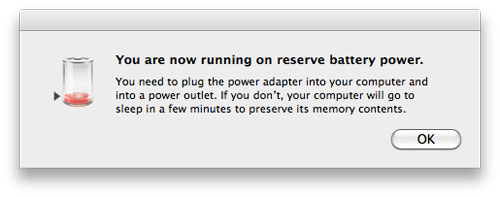
(Note 45 minutes elapsed between 1st warning and 5% warning)


Last week, Michael Arrington of TechCrunch aggressively said the HTC EVO was "seriously flawed" and said not to buy the phone - the same I've been using since Google I/O. One major reason cited was the battery life. It's the major knock against the device I hear in most reviews. My experience hasn't been so brutal, but it, like the iPhone before it, and my laptops, and every digital device I've used, has required me to bring power along, for fear of going dark. In fact, practically the only mainstream computing device I've used that has a battery to be celebrated is the iPad. Whatever Steve Jobs and team did to get that bad boy up and running for a few days is fantastic - but it is the exception, not the rule.

When using the EVO or iPhone or laptop, I plug in whenever possible. It's become as old hat as hitting Save every few minutes any time I use a Microsoft application. Old habits die hard. Today, I chose to use the EVO as I have been, but to keep it unplugged and let it run down to zero. Turns out, despite warnings out there that it's toast after about three hours, it was unplugged for more than 9 hours before spouting warnings, and I can't even guarantee it was full when I started. Interestingly enough, the EVO (and other Android phones, I assume) features the option to find out just what it is that is driving the battery downward.

What's Consuming My Battery Anyway?

According to the device, the hours of phone calls I made sapped 29% of the battery. Cell standby took another 17%, Bluetooth 17%, 15% for idling, and 13% for the Android OS itself. Good to know. But even though I had made hours of calls, and other activity on the device, it rivaled my experience with the last generation iPhone, which similarly was notorious for draining the battery, whether I used it or not. And while many people have pointed to needing to use a Task Killer to reduce drain on the EVO, Apple's helpful guide on preserving iPhone battery life isn't all that different - saying to fetch data less frequently, avoid Push notifications, or even to go into Airplane mode whenever possible!

Needless to say, companies like Apple wouldn't have to go into such details about preserving battery life if the phones were designed for always-on behavior. Meanwhile, laptop batteries are about the same they were more than a decade ago. In 1998, Apple introduced the PowerBook G3, claiming five hours of battery life, ostensibly enough to watch a DVD through fully, twice. The newest Apple MacBook Pros say they can last from eight to ten hours, though I don't know of many people who can claim having reached that threshold. So in 12 years, assuming truth in marketing, battery life has improved about 60-80 percent, while Internet speeds have improved much more dramatically, and CPUs have morphed from hundreds of megahertz to a few gigahertz. Batteries continue to lag the market, relative to most other measures.

It seems the best way to preserve battery life on laptops or mobile phones is to simply not use the devices or reduce activity on those devices. But today's machines are being built for multi-tasking, and for ever-increasing demands via Web browsers and high octane Office or rich media editing apps. I'm happy we're now seeing the first real products that leverage wireless power, but they are so limited as to not even be intriguing to this early adopter. I want real wireless power, just like 802.11, or I want an alternative that lets me charge up on the go, without cords. In this case, it's not about jousting between phone models, it's about making the same leap we did in networking. Fewer wires. More functionality. How can we get there?

June 17, 2010

June 17, 2010 · 1 MIN READ · BY LOUIS GRAY

Cinch Mobile Podcasts Now Available In Android Flavor

Cinch Mobile Podcasts Now Available In Android Flavor

Since switching to Android from iPhone in an extended trial, there have been few applications that I've sorely missed on the new platform. Topping the list of app vacancies has been Cinch, from BlogTalkRadio. On multiple occasions since the switch, I've found opportunities where I wish I could just fire up the app and do an on the spot interview, only to be left wanting. And my opinion is not the only one. At a recent dinner, I asked Robert Scoble what app he missed most on Android, and he too answered, "Cinch". Luckily for us both, and for the many people who like Cinch and Android, that gap was filled today, as the simple podcast recorder and directory entered the Android Marketplace.


Connecting the New Cinch App for Android to My Account


Just like its iPhone app sibling, Cinch for Android lets you record podcasts simply by opening the app, pressing the record button, and when done, publishing. You can customize the podcast with a title (under the magically familiar 140 character limit), a photo, and can simultaneously update the CinchCast site as well as Twitter and Facebook, should you so choose.


Browsing Cinch Content from Friends and My Account

The Cinch app is free in the Android marketplace. While the debate can still rage over what OS is better, or what handsets are the greatest, having top-quality apps on both sides of the aisle is beneficial to all. Now, I just have to hope Redfin, eTrade and my6sense show up soon to make my phone complete.

You can find me on Cinch at http://www.cinchcast.com/louisgray.

See Also: RWW: From Your Mouth to a Thousand Ears, New Apps Make Mobile Podcasting Easy

June 16, 2010

June 16, 2010 · 1 MIN READ · BY LOUIS GRAY

Video: The Continued Debate on HTC, Android, iPhone

Video: The Continued Debate on HTC, Android, iPhone

As the debate around Android vs. iPhone continues to rage, I took time to visit the new Qik studio, and sit down with Daniel Brusilovsky (@danielbru), a marketing manager at the company, who is also the founder of Teens In Tech (where I am an advisor), to talk about why I've stopped using my iPhone, and why even the new iPhone 4 isn't enough to have me going back to Apple, instead of Android.

As I've discussed many times, the trajectory in mobile seems to be heading toward Android, and I don't want to be limited to my choice of handsets and carriers. More, in full, below.

June 16, 2010 · 2 MIN READ · BY LOUIS GRAY

Amplify Goes Mobile With Clipping Service for Curation

Amplify Goes Mobile With Clipping Service for Curation

With the world of Web pages turning to a Web of streams, there becomes a battle to find value in those streams and capture points in time, sharing with your social graph. Between the medium of full-length blogging and more instantaneous tweeting or status updates is forming a lightweight medium, featuring products like Tumblr, Posterous and an intriguing entrant, Amplify, which is built to let its members post short updates, engage with the community and more importantly, clip favorite pages or Web sites along the way for discussion. Showing steady traffic and user growth over the last year, Amplify is now branching out to mobile devices with a mobile bookmarklet, letting you post updates from your iPhone, iPad or Android handset.

Amplify's New Mobile Clipping Service

One of the biggest drawbacks of surfing the Web on an iPad for me is the consistent reminder that its user agent tells downstream sites that it is a mobile device, and not a full-fledged computer, bringing me mobile versions of favorites like Google Reader and Twitter, for instance. Similarly, some site's widgets and bookmarklets don't behave in a standard way. But Amplify's new code is built to take advantage of the new world of advanced mobile devices and touch screens.


Using Amplify Mobile to Share a Link to Sports Blog Nation


If you go to http://amplify.com/m-bookmarklet, being rolled out this morning, you can now clip and share pages and posts you find interesting and share them downstream from your mobile device. It's not the most advanced technology I've ever seen, but it absolutely works. Just add a JavaScript bookmarklet to your browser, and tap it when you come across something interesting.

As with other Bookmarklet-driven services, Amplify offers you the option to share the URL and make notes about that share, which are added to your dedicated page. For example, my own feed is here: http://louisgray.amplify.com/. You can also "clip" from the shared page, which grabs not just selected text, but even graphics included, just as if you had clipped a newspaper or magazine article - which is very nice.


Clipping Twitter's Blog Post And Selecting Text on Amplify


For example, last night, when I shared Twitter's latest post about uptime struggles on Amplify Mobile, I was prompted to clip the article, tapped twice with my finger on paragraphs I wanted to include, and Amplify went above the call of duty to include the links to the company's Status blog and @Support. The resulting share (here) is displayed elegantly and captures downstream impact of likes, comments and retweets from the community.

Amplify's Clips Are Clean, Include Comments, Graphics, Link to Source

Amplify's mobile solution doesn't have to be a dedicated iPhone or Android app - and mobile clipping promises to be the beginning of their off-desktop strategy. But it absolutely works great, and it seems they have an engaged community looking to see what you share. If you're an active bookmarker on Delicious, or have previously enjoyed using Bookmarklets on FriendFeed and other services, Amplify is very interesting indeed. You can of course connect to your extended social graph from Twitter and Facebook, so make sure you're not Amplifying the news alone. I'm here: http://louisgray.amplify.com/.

June 14, 2010

June 14, 2010 · 3 MIN READ · BY LOUIS GRAY

Redfin Rocks for Relevant Real Estate on Web, iDevices

Redfin Rocks for Relevant Real Estate on Web, iDevices

A truly brilliant Web service is one that impacts your life offline, and can change your life for the better. While there are many different Web sites considered must-visits practically every day, there are other vertical apps which can be especially important for a brief period of your life - such as those, for example, based around health issues, graduate test prep, or prenatal planning. In our home in the last few months, in companion with Mint.com, no single service has been more important, nor more heavily utilized and debated, than Redfin.com (and its associated iPhone app). As we anticipate our third child in a few months, we've known we need to move to a bigger place, and we have done almost all our research and comparisons through Redfin. Essentially, if the activity isn't displayed on Redfin, we assume it doesn't exist.

While there are no doubt many different real estate search sites on the Web, Redfin came well recommended by peers, and in my own comparisons, I often found that Redfin data was more recent and more accurate than others, such as Zillow.com, despite the fact that both services (and many others) pull from the same sources.

Searching for homes on Redfin by price, size and bedrooms...

As a family looking to get a better home, but not being uber-rich, which would come in handy here in the high-priced Bay Area, my wife and I had to determine several things, including those factors which we determined were important to us, including location, size of the home, number of bedrooms, the type of backyard, size of the yard, and quality of nearby schools. Meanwhile, as I played with Excel to try and figure out just how much we could afford, I started dabbling with Redfin to find potential homes and stow them away in my favorites.

Results of Homes that Match Criteria - All Clickable

This dabbling soon became a full-time hobby. For the last three months, I've scoured the Peninsula for homes that made sense for us. If I thought they were a candidate, I hit favorite. I could sort by price, sort by the size of the home, eliminate those that didn't meet criteria, and find which ones had upcoming open houses. Meanwhile, Redin.com has been sending me updates by e-mail overnight to catch me up in case prices change, those on my watchlist saw sales pending, or if open houses were planned or canceled.

One Update from Redfin via E-mail.


Redfin has become my hub for the entire search, and has been so effective that my wife and I haven't looked anywhere else. Every home we have looked at, we previously previewed on Redfin and had the specs memorized before we went through the front door. And after every visit, we went back to Redfin to make changes to our list.

Redfin Pulls From a Wide Variety of Listings (As You Can See)

Knock on wood, this search looks to be soon coming to an end, hopefully. As my wife's not getting any less pregnant, and the buyer of our condo is entering the homestretch on his approvals and paperwork, I hope we start planning the moving phase, and dealing with that major headache.

Redfin.com is not available in all areas, focusing on a number of select metropolitan areas - which, obviously, the San Francisco Bay Area is one. As somebody who prefers to leverage the Web for practically everything I possibly can, it's been awesome to have a strong silent partner like Redfin.com doing all the hard work of looking around for me and letting me know exactly how much I would have to pay each month, or in property taxes, or even how the price of potential homes has changed over the last few years. I love playing with data, and Redfin has a ton of it. If you are thinking of moving or selling your place, and Redfin.com is in your area, I can't see why you would go it alone.

June 13, 2010

June 13, 2010 · 2 MIN READ · BY LOUIS GRAY

Qwotebook Gets Qwotes In, Qwotes Out, Adds Advisors

Qwotebook Gets Qwotes In, Qwotes Out, Adds Advisors


Following Qwotebook's soft launch in March and public unveiling a month ago, the service, driven by notable quotes from people past and present, was profiled on Venturebeat as "Bartlett's of the blogosphere", and now, over the weekend, rolled out a number of new features to ease the addition of new entries. Also added to the service? A small board of advisors, featuring Ethan Zohn, Shira Lazar, and me. The three of us will be teaming up with Drew Olanoff and the service's developers to grow the site into a vibrant repository of memorable lines.

Drew and I worked together previously on ReadBurner (which was essentially put on hold at the end of 2009), and have become good friends, while he battled Hodgkin's Lymphoma and launched BlameCancer.com, helping to kick the omnipresent disease to the curb. Despite the fact Drew and I get along well, he knows I will push him, as we will be collaborating to make the service a very interesting one.

Drew Tweets to QwoteBook Using @qwoted

Among the feature enhancements added to the site in recent days are two memorable ones, which I'll call "Tweet in" and "Tweet out". If you have registered with the site and added your Twitter credentials, you can send any qwote to your Twitter stream. Even more interesting is the opportunity to send a qwote to Twitter and have it land on Qwotebook, very easily.

The Qwote Lands on Qwotebook

To do so, just post a tweet starting with @qwoted, the body of the qwote and then the Twitter handle of the originator. See below for an example. At that point, the "@qwotebot" will go to work, match the IDs to names and post it to the site.

Sending a Qwote to Qwotebook is This Easy

Advising the Qwotebook team is something I will be doing on my own time, and is not associated with Paladin Advisors Group. The Qwotebook advisory role joins similar positions with SocialToo, MyLikes and TeensInTech. A previous role with BuzzGain ended when it was acquired by Meltwater Group earlier this year.

You can find me on Qwotebook at http://qwotebook.com/louisgray/. I hope you find value in the site and will start qwoting. It's actually a lot of fun. As you can anticipate, any future coverage will have the appropriate disclosures.

June 11, 2010

June 11, 2010 · 1 MIN READ · BY LOUIS GRAY

InfoSmack Podcast: Apple iPhone vs. Android, HTC EVO

InfoSmack Podcast: Apple iPhone vs. Android, HTC EVO

Following general release of the HTC Evo last week, and the revelation of iPhone 4 at WWDC from Apple on Monday, the smartphone wars are in full swing. Being among the first to have the HTC Evo, thanks to attending Google I/O, it seems everywhere I go, people are asking about my choice to make Android my primary mobile OS, and putting the iPhone aside. My quick comments on iPhone 4 Monday got a lot of attention, especially thanks to my comment that developers should start coding for Android ahead of Apple's platform. (See responses from JMetz.com, The Apps Lab, Ken Yarmosh and Daring Fireball for example...)

While you heard some of my thoughts on EVO vs. iPhone when Chris Saad and I spoke last week, I expounded on my thoughts when talking with Greg Knieriemen of Chi Corporation and Marc Farley of 3Par and StorageRap.com on a new episode of the Infosmack podcast this evening. We talked about the prospects for Apple, Google, Windows Mobile, and Android in general. For guys who generally talk about enterprise products and the datacenter, they did a great job talking consumer today. I hope you find value.

You can listen in below:

June 10, 2010

June 10, 2010 · 1 MIN READ · BY LOUIS GRAY

Feedly's RSS Start Page Makes It to Safari After Two Years

Feedly's RSS Start Page Makes It to Safari After Two Years

A week away from the service's second birthday, Feedly, the advanced RSS and news reader, displayed in a magazine-like format, finally made its way to my browser of choice, Safari. Having long required Firefox, and later supporting Google Chrome, through a browser extension, Apple's release of Safari 5, with support for browser extensions has brought Feedly to me.

As I've mentioned several times, RSS, and Google Reader specifically, is my go to starting point for news discovery. As Google Reader and Google Buzz have grown in parallel, and in many ways merged, I am turning to Google's RSS-powered engines to bring me the best news from the Web and from my friends' recommendations, where we can engage in discussion around the news or simply say we "like" something.

Most Popular Items in Feedly on Safari

My Feedly Digest On Safari


Feedly, one of the closest-working partners to Google Reader, and a strong user of their API, has innovated alongside the service's developments, adding in each of the new social elements as they debut. But for the most part, I just watched, because I am reticent to ditch Safari, which has all my customization, bookmarks, and history - plus synchronization to iPhone and iPad.

Buzz on Feedly on Safari

With Apple rolling out Safari as part of their fleet of announcements at WWDC this week, Edwin Khodabakchian and his team took a couple days to spin up a Safari extension which provides the full Feedly experience - finally - in Apple's browser. While I am still not a huge fan of browser extensions, I am absolutely willing to sacrifice my ideals for such a long-anticipated, high quality, news discovery experience.

Installing the Safari 5 extension is simple. Just download it - linked from the official Building Feedly blog, double click to install, and you're good to go.

June 9, 2010

June 9, 2010 · 2 MIN READ · BY LOUIS GRAY

50 Top Startups Worth Watching

50 Top Startups Worth Watching


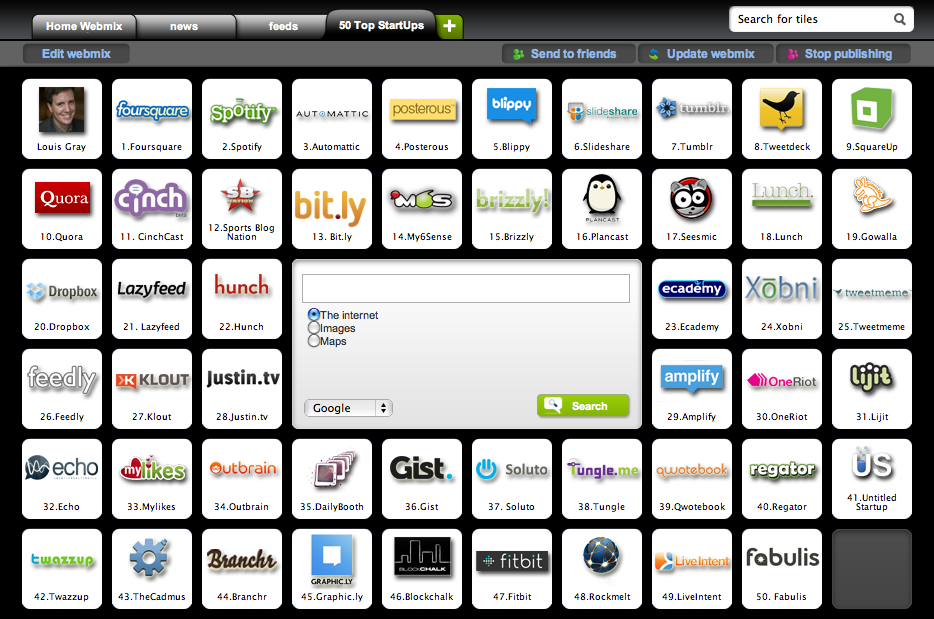
Alongside this morning's launch of Symbaloo in the US, I prepared a list of 50 top startups that I am watching. Challenged to rank the 50 from one to fifty in terms of both interest and viability, it proved to be a challenging task, but I can make a good case for all included, as well as their position. Of course, no list is without its omissions and second guesses. I am sure that if I ran this exercise 10 times, I would get a different list 10 times.

With the understanding that being a private company does not always mean you are a startup, I looked below the uber-players such as Twitter, Facebook, LinkedIn, Groupon, Craigslist, Tesla, and others, with a focus primarily on Web services, with a tendency toward social, and apps I am using frequently. I am more than happy to share with you the list, and it would be great to hear those you think I left off the list and missed, or how this is off base. Thanks to Symbaloo being out there, I hope to keep similar lists updated on my Webmix.

Without further ado...
  1. Foursquare http://www.foursquare.com
  2. Spotify http://www.spotify.com
  3. Automattic http://automattic.com/
  4. Posterous http://www.posterous.com
  5. Blippy http://www.blippy.com
  6. SlideShare http://www.slideshare.com
  7. Tumblr http://www.tumblr.com
  8. TweetDeck http://www.tweetdeck.com
  9. Square http://squareup.com/
  10. Quora http://www.quora.com

  11. CinchCast: http://cinchcast.com/
  12. Sports Blog Nation http://www.sbnation.com
  13. Bit.ly http://www.bit.ly
  14. my6sense http://www.my6sense.com
  15. Thing Labs http://brizzly.com/
  16. Plancast http://www.plancast.com
  17. Seesmic     http://www.seesmic.com
  18. Lunch http://www.lunch.com
  19. Gowalla http://www.gowalla.com
  20. DropBox http://www.dropbox.com

  21. Lazyfeed http://www.lazyfeed.com
  22. Hunch http://www.hunch.com
  23. Ecademy http://www.ecademy.com
  24. Xobni http://www.xobni.com
  25. Tweetmeme http://www.tweetmeme.com
  26. Feedly http://www.feedly.com
  27. Klout http://www.klout.com
  28. Justin.tv http://www.justin.tv
  29. Amplify http://www.amplify.com
  30. OneRiot http://www.oneriot.com

  31. Lijit http://www.lijit.com
  32. Echo http://aboutecho.com/
  33. MyLikes http://www.mylikes.com
  34. Outbrain http://www.outbrain.com
  35. DailyBooth http://dailybooth.com/
  36. Gist http://www.gist.com
  37. Soluto http://www.soluto.com
  38. Tungle http://www.tungle.me
  39. Qwotebook http://www.qwotebook.com
  40. Regator http://www.regator.com

  41. Untitled Startup http://www.untitledstartup.com/
  42. Twazzup http://www.twazzup.com/
  43. The Cadmus http://thecadmus.com/
  44. Branchr http://www.branchr.com
  45. Graphic.ly http://www.graphic.ly/
  46. BlockChalk http://blockchalk.com/
  47. FitBit http://www.fitbit.com/
  48. RockMelt http://www.rockmelt.com/
  49. Live Intent http://www.liveintent.com/
  50. Fabulis http://www.fabulis.com
Disclosures: Symbaloo and my6sense are clients of Paladin Advisors Group, where I am managing director of new media. In addition, I am an advisor to MyLikes and have previously done work with Ecademy.
June 9, 2010 · 3 MIN READ · BY LOUIS GRAY

Symbaloo Hits US Market With Start Page, Curation Engine

Symbaloo Hits US Market With Start Page, Curation Engine

Before there was social networking as we know it today, and before blogs, there were flat home pages. Among the first things most of us would do with these flat personal home pages would be to compile a list of links - essentially an extension of our browser bookmarks - so that our friends and other Web visitors would find out what we like, or possibly, so we could demonstrate an expertise. Now, as we have moved to a real-time Web built as much on streams as on pages, our sharing has sped up and many people are talking about the discovery and highlighting of key content as curation. New word... same idea.

Good curation tools are hard to find, though I have seen a number of attempts to get the formula right - and much of the fault lies with gaps in today's search engines, who are increasingly favoring most recent content over most exact content. Into the void comes Symbaloo, a company that is taking a new spin on personalized link pages, or start pages, and creating what are called "Web Mixes", with core components being tiles (much like bookmarks), RSS feeds and rich media, which can be used to capture the day's news - but more importantly serve to be a page of record for a topic or a time.

Symbaloo, a Dutch company, which has already enjoyed strong success in some areas of Europe, is today opening up to US customers in an early beta. With roots deep in the Continent, they are unapologetic about taking baby steps to serve us on the mainland, but they are eager to make a dent here as well.

A Default Symbaloo Start Page With Dedicated Tiles and Resources

Symbaloo's main design features 52 tiles, laid out in a 6 x 10 rectangular grid, with the center area reserved to display selected RSS feeds or to search the Web with any of the pre-loaded search engines. Whatever you choose to do with those 52 available tiles is up to you - and you can share any custom Webmix you build with your friends downstream, highlighting the curation you have done.

50 Hand-Selected Top Startups In a Symbaloo Webmix

For example, given my interest in Web services and early adoption, I put together a list of 50 top startups, excluding the "wise beyond their years" examples of Facebook, Twitter and other large private companies, and then ordered these 50 from 1-50 in terms of potential impact and visibility, starting with Foursquare and ending with Fabulis. As you can see, the "50 Top Startups" Webmix displays high quality graphics for each tile and is visually appealing.

http://www.symbaloo.com/mix/50-top-startups

Similarly, I also chose to take a few minutes and display 50 core Web sites you probably visit often, all in one place:

http://www.symbaloo.com/mix/50-core-web-sites

50 Core Web Sites To Get News, Networking and Finance

Creating your own Webmixes is very easy. After logging in, hit the + sign to create a new Webmix, and then click a tile where you want to add a link. If the link you are looking to add already exists, just click to add it to your Webmix. If it doesn't, then you can create it using an image from your computer, or one of the many standard icons provided by Symbaloo.

If you have a field of expertise, and want to share your findings, or your sources of data, with the world, Symbaloo's Webmix approach packs a lot of links into a single graphically pleasing page. I would expect you could rapidly see topical pages built for everything from Sports to Business to History. I could see Webmixes being created not just by technology curators like me, but also by teachers and journalists working stories.

For many, Symbaloo's approach may be compelling enough for them to use as their new browser start page, but for most of us, we have already edited our portals and are pretty set with what we want to see the first time we open up the Web. Instead, I think the opportunity to curate the Web and share with friends what we know is going to be the biggest opportunity. I expect to leverage Symbaloo as a one-stop personal portal, which I can get to from my desktop, iPad or any other mobile device. You can start making your Webmixes at http://www.symbaloo.com.

Disclosure: Symbaloo is a client of Paladin Advisors Group, where I am Managing Editor of New Media.

June 7, 2010

June 7, 2010 · 3 MIN READ · BY LOUIS GRAY

iPhone 4 Is Nice, But It's Not Enough to Slow Android

iPhone 4 Is Nice, But It's Not Enough to Slow Android

I am running in danger of sounding as much an Android fanboy as I ever was an iPhone fanboy, so let it be known even if the subject is changed, the internal debate continues to rage, and the enthusiasm to make the right choice, fairly, is still the same. Like most of you, I wondered how Apple and Steve Jobs could wow us with the latest iteration of iPhone, and whether it would be enough to attract those of us considering Android as an alternative - most specifically the new HTC EVO or similar devices - to come back to the Apple fold.

With Jobs' keynote complete, it looks like Apple is making some good moves with high quality imagery, cameras, and smart integrated apps like iMovie and FaceTime, but I didn't see anything that made me feel I have made the wrong choice. I stand by the belief that Android has achieved parity with Apple in many respects, is superior to the platform in a few ways, and has the momentum behind it with an ecosystem set up for continued growth - not held down by the still-stunning ineptitude of a major partner like AT&T.

The iPhone 4 update focused on improved screen quality with more pixels, the long-awaited introduction of multi-tasking, HD video recording at 720 pixels, a fast Apple A4 processor, the introduction of a front camera, and two pieces of software - iMovie for editing of film clips on the iPhone, and FaceTime for video calling, assuming both parties have iPhone 4 models.

The introduction of multi-tasking and a front-facing camera both are catch up features to the latest Android models, including the aforementioned EVO. The iPhone is no doubt thinner than the EVO, and speed and battery life measures are subjective. But Apple's complete silence on wireless hotspotting, tethering, and finding an alternative to the boat anchor of AT&T were a big miss. While the company can trot out market share statistics showing installed market share for iPhone devices ahead of Android, it certainly seems like the onslaught of capable devices running Android are eating into Apple's share - and that's something which fancy iAds aren't going to fix.

If I were an Apple developer today, I would be very happy with the company's revenue sharing policies and attempts to further improve monetization with iAds. I might even take them at face value when Jobs said they were approving the overwhelming majority of applications submitted to the iTunes store. But I would absolutely make sure I was also coding my applications for Android. I believe that if I were starting a business built on mobile applications today, I would start by coding for the Android platform, as there is a greater chance to gain first mover advantage in that marketplace, and to become a revenue leader as the tide rises. Code for Android first, and iPhone/iPad second.

What I was looking for today was not a device that offered feature parity or similarity to what I have now somewhere else - on a platform that isn't limiting me to the manufacturer or to the carrier. I wanted more flexibility and more functionality. An iPhone 4-only parlor trick of video calling much like that on AIM or Skype or Yahoo! Messenger from the last decade isn't what is going to make my phone buying decisions made up, but instead, a promise to create a high quality experience for all aspects of my using the device.

AT&T has failed that litmus test of quality and has done so consistently for years. Today, Apple had the opportunity to look customers in the eye, and either apologize for the poor service we have come to accept from AT&T and Apple, and the missed promises, or better yet, offer an alternative. They didn't. That tells me either they do not fully understand the magnitude of the problem, or they think they can get away with continuing to ignore it.

Apple, I didn't want a thinner iPhone that's slightly faster and better looking. I wanted a promise that the new one would make phone calls, act as a fantastic Web device, and provide 3G access to other devices. Today, you didn't do that, and it's disappointing. A smartphone can't be smart if it's married to a company as dumb as AT&T.
June 7, 2010 · 4 MIN READ · BY LOUIS GRAY

Steve Jobs' Opportunity: Apple Products are for Humans

Steve Jobs' Opportunity: Apple Products are for Humans

At 10 a.m., Apple CEO Steve Jobs will take the stage once again at WWDC, no doubt introducing the next generation iPhone, along with its already previewed iPhone OS 4 software, as part of what will hopefully be many announcements in the day, which point to the future of the company and its application ecosystem. His remarks will come at a time when Apple as a company is tremendously strong, firing on all cylinders, with the launch of the iPad looking like a tremendous success. Yet, in the background, the company's iPhone juggernaut seemingly looks like it is vulnerable, thanks to continued momentum from Google, Android, and Sprint's record-setting sales of the newest device, the HTC EVO (which I've discussed at length the last few weeks).

Steve Jobs is a master visionary for foretelling the future of tech, and also a master salesman, convincing you to think he was the leader, in the occasions when Apple is actually late the game. He and Apple have been among the best in convincing customers that features or products are not needed, or markets are not interesting, right up until the minute they introduce their own version. At this WWDC, Jobs will need to convince those watching and listening not only that the company's present is strong, but that their future is as well, that they can remain atop the charts in the smartphone race, in the face of the onslaught from Mountain View. One way he can turn this tide is to turn Android's marketing around against them - taking on the harsh, metallic, robotic, messaging directly, and say that in contrast, Apple's products are designed with soul, by humans, for humans - connecting with one's emotional side in a way that Google hasn't traditionally been able to do.

As far as robots go, the Android robot is cute - friendly and appealing even. So too are the code names for the Android releases themselves, each sounding like a calorie-rich dessert one would lust for. But, at the end of the day, it's still a robot, and Google, so far, hasn't been known for a soft, creative, approach. The stories about the company being data-driven and letting the numbers tell the story have reigned supreme, often being pointed to as one contributing reason behind the company's false starts in social, and, amusingly, the lack of a Google Sports to go alongside Google News. In contrast, Apple is all about emotion, and creativity, and how one feels about an experience - be it on the desktop, on a tablet or from a mobile phone.

Apple once said its operating system was so divine that "you would want to lick it". Licking and loving? Human emotions, not something robots desire to do. I don't see Google wanting you to lick your Nexus One or your Droid Incredible any time soon. They just "do". And even though I am enjoying my Android experience still, I am working around some of the lameness when it comes to non-humane error messages, non-intuitive software design and things that take more steps than they should, which Apple already tackled in the simplicity department long ago.

Do you know the primary use for the pair of iPads we got the first day they hit stores? Playing YouTube. Now, before you say that's a Google product (which it is)... what I left out is that the primary users are my nearly two-year-old kids. The two of them are constantly on the iPad, browsing videos or playing simple arcade games. That we have two iPads for the two kids is a must, for when one is in the room, they are fighting over it. The simplicity and human approach Apple took to the iPad is so well executed that the twins don't hesitate in learning how to approach new apps and to swipe between screens. But when they look at my EVO, they're pretty much lost.

Jobs may not try and present iPhone as the alternative to Android at WWDC, in the same way Google presented itself as the alternative to iPhone at Google I/O. Maybe he doesn't want to give them that much credit. It's just as likely that he will tell us how much better iAds are to AdMob, or tell us how many more cool apps there are for iPhone and iPad than there are for Android. Maybe talking about one's human nature and personality is too much of a throwback to Jobs' hippy days, but it's certainly an opportunity, one that would resonate with many people considering their computing choices going forward. We're not robots, and Apple is a touchy-feely company who understands touch and feel better than anybody else in tech. Therein lies the opportunity to remind customers.

June 6, 2010

June 6, 2010 · 2 MIN READ · BY LOUIS GRAY

Spotify Social Is Close to a Music Utopia (If You Can Get It)

Spotify Social Is Close to a Music Utopia (If You Can Get It)

Every day I spend using my cloud-centric MacBook Air and my HTC EVO brings me further and further away from an iTunes-centric digital media life. A once-diehard iTunes user who has no doubt purchased thousands of tracks from the music store since its debut, I find myself interacting with the application less and less over time - as my music is now coming from far-flung Web-based places like Last.fm and Pandora, satellite from Sirius/XM Radio, and, as often as I can, from Spotify. A near-immediate Spotify convert back in August when I first got my hands on the application, I have also enjoyed its iPhone app, and can now leverage the preferences and playlists from friends who I am connected to on Facebook, to see what songs they recommend.

Spotify already seemingly has the lion's share of music available with instant streaming, but now, it makes enjoying tunes a social experience. Despite the fact the service still hasn't publicly announced a launch date here in the US, it looks like a lot of my peers have gained access, one by one, so my social sidebar in the app is populated by several dozen audiophiles, each listening to their favorite music, and favoriting tunes for me to discover.

David Recordon Loves the F8 Playlist on Spotify

As with Last.fm and MusicMobs before it, the social elements of Spotify are great for finding shared musical preferences between friends you may not have known existed. For example, I was surprised to find Marshall Kirkpatrick of ReadWriteWeb is high on Blonde Redhead, and that I could relive high school with Pearl Jam's Spin the Black Circle off Chris Messina's "Rock Out" playlist.

Marshall Kirkpatrick Rocks to Blonde Redhead

The future of software is to be connected, instant and social. Spotify starts up tunes faster than any product I've seen (no buffering noted) and, of course, lets you share tracks to Facebook and Twitter. It's all about enabling improved song discovery and expanding social connections.

At LeWeb 2009 last December, Spotify said their plans were to open in the US in Early 2010. We're practically reaching the midpoint, so it seems things are going slower than anticipated. With WWDC upon us, it will remain to be seen what plans Steve Jobs and crew have for LaLa's integration into iTunes, and whether their offering will be strong enough to make Spotify's eventual launch too little too late. Hopefully not, for what they're making is extremely good... I just worry about the ticking clock.

June 5, 2010

June 5, 2010 · 1 MIN READ · BY LOUIS GRAY

Edge Theory Conversations: Android & EVO vs. iPhone

Edge Theory Conversations: Android & EVO vs. iPhone

On Friday, the HTC EVO, powered by Google's Android operating system, finally went on sale. As you know, I have been using the device, courtesy of Google I/O for the last few weeks. First I started using it exclusively, and later, I reported on my experience.

Tonight, Chris Saad (@chrissaad) and I talked about how the mobile landscape is changing with the rise of Android and the near-term arrival of iPhone OS 4 and a new iPhone device from Apple at the Worldwide Developers' Conference this week. Chris, seeing many mixed reviews of the EVO in particular, especially when it came to battery life, has not yet made the plunge, but I promised that if he did, he wouldn't regret it. In fact, I am having a hard time seeing myself return to the iPhone platform - barring something amazing. This probably violates my Apple fanboy contract, but that's what's happening.

This and all other EdgeTheory conversations can be found on the dedicated ET Conversations site.

Listen to the full recording below:

June 3, 2010

June 3, 2010 · 2 MIN READ · BY LOUIS GRAY

You Can #BlameCancer For Everything at BlameCancer.com

You Can #BlameCancer For Everything at BlameCancer.com


One year ago today, I shared with you the story of my friend Drew Olanoff's battle with Hodgkins Lymphoma, and his choice to take cancer head-on with a site and cause, Blame Drew's Cancer. The idea moved from novelty to phenomenon, as tens of thousands of people took to Twitter and other Web outlets to blame Drew's cancer for everything. With Drew's cancer in remission and his chemo treatments in the past, it's not time to forget about blaming cancer, but it is time to stop blaming Drew. Starting today, a new Web site at http://blamecancer.com/ has launched, to continue the fight against cancer, which took nearly 600,000 lives, in the US alone, in 2009.

The site and new cause, Blame Cancer, extends a year-long fight that has seen high-profile involvement from charities including Lance Armstrong's LiveStrong, and support from The Price Is Right's Drew Carey, who famously bid six to seven figures of support, in exchange for Drew Olanoff's @drew Twitter account. Like the previous campaigns, Blame Cancer will be run in partnership with new foundations and charities who are more than willing to lend their brand, their time and their money to support the fight against the disease.

The New BlameCancer.com Site In Action


The first to step up is VeggieGrill, who approached Drew, saying they wanted to do something to support the cause. Details will arrive in coming weeks, but the process of "donation by action" that Drew promoted in round one is going to be proven again in round two.

"Blame Drew's Cancer became part of the vernacular so it's not a novelty," Drew Olanoff said this morning. "I want that to stop, but I want people to just blame cancer. Whenever something sucky happens, I want people to blame cancer, in real life, on Twitter, on the Internet, on Facebook, and that's it."

Drew says that BlameCancer.com is going to be an anchor site for this movement of donation by action, and promises that this will "live forever" - powered only by the words of the masses who want to give Cancer a kick in the shins.

"With BlameDrew'sCancer, we raised a bunch of money and a bunch of awareness, which was key," Drew said. "It was unique. It was not cookie cutter. You had to think of something, and people did - well over 25,000 people."

To Blame Cancer for whatever is driving you nuts today, simply add the hashtag #blamecancer to any tweets you put on Twitter or "Blame Cancer" wherever you are - on the Web or off. All tweets that have the #blamecancer hashtag are counted and displayed on BlameCancer.com. I #BlameCancer for my father, aunt, and countless others in my family and friends' families for having to battle the disease. It's time to make cancer history starting with being a part of Web history.

June 2, 2010

June 2, 2010 · 4 MIN READ · BY LOUIS GRAY

5,000 Tweets Later, The Twitter Medium Has Changed

5,000 Tweets Later, The Twitter Medium Has Changed

Forget about the idea that early adopters are always first at everything. Sometimes it takes some of us a little bit longer to find utility in products or services that others get right away. Twitter was an obvious initial miss for me. I held out for a long time - by my standards - swearing first that I would never use it, and then finally giving in after getting some good feedback from peers who were finding value.

Now, nearly 30 months later, and 5,000 tweets later, the milestone I'll hit once this blog hits the service via FeedBurner, Twitter has become a powerful force. Even those people who are not on the service, or using it as often as many of us are, have at least heard of it, or know people on it. The assumption now is that everybody has a Twitter account, in the same way as we believe everybody has an e-mail address. News breaks on Twitter. People break on Twitter. And it has become the go-to source for real-time feedback from a massive audience. Maybe Twitter doesn't cure cancer, but it turns out, it can help - as we learned with #blamedrewscancer... and it sure doesn't cause cancer, no matter how frequently you update, or what client you prefer.

TweetStats Shows My Twitter Use

5,000 tweets sounds like a lot to me. That's almost 6 per day, or one every 4+ hours around the clock for 2 1/2 years, scattered almost exclusively between 8 a.m. in the morning and 2 at night, if TweetStats tells the truth. With 140 characters to play with, that's 700,000 characters of wiggle room. But as we once discussed with a Twitter Noise ratio I made up, one's pace can depend on their personal preferences, their choices to share links or engage in conversation, or what social networks make sense for them. I know, for example, that many Twitter-centric folks long since left 5,000 and 10,000 or even 20,000 and 50,000 tweets in the dust. @chrisbrogan sports nearly 70,000 while @parislemon is approaching 14,000 and the legendary @queenofspain is going to cross 85,000 before the month is out. So I must not be too noisy amid such elite company.

My First Tweet - Clearly Tentative

Twitter, for all its ups and downs with infrastructure strains and developer changes, through the company's maturation, has become an important player for many different things. Its limitations have been rebranded as simplicity, and what used to be a geek mecca is as much home to celebrities, teens and marketing as anything else. That's the problem with a nice neighborhood, everyone moves in and the ads go up. But the crowds have brought relevance. With worldwide growth and use in many different markets for many things, one can practically assume someone is twittering most events, in the same way one can safely assume that any scene of interest is being videotaped. The world is being recorded, and the world is being tweeted.

If I am Awake, I am Tweeting?

My comparatively slow approach to Twitter contrasted with some of my peers continues thanks to my own internal checks against noise. I still use Twitter primarily for distributing links from the blog and others I think may be relevant to followers. I set up a dedicated account at @lgstream for even more shares, without drowning my feed. I try to keep idle chat to a minimum, engaging on Google Buzz, FriendFeed and Facebook for some, and using Twitter DMs in other cases. I don't know if I'll ever make Twitter a place where I want to drop in and stay a while. I am absolutely glad it's there, and recognize its significant utility, but it still doesn't feel like a destination to me - instead, a powerful, increasingly critical utility.

New FriendFeed Blog iPhone Google Post Social Time! [pic]

By the time I hit 10,000 tweets, I expect Twitter will be dramatically different again from where it is now. As the company may have approached 200 employees, it could be at 1,000 or more by that time. It might be a public company, and the service could be dramatically different. Maybe popular clients like TweetDeck, Seesmic and Brizzly will be purchased by other brand names, or by Twitter themselves, like Tweetie was. But Twitter looks not only here to stay, but to play a big role in how this generation communicates. It may be through 140 characters at a time, including @Replies and short URLs, but it's what we've got.

Here's to filling your stream with another 5,000 useful tweets. You can find me at @louisgray.
June 2, 2010 · 4 MIN READ · BY LOUIS GRAY

Descending Into a Nation of Bloggers: How Steve's Right

Descending Into a Nation of Bloggers: How Steve's Right

Steve Jobs, unfiltered, seems to be the most attractive interview in the tech world, bar none. That's why his opening up at AllThingsD last night continues to make waves in the tech news world, as his every word is dissected, repeated and spun. The extremely quotable Jobs dropped a number of interesting insights and remarkable candidness for the leader of the technology industry's largest company, and arguably one of the most successful, with legions of loyal customers, and a similar number of would-be competitors. One of his most remarkable quotes regarded the challenge of supporting high quality content, and an editorial press, contrasted with what he saw as a descent into a "nation of bloggers".

Rather than react in an emotional way, pounding out paragraphs to pooh-pooh Jobs' dismissiveness of an entire craft - of which I am obviously part - one has to understand his perspective, and how Apple is impacted by the world of blogs, to see how he could come to his conclusions.

In a world when many many businesses are becoming more open, sharing short updates on Twitter, single paragraph announcements and events on Facebook, and regular posts from thought leaders and executives through blogging, Apple seems to be on the outside looking in. They are notable for their continued closed approach, one built on secrets and surprise. Of late, Steve Jobs has opened up a bit, acting as a one man social media machine with e-mails to customers and bloggers, and penning longer notes on the Apple.com Web site, like that on Flash from last month. But Apple not only doesn't really need to participate in this world, but honestly has not seen much benefit from the army of Mac bloggers. It's no surprise that Steve has the opinions he does about bloggers, and the company needs them less than many others do.

The funny thing about Steve Jobs is he's been doing this for a long time. He was on the cover of Time and Fortune, BusinessWeek and Newsweek decades before the first blogs. His return to Apple in 1997 came as the Internet was ascending, but the term blogging was practically unknown. This was two years before Ev Williams and team started their blogging software at Pyra Labs, and two years before Brad Fitzpatrick started LiveJournal. In his time at Apple, Steve Jobs and his team has never really suffered for a lack of news. The mainstream media, from the aforementioned press to the Wall Street Journal, New York Times and others, have been available to review the company's products, to report on their news, and to dissect the company's typically rosy financial results.

Meanwhile, for the most part, Apple and Mac coverage on blogs can be divided into three camps - Apple fans, Apple haters and Apple rumor seekers.

Those who love the company and its products are almost mythical in their obsessions and loyalty. Those who hate Apple are similarly entrenched, if not always as vocal. And those who are constantly seeking to undermine Steve and Apple's launch schedule and product roadmap have expanded from a once-niche industry to something much more mainstream. And in many cases, Apple has had to take aim against blogs to protect their positions.

Apple's conflicts with bloggers have been well documented. Apple sued anonymous posters on AppleInsider for leaking product photos, including the G4 Cube, before their time. Apple sued the then anonymous author of Think Secret, for discussion of an unlaunched product, called "Asteroid", a new audio interface for GarageBand users. And of course, most recently, Gawker Media paid to gain access to a prototype next generation iPhone which may or may not have been stolen. And yes, Apple is going after those guys too. (This doesn't even go into his latest e-mail trading with Ryan Tate at Valleywag, a coworker of mine from a decade-plus ago.)

As far as Apple is concerned, in contrast to what they see as professional and respectable coverage of their products in the still much read mainstream media, the bloggers have really been nothing but trouble, with the drawbacks and amateur approach outweighing any potential benefits from consistent fandom selwehere. The Macintosh rumors industry, which I have largely ignored of late, is in constant flow, since Mac OS Rumors kicked it off in the mid nineties, and it's no wonder why Apple has taken this approach to not trust the industry as a whole.

Can one separate the term "blogger" from one who blogs, and not feel like Apple and Steve Jobs are slamming an entire informal industry? Of course. There are absolutely some very well written, professional, editorially focused blog networks out there. There are a lot of individual bloggers who do a great job expressing their thoughts on Apple and many other companies. But for one of the world's best Marketers, blogs are little help at all. Of course Steve Jobs wouldn't want the nation to "descend" into one full of "bloggers" who target his company with falsehoods and borderline criminal activity. Of course he would like to control the message and keep the element of surprise.

Steve's comments don't mean that Apple wants sites like The Unofficial Apple Weblog and The Apple Blog to go away, but Steve is calling for decorum that he just isn't exposed to. Steve Jobs and Apple don't need bloggers. They have operated above the fray, and are calling for something better than what they have seen - something that delivers them value.

June 1, 2010

June 1, 2010 · 12 MIN READ · BY LOUIS GRAY

iPhone Armageddon: A Week With Android & EVO

iPhone Armageddon: A Week With Android & EVO

Last Monday, I mentioned that I was starting a self-initated experiment to put my iPhone aside and use the Android-powered HTC EVO, with Sprint voice service, exclusively for at least the full week. Curious if Android and the new handset could live up to the same standards, or better, than those I have come to expect from Cupertino for the better part of two years, what is worth noting is that I haven't gone back to the iPhone out of frustration at any point. I haven't lusted after any specific functionality or felt completely at a loss for specific applications, and most importantly, I know that if the iPhone platform were to magically evaporate from the Earth tomorrow, all would be well, because the iPhone is no longer the only highly qualified smartphone game in town. I expect I will be watching Steve Jobs' WWDC presentations very closely later this month to see what is the story with the next generation iPhone and software, but I would be perfectly happy if I never had to use an iPhone again.

Making a choice of smartphones is not a winner takes all proposition any more, as I mentioned on Saturday, so I am not going to tell you what you should do with your mobile plans. Instead, the goal is to share what I found as differences between the two platforms' combined experiences - from software, hardware and execution.

Voice Quality: No Dropped Calls With Sprint - Ever.

First things first, and this is a big one... I have not dropped a single call or complained about voice quality in any way in my use of the HTC EVO. On the iPhone, whether a call would drop unexpectedly or not was a constant concern. Whether you think fault lies with AT&T or with Apple, the fact that this problem continues to be so widespread, with no end in sight, is a major point in the corner for Android's wide array of carrier options. Once I forwarded my calls from iPhone to the EVO, and connected the EVO to the bluetooth in my car, nobody ever had to know I wasn't using my original phone - except for the fact the calls always went through. The only issue I have ever encountered related to the phone is that Sprint's 30-day trial doesn't include international access, so when I missed a call from Barak Hachamov of My6sense, whose main number hails from Israel, I couldn't call him back.

If Apple goes through another WWDC, and beyond, with AT&T having an exclusive, the platform will have major problems - regardless of Android's perceived quality or app ecosystem. But everything I have heard points to Apple at least partnering up with Verizon as an alternative in the near-term, which will stem the tide of switchers.

   
App Screens on my HTC EVO - Much like the iPhone


Starting With the EVO's Apps, Screens and Widgets

Initial experience with the EVO, and my continued use over the last week plus, has been very easy to grasp, coming from the iPhone platform. While the device is not without its issues, as evidenced by the somewhat arcane error messages I encountered with some frequency, and the not-invincible battery life, I rapidly set up the phone's home screen and subsequent pages with many familiar application icons, just as I did the iPhone. But Android also offers the ability to add Widgets, which are essentially smaller live applications that display content directly, without having to be opened. For example, I added widgets for Twitter and Facebook, letting me thumb through friends' updates directly. I also added widgets for Google Analytics, Google Buzz and Mint.com, giving me stats at a glance.

  
Twitter and Facebook Widgets, Plus All Screens At Once on the EVO

Sliding between phone screens on the EVO is precisely as you would expect, coming from the iPhone, with a few small twists. While the iPhone starts with the home screen fixed to the left and subsequent screens are to the right, the EVO home screen is the center position, atop an arc, with screens both to the left and right of center. And unlike the iPhone, you can tap the home button twice to see all screens, offering quick navigation to one or another.

Also a benefit in the EVO's corner - the option to install applications without taking up valuable screen real estate. In the world of iPhone, every downloaded application gets a spot on one screen or another. On the EVO, removing apps from a screen doesn't delete them, as they are all essentially shortcuts. I could even put multiple instances of an application on one screen or multiple screens if I felt like it.

   
Many Apps and Widgets Are Available on the EVO

Future Features Above the iPhone

Other major benefits to the EVO that the iPhone 3G lacks (note I do not have the 3GS) are much discussed, from multi-tasking to offering a wireless hotspot, tethering, an integrated camcorder, and a front-facing camera. We know the 3GS has the camcorder, and the lack of tethering again falls to AT&T, while multitasking arrives in iPhone OS 4, but the EVO has all these today, not forcing me to wait for the next rev of software or for the carrier to catch up to competition.

The Notifications Box Keeps Me Updated On What's Happening

One of the features I have enjoyed on the EVO is pull-down Notifications tab which, from one place, alerts me to new e-mails from both my .Mac account and GMail, mentions on Twitter, updates on the Marketplace and shows me the current status of any music applications I may be running - including the Android version of Sonos (Androinos), Last.fm, or Sirius XM Radio.


Multi-Tasking Is Great, Except for Multi-Crashing


Errors Are Not An Uncommon Sight On the EVO


The ability to multitask on the phone is extremely welcome. It's not uncommon to be running a music service in the background, while browsing another thing on the Web, having e-mail getting checked on multiple accounts, and, possibly, letting the phone's built-in Navigation alert us to the next stop. (So long as I am in the passenger seat, of course) But multitasking is not without its problems. In addition to what some people have said is poor battery life, I was frequently surprised by background apps crashing and needing to be force quit, while I was using another app. The good news was that the foreground app could keep going, but the frequency of crashes - combined with engineering-friendly explanations as to what actually happened, should get a lot of work as the platform (and accompanying devices) increase in sales and get picked up by less geeky customers.

A Maps Crash Interrupted My Baseball Game


Apps and Apps Everywhere - Quality Needs a Boost

Coming from the viewpoint of an iPhone-a-holic, the breadth of offerings on the iTunes App Store set the stage to potentially be disappointed with what I often heard was a non-comparable Android Marketplace. What I did find, however, was that practically every need was met when I searched for it. Almost all the major applications I truly wanted are posted on both platforms, and for those that are still not there (for example, my6sense, CinchCast and Redfin), in most cases, I already know Android versions are in the works. Where the Marketplace did often fall short, however, was the quality of the apps.

   
Redfin and Etrade are Two Notable Holes In the Marketplace

For the most part, it is easy to determine that iPhone and iPad applications are better than those on Android, in appearance, polish and ease of use. Instead of all the major brand names one can see dominating the iTunes store, the Android Marketplace is populated, seemingly, by lesser-known developers, often unaffiliated. That doesn't necessarily spell bad news for the Marketplace. I would chalk that up more to the newness of the platform, and its open source ties, while iTunes is more tied to labels and has had a big headstart. Those of us who tried to buy music off iTunes back in 2003 and 2004 remember fondly how light the options were back then as well - so I wouldn't be surprised if the same kind of migration headed Android's way, and quality improved.

Back in October, I started talking aloud about the opportunity for Google to replace Apple in many of the applications and devices we Mac fans have enjoyed. One of the biggest draws for Apple users is the company's integration of software and hardware. My Apple devices work best with MobileMe and iLife keeping all my digital media in one place, from mail to calendars, music and photos. The iPhone and iPad leverage that marriage. But the Android platform is married to equivalent Google services - meaning to gain the best experience, one should optimize their Google Contacts, GMail, Google Calendar, Google Talk and other apps. Once complete, the Android/Google data concept could be as interwoven as the Apple iPhone experience has been. For me, getting to a happy state meant exporting my Address Book contacts on the Mac and reimporting them to my GMail, which also impacted my Buzz connections, but made the Address Book on my HTC EVO completely up to date. Purchases from the Android Marketplace also tapped my Google Checkout account, associated with my GMail.

Photos and Video

Hard-core gadget geeks who like to dissect every megapixel might want to know how the EVO's camera (and camcorder) stack up against those of the iPhone. First of all, the camera on the EVO is higher resolution. It also automatically focuses on the main subject of the photo, to the best of its ability, and it offers Flash as well. The front-facing camera is also a nice touch, even though it is of lower quality. You can also see a few of the videos we made with the EVO on YouTube. Solid quality equal to that from our Casio handheld - even if not a professional offering.

Where the iPhone wins here is the ease of integration with iPhoto, and multiple issues I had with EVO saying I didn't have file permissions set correctly on my SD card when it came time to actually take pictures or shoot video. If you have ever been somebody who needed to take the picture - right now - it's not exactly the time to try and troubleshoot file permissions, consider unmounting the SD card, or turning the phone off and on, so that was frustrating.

Don't Assume Your Geeky Target is the Only Audience

Also frustrating? The frequent feeling that I was working not with polished software, but with a product still in beta. While Google has no doubt made tremendous strides in their development and release of Android in the last few years, basic elements like taking a screenshot - which on the iPhone is a snap - require too much research, or investigation into third party apps. The error codes also seemed to be better served to the developers making the product and not the end user, who could care less if (process com.google.android.apps.maps) stopped unexpectedly. I also wondered at times where I was downloading software to, in the rare case I did, or why I had reached the number of maximum windows open in my Web browser when, so far as I could tell, only three were.

I did test out the EVO's hotspot capability, thinking the feature would come in handy either for long car trips or outings to the park when one of us would want to bring our 3G-less iPads. Sure enough, it worked. By turning on the EVO's hotspot capability, my daughter could browse YouTube in the back seat on the iPad as we drove from our home to Palo Alto, and while she's only approaching 2 years old, she didn't complain about any stuttering or slowness. That said, trying to type or use the phone when it was in hotspot mode was pure molasses, so if you are running it as a hotspot, make sure that's all you're doing.

Power Up, Captain!

Other reviews of the EVO have slammed the product's battery life. I won't. For me, practically the only major computing device I can trust to not run down quickly is the iPad. I have always left my iPhone powered up overnight and carried my USB cables with me in case I needed a charge. I found the EVO to be similar, and even left it unplugged overnight a few times with no problems, finding it half-way full the next morning. If you use the phone as an alarm clock, as I have been, it's much safer to use the EVO unplugged than it is the iPhone, which might die before asking to wake you up. No doubt the EVO can consume plenty of juice, but that's due to the many things you are able to do at once. If you do think you're sucking down too much power too frequently, it makes sense to get a Task Killer and stop all wayward apps whenever you can. I found myself doing this often - a necessary evil of sorts that one hasn't had to encounter with the one app at a time world of iPhone, but it hasn't been so troublesome as to stop me from recommending the EVO as an option.

Conclusion (For Now)

Going into testing the EVO (And Android in parallel), the goal was to discover if making a switch would eliminate problems or introduce them, while adding features or stopping me from doing things I have always done with the iPhone. What I found overall was that the EVO gives me access to all the core pieces I need in a phone - from high quality phone calls and Bluetooth support, to a solid Web browser and access to bookmarks, contacts, calendars and e-mail. The EVO was built with more hooks to sharing and social sites than the iPhone has been, with much more flexibility in terms of how the device could be configured, with all sorts of static and live wallpapers, or different scenes that come bundled with the phone. Of course, the missing core for EVO is iTunes. The Marketplace is good, but until the Chrome Web Store debuts, there is no equivalent for browsing the PC and finding rich applications, music and media.

Anybody who thinks that Android is miles behind the iPhone in terms of usability and flexibility at this point is wrong. Yes, the Android experience has some rough edges, but they can be smoothed with time. There is no shortage of applications for download - even though some major names haven't yet made the move. Meanwhile, call quality on a respected carrier can make all the difference in the world for the basics of what the phone is supposed to do in the first place. My 30-day trial with Sprint goes through mid-June, after the conclusion of Apple's WWDC, which gives me plenty of time to keep using the EVO and watching what's next with iPhone 4 on iPhone OS 4.0. But I am feeling much more tempted to investigate the process of porting my number to Sprint than I am feeling tempted to go back to the iPhone right now. If I want an iPhone experience, I'll just go pick up my iPad.