My first two years in Silicon Valley were spent in Burlingame at a dotcom that hoped to revolutionize telecommunicatons online - with Web meetings, conference calls and even faxing from the Web. They had great services, but not enough customers, and eventually ran out of funding in early 2001, jettisoning marketing, sales and business development folks, before selling for scraps to Oracle.
Being in Marketing myself, this meant it was my first trial to try and find a full-time job, in a world where online job databases were taking over. I'd polished the resume and started applying at anything that sounded close to what I thought I did...
Web Marketing Manager... E-Marketing Manager... Marketing Manager... Internet Marketing Manager...
Keep in mind this was a time when companies knew the Internet was a humongous deal, but were still trying to figure out where the money was coming from. The dotcom stocks had gone to the moon and crashed down. E-Business firms were raising tens of millions to figure out how put supply chains on the Web, and it could be hard to separate the real from the fake.
Meanwhile, with the crush of aspiring gold-seekers flooding to the Valley, hoping to win the stock option lottery, traffic was a mess. I used to compare driving 101 South to parallel parking at 70 miles an hour -- just a zoo. So very quickly, the location of where I could start was just about as important as the starting salary. Belmont was better than Palo Alto. Mountain View better than San Jose. Maybe I could even walk.
I tweaked my CV as best I could and threw it on Monster and Dice.com and all their clones, hoping to break through the noise. Here's what Dice.com looked like back then.
One of my job hunting volleys reached a company who so obviously needed my help. Their website was this hideous reddish purple and their icon looked like a squished crow. But they promised big things with revolutionary shock waves. I applied for the role of eMarketing Manager, to aid with promotion and copy, and redo their Website.
They asked me to come in for an interview and I pored over their site, ready to talk about how they needed to tailor their content for who their visitors would be -- investors, partners, analysts, and yes, customers. I studied the site in and out and felt prepared.
That Monday, sure their headquarters was in some garage somewhere, with like maybe 5-8 guys who couldn't write, I rolled in ready to tell them the ins and outs of marketing and publishing on the web. I pulled into the parking lot on Bernardo in Mountain View. Across their lot was Placeware, the Web meeting company eventually purchased by Microsoft. And one building down -- Handspring, the exciting handheld company run by Jeff Hawkins and Donna Dubinsky in their follow-on from Palm.
Instead of less than a dozen people, Synaxia had a quiet swarm of folks. About 50 were in Mountain View, and they'd raised two rounds of funding, for about $35 million. I still didn't really know what they did.
The first interviewer, a director of product marketing, and I went back and forth as I kept sounding confused as to their promise. He said they made the Web faster with specialized network servers. I thought they competed with Akamai. He said no. Maybe Akamai would be a customer? No. I felt a little stuck, as he talked about host bus adapters, raid arrays, and fibre channel.
So I went to what I knew - Web sites. As I began my spiel, he shook his head and stopped me.
"Louis, the Web site is a fake. The company name is a fake. In two months, we're going to rebrand and launch our product, so none of this matters."
I felt like my legs had been pulled out from under me, that I may as well just leave, but I was young enough (and likely cheap enough) that they didn't give up on me, even as I got through two more people.
My final interview was a friendly, older, and heavier guy, with short cropped white hair, folded arms resting on his belly, and an ability to talk your ear off. He was the vice president of marketing. I had 30 minutes with him, and for 20 minutes or so, he yammered on about the state of Catholic high school athletics, and told me about his kids, or told me stories about his career. He seemed very nice, but I was scared he wouldn't get a chance to learn about me at all - let alone figure if I was worth hiring.
Before I had felt like I even had a chance to get a word in edgewise, he interrupted, and said, "Look, if you got to me, you'll be fine," and just as quickly, he was gone -- off to the next meeting.
Years later, he would constantly tell me how he had been the reason I was hired, that I had been his discovery, and he took all the credit for my accomplishments. A fantastic boss, but an even better story teller.
A few days later, I got a call that offered me the job. I had no idea, really, what kind of salary to ask for, but, having just finished my double major from Berkeley, and getting two years under my belt, I was looking at a 50% raise over my last job. It seemed like so much money -- commensurate with being able to deliver a brand new website in about 30 days (which my designer and I managed).
I agreed to the job, and the pay bump, and my excitement lasted almost a full workday.
On the first day, HR asked me to sign papers to complete my employment, and I added my signature with enthusiasm. I walked back to the HR manager's desk, and she opened a folder titled "E-marketing manager". The first page in the folder was a job description (mine) with a salary range.
The bottom of that salary range was above where I had signed, and the top of that range went a full $30,000 higher. I immediately felt like I was underpaid, and I'd have to work a decade before I felt like I'd caught up. But I managed to get the job at the stealth company, and their fake website -- lasting 8 1/2 years, until I left in 2009.
Above is one of the last real ones I published, after multiple generations of product and many hundreds of customers. (And eight bosses. I outlasted everyone I interviewed with)
Showing posts with label Silicon Valley (103 posts). Show all posts
October 17, 2018
January 9, 2018
Space Fillers and Superstars: Silicon Valley's Divergent Career Arcs
Career Paths Are Often Circuitous Routes
My career in Silicon Valley started before I'd even graduated from college. Rather than plug away at Berkeley and try to get top grades, I split my time my senior year between going to classes and commuting across the Bay Bridge to Burlingame, working for a revenue light startup during the initial dot com boom. By the end of 2018, I will have completed twenty full years in the Valley.
In these twenty years, I've been laid off. I've been promoted. I've fought for raises and rejected stock offers. I've co-founded my own consulting business. I've worked at startups with three people, ten people and two hundred. And for the last six plus years, I've been at Google, which can hardly be called a startup.
In these two decades, I've seen companies lay everyone off firsthand, and had another acquired. I've pitched Sand Hill Road for venture capital funding, been part of corp dev talks about a possible acquisition, and even filed for IPO. I've worked with billionaires, millionaires, neighbors, and colleagues straight out of college, with debts to pay.
And while I've been lucky enough to accumulate 15 years of work at just two jobs, that is fairly unusual for the industry. Some estimate the average software engineer, used as a metric for the average employee in our tech-centric world, is only 1 to 3 years. (Source)
Underneath the headlines and noise of product announcements, and seeming get rich quick ideas, the reality is the overwhelming majority of Silicon Valley employees are role fillers, who just get things done. Some are living month to month, and others are more comfortable. But for each example of wunderkids who get lucky on their first try, you have cubicle dwellers whose LinkedIn history won't have you blinking an eye. And the Valley needs these people. Hundreds of thousands of them.
The Intersection of Skill, Luck and Loyalty
Marissa Mayer famously put together a rubric after completing a Symbolic Systems degree at Stanford to determine where she would take the leap from her 14 job offers, and Google was seen as having the greatest upside. Tough to argue against those results, and hindsight is 20/20. Yet a close friend of mine who graduated from the same school with the same major is as anonymous as they come, with a pedestrian career. There's no discounting Marissa's hard work and ambition, but not everyone gets lucky.
In 2009, I wrote about this magical intersection of skill and luck - where good people work incredibly hard at toxic companies, or doomed dinosaurs. There are tomes to be written about the worker bees of the Valley who come in and work hard for a full day's pay to make all the services go, but aren't job hopping for the latest startup du jour, instead hanging on with loyalty to the company even if the company doesn't return the favor.
Roll the Dice or Buy a Lotto Ticket
For every superstar like Marissa, there are thousands more stories like my friend and others who just missed. A decade plus ago, I had a roommate who passed up being one of the first 25 employees at Google, so he could instead finish his PhD. (He is now a professor at NYU)
The more cynical among us could say that aggressively enterprising workers should quickly hop from job to job and ride the rocket to financial happiness, and yet another group will say that if the current workplace isn't looking like a lottery ticket, you should quit and form your own startup. It certainly looks easy enough, with so many ideas landing venture funding.
Venture capitalists will tell you they are looking for that elite leader, the masterful person with unique product vision and market awareness - a founding team with impeccable credentials. But every decision is a bet. The VCs and companies make bets on the staff, and the staff makes bets on the companies each day they show up. Sometimes you win the jackpot, sometimes you push, and other times, you could lose it all and have to start over.
Among a world of aspiring superstars, a much more common, but also important, role played out daily amidst the rows of cubicles and open office spaces in the Silicon Valley is an army of people making it all run, quietly.
Disclosures: I briefly overlapped at Google with Marissa from 2011 to 2012. Also, if you must know, I attended UC Berkeley, a natural rival of Stanford. But that's not really super relevant.
January 2, 2018
Why Silicon Valley's Real Estate Crisis Is a Present Danger
This nice home would probably go for $2 million in some Bay Area cities.
That Silicon Valley housing is very expensive is no surprise to anyone who is paying attention.
Fueled by a bullish tech market for the better part of a decade, with inventory dramatically constrained, each new home entering the market can be flooded with aspiring buyers who are eager to pony up millions of dollars for uninspiring homes, with the desirable promise of reduced commute times to big tech companies or startups, or access to high quality schools.
As a homeowner who bought our place in 2010, I could be doing victory laps about perceived value increases each time I view Zillow or Redfin to see how our long-term investment is doing, but the harsh reality is that the daunting financial demand needed just to find a place to live is having a dramatic impact - not just on the Bay Area as a region, but in markets far from our tech epicenter.
Prices in secondary markets outside the Bay Area are skyrocketing as distressed Californians seek alternatives. Working class families are being priced out of the most desirable cities, forced to endure hours of commute times from far-flung outlying towns, or losing their homes outright. Some small businesses are closing because they can't afford the lease, or can't find enough help to keep their business running. Help wanted ads for service workers are visible practically everywhere, and few answers are clear, aside from pushing for more housing, which in itself finds opposition from the slow to no growth community.

The topic of Silicon Valley real estate is ever present. The high entry point presents a barrier to tech workers looking to start their careers. It presents a challenge to new families in high priced rentals who may once have expected to save for a home, but see that opportunity get further out of reach each month, as savings never catch up with price inflation. Others living outside the Bay Area may turn down career opportunities because the promised salary and benefits can't deliver an expected standard of comfort. It's happening, and it's very likely to get worse.
About two and a half years ago, I read the tea leaves and talked about how I saw Sunnyvale as being in an enviable position, flanked by Google and Apple, both of whom are aggressively growing and are significantly profitable, helping to drive up demand for homes and attracting well-paid tenants. That post, "Tech Company Shifts Position Sunnyvale as Major Hub for Next Decade", helpfully marked some median home prices at the time of the article and allows us to compare what's happened since.
While Bay Area prices have increased, Sunnyvale and Mountain View lead.
As I had expected, not only have home values continued to spike on the San Francisco peninsula, but pressure from Apple's new campus, built on the Sunnyvale border with Cupertino, and increased growth from Google and LinkedIn, etc, have pushed Sunnyvale prices higher at a rate that dwarfed even its pricier neighbors, and driven average home values to nearly $2 million. You also saw a similar rise in Mountain View homes, where Google is based, but Sunnyvale has practically caught up.
What this means in real-world impact is that homes purchased just a few years apart, on the same street, can have wildly different purchase prices, monthly mortgage payments, and property taxes. Our neighbors, two doors down from us, recently paid more than twice the price for their home than we did in 2010, even though theirs is smaller. And they'll get nailed with twice the property tax to boot - their gift from the state of California.
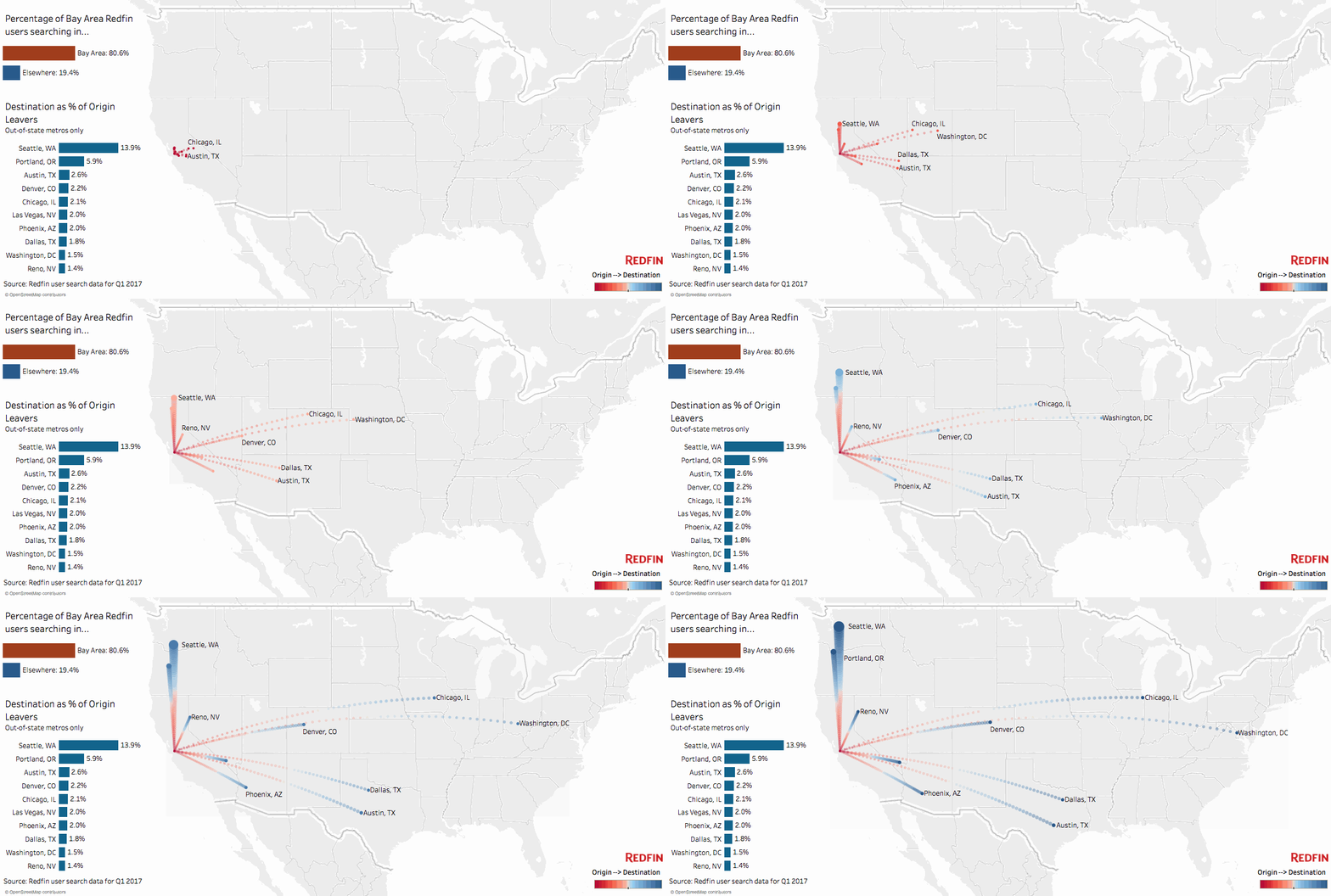
Redfin highlights migration patterns out of California. (Source)
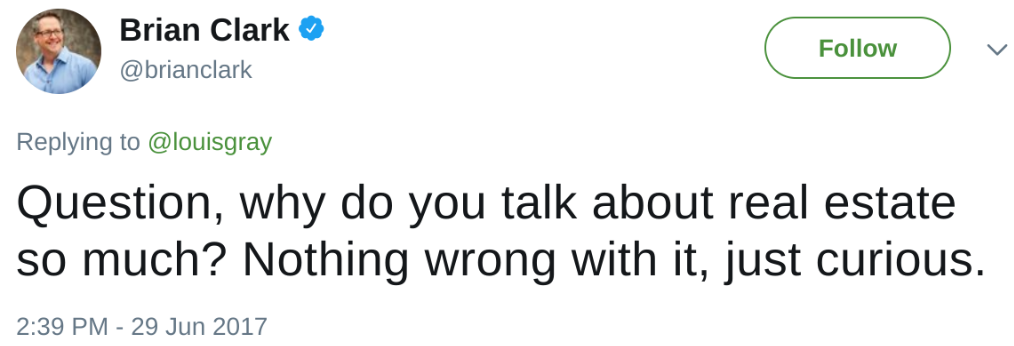
For those who can't stomach a $2 million price or higher (and that includes us, by the way), buyers are looking elsewhere - to Seattle, Boulder, Austin, Portland, or even Washington DC, for alternatives. Seattle's home prices were up 16% in the last year alone, largely driven by migration out of California, which impacted the entire country. And while prices went up, more people were sent to the street - which has led to a spike in homeless deaths in the highest priced cities. (Source)
As I mentioned yesterday, the majority of children in school districts near Facebook headquarters are homeless. This is a new and growing crisis. Low to middle wage earners who can't afford to buy homes here are living in their cars and RVs. I see many of them when I walk the dog at night and recognize familiar faces who are just trying to make it to the next day. Even as Sunnyvale and other cities nearby are raising our minimum wages to $15 an hour, that is not a sustainable wage that can cover high rents that continue to grow. And there is always resistance from NIMBY (Not In My Backyard) neighbors who enjoy the high home values, but want to avoid rising traffic, taller buildings and crowds that come with job demand. Add on to these issues competition from foreign money like China, where many area buyers come from, and you have a recipe for disaster.
Silicon Valley's successes have had incredible impact on the world and the region. Some people have gotten obscenely rich from company successes and acquisitions, and have the option to buy these multi-million dollar homes for cash, or dual income couples with big bank accounts can float enough to solicit high bank loans to get there. But traffic on area streets is consistently thick as people drive further to daily routines. Highways are jammed as badly as Los Angeles - and commutes are worse.
California is where you look to see the future, from our inventions, to our forward thinking governments and social acceptances. The Bay Area is where you look to see what is coming to metropolitan areas throughout the country, and perhaps, the world.
Our high prices today are yours tomorrow, and we're erecting a massive "No Vacancy" sign to those who aren't here yet. Good luck to us all.
January 1, 2018
Silicon Valley's Lost Year Blends Fake With Future
At the beginning of last year, as the Trump presidency sickeningly took hold, I worried his mere presence and daily volleys against what most of us thought to be good and proper, right and just, would dominate our every thought and conversation. His long shadow of darkness constantly loomed against any chance of progress and invention - taking the luster off usual excitement, demanding an unrelenting distraction, and regular dread.
I pushed pause on the blog because I felt like my comments on the day to day in Silicon Valley carried less weight in a world of crisis, as politics overwhelmed the usual storylines. But I realize silence is not the answer. Instead, we should ask more of ourselves when the wind is not at our back, but against us.
So what if we can make cars to drive themselves, only to find our streets hit by long-range missiles? So what if we could make it easier to connect people together on the Internet, all while seeing people turned away at the entrances to our countries, and see laws enacted that pitted people against each other in ways that we found abhorrently racist fifty years ago? So what if somebody could sprinkle some magical Internet dust on cryptocurrency and make a handful of desk jockeys rich (on paper), when trillions of real world dollars were being extracted out of the lower 90 percent of earners from an egregiously unequal tax bill jammed through congress, with chicken scratches in the margins?
It all seems pretty foolish sometimes, as we banter about over variations in cost per click on banner ads when retail supermarkets are going out of business and laying people off. It seems ridiculous that customers can debate the benefits of the latest food delivery startup when US senators openly debate eliminating food stamps for those who need them. And you can't get all that excited about meal replacements like Soylent and the highest tech juice squeezers in all the land when there are people just miles from the most valuable companies in the world who can't afford to both live and eat.
Remember "Everything's Amazing and Nobody's Happy?" Well, not only is the guy telling that story now tainted with his own awful reality, but not only is nobody truly happy, but there's a lot of crap that isn't amazing.
Nearly 60 percent of children in the city of East Palo Alto, buttressing Facebook headquarters in Menlo Park are homeless, victims of skyrocketing housing prices. Families have stuffed themselves into RVs, only to be told to move along, in Mountain View and Palo Alto, home to $3 million average home prices, bordering Google and Stanford. And yet, the big tech companies keep hiring, while Bay Area cities don't even come close to keeping up with the housing demand.
The Uncloaking of the Alt Right and the Me Too Phenomenon
As for those tech workers who have managed to find a way to live here? 2017 was a mess. Along with an emboldened racist and sexist wing in the Valley, with a new hero in the White House, and a self-promoting ex-Google engineer having penned a hateful screed that cast doubt to his colleagues' abilities solely due to their gender at birth, we also managed to get pummeled by regular news alerts to who the latest scumbags were who mistreated women and thought they could forever get away with it.
What a disaster to see people I considered friends in years past - like Robert Scoble and Dave McClure, to find some of their seedy behavior exposed to the world, and know that's just the tip of the iceberg, as others who have made sport of inappropriate behavior a practical part-time job are legion. While I am very glad to see that it seems, finally, women are being believed, and men are admitting they screwed up, it will take generations to see our workplaces truly be welcoming places for everyone - if it is ever to be.
(Time out: What a f---ing disaster Robert's non-apology post turned out to be. I was stunned at how bad it was, when the easiest thing to do would be to admit guilt, admit to being an ass and promise to work on making things right. I was horrified when I saw it...)
Bitcoin - A Bet or a Con?
So what did our best and brightest minds tend themselves to, instead of taking on hard work and pushing back on the vacuous fact deniers running the place? Many of them took to gambling their life savings on shiny internet tokens and watching prices rise like addicted penny stock chasers - making their own lingo, and debating the basis of specific coins, as if there were any real value in it - besides to get rich, and quick! Thanks for nothing, crypto nerds.
I'm old enough to remember the first dot com boom, with its own fake money games - Beenz and Flooz, that made up their own online currencies, only to go bankrupt at the first sign of weakness. At risk of being the last person on the crypto train, spare me the spam messages and emails and tweets, and please, get back to work. There are too many things you could have done with your time that helped the world, like we are supposed to do.
I apologize for my irregular notes here. When the Valley is really humming, and working on important tools and exciting ways to help us all learn, communicate and share, that's exciting. I see those flashes of brilliance, where I am, at Google, more than I tell you. But I worry many of the trends we've seen that reward bad behavior have become so entrenched, that the real value is being absorbed by the funders and the funded, more than the users. We have to share or the backlash will be stronger than we've already seen.
April 21, 2016
Real Valley Stories: The SVP of HR and a Bunch of Lawyers Will See You Now
Editor’s Note: Part 11 in an irregular series of stories from my many years in Silicon Valley. Part 10 talked about the time I left my job for a competitor and rescinded the offer. This time, a story involving industrial espionage, the SVP of HR and way too many lawyers.

If I could show the leads from the lawyers’ lists were gone from our system,
we’d be on a path to redemption.
The day had started innocently enough. I was hosting our company’s public relations firm at the office, as we worked with our product marketing and management teams on interacting with press. At a break, I stepped outside of the conference room and found the longtime senior vice president of HR waiting for me — usually not a good sign.
“Louis, please come into my office,” he said, with a tone that made it obvious this wasn’t really a choice. So I followed.
We entered his office, only to find another man in a suit was waiting. The HR SVP shut the door behind us, and then turned back to me. “Louis, on the date of (whatever it was), did you upload a list of contacts to Salesforce.com from (an account manager)?”
“I Don’t Recall”
I paused. In my marketing role over the last few years, I had used Salesforce.com practically every day. It was our customer contact tool that hit all aspects of our business, from prospecting, to forecasting and demand generation. So it sounded like something I’d do. But I couldn’t tell him yes or no without looking.I heard the words escape my mouth as bluntly as Oliver North in the Iran Contra hearings: “I don’t recall.”
But I promised to check — not knowing exactly what they were expecting to find. Somewhat shaken, but mostly mystified, I opened up Salesforce.com, logged in, did a query, and found I had uploaded a list of contacts into the system on that date. But it didn’t have any significance for me than any other list or date. It was just one of the regular requests I’d gotten from our director of Sales Operations, who often asked me to do the imports or set up reports in the system that she was responsible for, but didn’t completely understand.
So I went back to the SVP of HR, a little more nervous now, and said that yes, I had uploaded the list on that day. So what was going on?
Unwittingly Aiding Corporate Espionage
It turned out that, unbeknownst to me, an account manager acquired a customer list from his previous employer, complete with contacts and titles, and shared it with his inside sales representative — whose job it was to email and call these prospects to sell them our products. The ISR then sent the list to the Director of Sales Ops, who forwarded the request on to me. So while I had been fulfilling a standard request, I was, in effect, aiding what amounted to corporate theft.The SVP of HR was clearly not too excited with me about my role in the upload. But he was more annoyed by the director’s not investigating the source of the list, and her not being in tune enough with Salesforce.com to do the upload herself — not to mention his being beyond furious with the account manager and ISR who had put us in this mess. Unsurprisingly, the suited man in the HR SVP’s office was on the company’s legal team, and our competitor wanted us raked over the coals for the impropriety.
Immediately, on the spot, the account manager responsible for obtaining the list was fired. The ISR, whom I considered a friend, was also fired, knowing what the contacts contained and calling against the list. He packed his personal items into a box, took a very lonely stroll trough the parking lot — and I never saw him again.
Running Queries to Solve the Whole Mess
Now I was back in the HR office. Having somewhat absolved myself, our efforts turned to limiting the damage. The press training boondoggle I’d been working on with the PR team was practically a memory at this point. I told them they could leave whenever they were done as I was busy, but didn’t tell them just why I was now occupied.The HR SVP, and our attorney, wanted to know if I could find all the records that had been uploaded from that list, if I could find out what action had taken place — and if possible, could I remove those records from our company database. Of course, the answer was yes, so long as I knew what questions to ask Salesforce.com.
I started to run the queries, with both him and our attorney looking on. I ran a query showing what Leads had been added to Salesforce.com by my account on that day — and came up with a few hundred. A few clicks on each lead would show if they had been called, or emailed, if any meetings had taken place, and if we had any resulting sales pipeline in our forecast from the illicit list.
I produced reports that showed how many records were in the system, with both he and the attorney taking note of what I found. I was told to take no action on those records, and to be ready to come back into the office at the crack of dawn the next morning to begin the purge.
With Great Data Comes Great Responsibility
After a night to repeatedly think over the previous day’s events, I got up early, dressed much better than normal, grabbed my work laptop and headed back into the office to join the SVP, that same attorney, and surprisingly, about a half dozen more lawyers, who represented the competition, and had been sent to confirm we were in compliance. We entered the boardroom, centered with a long table seemingly carved from a massive cedar tree, and I had the projector all to myself.Whether I could perform the next tasks correctly were central to showing if we were acting in good faith.
My task was clear — explain to everyone in the room what had been uploaded, show how it could be extracted from our main database, and then destroyed forever in a way that was unrecoverable.
After an opening introduction from the HR SVP, I fired up Salesforce.com, ran the same queries as the day before, highlighted the records, and started the purge. As I’d delete 100 records at a time, the attorneys for all sides would mark it. I’d pause for agreement to continue and move to the next set of 100. Soon, the records were out of the main DB, and into the Trash.
Then, with everyone around the table nodding in agreement, I emptied the system’s Trash, so the records were truly gone. Then, the attorneys flipped through hard copy printouts of the offending names and cherrypicked customer data to see if could be found. “Jane Smith of Acme,” they might say. I’d search. No records found. “Evan Jackson of Key Labs?” No records found.
The Salesforce.com database was clean. I was pretty much off the hook — having shown I had the capability to both get us into the mess and get us out of it. But it didn’t mean our company was found without fault. Those prospect companies on the lists were added to a “Do Not Contact” registry that fell across our entire sales organization for at least a year forward, and had us saying no to many different potential sales opportunities as a result.
In the next few years, the SVP of HR left our company and later became the Executive Vice President at a pre-IPO firm that eventually went public and made him undoubted millions. The director of sales operations didn’t last long, finding her role replaced by her predecessor, who was returning to the company — later telling me how stunned he was that personal keepsakes he’d left in his desk drawers remained untouched while he was away. I stayed another five years or so, exceptionally more skeptical now about importing any leads to Salesforce.com from any source that Marketing didn’t explicitly gain ourselves. And that ISR, according to LinkedIn, seems to have recovered and since enjoyed a solid career in sales management.
The experience was not one I had expected to have when taking such an active role with our customer relationship management system, but with great data comes great responsibility. When it came to proving ourselves in a room full of lawyers, we had survived.
January 14, 2016
Listen Different And Learn
For most people, new ideas and perspectives make us uncomfortable. It’s easier and less taxing to surround ourselves with people who agree with our worldview, and reinforce our way of thinking, to make us believe we are correct. We self-select our communities, both in the physical world, and the online space, and these friends or peers become an extension of our own identity.
A byproduct of this selection process is that our communities end up looking a lot like us and behaving like us. Techies follow techies. White guys talk to white guys. Democrats engage with Democrats. While the Internet has a virtually infinite pool of people and ideas to choose from, we easily ignore, unfollow, mute or block those voices and appearances that we don’t identify with or make us question our position.
Ten years ago, I saw this polarization coming, saying the web was dividing in what I called a “bifurcation”:
But I know that’s not good enough. To close ones eyes to the rest of the world means also closing my ears, and my mind. Last May, I was especially struck, and angered, honestly, by how the Silicon Valley community seemed especially blind and silent on the topics of racial bias in our country’s police forces, which sparked unrest in places like Ferguson and Baltimore. While protesters loudly called for improvements in their world that begged for equality, millionaire VCs speculated about unicorn valuations and other techies complained about high rents in San Francisco — which don’t seem all that important in comparison.
Amid this noise and seeming tone-deafness from the public profiles of many active Valley participants, we have an ongoing cry for help and recognition and value from women in tech, who correctly see an uneven playing field that throws roadblocks at their career progress, polluted by landmines of sexism, bias and the good old boy networks — as well as a call for an expanded level attention to increase diversity in all our ranks, with diversity meaning not just women, but people of color (POC).
So over the last year-plus, I’ve actively tried to do a much better job of listening and engaging with people who aren’t like me. And this simple act of listening opens my eyes every day to things I may have missed — while making those topics that I might have previously ignored become critically important to me as an individual.
Twitter Analytics shows my audience is overwhelmingly male. Not a surprise.
As I still love tech, and still identify a geek, my bias and interests remains there, but I’ve aggressively opened my eyes and ears to more women voices and more black voices — especially on Twitter, where the following model is very lightweight, and the stream’s recommendation system smartly brings me new people who I may never have previously discovered.
On Twitter, as of today, I follow just under 600 accounts, including brands. But by no means is my stream a perfect picture of diversity and equality. So I created a list that explicitly expunged all the men and all the brands from my stream — carefully only showing tweets from the 170 or so women I choose to follow, as well as those retweets they found interesting (No Men. No Brands.). And by dipping my toe in this curated stream, the view is remarkably different.
While this may not be rocket science, women don’t always want to talk about what the loudmouthed ego-driven men want to talk about. They bring in topics and conversations that often get otherwise lost in the testosterone flood, and introduce me to even more interesting ideas and initiatives. So when the men annoy me too much, I turn them off by following that list instead.
But as I said above, it’s not enough to count my streams as diverse just because I made a list that follows a bunch of women — because diversity means diversity of thought and backgrounds.
As the conflicts in Ferguson and Baltimore extended to cover alarming incidents in Cleveland, Texas, and so many other places across the country, those leading the social justice movement, like Deray McKesson, Shaun King, and Johnetta Elzie spoke loudly to me, as did others speaking up about inequality everywhere, like Bianca St. Louis, Jacky Alcine, Yukio Strachan and Trilly Stardust. I started adding them, and each new person brought me a new voice. And, unlike the old days, where the lack of a return follow may have felt like personal rejection, I’ve left the ego at the door, and not expected the same. I have to earn my way into the conversation, and can’t just expect a seat at the table.
In July, I saw many in my stream go in euphoria over Drake and Meek Mill.
But most of you missed it.
Now, it’s not uncommon for my Twitter stream to be overwhelmed by updates from women, and people of color. And it’s excellent. The increased diversity of voices and topics means it’s not a monotonous echo chamber, but one that’s vibrant and has me seeing things I would never likely otherwise see.
All of us who participate online, even if we’re not in tech, have a responsibility to keep our eyes, ears and minds open to people who don’t share the same backgrounds, and may not look like or sound like us. But so many times, that’s the trap we fall into. We may not like looking into a mirror, but we are surrounded by our clones.
My colleague and great friend, Rick Klau, also spoke on this issue last summer in his post “My unconsciously biased address book”, where he stated the downside of keeping our world homogeneous:
Without listening, we can’t be learning. If you think you’ve built your networks with blinders, take them down. Cast them aside and rebuild. It’s beautiful over here.
A byproduct of this selection process is that our communities end up looking a lot like us and behaving like us. Techies follow techies. White guys talk to white guys. Democrats engage with Democrats. While the Internet has a virtually infinite pool of people and ideas to choose from, we easily ignore, unfollow, mute or block those voices and appearances that we don’t identify with or make us question our position.
A Divided Web
Ten years ago, I saw this polarization coming, saying the web was dividing in what I called a “bifurcation”:
“It is human nature to seek out a community of peers and equals, of those who yearn for the same things or have parallel experience… (and thus) polarized and wholly separate communities will grow and thrive.” — Feb. 23, 2006As a white male in Silicon Valley for the better part of two decades, my world view is a very specific one. I know that my experiences don’t always match people who don’t look like me, or whose LinkedIn profile looks vastly different. And over the last decade of participating in many different social channels, (Google+, Twitter, Facebook, etc.) my established audience I’ve curated has ended up looking a lot like me. It’s very white. It’s very male. It’s full of people from Silicon Valley, who love tech, and, in most cases, vote Democrat.
But I know that’s not good enough. To close ones eyes to the rest of the world means also closing my ears, and my mind. Last May, I was especially struck, and angered, honestly, by how the Silicon Valley community seemed especially blind and silent on the topics of racial bias in our country’s police forces, which sparked unrest in places like Ferguson and Baltimore. While protesters loudly called for improvements in their world that begged for equality, millionaire VCs speculated about unicorn valuations and other techies complained about high rents in San Francisco — which don’t seem all that important in comparison.
Amid this noise and seeming tone-deafness from the public profiles of many active Valley participants, we have an ongoing cry for help and recognition and value from women in tech, who correctly see an uneven playing field that throws roadblocks at their career progress, polluted by landmines of sexism, bias and the good old boy networks — as well as a call for an expanded level attention to increase diversity in all our ranks, with diversity meaning not just women, but people of color (POC).
Exploring New Streams for New Voices
So over the last year-plus, I’ve actively tried to do a much better job of listening and engaging with people who aren’t like me. And this simple act of listening opens my eyes every day to things I may have missed — while making those topics that I might have previously ignored become critically important to me as an individual.
Twitter Analytics shows my audience is overwhelmingly male. Not a surprise.
As I still love tech, and still identify a geek, my bias and interests remains there, but I’ve aggressively opened my eyes and ears to more women voices and more black voices — especially on Twitter, where the following model is very lightweight, and the stream’s recommendation system smartly brings me new people who I may never have previously discovered.
On Twitter, as of today, I follow just under 600 accounts, including brands. But by no means is my stream a perfect picture of diversity and equality. So I created a list that explicitly expunged all the men and all the brands from my stream — carefully only showing tweets from the 170 or so women I choose to follow, as well as those retweets they found interesting (No Men. No Brands.). And by dipping my toe in this curated stream, the view is remarkably different.
While this may not be rocket science, women don’t always want to talk about what the loudmouthed ego-driven men want to talk about. They bring in topics and conversations that often get otherwise lost in the testosterone flood, and introduce me to even more interesting ideas and initiatives. So when the men annoy me too much, I turn them off by following that list instead.
But as I said above, it’s not enough to count my streams as diverse just because I made a list that follows a bunch of women — because diversity means diversity of thought and backgrounds.
Diversity Doesn’t Just Mean Women
As the conflicts in Ferguson and Baltimore extended to cover alarming incidents in Cleveland, Texas, and so many other places across the country, those leading the social justice movement, like Deray McKesson, Shaun King, and Johnetta Elzie spoke loudly to me, as did others speaking up about inequality everywhere, like Bianca St. Louis, Jacky Alcine, Yukio Strachan and Trilly Stardust. I started adding them, and each new person brought me a new voice. And, unlike the old days, where the lack of a return follow may have felt like personal rejection, I’ve left the ego at the door, and not expected the same. I have to earn my way into the conversation, and can’t just expect a seat at the table.
In July, I saw many in my stream go in euphoria over Drake and Meek Mill.
But most of you missed it.
Now, it’s not uncommon for my Twitter stream to be overwhelmed by updates from women, and people of color. And it’s excellent. The increased diversity of voices and topics means it’s not a monotonous echo chamber, but one that’s vibrant and has me seeing things I would never likely otherwise see.
All of us who participate online, even if we’re not in tech, have a responsibility to keep our eyes, ears and minds open to people who don’t share the same backgrounds, and may not look like or sound like us. But so many times, that’s the trap we fall into. We may not like looking into a mirror, but we are surrounded by our clones.
We Have a Responsibility and Challenge
My colleague and great friend, Rick Klau, also spoke on this issue last summer in his post “My unconsciously biased address book”, where he stated the downside of keeping our world homogeneous:
If the majority of leaders at most companies are men and if the majority of their networks are men (as mine are), then this is a self-perpetuating problem.We have an opportunity to choose our networks. When we unconsciously choose for our network to shut out a segment of people, we are doing a disservice to them and to us — and we extend the issues, which are very real, one generation further, rather than confronting them head-on ourselves.
Without listening, we can’t be learning. If you think you’ve built your networks with blinders, take them down. Cast them aside and rebuild. It’s beautiful over here.
October 13, 2015
Layoffs and Loyalty in a Liquid Valley
Layoffs Are Painful. Even if the X Doesn’t Land on You
(Image: Dreamstime)
(Image: Dreamstime)
In two cases, the startup I worked for ran out of funding, and once, the new VP wanted to change things up, bringing in somebody they previously worked with instead of going with the team they inherited. When it comes to a debate between the company succeeding versus your being comfortable, the CEO will never pick you.
Layoffs initiate feelings of numbness and outrage, fear and self-doubt. People cry at almost every layoff, even if their jobs were spared. Others yell or curse under their breath as they are escorted out of the building, having already handed in their security badges and seeing their work files, along with hundreds or thousands of email threads, no longer relevant, slip from their view.
I’ve seen companies hire armed guards to patrol the building, in case of retaliation, and once arrived at work the morning after a reduction in force to find a brick had been hurled through the HR VP’s office window, making the premises a crime scene.
Layoffs suck. Getting laid off sucks. Seeing coworkers lose their jobs sucks. Laying people off.. sucks. When a company cuts staff, they are admitting something has failed and needs to change. They’re not growing fast enough. Too many people were hired to do not enough things. Something isn’t working. Today, Twitter laid off 336 people. That’s a lot. Not the 30,000 reported layoffs at HP, but a significant number, one that wasn’t supposed to happen at one of the tech industry’s most discussed companies.
In recent months, gallons of digital ink have been spilled on the frothy technology market we see today. Talk of unicorns and skyrocketing Bay Area housing prices focuses a microscope on the top one percent of success, while many on the outside look in wonder why they haven’t joined the vaunted three comma club. Effort and skill aren’t enough. You need luck too.
I’ve been lucky enough (so to speak) to be present at a number of layoff rounds in my near two decades in the Valley. Let’s talk about it. It’s human.
After eight months as an E-commerce analyst at a low-revenue startup during the dotcom heyday, my boss rolled up to my desk in his chair, and in halting English, crowned by his Russian accent, told me the lead investor was done with his little experiment, and we, in two weeks, would no longer have jobs.
His crowning quote: “You and Ferris (my colleague) are laid off. I am fired.”
More: Real Valley Stories: You Stay, Your Boss Has to Go
Somehow I escaped that layoff with my desk intact. I took a different role with the sister company in the same building. While that was unusual, and I put in nearly two solid years at the company, it too fell on hard times.
Our $1 million in seed funding (at a $10 million valuation) was running dry. By the end of 2000, we were asked to work without salary, waiting for a follow-on round that never came.
A few weeks into the new year, my boss, the VP of Marketing, called me into a meeting to say he was laid off. In fact, all of sales, business development, and marketing, myself included, were done. Only the engineers would stay behind to clean up the mess.
I lingered around the full workday, wasting time on the Internet, until a friend flew into the San Francisco Airport, as we were set to go to MacWorld Expo the next day. He helped me lug my PowerMac G4 and monitor to my car, and I was done. The next day we saw Steve Jobs introduce iTunes.
After a brief three weeks out of work, which seemed like an eternity, I landed at a fast-talking hardware storage startup with $30+ million in the bank, en route to a 72 million Series C round that May, which valued us above $300 million. But our gaudy goals, combined with product slips, ruthless competition and a shocked economy after 9/11 meant we just weren’t meeting expectations.
With rumors buzzing in the hallways for weeks, we cut 15–20% of staff on a Friday after Halloween, said goodbye to our crying coworkers, and were battered by a huge reality check. Our charismatic CEO swore up and down in a mandatory all hands meeting that afternoon in the company breakroom that we would never have to experience this again. He was wrong.
Five months later, we had another all hands meeting. But our CEO was missing. In his place, the chairman of the board, who informed us that he, not kidding, was the new CEO and that our previous CEO was visiting family, in Italy.
There was no mob hit, but the following week, we browsed the Active Directory from our Windows machines at the office, and quietly sat shocked as we saw red minus signs on dozens more of our coworkers, whose accounts were immediately made inactive.
I looked up to see two of my best friends in the hard working Inside Sales team grab boxes at their desk, and punched the cubicle wall.
That afternoon, our Marketing Communications Manager, on his honeymoon, called me at my desk to ask about the rumors. I couldn’t tell him that by the time he got back to the office, he’d be without a job. The next Monday, he packed up and joined the ranks of the unemployed.
Having somehow lived through the post 9/11 recession, raising money when we needed it, and delivering a product that just enough customers liked for us to keep the VC checks flowing in, we were on our third CEO, fifth head of marketing, and fourth sales lead. Or something like that. Our stock options had been reverse split twice, first at a 550–1 exchange, and later, 40–1. They were worthless. So there was a lot of grumbling.
Amidst the grumbling, some things were working. The product was starting to find a niche. A few verticals swore by it. And we were able to raise a series AA - a recapitalization that essentially rebooted our financial valuation, and trashed the cap table, wiping out previous investors.
One of the requirements to the raise? Another reduction in force. But this time, instead of sacking the underperforming or most-recently hired, the company excised the bad apples who talked badly about leadership and expected failure.
When their pink slips came, they were happy to get them, and the company was happy to see them go. My old boss, and the IT manager, who closed his own account, literally had tee times set up at the golf course that afternoon, and groused about how long the layoff was taking, so they could make their appointment.
As I pored over the tech newswires, I saw news that our chief competitor,NetApp, had missed earnings, and cut hundreds of jobs. Our newest marketing VP, the sixth to hold the role, had joined us from the NAS storage giant, so during our sales meeting, I tapped her on the shoulder and gave her the news. Her eyebrows shot up. She got up from her laptop, grabbed her phone and went to the hallway to start making calls.
One of those calls was to an ex-colleague of hers who had been impacted. The new marketing VP’s vision? Bring her old friend in as someone she knew, and give me the gift I’d watched play out in front of me many times — the layoff.
By April, I too got pink slipped and was on my own. My running clock of eight and a half years of loyalty got reset to zero.
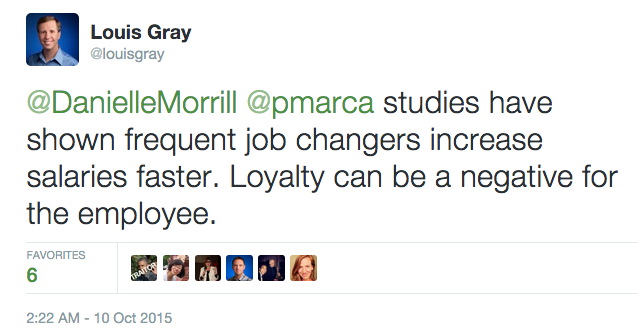
You can lament the frequent job changers,
but the company doesn’t have loyalty to you.
In business, and particularly in the insular, navel gazing, Silicon Valley, it’s easy go Pollyanna and only talk about good news. The billionaires. The parties. The VC funds and App Store rankings. On the flip side, it can be easy to demonize the bad actors or complain about traffic, and the ripples of corporate decisions. But the truth is always in the fuzzy middle.
Loyalty is wonderful when you find a passion and team you can believe in. But it can all be discarded in an instant, through a fight with a manager, or a merger or acquisition that sees you as redundant. A stock market crash. A change in heart. A bad quarter.
Layoffs happen. They can make you question everything you worked for. All the thousands of hours you put in caring about the little things that got you to where you are. All the conversations and debates that made the product you own.
You have to reexamine what’s important and decide on a new trajectory. And it’s okay to take time to both feel and to heal. Being emotional is part of what makes us human, even in a data-driven world being taken over by robots. So yes, it hurts, and you are going to be angry. Furious even. But being laid off in 2015, in an active tech job world is a much different event than in the tighter, pessimistic environments of 2001 and 2008.
Twitter’s job losses today won’t be the last we’ll hear from current and past unicorns. Those who ride the highest, like Icarus, can be burned by the sun.
Disclosures: I work at Google, which is an occasional partner to Twitter, and assumed competitor in some ways. I have friends at Twitter. And any examples I use here related to my previous work experience are intended to be accurate, even if I missed a date or anecdote.
August 31, 2015
Having a Clear Call to Action Can Drive Real Results
As a member of the Google Analytics team, I regularly field questions at events or on our social channels about how online and offline activity can drive results, and what metrics have value. As no two businesses are the same, it's critical to determine the status of your company and find if your activity can bring impact to results that matter, be they clicks, leads, registrations, opportunities or real revenue. When the goals are determined, and you have stakeholder buyin, then you can start your work. (See: Measure What Matters Most)Among the most common questions I see are those around driving visitors to a specific call to action. Most websites have many different routes for visitors to take, and the many choices can be overwhelming. But in some other cases, only one outcome is required, and all efforts should be taken to get the user there.
Nearly 15 years ago, I held a role with the inconspicuous title of eMarketing Manager at a company whose product line was in stealth mode. As we approached the launch date, our small marketing team debated how we were going to handle the first version of our website, and just what our calls to action were going to be.
Most Sites Have Many Calls to Action, Which Distracts Visitors
We knew our product would have a long sales cycle of more than six months, and the average sales price would be north of a hundred thousand dollars per unit. We didn't yet have any customer success stories, and our target markets were an educated guess, based on how we thought the product would perform, and colleagues' experience selling competitive products. We didn't even really have photos of the hardware we expected to sell, as that too was a work in progress.
But what we did have was a launch date, to coincide with the announcement of our product and corresponding news coverage. We had to ship a site with our new company name, and it had to give just enough information to keep people interested, even if we couldn't deliver all the details.
The BlueArc product page in February of 2001 (via Archive.org)
Our Solution: A Single Call to Action from All Pages

Our monthly newsletter, which shipped with my name as the sender for more than eight years, gave us a consistent customer database to talk to for years, and was responsible, in the long run, for prospects, ongoing communication to soft leads, and updating the press and analysts.
This result was from keeping our mission simple. Instead of trying to dazzle visitors with things to download, an array of phone numbers to call, or videos to watch, we just took the casual visitor coming from the New York Times and Wall Street Journal, and gave them the chance to hear from us again, so that when our message was ready for them, we would have that channel in place.
When you know what to measure, driving toward a goal becomes easier. And if you don't, not only are you confused, but so are your users. This is a lesson I learned firsthand a decade and a half ago.
Disclosures: I work at Google on Google Analytics, and worked at BlueArc from 2001-2009.
July 30, 2015
Tech Company Shifts Position Sunnyvale as Major Hub for Next Decade
In Silicon Valley, some of the most prosperous cities and most sought after zip codes to live, raise a family and send kids to school, are directly dependent on the proximity to corporate headquarters of the leading technology companies. As some of the biggest companies are running out of room in their headquarter cities, the resulting demand for continued growth is putting pressure on neighboring communities. Sunnyvale looks like ground zero for this next wave.
Cupertino, home to Apple, the most valuable company on the planet, has a median home price north of $1.7 million dollars, up 15% year over year. Mountain View, home to Google, has a median home price above $1.3 million, up 20% year over year. And these high marks significantly trail the more upscale suburban locales such as Palo Alto ($2.44 million average) and Los Altos ($2.65 million average). Quietly sitting wedged between Mountain View and Cupertino, in a state of tug of war between Apple, Google and more companies, like Yahoo!, LinkedIn and NetApp, is Sunnyvale ($1.28 million average). Sunnyvale has not only seen the fastest increase in average home prices over the last 12 months, but is set up to see even more demand as jobs flow to the city. As a biased Sunnyvale homeowner and area employee, this is very interesting to watch.
As the total land available to new workers entering the area or existing employees looking to leave apartments and find a home near their office stays static, the old rules of supply and demand are taking hold. Sunnyvale home prices are up 23% year over year, at a pace slightly above the surrounding neighborhoods, higher than the aforementioned Cupertino, Palo Alto, Mountain View and Los Altos, but even quicker than Facebook's home, Menlo Park (up 17% y/y), or San Francisco, home to Twitter and many others (up 13% y/y).
So why is this? And who cares? As somebody who has been working in the Valley since the rise and fall of the first dotcom boom in the late 1990s, I've seen ebbs and flows in the economy impact hiring, funding, area traffic and housing prices. Big names that once were major land owners and employers, like Sun Microsystems and SGI, can virtually disappear. But when large companies present stability and prosperity, they can be a magnet for skilled workers. And in the last two years, you have seen major announcements from Valley leaders, like Google, Apple and LinkedIn, announcing new campuses or building into Sunnyvale, as offices in neighboring Mountain View and Cupertino become saturated.
While much press has been spilt over Apple's amazing spaceship campus under construction in Cupertino, what few note is that this work, taking over an older Hewlett Packard lot, is snugly cornered on the border of Sunnyvale city limits, and the company has been snapping up buildings all over the city to manage growth. LinkedIn has been building sparkling new buildings in downtown Sunnyvale and looks poised to move thousands of workers there soon. Google has made headlines as they've taken over buildings from Juniper Networks and even took over nearby Moffet Field.
This expanded pressure from Cupertino on the South border, and Mountain View to the West and North, is pushing Sunnyvale costs and demand upward, much like new mountain ranges are formed under pressure from moving tectonic plates. And this isn't to say that Sunnyvale doesn't already have significant employment hubs of their own. The city's largest employers include Lockheed Martin, Northrop Grumman, Synopsys, Broadcom, Infinera, Nokia, and and many of those I've already mentioned, like NetApp, Juniper and Yahoo!. But the new occupants in the city come armed with significant war chests and momentum, almost certainly strong enough to ward off any turndown in the hot tech economy or an eventual recession.
The stats are Sunnyvale are fairly pedestrian as Bay Area cities go. The last census reported just shy of 150,000 residents, and a workforce of nearly 120,000. The city has adapted to economic shifts, from agriculture to defense to microprocessing through Silicon Valley's first wave, and now, the Internet. With Google bordered to the East by water and marshlands, and Apple by rolling hills of past Highway 280, the growth point is aiming straight at Sunnyvale. Watch this space.
Disclosures: I work at Google, and live in Sunnyvale.
Cupertino, home to Apple, the most valuable company on the planet, has a median home price north of $1.7 million dollars, up 15% year over year. Mountain View, home to Google, has a median home price above $1.3 million, up 20% year over year. And these high marks significantly trail the more upscale suburban locales such as Palo Alto ($2.44 million average) and Los Altos ($2.65 million average). Quietly sitting wedged between Mountain View and Cupertino, in a state of tug of war between Apple, Google and more companies, like Yahoo!, LinkedIn and NetApp, is Sunnyvale ($1.28 million average). Sunnyvale has not only seen the fastest increase in average home prices over the last 12 months, but is set up to see even more demand as jobs flow to the city. As a biased Sunnyvale homeowner and area employee, this is very interesting to watch.
Bay Area Housing Prices: High and Increasing
As the total land available to new workers entering the area or existing employees looking to leave apartments and find a home near their office stays static, the old rules of supply and demand are taking hold. Sunnyvale home prices are up 23% year over year, at a pace slightly above the surrounding neighborhoods, higher than the aforementioned Cupertino, Palo Alto, Mountain View and Los Altos, but even quicker than Facebook's home, Menlo Park (up 17% y/y), or San Francisco, home to Twitter and many others (up 13% y/y).
Sunnyvale's Average Increase Highest Over the Last 12 Months
So why is this? And who cares? As somebody who has been working in the Valley since the rise and fall of the first dotcom boom in the late 1990s, I've seen ebbs and flows in the economy impact hiring, funding, area traffic and housing prices. Big names that once were major land owners and employers, like Sun Microsystems and SGI, can virtually disappear. But when large companies present stability and prosperity, they can be a magnet for skilled workers. And in the last two years, you have seen major announcements from Valley leaders, like Google, Apple and LinkedIn, announcing new campuses or building into Sunnyvale, as offices in neighboring Mountain View and Cupertino become saturated.
While much press has been spilt over Apple's amazing spaceship campus under construction in Cupertino, what few note is that this work, taking over an older Hewlett Packard lot, is snugly cornered on the border of Sunnyvale city limits, and the company has been snapping up buildings all over the city to manage growth. LinkedIn has been building sparkling new buildings in downtown Sunnyvale and looks poised to move thousands of workers there soon. Google has made headlines as they've taken over buildings from Juniper Networks and even took over nearby Moffet Field.
This expanded pressure from Cupertino on the South border, and Mountain View to the West and North, is pushing Sunnyvale costs and demand upward, much like new mountain ranges are formed under pressure from moving tectonic plates. And this isn't to say that Sunnyvale doesn't already have significant employment hubs of their own. The city's largest employers include Lockheed Martin, Northrop Grumman, Synopsys, Broadcom, Infinera, Nokia, and and many of those I've already mentioned, like NetApp, Juniper and Yahoo!. But the new occupants in the city come armed with significant war chests and momentum, almost certainly strong enough to ward off any turndown in the hot tech economy or an eventual recession.
The stats are Sunnyvale are fairly pedestrian as Bay Area cities go. The last census reported just shy of 150,000 residents, and a workforce of nearly 120,000. The city has adapted to economic shifts, from agriculture to defense to microprocessing through Silicon Valley's first wave, and now, the Internet. With Google bordered to the East by water and marshlands, and Apple by rolling hills of past Highway 280, the growth point is aiming straight at Sunnyvale. Watch this space.
Disclosures: I work at Google, and live in Sunnyvale.
May 14, 2015
Preaching to Our Choirs and Setting Up Blinders for All Else
Just about four years ago, Eli Pariser raised some very real flags about the "filter bubble", concerned that many of us on the Web were limiting our viewpoints by following those people and companies with whom we were most aligned. Our personal positions on politics, sports, and yes, even technology, have us in a constant state of affirmation seeking, and the desire to be part of a group of like-minded people, to reinforce our position and strengthen our decided upon beliefs, that we just might be right. And should somebody in our streams disagree with us, or launch into an off topic rant, we can easily unfollow them, and "clean up" the channel.At the time, thanks to tools like my6sense, where I was an advisor, and later VP of marketing, I said the filter bubble was "not bad" as options were always there to see new voices. While my6sense may not have been a massive consumer success, it was amazingly smart tool that solved the problem for me. But in the ensuing time, it's become even more clear that people, through constant following and unfollowing on our many social networks, are growingly subscribed to homogenous streams, and the content creators, be they bloggers, Tweeters, photographers or anything else, are limiting the subjects they discuss, to continue feeding the faithful.
As someone who gained a following talking about tech, new tools and communities, I've staked my position on the Web as an early adopter, a cloud proponent, a measurement advocate, and engaged social media participant. I have a pretty good idea of what topics will resonate with my audiences on the various streams, and what won't. I know that my discussing items outside of my bubble are seen as noise to those who have chosen to follow me, and they vote with their engagement, or lack of it.
More than nine years ago, shockingly, I saw this coming, when I talked about a Web divided, where people who espoused a certain view would flock toward an extreme community and not be interested in the opposite view. But it goes beyond picking a side in a discussion. What's happened is that people set up blinders to avoid discussion of anything else - including the content creators themselves.
There's a lesser-used feature in TweetDeck, which enables you to view a Twitter stream through the eyes of another user, surfacing public tweets from accounts they follow. During the Baltimore riots, while a huge portion of Twitter's audience was living through the accounts through the news media, or sharing their experiences about race and police, the Silicon Valley tech bubble largely stayed silent, as if there were two different worlds that didn't connect. I could log in to TweetDeck and pick any prominent voice in tech and see that, in their streams, there was no talk of Baltimore. Or race. Or Ferguson. While people marched in the streets, and dodged rocks or tear gas, the digerati continued to talk about who was raising money, the quality of pitch decks, or complaints about housing prices in San Francisco.
My tweets about Baltimore arresting police offers or links to why the situation exploded in the first place went unnoticed - while the streams continued to debate the future of wearables or the latest entrant into Unicorn status as a billion dollar startup. It was more than an echo chamber. It was a wind tunnel. And my daily journey into Feedly seemed to be no different than any other time. The same articles were written by the same people, about the same things. The same headlines begging you to click were thrown out there, only to be reshared and retweeted in a rush for page views.
Oh. I see you're tweeting about something that's not tech.
Maybe we've grown fatigued of outrage. Maybe there have been enough dramas and disasters and disappointments that we just don't react publicly. But I think there's more to it. We have been taught, thanks to our constant focus on engagement and numbers, that we have to speak to a niche. VCs talk to VCs. Engineers talk to Engineers. Startups talk about being a startup. We're becoming afraid of expressing a position that may cause a debate. We're refusing to talk about things that are uncomfortable, and we're closing our eyes to people who don't always care about the things we do. And I think that's dangerous. It sets us up to further carve out our cliques and become closed minded.
I mildly apologize for the irregular posts here of late. But part of the reason, beyond being busy, or focused on other things, is I don't want to be more of the same. The world is a vibrant tapestry, not monochrome, and I don't want to be the thirty-second person to talk about the same things everyone else is. We should embrace a world focused on curiosity, not compliance.
November 25, 2014
You Can't Achieve Equality by Expecting Everyone to be the Same
There's not much a fairly privileged white guy who hails from the suburbs can say about diversity or racism without being questioned. Compared to many other people who don't hail from WASP backgrounds, most of my challenges are pretty easy. I don't come into life fighting against a biased expectation of who I am or what I'm capable of. I don't immediately find that people assume I'm not smart enough, or honest enough, or trusted enough to participate in their workplace and their communities. Things are remarkably comfortable.Speaking up or talking about hard issues like racial bias or diversity, or calling for attentiton to inherent problems, makes it possible I'll misspeak and say something quotable where I don't want it. It's instead much easier to sit quiet and let other people fight their battles - to watch big conflicts and flareups remotely, trivializing someone else's experience, as something that's not happening here. But even in the 'burbs, and in our corporate offices, there are issues. We may not see unarmed men shot 12 times and killed in our hallways, but there are opportunities to bring down or build up our peers daily, and most of us aren't doing much to aid their quiet struggles.
Earlier this month, one of my best friends, +Erica Joy, who works with me here at +Google, talked about how bias has worked against her, as a black woman, in a predominantly white and east Asian world. Her piece "The Other Side of Diversity" removes the abstract anonymity of company statistics and tells you the direct reality of what it's like as someone who walks into a position where people may have already made their mind up about you, where your mere presence may make them uncomfortable, and where artificial limits are put on your potential.
Lunch With +Erica Joy in 2013 #throughglass
(And she'll hate that I shared this photo...)
I've known Erica for about seven years, and have been colleagues with her for the last three plus. She's the kind of person who I've always felt free to open up to and tell her just about anything. She's clever, insightful and hilarious - if you take the opportunity to know her. She's also especially thoughtful. She can be a sharp critic when our products don't work well, and she can push back on me if I say something daft that needs revision or clarification. And yet I know not everyone is open to finding out her personality, and as she spells out in her piece, as well as the follow-on "No Solution", her professional career (and personal no doubt) has been impacted, multiple times, by the shortsightedness of others.
While I may comfortably sit on the side where I don't have to fight for inclusion, it's incredibly frustrating to see this happen time and again, whether people are strong enough, like Erica, to speak up about it, or they remain in silence. For no matter how you carve up the numbers being shared from our workplaces, we have some obvious gaps in our nurturing, recruiting, hiring and retention practices - which extend a gulf in our representation of women and minorities in tech. This is a systemic issue at all levels, and while I know companies (including mine) honestly are working hard to improve things, the day to day realities can't be glossed over with an expectation of prettier futures.
Sometimes when Erica and I get together, we joke about seeing if we can hit a quota of spotting more people like her (namely black women) on campus - like the proverbial unicorn. If we can find two more (not including her) over a standard lunch visit, we've done pretty well. Sometimes, depending where we walk or where we're eating, we see more. Other times, none, as streams of geeky white guys (like me), and assorted people from all other directions walk by.
But it shouldn't be a numbers game. One shouldn't have to try and play "Where's Waldo?" to find peers who share their same background. One shouldn't have to try and mask their identity to be included, or assimilate as to not draw attention. As I read Erica's first post pre-publishing, as a friendly editor, what struck me the most from her experience was one of her last bullet points:
"I feel like I’ve lost my entire cultural identity in effort to be part of the culture I’ve spent the majority of the last decade in." -- "The Other Side of Diversity"If you have to change who you are to fit into the culture, maybe it's the culture that needs changing. I've been lucky enough, even as a dumb white guy from the burbs, to have had some experiences in fairly open communities. I'm glad I attended UC Berkeley, which was even more diverse when I attended school there in the late 1990s than it is now, and for all its continued challenges, I believe Google has its heart in the right place to empower people from all different backgrounds, and is working on it from multiple directions. While my neighborhood isn't the picture of diversity, I've always followed and engaged with stimulating people online, no matter their racial makeup.
As a numbers exercise, I did a quick count a week-plus ago of those whom I'm connected to online. Of the 246 people I'm mutual friends with on Facebook, for example, only eight are black. That's 3.5%. If I edit the count to remove immediate family members, or colleagues, to only include friends I've hand selected as acquaintances, that goes up to 4.5%, ahead of the Santa Clara County percentage of 2.9%, but behind the California percentage of 6.6% and the national census of 13.5% or so who self identify as black. And really, what constitutes a good number anyway? I can't look at my social networks, pick a few dozen black avatars, add them to my circles and call it a day. There's no seal of approval that clarifies whether I'm part of the problem or part of the solution.
The Ferguson incident and its ongoing echoes has the topic of race back in the headlines again. And eventually our short attention spans will migrate on to some other hot issue of the day, while the family and community suffers permanent scarring. But for many of our friends and peers, this is not a one day, one week, one summer type of challenge - but a lifetime.
We can abstract the Valley's diversity issues into sets of percents, charts and graphs, and cite our efforts with dollars spent or scholarships awarded, but whatever we do, we have to keep pushing and it starts with a recognition that something is broken, and we need to be aware of it. We need to encourage people who run into these trials daily to speak up, and to please be themselves. We are better because of our differences.
October 14, 2014
What If We Redid the 2000 .Com Monopoly Edition for Today's Web?
In the year 2000, as the .com bubble was at its peak, it seemed new tech names were going to rapidly eclipse the old guard. Emails and downloads were new conversation topics, and if you weren’t still on AOL, debates would ensue over which ISP you should choose, or which search engine or portal was the best. Sun was the dot in .com and Linux seemed poised to take over the desktop. Obviously, not everything turned out that way, even if some of the names are still around, and even strong.
The 2000 .Com Monopoly Board
One of the fun collectibles that came out of this time was a .com edition of Parker Brothers’ Monopoly. Instead of properties around Atlantic City streets, you had websites. Community Chest and Chance were replaced with Email and Download cards. And you couldn’t buy property for a few hundred bucks, as everything was in the millions of dollars. Not too soon after the game came out (and of course, I still have it), the .com market was decimated, as the companies of the future weren’t built for the present. Now the game board itself looks like a relic of a short-lived era gone by.
The 2000 List of Companies and Categories
As something of a lark, and thought exercise, let’s consider who would take these 2000 era companies’ spots on the board. I’ll go first with my take on today’s cast of characters.
Dark Purple
2000 .com Monopoly edition: Sportsline.com and FoxSports
Commentary: Back in 2000, ESPN, as part of Disney, didn’t have a great approach at owning its web presence. It was part of the Go.com family, one reason it missed the original .com board. Now, ESPN represents sports on all media. Deadspin is an exceptional alternative with sharp commentary that is a must read for serious sports fans. (Apologies to SB Nation)
Light Blue
Commentary: The 2000 edition definitely had a bent toward community. With iVillage and Oxygen, two of the three properties were focused on women. GeoCities didn’t age well and was retired. Pinterest, SnapChat and WhatsApp have become some of the fastest growing communities for pretty much all ages and both genders.
Light Purple
2000 .com Monopoly edition: Shockwave.com, Games.com and E! Online
Commentary: Shockwave? Really. Let’s move on. For fun entertainment and burning hours of Web surfing, TMZ, Buzzfeed and Reddit can’t be beat. Reddit is a tough one to categorize, as it calls itself the Web’s front page, but it’s knocked off Digg, Slashdot and others for that title.
Orange
Commentary: eBay could easily be a repeat in 2000 and 2014. Priceline and Expedia are still doing fine. But Square and PayPal are how the Web does business these days, while Yelp is often the place to go for recommendations on what to buy or where to go.
Red
2000 .com Monopoly edition: The Weather Channel, About.com and CNET
Commentary: About.com looks like a content farm, and while CNET’s still alive and kicking, there’s been nothing to talk about since its CBS acquisition. The Weather Channel? Please. There’s an app for that. And more than just finding content sites, anybody can create and share content globally with apps like Instagram, sites like Tumblr and share it on Dropbox. (Apologies to WordPress, Box and others)
Yellow
2000 .com Monopoly edition: eTrade, Monster.com and Marketwatch
Commentary: Monster.com and eTrade were monsters in 2000. I still use eTrade regularly, but they’re not known for their monkey-centric Super Bowl ads any more. Marketwatch is a snooze. Now, people get their financial and business data from each other via LinkedIn, in real time on Twitter, and check its veracity on Wikipedia. (Apologies to Seeking Alpha and StockTwits).
Green
2000 .com Monopoly edition: Ask Jeeves, Alta Vista and Lycos
Commentary: In 2000, Search engines took the entire final row of the Monopoly board. But the positions of Alta Vista, Lycos and Ask Jeeves weren’t strong against innovators that got stronger in the next decade. Now, diverse infrastructure plays like Microsoft, Amazon and Apple (for many reasons each) occupy this highly valuable section of the board.
Dark Blue
2000 .com Monopoly edition: Excite@Home and Yahoo!
Commentary: That Yahoo! was the Boardwalk of 2000 is telling. Excite@Home was a $6.7 billion megamerger in 1999, but by 2001 was pretty much in steep decline. Without intending too much bias toward my current employer, Google and Facebook are the 1-2 when it comes to the Web today, from the top destinations to hours spent, tools deployed, etc - and both play a role in discovery for everyone.
Railroads/Stations
2000 .com Monopoly edition: Nokia, MCI Worldcom, Sprint and AT&T
Commentary: Worldcom? Whoops. Nokia? Whoops. Things change, and companies don’t always adapt quickly. The megalopoly of AT&T is now most like Comcast’s ISP/cable monolith, and Verizon (including their FIOS offering) is the big carrier to be dealt with. Fighting the good fight, and using a ton of bandwidth in the process are Netflix and YouTube, which are essential media mediums on every device.
Utilities
2000 .com Monopoly edition: Linux and Sun Microsystems
2014 .com Monopoly edition: WiFi and Cloud
Commentary: We’re still waiting for the year of the Linux desktop, and Sun is now somewhere in Oracle’s beautiful campus. But while you could take a stab at a language or a platform, like Python, Ruby on Rails, or even PHP, generically its best said that the storing of data and access to that data are the true utilities of 2014. Pervasive WiFi (or 3G/4G) and Cloud power every app and every site.
Summary: The Web is dramatically larger, and more global, now than it was less than two decades ago. This admittedly English-first version of the .com Monopoly for 2014 misses out on the international communities like Baidu, AliBaba and others. There’s no place for the Uber and Lyft rivalry, and while Tumblr was included, it’s hard to put Yahoo! on the board, which probably isn’t 100% fair. I wanted to find a spot for Spotify and Hulu, but failed. I’d be ecstatic to see if Parker Brothers was up for another run at the web centric board, and you know I’d buy it.
Disclosures: I work at Google, which is a customer, partner and competitor with many of the names on this board. Putting them on a Monopoly board is not an opening for the company (or any other on the board) being a monopoly joke.