Silicon Valley Technology Commentary & Archives · Est. 2006 3,045 Posts · 2006–2026
Showing posts with label eMail (48 posts). Show all posts

September 4, 2014

September 4, 2014 · 5 MIN READ · BY LOUIS GRAY

Striving for Streams of Serendipity or Inbox Zero?

Striving for Streams of Serendipity or Inbox Zero?

Nobody really likes spam - those unrequested commercial emails that join your email box. They interrupt you, distract you, mislead you, or maybe worse - trick you into giving up your money or personal information. And over time, most email services have been pretty good at determining just what is spam, and what's not, while we, as consumers, are getting better at refining just what content we want on all our screens, be it our email box, or our social streams.

With this experience, what we've labeled as spam now not only encompasses the obvious scam message, but practically anything that enters our view that we didn't explicitly ask for, or surprises us. Most of us living in a social media powered world have taken a lot of effort to refine our content sources, to the right sets of blogs, and the right friend groups on social networks. When we log in to Twitter, Facebook, Google+ or anywhere else, we pretty much know what we're going to get.

Many of these social networks, dating back to the first blogs, are sorted chronologically, with the newest content at the top. With some effort, you can quickly scan to where you last left off, and feel complete. There's no more to read, and you can move on to the next thing. It's a permuation of the famed "In Box Zero", which says your task is complete.

But increasingly, thanks to pressure to fill streams of less active users, or to increase engagement from regular users, it's become more commonplace to push content that's not explicitly requested into user streams. This can be "Friend of a Friend" content, like we saw back in early 2008 when FriendFeed first introduced the feature, or more recently, items that your friends on Twitter have retweeted or favorited, that Google+ friends have +1'd or Facebook friends have Liked.


It's assumed the more signals given to the network about what your friends like, the more likely it is that this piece of content is also relevant to you. It's not necessarily wrong, but it's a change, unwelcome to people who like to perfectly curate their streams - while possibly exciting to those who do want to take signals from the network - believing they aren't the one perfect arbiter on whether an item is interesting or not.

In 2008, FriendFeed spoke to this change, saying, "Our goal is to make the most interesting shared items more prominent so your FriendFeed has a higher percentage of interesting stuff and active discussions." And it worked. If I believed +Paul Buchheit had high quality interactions, I could be alerted to items on the stream that he had liked. But FriendFeed also gave me the option to turn it off, and many people did.

In 2014, Twitter is a lot bigger than FriendFeed was six years ago. It's a world-recognized stream for real time communication, so their moves get a lot of attention. Every minor change in the stream is especially scrutinized. After already taking for granted the fact that retweets from friends would be sent to my stream, the occasional tweet now appears, simply because someone I follow added it to their favorites. Unsurprisingly, this experiment, which is easy to spot on their mobile app, set the tech blog debates abuzz again - trying to figure out how it worked, and whether it was good or bad.


It's widely assumed putting content in user streams benefits the service provider. Twitter should see higher engagement, higher relevance and more clicks. For the OCD "In box zero" types, these serendipitous pieces disrupt their worldview, and, unsurprisingly, those who write about tech and social media all day are more likely to be of this type than the general population.

When +Barak Hachamov and I were working on my6sense, we were more than happy to rank social streams based on your activity and implicit interests. The solution, in my view, hasn't seen an equal, even in the three plus years it's been gone from consumer's hands. We offered a stream based on relevance, with your interests playing a huge role, a toggle to view the stream chronologically, and yes, we promised occasional serendipity to deliver surprise - to get you out of a knowledge rut, which can come from seeing the same topics debated and shared by like minded thinkers.
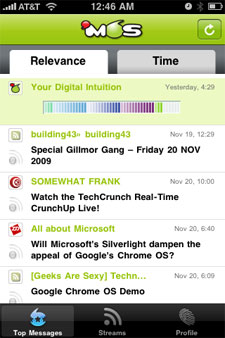
Relevance vs Time in my6sense

What we've learned from the Web is that we tend to gravitate to people who reinforce our own views and agree with us. Debate happens, but we don't actively seek out opinions from those with opposing takes on political, religious or even sports. (I wrote about this in 2006: Blogging Bifurcation - A Web Divided) The Web, despite being especially diverse, leads to us forming cliques, with friends, with what we read, and where we choose to congregate. Our three social pillars are what I called out back in 2009: Technology, Community, Relevancy. Most of us active in social streams have bought into the technology, and crafted our community, assuming the community's thoughts are themselves relevant. And by seeing new content, we immediately question its relevance.

For the 95%+ of people who haven't put hundreds of hours into scanning their streams to never miss a post, and who haven't taken time to set up lists, form circles, or fully understand Facebook sharing settings, the serendipity of surprise is as important as what they've explicitly asked for. While those of us on the tech edges react to the surprise with shock, we should know this is something we give in exchange for participation in somebody else's stream. The only thing I'd ask is that, like FriendFeed, we always have the option to please, kindly, be able to turn something off. Then we'll all be happy.

Standard Disclosures: I work on the Google Analytics team at Google, which provides Google+. Various services from Google partner with or can be assumed to compete with products from Twitter and Facebook. Also, from 2009 to 2011, I had a consulting relationship with my6sense as part of my work with Paladin Advisors Group. Disclosures are fun.

August 15, 2013

August 15, 2013 · 4 MIN READ · BY LOUIS GRAY

Real Valley Stories: Emailing the Company About Future Layoffs

Real Valley Stories: Emailing the Company About Future Layoffs

Editor's Note: Part 9 in an irregular series of stories from my 15 years in Silicon Valley. Part 8 talked about how I determined I was undervalued at work, and started a process to catch up. This time, another real example from the trenches, about how I once prematurely notified the entire company layoffs were coming - and the effort to undo that mistake.

After the dot-com crash and subsequent recession in the early part of the last decade, many venture-backed companies, including my own, were fighting to stay relevant and alive in a suddenly more challenging environment, where customers were exceptionally risk-averse, going with what the vendors they knew and not the ones they didn't yet know. With this challenging landscape as a backdrop, one of the storylines that emerged was not so much one of thriving, but simply survival - and if there was an opportunity to get positive press simply for sticking it out, even if we weren't hitting on all cylinders, it was one we'd go for.

At that time, in early 2002, one of the roles I held for the company in marketing was internal communications. As we gained customer wins, case studies, press releases and press mentions, it was typical for me to take the story and send it to one of our many Exchange distribution lists to the company so we could  all share in the good news. I'd add a one-paragraph intro, send it off and watch the backslapping and replies come in. Sometimes, I didn't even have to do a lot of the work, but I always got some of the credit.

One morning, my news alerts on the company turned up an interview our CEO had done with the Wall Street Journal. I'd known the story was coming, and as I read it, the CEO talked about how we had scaled back our goals from our original unrealistic expectations, had tightened our budgets and had even been forced to do some staff reductions. That last part seemed odd to me, as we hadn't done any reduction in force, but seemed to make sense, as two of our senior vice presidents, one in product marketing and one in sales, had left the previous month.

Wait... You're Saying I've Been Sacked?

As with all our news bites, I copied the text in full, excerpted the relevant quote and emailed it to the company, positioning the news as our showing strength in a tough economy. This bit of work done, I then went to the next task at hand, where my desk voicemail was lit, showing I had a message. I listened, with some horror, as it was a message from my boss, having been left earlier in the day, saying specifically, "Louis, don't send the Wall Street Journal story to the company," which I had, of course, just done.

I stopped what I was doing, and sheepishly made my way to his office, not only ready for a verbal dressdown, but also curious why this piece was so particularly volatile. I knocked on his door and told him what had happened.

"Goddamnit, Louis," he snapped. "You have to recall that message, immediately..." along with a few other choice words, saying that the very first thing I should be doing every day is checking my voicemail and I should have known better.

Attempting to recall the message from the few-hundred person company wasn't perfect, as you can imagine. Those who had already seen the story hit their Outlook inboxes wondered why I'd recall a story from a paper as impactful as the Journal, which only further raised suspicion about what the CEO had said, or I had relayed. My own inbox filled with each individual recall success or failure, and needless to say, I was in my boss' doghouse for the remainder of the day, if not a bit longer.

Two days later, the layoffs preannounced in the Journal came true. That Friday, Silicon Valley's traditional day for eliminating positions, welcomed us with moving boxes and practically every conference room booked for a series of brief one on ones. There was frustration for some, tears for others, and relief for those who probably wanted out. More than one person came by my desk, knowing then what we had figured out earlier in the week, that the layoffs made the Wall Street Journal before they had even taken place, and the CEO had so matter of factly mentioned it, in a national publication.

For months afterward, as you can imagine, the very first thing I did when I got to the office each day, before email or grabbing a Diet Coke even, was checking my voice mails. I became even more careful as I shared news and announcements with our internal mail lists, to avoid anything that could possibly be interpreted as bad news, or an executive saying something he shouldn't. And yes, we had future rounds of layoffs, as the company cut itself practically in half before growing again to surpass its original peak, eventually filing for IPO, twice, and getting acquired.

Telling the Wall Street Journal about planned layoffs before the people impacted were told was bad. Sending news about that layoff to the very people who were going to lose their jobs was bad too. I never made that mistake again.

April 30, 2012

April 30, 2012 · 3 MIN READ · BY LOUIS GRAY

The "Archive" Button Can be Your In Box's Best Friend

The "Archive" Button Can be Your In Box's Best Friend

You practically can't open your RSS reader or spend a day on a social network of your choice without running into complaints about email. Nobody likes it. Everybody says they have too much of it. People gloat over mass deletions of unread items, or sporting a full in box four or five figures deep. Some people take vacations from it or swear they'll pound through their to-read list in what could be an eventually futile journey toward the improbable in box zero. But for many of those people, it's likely the impenetrable in box is symptomatic of something else - the inability to make a decision the email requires, or the option to escape a discussion and call it complete.

When I joined Google last fall, I anticipated my corporate in box exploding. A notorious information-driven company with cool words in the lexicon such as "centithread", I imagined finally crossing over from my "I'll get to every single message, I promise," mentality, to accepting defeat. But this hasn't been the case. As I had before I joined, the email box has been no bigger a challenge than handling one's updates in Google Reader, or seeing all mentions on Google+ and Twitter.

This is helped by having a practical "always on" schedule, enabling messages to be consumed or responded to from the nearest Android phone or tablet, and the laptop is practically another limb, but the best tool for making sure I don't get lost in a torrent of email, beyond discretion in consuming tangential mailing lists, is the "Archive" button in Gmail.
The "Archive" button is pretty straight forward. If you have determined that an email message or its resulting thread no longer needs any action from you, and shouldn't take in box attention, you just hit the button and it is moved out of your in box. It's not deleted outright, meaning the thread can pop back up again if a new message arrives, and it's still discoverable in search, so you don't have to worry about being able to find it again if you change your mind later.

About 18 months ago, I talked about how one has to hone their stream in what is being perceived as an "attention" crisis, and that the onus is on us to read fast, process fast and decide fast what requires action and what does not. Information overload can be overcome with filtering what you take in, and where you participate. When to archive threads and when to extend threads requires that same level of precision. Guess rightly and you are able to get the right information to the right people at the right time with the smallest amount of effort. Guess wrongly and you could find yourself distracted by off-topic content and miss the important information amid a sea of comparable noise.

If you're a Gmail user, you probably know Google bumped up its storage capacity to more than 10 gigabytes apiece, so the issue of how you manage your email is less about can you store it all, because you probably can, but if you can manage it all. Using the archive button well is a key part of email in box survival.

Disclosures: I work at Google, and naturally, I use Gmail at home and at work.

June 2, 2011

June 2, 2011 · 4 MIN READ · BY LOUIS GRAY

Apple's Missed Identity Play: "Sign In With Apple"

Apple's Missed Identity Play: "Sign In With Apple"

One of the greatest tug of wars amidst leading Web companies today is that for ownership of your identity, through your personal profile, or pushing you to "Sign in with" their credentials. You may sign in with Twitter, Facebook, Google or OpenID, and enable those services to certify it's you. One of the most successful tech companies out there who never comes up in this conversation is Apple, and it's incredible to think how easily they could have converted its army of Mac loyalists (myself included) to "Sign in With Mac", carrying the Apple flag forward as a badge of honor. More than a decade after getting my .Mac e-mail account (and later signing up my wife to do the same), I am splitting my email activity fifty-fifty with GMail and haven't gained much reason on Apple's side to double down on Cupertino.

When Steve Jobs unveiled iTools at MacWorld San Francisco in 2000, one of the primary offerings of the then-free product was an e-mail address ending in Mac.com. Fresh off success with the 1998 launch of iMac, and still a year away from the debut of the iPod, the company still had its most loyal followers "Thinking Different", and sending people messages with my Mac.com account was cool. It told everybody who would get a note from me that I had chosen Apple. Even when I would have to spell out my e-mail address on the phone, I'd always tell people... "M.A.C. As in Macintosh" in case it wasn't obvious.


Steve Jobs Introducing iTools (MWSF 2000)


But for a variety of reasons, the Mac.com address wasn't especially capitalized on. The service, initially free of charge, controversially converted to an annual paid service by 2002, alongside tools such as iDisk and .Mac home pages, and later rebranded as MobileMe in mid-2008, pushing people even further away from the allegiance with Apple but instead to theoretically more personal Me.com address.

When Apple initially made the move away from free Mac.com addresses for all, the message was that the free mail service was being abused, which no doubt cost them money and headaches - on top of costs for iDisk storage. But of course it also decimated the potential audience of users, most of whom already had free email accounts from somewhere else, be it Hotmail, Yahoo, Netscape or their ISP. Using a Mac.com account almost seems like an artifact unless you're a clear Apple loyalist.

In parallel, while Apple put MobileMe/iTools/Mac.com/whatever on the backburner, the company experienced incredible success with the iTunes ecosystem. Every iTunes customer has an Apple ID (or signs in with AOL), and has trusted Apple with their credit card details, as iTunes expanded from its initial offering of music to music videos, TV shows, movies, books, and of course, mobile applications for iPhone, iPod Touch and iPad. So Apple's effectively sitting on one of the most actively spending user databases in the world, but one that isn't leveraged elsewhere on the Web. There's no "Sign in With Apple" on major sites like the New York Times or CNN. There's no "Sign in With Apple" on Amazon.com or eBay.
iTunes Knows My Apple ID, but the Rest of the Web Doesn't

The fight for identity relevance between the major players of the Web, including Facebook, Google, Twitter, LinkedIn and others is critical, especially as signing in with one's identity brings additional privileges. Signing in with Facebook brings you your social graph and their history as you find what articles are popular. Signing in with Google is starting to bear fruit with their +1 initiative, but it's early days. Signing in with Twitter gives you the option to follow people on downstream sites if they have Twitter @Anywhere installed. But Apple's not playing in a place where they absolutely could have an impact.

Much has been made of Apple's perceived struggles when it comes to Web services. Those of us who have been watching Apple seemingly forever recall the false start of iReviews, where people could review Web sites on the Internet, the aborted launch of iCards for greeting cards through iTools, the lukewarm approach to .Mac Home pages, and the constant renaming of the email service. This is by no means discounting their fantastic success in hardware and some software, but they could be my identity. I, and many others like me, at one time and even today, want to tell the world we are Mac people, and we could sign in with Apple. But we aren't.

With iCloud to be presented at WWDC this next week, we're moving even further away from the naming of .Mac and what it meant to be a Mac person, especially if this product suite gets its fourth name in a decade or so. No doubt they'll keep shipping some great stuff, but even we Mac people are going to sign in with somebody else all around the Web.

April 5, 2011

April 5, 2011 · 3 MIN READ · BY LOUIS GRAY

Did You Know All Your Emails Were In One Basket?

Did You Know All Your Emails Were In One Basket?


Prior to this weekend, most of your thoughts around the word Epsilon were probably about Greek fraternities or toga parties, but headlines in the tech and security world over the last few days have us instead associating Epsilon with a company most of probably never heard of before - a massive email marketing company used by many top brands. A major security breach seems to have escorted customer email lists from respected companies many of us interact with every day, and with the names piling up, I have to wonder if we had any idea that this centralization of our relationships with companies was happening, or if we are all the unlucky benefactors of outsourcing gone wrong.

The fun started late Saturday when I first got an email from TiVo saying my email address and first name had been exposed due to unauthorized access to their email service provider.

Of course, if you know me, that's no big deal. Everybody and every spider in the world knows my main email addresses are louisgray@mac.com and louisgray@gmail.com. Tough finding that out and combining it with my mysterious first name. You know I don't have too many issues around sharing my cell phone number either - this being a key focal point of a CNN.com article on the "death of privacy" back in December.

The String of Notification Emails

Modern anti-spam measures from both Apple and Google prevent most garbage from missing my in box. For more insidious emails, that fraudulently pretend to be something they are not, which is made possible from this breach, I am wary enough not to do anything foolish.

But, as many others soon found, the first notification of a breach was followed by a second, a third, a fourth, maybe more. The next two days saw more apologetic emails following the breach, from Best Buy, Hilton Hotels and Chase Bank, to name a few. The issue reminds me a bit of the Gawker hack in December that forced people to change their passwords everywhere, myself included. So now what's exposed is not just my email address and first name, but that many companies passed the buck by putting their customer lists in the hands of a single third party who wasn't prepared for such a responsibility.

(Of course, this single third party shrugged it off as impacting a 2 percent subset of their clients)

In the 8+ years I managed our company newsletter and mailing list, from 2001 to 2009, we used a variety of partners, including Responsys and GotMarketing. Later, we put our data into Salesforce.com, and never once suffered such a breach. But in the last few years, companies have gained the ability to self-manage one's database and marketing tools, and do so independent of other companies. There's no great reason that a single third party's mistake should open up the vault to such a bonanza of brands. What this specific failure does is expose that the type of multiple verification systems and complexity expected from us as consumers isn't followed quite as well at the very companies whom we trust to watch over our personal data.

I don't have any problem with putting my email address out there. I don't mind sharing my data with TiVo and Best Buy. I shrug at Hilton and have to trust Chase, or we're toast. But I have to think we're lucky this time that the type of data accessed was so relatively harmless. People are worried that this will lead to phishing attacks and later successful breaches that get more impactful information, but for now, it seems we'll be more annoyed than ever. But think about whether you knew that all of these companies were putting your data in one basket to be raided by one intelligent hacker...

Does knowing that all these brands stuck your data in one place make you feel less safe or more safe? I think we've got to have an alternative, and self-hosting with self-managed security is looking a lot smarter these days.

March 15, 2011

March 15, 2011 · 2 MIN READ · BY LOUIS GRAY

Your App Is Not Complete Until You Can Tweet from It

Your App Is Not Complete Until You Can Tweet from It

One of the famous mantras around Web services and communication apps is that no service or application is truly complete until it offers private messaging or email. Users practically expect they need to connect one to one or one to many if they are given unique IDs, part of why you can find, outside of your traditional mail systems, ways to email one another on places like LinkedIn, Quora, Twitter, Facebook, FriendFeed and countless other networks, creating a practically endless supply of in boxes that need to be checked.

In that vein, I'd venture that there's some truth to a new extension of that phrase for 2011 and beyond - that no application is complete until you can tweet from it.

Two years ago, as Twitter's ecosystem was finding its legs, the fact that a game would offer users the option to tweet a high score was in itself news. Unsurprisingly, one of the first comments on that post was simply, "Looks like a great way to get people to stop following you..." But since that time, it seems most iPhone and Android games offer the chance to share scores via Twitter. eReaders let you tweet what page you are in for the book you are reading, and music streaming services give you the option to tweet out tracks or artist pages.

With Twitter's update to the official Mac desktop app, a contextual menu option which comes up with every right-click or Control Click is "Tweet". Tweet the words you have highlighted on the screen. Tweet the Web page you are viewing. Tweet tweet tweet. Tweet the YouTube video you just watched. Tweet the Flickr photo you viewed. Tweet the blog post you just wrote. Tweet tweet tweet.

So how much is too much? So far, it doesn't seem like there's really a limit to what is tweetable and what's not. I told the developer of a business card indexing app that he should let users tweet when their jobs start and complete, for example saying, "I just indexed 200 business cards at businessURL.net!". After all, if customers want to share your message, you should make it easier.

Now we have inanimate objects tweeting. Scales tweet your weight. Shoes tweet how far you ran or how many calories you burned at the gym. Location apps tweet everything under the sun, including who you're with and where you are. If an application exists, it can tweet. Unsurprisingly, even this post will automatically get tweeted, and you can tweet it.

Fight the 140 character limit or not, but Twitter is an ecosystem for people, services and bots. If Twitter is to be a channel of your lifestream that shares what you're doing in your life, than all the services you interact with will get a piece of your profile and your stream. If you're developing an app, before you hit publish or ship, think... does it tweet? If it doesn't tweet, maybe you're not done.

April 25, 2010

April 25, 2010 · 3 MIN READ · BY LOUIS GRAY

Steve Jobs: Apple's One Man Social Media Machine

Steve Jobs: Apple's One Man Social Media Machine

In a time when the company's core business has grown to record highs, with its iPhone business, flanked by Mac sales, iTunes store revenue, software and peripherals all contributing to Apple's strongest position of all time, the company has practically opted out of the trendy move most of its peers have embraced - social media. There are no official Apple blogs, and with the exception of its iTunes Music property, there is little to see from Apple on Twitter and Facebook.

This has not impacted the company negatively, as it gets plenty of press from the Mac faithful and increasingly curious mainstream media, but in the last few months, a surprising trend has emerged - as the company's cofounder and CEO, Steve Jobs, has taken on a much more active role in responding to customers one to one from his personal e-mail account, reducing the barriers needed for end users to engage with one of the most influential people in the world. In effect, Jobs' usually quick one-liner e-mails are providing the same results many have championed with social media - access to customers, rapid response times, and providing a human face to a business.

Steve's attention to detail, and most would argue, control, over Apple's efforts is legendary. While Apple's media events have recently seen an increased number of executives speaking on behalf of the company, it is still Steve who starts things off, wraps things up, and orchestrates the process in between. Rank and file Apple employees, like those who would manage the company's social media properties, if they were active, are not blessed with the option to speak on behalf of the company, and those who make even the most minor of mistakes are at risk for termination.

Thus, there is a vacuum for official Apple news between company press releases and events. As the company has gained a higher profile with its iPad introduction, regular iPhone upgrades, and constant introductions at the iTunes store, users and developers with questions are increasingly turning to ask Steve directly about company plans, policies or even to send off notes of frustration. And he's answering. Not all of them, no doubt, and not often with significant length, but one doesn't need 1,000 words from Steve when 10 or 50 will suffice. These nuggets seem to be a big shift from Cupertino, historically tight-lipped and non-responsive to rumors or other inquiries, and it will be very interesting to see if this move is a fad, which fades quickly, or if Steve can scale as it becomes more widely known that you can reach him by simply lobbing an e-mail.

While this one man social media experiment exists, you can see Steve responding:There are many more, but the pace is rapidly increasing, especially now that Jobs has his iPad at home. Maybe it's the environment he wanted to fire off one-line e-mails to customers, or just him getting more smooth as he ages, but it's become a highly effective press channel that doesn't need Mossberg and Goldman and others to interpret what he says as he can go directly to those who care - and I don't know of any similar high profile tech CEOs who are making themselves as accessible as Steve is in this way. Is Eric Schmidt responding to e-mail? Is Mark Zuckerberg? Ev Williams (@ev) occasionally posts replies on Twitter, but not to the types of questions Steve is fielding. I just hope Steve has found his comfort zone, and that this can be something that continues, so we don't see Apple as an impenetrable silo, but one that talks back, even if it's still through one unique individual.

February 28, 2010

February 28, 2010 · 2 MIN READ · BY LOUIS GRAY

Beware the BCC: Copying Can Make Us All Blind

Beware the BCC: Copying Can Make Us All Blind

Assuming E-mail is the original social network, this Web 1.0 tool continues to have a large role in how we communicate and share ideas. With the exception of the clear GMail/Buzz integration or the recent Outlook/LinkedIn tie-up, for the most part, e-mail has not been dramatically revamped to take advantage of today's faster-moving, highly featured social networks. But despite e-mail's longevity, some basic attributes of the form continue to cause trouble between contacts who haven't mastered their core functionality. One of the most troublesome, the infrequently used, but often abused, BCC.

With BCC, the recipient doesn't know all who got the message.

As you no doubt know, BCC stands for "Blind Carbon Copy", providing a way to send e-mails to people without revealing their e-mail addresses. This can be an aid for mass mailings without exposure, but also used to be sure an individual gets a note without the direct recipient's knowledge.

For every blow-up around poorly-trained marketeers who copy their entire customer base, or PR flacks who display all the intended reporters by dumping their contacts database in the TO or CC field, you have quieter mistakes that happen when the intended recipient who thought they were having a private conversation sees a third party jump into the discussion without warning. As the intended public recipient sees the third party elbow their way into the conversation, they may lose trust in the original sender, and wonder what other messages were being shared.

Often, those BCC'd blow the cover of the messages' routing.

Some e-mail clients (such as a BlackBerry) will automatically make it clear to the recipient that they were BCC'd on a conversation, which hints they should not reply all. But not all people are as discerning and recognize their role in the world of BCC to be a silent observer. I know that when I get a BCC message that any reply I provide goes to the originator and not to the others in the thread.

Given my goal to be public about communication, my own use of BCC is extremely infrequent. Due to the potential issues that can arise as trust is perceived to be broken, I tend to follow up a BCC note to the individual saying "You were BCC'd. Make sure not to reply."

If you are someone who tends to BCC individuals as a normal course of business, I have no doubts that you can get caught by this process. Not all recipients watch the To and CC fields closely, and they may expose your willingness to overshare. With so many other ways to have private conversations 1-1, and the ease of which forwarding prior conversations via e-mail can occur, it makes sense to get above board, and preserve the BCC option for simply obscuring mass mailings.

February 9, 2010

February 9, 2010 · 4 MIN READ · BY LOUIS GRAY

Google's Buzz Brings Social Sharing, Aggregation to GMail

Google's Buzz Brings Social Sharing, Aggregation to GMail

Google's growth from its roots as a spartan, but highly effective, search engine has been as transformative as the changes the Web itself has seen over the last decade-plus. As the Web has evolved to include more rich media and social connectors, so too has Google evolved, as the company now operates not just the most popular data discovery engine but also some of the Web's most popular data creation and sharing engines, including Gmail and YouTube. But the company, so far, has struggled a bit in connecting its wide array of properties and making them feel personal and social. Today, with the launch of Google Buzz, the company aims to change that, making Gmail, and its sister sites, including Google.com and Google Maps, new places to share information of all types, with your friends.

Google Buzz is more than just another status updater. The world has seen plenty of those already. What Buzz aims to do is help Gmail users share content with connected friends, extending the popular messaging platform further from its roots, to a high quality multi-media social experience. And lest anybody fear that Buzz has Twitter in its sights, Twitter is supported from day one, so your updates can feed into Buzz and be part of the conversation.

Google Buzz Connects You to Friends and Followers


Starting today, all Gmail users can see the Buzz icon just below their Inbox. Clicking the Buzz icon places you in a familiar-looking aggregator, where you are immediately connected to those people you e-mail and chat with the most frequently in Gmail, giving you an instant start to a new social network. Within Buzz, you can share text, or more importantly, videos, photos and links - taking the product beyond Twitter and into FriendFeed territory. (Now also Facebook territory)

Add Social Services to Buzz


For veteran FriendFeeders, the look and feel of Buzz is an extremely familiar one. Every Buzz entry features the option to comment or like it, and shared items can be toggled from public to private, meaning Google can start indexing the shares into its search engine, or ignore them outright.

At launch, Buzz supports a few major services, including Google Reader, Flickr, Picasa and Twitter. Unlike many other aggregators we have covered in the last few years, Buzz isn't looking to pull in all links from dozens of different social sites, but instead, aims to make the act of sharing more commonplace for the mainstream.

Photos Shared On Buzz With Likes, Comments


Some of Buzz's main attributes include the product's attention to detail. Photos shared in Buzz are very high quality and can be viewed quickly. YouTube video shares play in line, and interestingly, links that are shared as status updates give the option to share any images from the page, much like FriendFeed's bookmarklet - only without the need for the user to install any JavaScript code on the browser.

Recommended Content from Buzz From a Friend of a Friend


Additionally, thanks to Buzz being partnered with Gmail, the e-mail in box is hardly the second cousin to the social experience, as it is with many other networks. Rather than simply being a repository for follower notifications and daily summaries, Buzz messages in your in box are live conversations, which are updated in real time with comments from friends as they flow in. You can get notifications to your in box when there are comments on your items, when others comment in conversations where you have been active, and when people send conversations to you through an @Reply feature, which autocompletes in Gmail.

In a conversation I had with the team behind Buzz on Monday at Google's headquarters, the developers said they focused on five major elements of Buzz:

1. Auto following, which prevents you from starting a network by scratch.
2. A rich and fast sharing experience.
3. Public and private sharing to mark individual posts or global settings.
4. Inbox integration.
5. Just the good stuff.

So what is the good stuff? Google wants to avoid the problems that have befallen other networks, which can be overrun with irrelevant, nonsensical updates, often from people you don't know. Buzz looks to surface content from those best connected to you, and will lower the visibility of inactive items. More active items, receiving comments, will bump to the top while others sink.
Embedded YouTube In Google Buzz Plays In Line


At the end of 2009, I aired my thoughts about how aggregation has thus far failed to set the world ablaze, with sites like FriendFeed, Cliqset, Arktan and others yielding comparatively lower user numbers than more simplified offerings. One of the major reasons for this, in my opinion, has been the need for a dedicated, or new, social network to follow. An advantage Buzz has in this case is that many millions of people are already using Gmail for their e-mail and many more use the company's contacts, maps, RSS reader and search software.

Buzz is a first major step in making Google more social, and setting up ways for users to share their external content with friends. It's not looking to kill other services, but to make these services available in a new place.

January 28, 2010

January 28, 2010 · 3 MIN READ · BY LOUIS GRAY

Google's Mac Mail Uploader Taunts Would-Be GMailers

Google's Mac Mail Uploader Taunts Would-Be GMailers

Tonight, I thought I saw the final missing piece fall into place that would let me take my gigabytes and gigabytes of e-mail off my hard drive and put them in the cloud, setting the stage for a long-discussed, but never fully implemented, move from my decade-old Mac.com e-mail address to a more Web savvy GMail account. An update on Google's Mac Blog introduced a new software option that promises to take all your Mail files from your personal computer, and take them to Google Apps. A free utility, the quick download looked like it was going to get me one step closer to a Web-centric experience, moving to the cloud. But it looks like I am still on the outside looking in, even though the product's release is extremely promising for an eventual solution.

More than two years ago, I talked about the potential attraction of GMail to corporate users who have long been tethered to the world of Microsoft. I said that Importing PST Files, or e-mail archives common to Microsoft Outlook, could be GMail's secret weapon. In the ensuing years, tools have been made to help upload e-mail from Windows, and to migrate Web mail to Google e-mail accounts. But tonight's announcement was the first for Mac users, who, despite the many synergies between Apple and Google, often find themselves last served, behind Windows and Linux users, by the Mountain View company.

101,000 messages to upload over 28 hours. Do it!

So, of course, I downloaded the application immediately. Without any configuration on my end, it found my Mail.app e-mail and the correct hierarchy, looking to move more than 100,000 messages I've been hoarding since the mid 1990s to the cloud, with appropriate labeling. The expected move time for these 100,000 messages? Almost 30 hours. But at least it was something.

Unfortunately, as many good things tend to have, there was a catch. The e-mail uploader "currently can upload only to Google Apps email accounts, and not to gmail.com or googlemail.com accounts", so the planned migration, once again, seems to be on hold.

Curses! No upload to GMail! Can I hack this?

Given the wording of the post, the author, Greg Robbins, seems highly aware of the issue, having called it out, and the word "currently" is promising that a solution may soon arrive. But until that time, I will continue to keep using my Mac.com e-mail and storing my data locally. For me, the archives are almost as important, and in some cases, more important, than my most recent data. If I could upload my 100,000+ e-mail messages, with appropriate labeling, to GMail and have the search functionality and all other great items offered in GMail, I would have started the process tonight, but the restriction to Google Apps keeps us on the outside looking in, still.

The promise of the move is tempting enough to open up a new Google Apps account, but I'm not interested in further forking my e-mail experience with more and more accounts to check. It's already a challenge to get work e-mail with multiple clients, and my various online accounts. I have been wanting a real Mac-friendly E-mail uploader to GMail since shortly after its debut, and almost six years after GMail shocked the world with its invention, I still don't have it. So Greg, I know you want what I want, so how can we make this happen?

November 16, 2009

November 16, 2009 · 3 MIN READ · BY LOUIS GRAY

Streams May Impact E-mail, But Won't Kill It Any Time Soon

Streams May Impact E-mail, But Won't Kill It Any Time Soon

As trendy as it can be at times to say that the new social "activity streams" are set to be the future of our communications, including most social networks and the nascent Google Wave, it is clear that e-mail has some serious life ahead of it. While many can complain about the growth of e-mail messages, the replacement of actual messages from people with simple notifications by robots, and a march toward "In Box Zero", this form of transmission is not going to be deleted for the foreseeable future, even if it morphs to adopt more social functionality. In an intriguing discussion at last week's Defrag conference, it was suggested e-mail could tap into the social networks, and that the most adept e-mail users would have advantages over those less savvy, but nobody called for its death. In an attention-grabbing blogosphere, that's a rare thing indeed.

Tim Young of Socialcast, reflecting on the move to activity streams in many of those networks we inhabit, echoed a belief of mine, saying that as information consumers, access to more data is key to our continued growth and adaptation to a changing world. He even took a second step to say that our ability to adapt quickly will promote the best discovery artists to the head of the pack.

"Information foraging is core to our human psychology," Young said. "It is the energy source for our minds. We hunt and gather for information to understand and adapt to our world. Natural selection favors organisms with the best food foraging strategies. In the future, natural selection will favor people and enterprises with the best information foraging strategies."

For the last two decades, one of the most frequent methods for finding information and distributing outward has been e-mail. E-mail, like blogging, is well known for offering the function of rich communications and longer-length missives, not restricted by the limits often found through mobile phone usage, Twitter and other sites. Unsurprisingly, a good number of e-mails are made to be sent to multiple recipients as well.

Alexander Moore of Baydin reported in a study of more than 250,000 e-mail messages (via Enron) and nearly half a million tweets, that 42 percent of e-mails are multi-recipient, contrasted with only 6 percent of tweets being for multiple recipients, but he did say our immersion in the social Web had shown signs of affecting the way we send messages.

"We are conditioned from using Web 2.0 services," he said. "E-mail is moving toward shorter messages due to the rise of mobile phones. E-mail is going to be around for a while, but there are things we can learn form Twitter, Facebook and social media."

The conference's panelists largely agreed that e-mail needed improvements, much like an evolution instead of a revolution. Michael Cerda of cc:Betty said "E-mail is on its last leg, but that leg is going to be for a long time," adding he preferred an e-mail box full of grouped conversations instead of individual messages. In parallel, Matt Brezina of Xobni, said he thought e-mail could be made more social through exposing relationships that live in e-mail, possibly even sharing attachments and e-mails with an extended social graph.

Brezina said that Xobni was formed as a plug-in to Outlook instead of an Outlook replacement as "people hate changing their workflows," saying his product "generates more e-mail happiness" and increased worker productivity. Similarly, Cerda asked to "waken up the data and bring it to life". One way to do this, as Moore recommended, was to make feedback on e-mail more public. Why not add a "like" button to e-mail as there is in Facebook, to give the sender credit, when most feedback on e-mail today is private?

The day's panelists looked to a future that keeps e-mail around, but starts to see the integration of more social activity, borrowing from the world of social. The medium is not limited in the same way that many social networks are, but its sheer age and its occasional overwhelming nature has people asking what's next. One of the major reasons it hasn't gone away? As Moore said, it is "rich in content, rich in conversation and rich in control". Nearly 9 of every 10 e-mails is 140 characters or more.

October 1, 2009

October 1, 2009 · 5 MIN READ · BY LOUIS GRAY

Google Wave Hits Shore. Flash Flood Warning In Effect.

Google Wave Hits Shore. Flash Flood Warning In Effect.

As you already know, Google released a waterfall of 100,000 invites to the Google Wave preview over the last day or so, giving bleeding-edge early adopter and information addicts a new playground to exchange conversations in real time. After months of hibernation and anticipation, Wave's arrival has everyone's tongues wagging, as we all get an early look into Google's plans to redefine messaging, delivering a real-time platform that includes rich media and extensibility through gadgets.

Since Wave's introduction earlier this year, I have seen a number of differing ways the product has been described. From a new development platform to a suite for business collaboration or an (insert popular social service name here) killer, the guesses have ranged far and wide. Interestingly, however, in an interview with the Wall Street Journal, Lars Rasmussen defined Wave as "a modern version of e-mail", adding that e-mail is "an old-fashioned technology". So it makes the most sense, at this point, to look at the Google Wave preview as a potential replacement or enhancement to today's e-mail systems, notably GMail.

Having received an invite to Google Wave via Denton Gentry, a Google employee who is also a frequent commenter here on this blog, I jumped into the Wave fray late last night, and found the system to be extremely stable and much faster than anticipated. For a "preview" release, Wave is very good, especially considering the complexity that is involved.


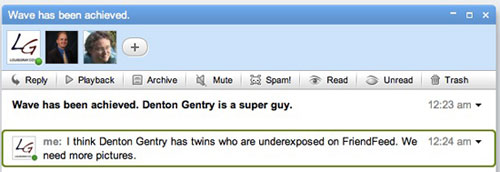
My first "wave" seemed simple enough.

Google Wave takes on traditional e-mail systems and incorporates chat-like or instant messaging technology all in one. Instead of a typical "I send you a message, you receive it and you reply" type of exchange, Wave encapsulates conversations between people and shows real-time responses in line, more like threaded comments than individual messages. If you and I are having a conversation in Wave, you see me type out my responses, typos and all, as I pound out a reply. To respond to my note, just click below the last message and extend the thread.


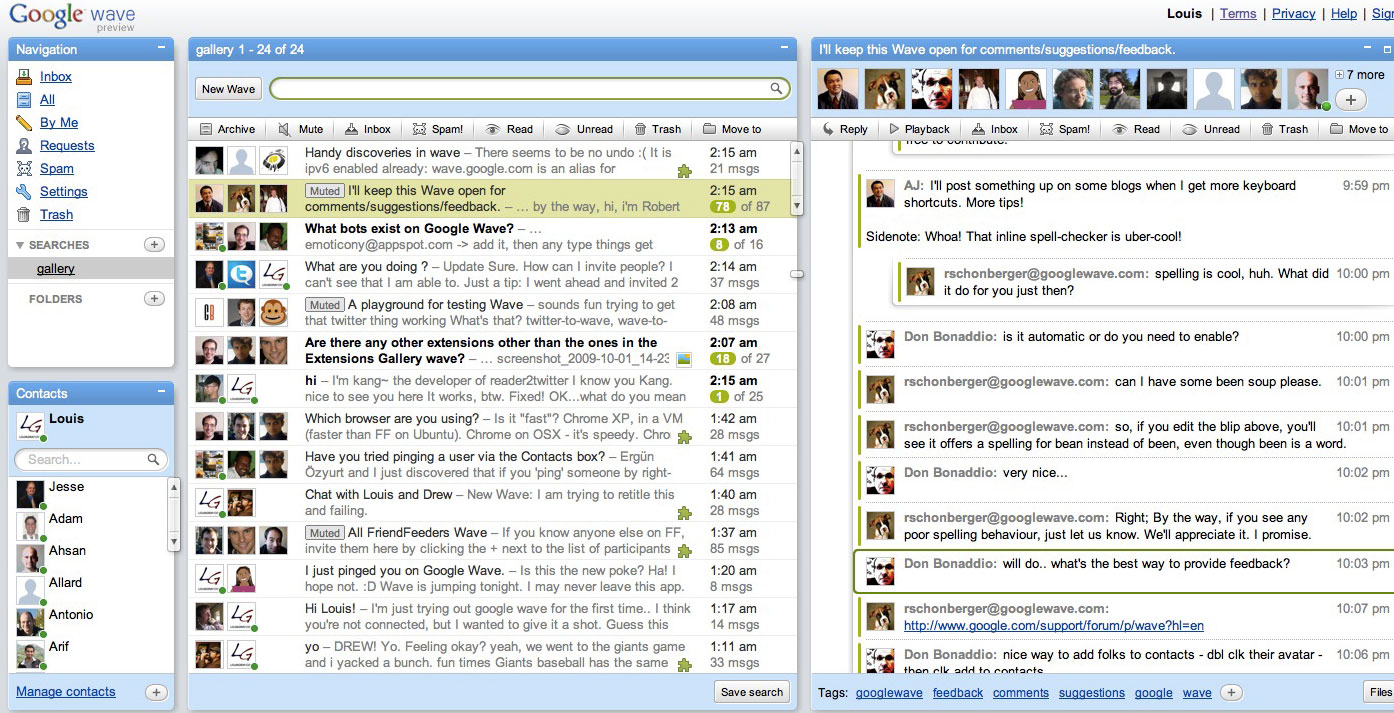
Almost immediately, my Wave filled up with conversation.

(Click for full-size image)

As this specific "wave" (lower case) is being updated, new waves can pop into our in boxes from anyone. Like traditional e-mail, if anybody has your address, you can be copied on a note. But Wave enables anyone to add contacts from their address book to any thread at any time. So while you may initiate one conversation, you could be dragged into another one that already has 60 entries. The good news is that Wave has a "Playback" button which enables you to watch the conversation occur, in the order it was entered, but the bad news is if you are in enough active threads, the act of watching each one can be time consuming.

Like most early discussions around new services, the vast majority of conversations are actually about the service. Just like FriendFeed-related items get liked more item on FriendFeed, and Twitter-related tweets get retweeted, last night's Wave swarm was full of conversations all about Wave. Does it work? Where are the gadgets? Who doesn't have invites, but needs them?


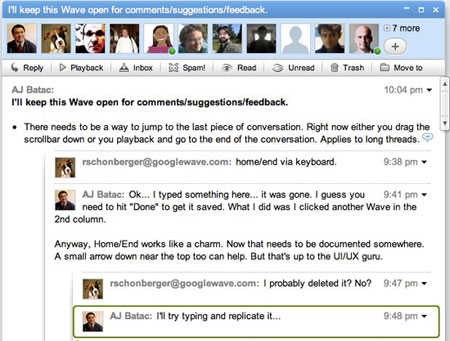
One active wave shows participants and nested comments.

Because of the real-time nature of Wave, I quickly found that if I engaged in one wave (lower case) and gained replies in another, the other contact might feel that I had "left" that thread. Since I can't yet be in two places at once, the real-time aspect was more like when you have multiple chat windows open in Google Chat or Facebook Chat than if you had more than one e-mail message. So staying on top of all active waves can be a tremendous challenge - one that practically promises to keep you embedded in the application until every single message is muted and all your contacts go do something else (which may never happen).

The instantaneous nature of Wave immediately makes other assumed "fast" programs seem slow. For example, adding comments to FriendFeed for a live conversation now seems slow, as it requires the entire message to be completed before being posted. In comparison, in Wave, I see you type it immediately, and can actually formulate a response as you're writing.

Google Wave, as should be no surprise, is integrated with Search. You can insert videos discovered on YouTube and photos from Picasa or other services into Wave, and make them part of any conversations. You can play back YouTube videos below text, or post new videos to those you're talking to.

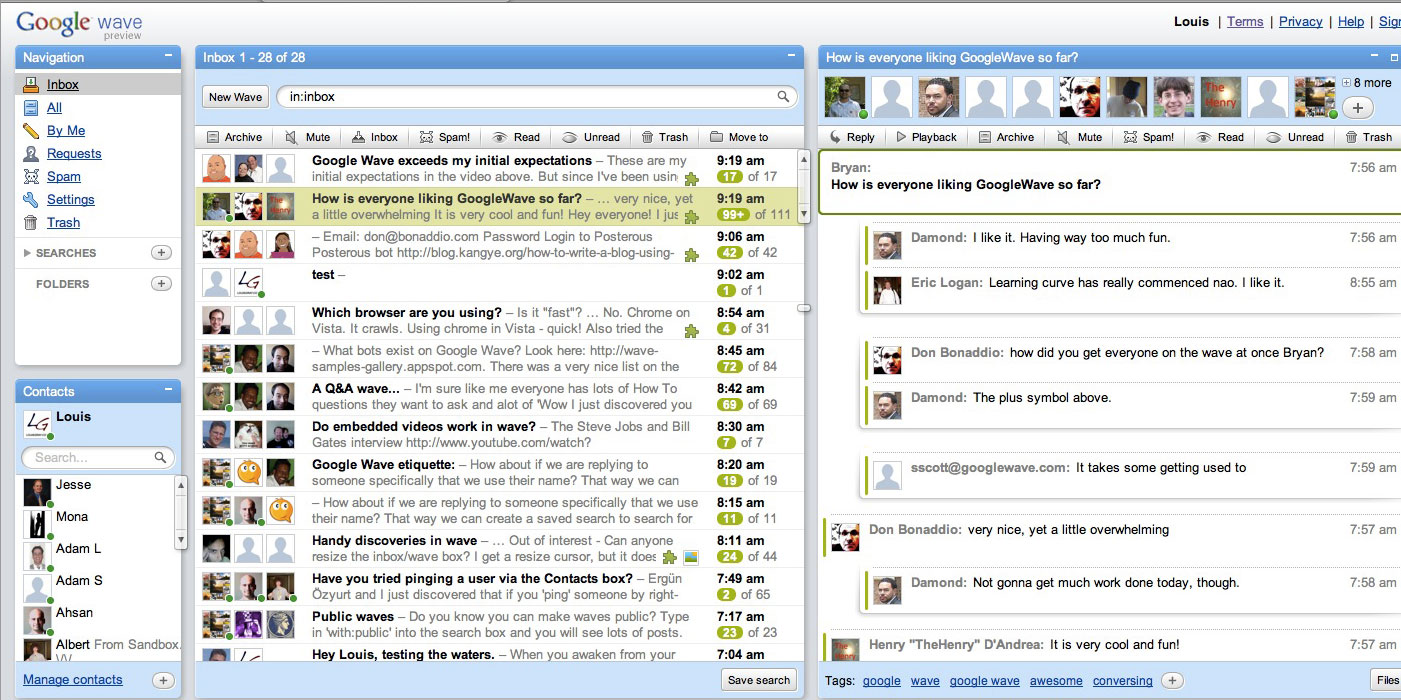
But yes, as you are watching a video, more waves are crashing into your in box. While you may not get the feeling that you have hundreds of unread messages, as you do with traditional e-mail, every single wave conversation shows how many new entries have been made since you last viewed the thread. Every single wave can have dozens of new entries, depending on the number of contacts and conversation that is there.


A typical Wave "In Box" after a night's activity.

(Click for full-size image)

Meanwhile, until Google Wave is integrated into GMail or other Google services, checking your Wave becomes yet another place to go so you're not missing conversations directed your way. So for somebody like me, who has a personal e-mail address, a work e-mail address, a GMail address, and e-mail addresses for company clients, Wave is yet another inbox and place to go to check in. And the new address (louisgray@googlewave.com) is another place for people to send me things.

I can see how small teams may use Wave for real-time collaboration. Its nature offers an opportunity to further eliminate distance and improve information exchanges. The ability to add people on the fly to conversations is very interesting, as is the ability to ping somebody and have a 1-1 conversation in the middle of any wave, or in a dedicated side exchange. I expect the company is set to debut more widgets to further extend the platform, both bringing content into Wave and content out from Wave. For example, last night, Jesse Stay and I had an exchange where he added a Twitter gadget, but thanks to something I would consider a security bug, I was able to send a tweet on his behalf because I was engaged in the thread. (See the tweet I made here)

Wave, like many Google products, also supports keyboard shortcuts to aid in navigation. I hopefully hit J to go down and K to go back (like I do constantly in Google Reader), but found it is the space bar that you hit to go step by step. Wave is an extremely interesting platform, and I would bet that after the initial surge of curiosity, normal conversations and information exchange will eventually take over, so this initial spike may be an exception rather than the new rule. But if you're diving into this new technology, expect do be exerting a lot of energy to stay on top of it, because messaging just got accelerated.

Also see: Scobleizer: Google Wave Crashes on Beach of Overhype