Showing posts with label Technology (370 posts). Show all posts

November 17, 2018

Technology Designed to Help You Breathe More Easily

Technology Designed to Help You Breathe More Easily


Silicon Valley has been the leader in many things for decades, but rarely has the region's first place position been for something as undesirable as air quality. Following the record-setting disaster that has wiped out my one-time hometown of Paradise, Bay Area residents are choking on the resulting downwind smoke, seeking answers as to how unsafe it is, and how they can gain relief. And while I know that a week-plus of uncomfortable air is hardly the worst outcome of these climate change fueled infernos, it's something that needs to be addressed.
After last year's record-breaking California fire season that saw unthinkable damage burn through Napa county, I expected we would have bad air days this summer. Planning ahead, I bought two sleeves of N95 air filter masks from Amazon and stowed them in my garage for a not so rainy day. After a summer that saw fires rack up acreage, but air quality stay within range, I wondered if it was another foolish purchase just taking up space. But in the blink of an eye, with the Camp Fire in Butte County, the masks seemed inspired.


With the sun's eerie glow as a backdrop and smoke where fog or blue sky should be, I found myself at the Google campus, expecting to be the only one looking like I intended to rob a bank. But, while I was in the minority, contracted employees including security vendors and valets, who spend much of their day outside, wore them as part of uniform, and many of my colleagues showed up with them as well. By this week, it was rare to see a group of people walk by mask free, as estimates said sucking down Bay Area air was the equivalent of a dozen cigarettes a day.

As for those who took their masks off to smoke? Well. I admire your dedication.

Traffic to EPA sites on Friday, November 16. (via @googleanalytics)

As we all saw our skylines and views mucked by gray and brown bits of my past, area residents everywhere flocked online to sites like AirNow.gov and PurpleAir.com, marveling at how our Air Quality Index (AQI) levels were deep into the unhealthy range. So many people flooded the government's AirNow site that they had to reverse a heavy website revamp, and individual city pages were among the most trafficked government sites all week.

On Thursday, after a week of fashionable awkwardness with my mask, I made some quick buys from the Google bus, aimed to help our air quality at home and contribute our AQI to the crowdsourced data. My first purchase was a pair of Molekule air purifiers that promised to cleanse our dirty and polluted air at home. The second was for a PurpleAir sensor, so I'd know just when we should leave the house with masks, or if we should hole up indoors.

Luckily, b8ta had Molekule devices locally, and the company's general manager made a home delivery to my front step by Thursday evening. They'd promised free overnight shipping to California, but same day was beyond expectations. I set up one device downstairs and the second upstairs, and they've been plugging away at removing toxins from the air so my family can breathe easily. Unsurprisingly, it even comes with a spartan app, so I can move the filters from silent mode to most aggressive, remotely.

This morning, my PurpleAir sensor came.

Like Rachio's smart sprinkler system or the Nest outdoor cameras, these new Internet of Things devices come with the smallest set of instructions. Power them up, connect to Wifi and you're essentially on your way. It even came with a Nest branded power supply, which surprised me, but made immediate sense. With the minimal amount of effort, I registered my PurpleAir device and am now broadcasting the AQI from our house to the shared map.

There's no PurpleAir app (at least that I could find) which would make tracking AQI and our personal data easier, but the website works, and mobile site works well enough on my phone. Still seems like a minor oversight for 2018.

Clearly, the avalanche of attention toward hourly AQI levels and scramble for air filters is going to spike and fall with the latest wildfire or other pollution disaster. I may feel in the future that telling the world my air is just fine isn't world changing. But I've always been delighted in being able to see the data and make decisions. That's why Fitbit works. That's why Nest makes sense. That's why I went solar with Sunrun.

The tragedies that have hit California, and are nowhere near done, are going to have impact on families and our entire region for years to come. We should adapt to a world that acts on data and protects those things we can control.

January 17, 2018

Smartphones Have Virtually Eliminated Boredom from the Modern Life

Smartphones Have Virtually Eliminated Boredom from the Modern Life

People are constantly on their phones. All day.
There's a flurry of debate over whether smartphones and their apps have become too addicting. While there is no complete agreement over how often smartphone users access their phones each day, estimates put the number at anywhere from 80 to 150 times. If you're a typical human who is awake about 16 hours a day, that's five to ten accesses per hour. Every hour. You might even put your own estimate much higher, or, instead, see it as one long continuous touch that consumes the entire day.

Independent of the discussion of whether this is a "good thing" or not, the ability to constantly engage with one's phone, checking messages from different apps, getting the latest news instantly, window shopping or achieving a new high score, the device has virtually eliminated the opportunity to be bored - acting as the glue that connects times when you're otherwise active. The smartphone acts as a space filler and a constant alternative for whatever else you might be doing.

Not too long ago, there was something we recognized as a quiet space between activities. Mental breaks. Whether that was standing at a corner for the light at the intersection to go green and allow us to cross the street, or taking an escalator at the mall, or waiting for the bus, we recognized those gaps as something like boredom. Was there nothing on TV? Bored. Forced to wait in line at the supermarket? Bored. Finished your book? Bored. Is the baseball season over? Bored for four months.

Think people aren't constantly on their phones while driving? Think again.
But this isn't the case now. If you look around at people, everyone is seemingly in a state of constant engagement with their phones. Drivers at intersections waiting for red lights to turn are waiting for cues from the cars next to them to indicate the signal has changed. Pedestrians are walking with their feet slightly askew to avoid unseen stumbles, and draft behind the people ahead of them, one hand holding the phone at an angle, looking up every few steps for potential surprise. Those waiting for the bus only interrupt their phone use to glance up and see if their ride is on its way.

Many a word has been spilled about how smartphones have invaded daily lives. Couples go to restaurants and read their phones instead of talking to one another. Colleagues may glance at their phones and tweet while you're talking to them, looking up on occasion to see if whatever you're saying is more interesting than whatever popped up on their screen. It's no longer a challenge to find something to do. Instead, it's a battle to see who can be the most sensational or carry enough weight to trump the alternative that is constantly available on a 4 or 5 inch screen.

Often, when presenting to rooms full of people at events, I see attendees on their phones. It's been years since you could authoritatively demand a 'laptops down' meeting and expect to get everyone's full attention. That people are going to try and deliver continuous parallel attention is a reality, and you are in a constant battle to earn their mind share, in a hope that your engagement will be more lasting and more significant than what their phone has selected to bring to the fore.

In the last decade plus, more of what we used to depend on full sized computers, cameras, televisions, maps and more has been miniaturized and made portable in our pocket. This has allowed our entertainment, learning and communications machines, our commerce engines... to be constantly with us. People meet their soulmates on their phone. They get paid on the phone. They can order food and have it delivered, all from their phone. If life's every important value, to consume, to share and to survive, can be designed and managed from your phone, it really begs the question of whether the world within the screen is less valuable than the one on the outside of it.

My own kids, still under 10, don't yet have phones. It's already challenging as a parent to provide them the structure they need to learn independently and prioritize work over entertainment, without giving them a magic device that does it all in their pocket constantly. But they do know they live in a world where boredom is a practical impossibility, and where everything is practically a request away.

Life moves faster now, and it isn't boring. That's no longer an option.

January 10, 2018

Linking Less and Talking More: Disappearing Web Mentions

Linking Less and Talking More: Disappearing Web Mentions


The World Wide Web was designed to primarily do three things - inform, discover and connect. A globally connected series of documents could instantly bring you to the thoughts and experiences of someone across the world. In the earliest designs of the Web, it was through hyperlinks that you would find those new voices. Links brought you new sources of data, and those downstream documents led you even further to new people and ideas.

As the Web evolved, and incorporated photos, videos, streaming, and all manner of media, discovery expanded to include search. Without an explicit link, you could still find pointers to new content in the results of your query. Destination sites, acting as content hubs, would surface new content, usually within their network, of recommendations you might like. Ads, essentially links with pretty pictures, would offer another exit.

WebCrawler: One of the Web's first search engines
When blogging was the main medium of first person information sharing, prior to the rise and later domination of real time social streams, the way we discovered new voices was through links to others. I'd mention those I agreed with and highlight, with more links, those I didn't. One popular feature in practically everyone's sidebar was a blogroll, to show those with closest ties or just who we liked to read. And there were custom search engines, like Technorati, which when combined with tools like Google Alerts, could let you know when somebody mentioned you on the Web.

Technorati: The original blog and link search engine
But over time, a number of things happened to chop away at this fluffy cloud of friendly discovery.

1. Many Blogs Gravitated Toward Internal Linking, Not External Linking
The big sites realized that keeping visitors on their own site was more profitable and aided their metrics more than sending them away did. And while there is obvious irony in my posting to my own discussions on this from the past, we actually had lengthy discussions about these internal linking practices in 2007 (Part two and part three) 
Arguments a decade ago in favor of internal linking were that site visitors were familiar with companies and topics discussed, and could see previous coverage by their publication to learn more if they weren't. And any link off site started feeding the ad revenues of a potential competitor.
2. Dedicated Blog Search Sites Didn't Graduate to Quality Businesses
Technorati was a specialized blog search engine that skipped the general Web and went directly to blogs for its content. Its leaderboard of bloggers was closely watched, as were trending topics on the site that led to see what the blogosphere was discussing. But it was seemingly always in financial trouble, and has pivoted beyond recognition to whatever it is now.  
A 2010 interview I had with the company's leadership team claimed a pivot to quality, but their CEO was gone a year later, and so are pretty much all the discovery tools that initially aided me to find some of the best voices of the Web 2.0 era. And yes, Google Blog Search quietly disappeared not too long afterward.
3. Blog Discussions Pivoted to Real Time Streams and Sharing
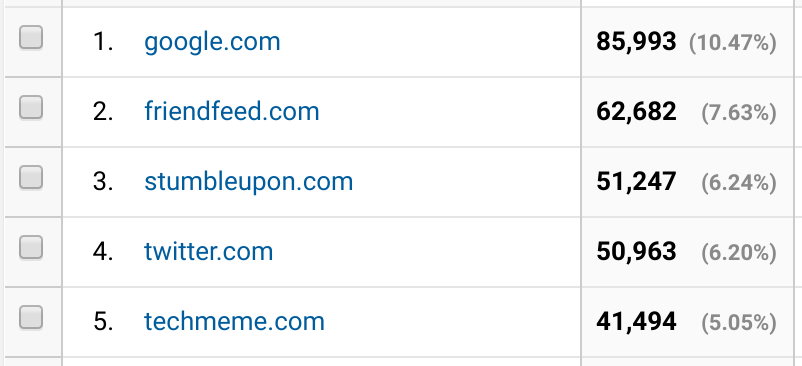
As I noted in 2009 (yet another internal link, am I right?), linking between communities was declining in favor of retweets on Twitter or sharing into the stream. The microburst of a little site traffic would provide that one time dopamine hit, but not leave a trail for later web spiders to find.
My top referring sites, via Google Analytics, from previous years

As the social streams of Twitter and Facebook took over, and bloggers (me too) got distracted, the share became the canonical mention. Your mentions on Twitter, or your notification of shares on Facebook, were faster delivered and easily quantifiable. And individual profile owners are quite unlike the publishers looking to deep dive into their analytics to discern where traffic came from.

Today, Brent Simmons laments the result of all the mentions going to the streams and leaving the Web. With links decreasing, and blog search being a relic, he yearns for a way to find again how his business is mentioned on the web or when he is being linked to. Joe Gregorio, like me, wistfully remembers analysis of referral logs to find how people found you... all through links.

Simmons' proposal is a limited one, keeping it to the MacOS/iOS community. A small project like that shouldn't be too challenging, but it speaks to a bigger problem, where the connections we once demanded are an afterthought behind the latest viral tweet and trending Facebook share. Streams are ephemeral, but the Web was built to last. It'd be great to see new voices building, informing and connecting again.

Disclosures: I work at Google and am on the Google Analytics product. So I think about publisher tools and visitor stats more than most.

January 3, 2018

How a Google Home in Every Room Gives My Kids Answers All Day

How a Google Home in Every Room Gives My Kids Answers All Day


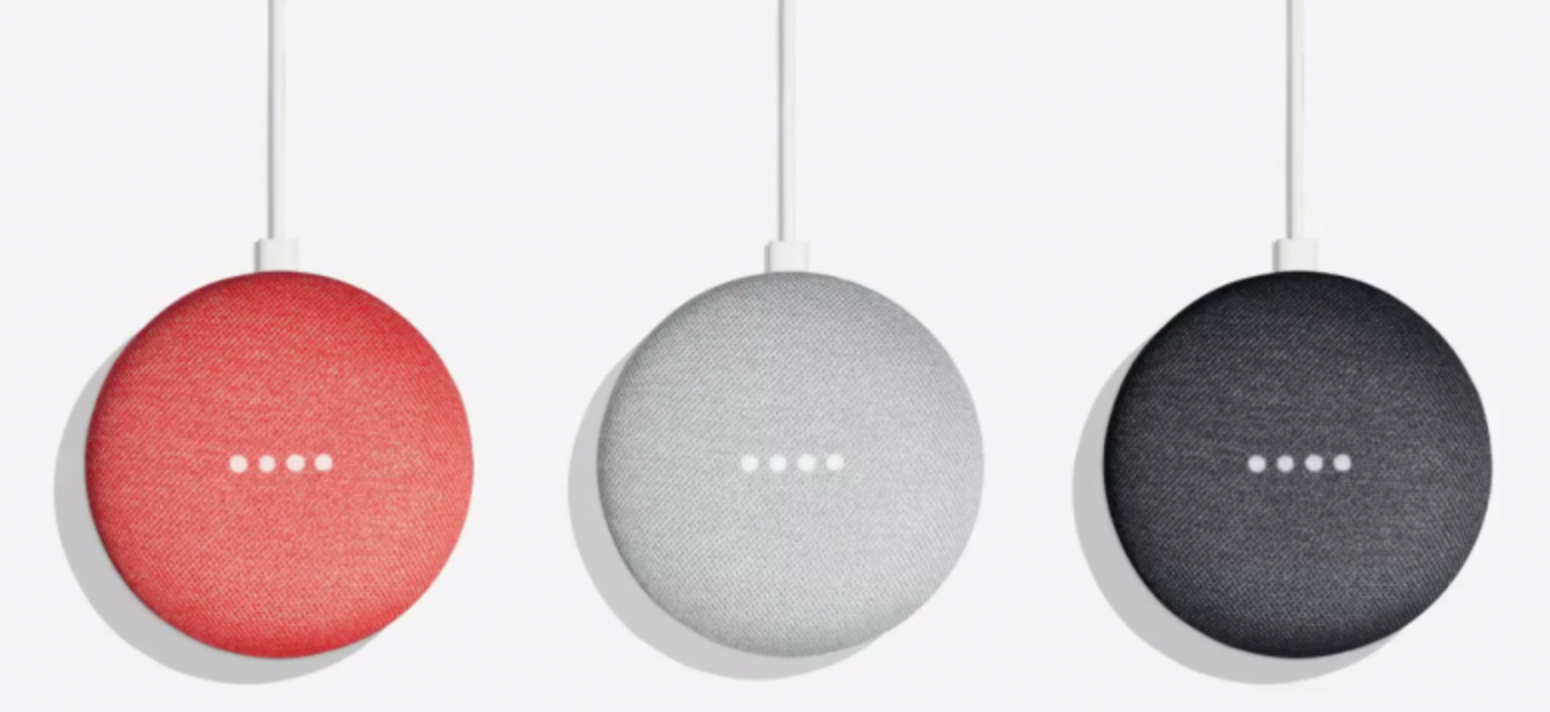
Some time last year, we installed five Google Home units in our house. One was placed in the master bedroom. One each went in both our kids' rooms, as well as one in the office, and one downstairs in the kitchen. Knowing that asking Google any question was just a simple request away, I was eager to see how the family would adjust to having a friendly assistant ready at any time to go fetch answers. What I've seen is that the devices are used throughout the day, and, often, the kids talk to Google before they talk to me.

OK Google, tell me a joke.

The morning starts with Google Homes sounding the alarm to wake up.

As the kids mumble "OK Google, stop", we have momentary quiet, until they shuffle out of bed and ask Google what the weather is going to be that morning. Obviously, depending on Google's answer, this can mean wearing shorts or jeans, long sleeve shirts or short sleeves. If the answer isn't detailed enough, I've heard the kids ask a second time, asking for the high of the day, which could impact how they prepare for PE at school, or if it's going to rain, and they need to pack an umbrella.

One example from our Assistant history.

As the morning routine begins, the first person downstairs gets to be the DJ, asking Google to play a song, which serves as the background music for breakfast. If the song isn't what they wanted, they simply say, "OK Google. Next song." until one they would prefer comes on.


If it's a weekday, we're most likely off to school and work, and we're all out the door. But if not, we probably have another query to Google Home to see how bad traffic is wherever we are going, how long will it take to get there - or sometimes, how the weather will be at our destination.


When the kids get home from school, Google does more than just act as background music device. My 9 year old twins use the Google Homes to confirm math homework answers to see if they are right, or ask it to sub in if an equation is too hard, or if they are unsure of spelling. The Google Assistant is the parent who is always willing to give an answer and never gets tired. 

With the expectation that Google has all the answers, the type of questions can be fast and furious. "What is hypoglycemia?" "Are hedgehogs nocturnal?" "What state is Boston in?" "What time is it in Sydney, Australia?" "What does salutation mean?" "What day is Black Friday?" "What time is it sunset?"

If Google doesn't know, or says, "Sorry. I can't help with that yet. But I'm still learning!", it's usually followed with sighs of exasperation and amusement, as they follow on with a different query more likely to get an answer.

The most popular question asked of Google Home this last year? By far, a simple one. "What time is it?", followed by "how much time is left on the timer?" for those ever important assigned times when they need to be reading, or when kids are taking turns with a game or a device, and need to hand it off to another child.

How many more minutes are left on my timer?

As homework time wraps up, and the kids find themselves on leisure, as dinner is eaten, and things are tidied up, I can hear them play music in each room as they have access to the world's artists on demand. "OK Google, turn your volume to 50 percent." "OK Google, play Katy Perry."

Do they always get the question perfectly right? No. But the device tries its best to guess and provide the answer - or pushes for another try. "Sorry. I don't understand?" or "Try again in a few seconds."

As bedtime approaches, everyone asks Google to set an alarm for the next day to start the process anew. And yes, if you're wondering, we do disable the devices in the kids' rooms by 9 p.m., so they don't end up rocking out in the wee hours. If they want something so badly they need to ask that late, they can ask me.

Set an alarm and call it a day.

The Google Home devices were such a benefit to our house that they were the go-to gift this last Christmas. Given they were only $29 apiece on the Google Store, I maxed out the order of ten, and shipped them in many directions - to family, to friends and even to neighbors, as they too could see the benefit of a smart assistant that takes the kids' tough homework questions on without complaint, and is more than happy to let you know if it's going to rain.

Just like touchscreens and tablets were so easily made a part of our family's life, from the very first iPads, and through the Nexus line, adding voice-activated devices has been simple and the children don't find them daunting at all. After all, who wants to get a laptop out and type in a query?

Disclosures: I work at Google, obviously. I paid full retail for my devices.


January 2, 2018

Why Silicon Valley's Real Estate Crisis Is a Present Danger

Why Silicon Valley's Real Estate Crisis Is a Present Danger

This nice home would probably go for $2 million in some Bay Area cities.

That Silicon Valley housing is very expensive is no surprise to anyone who is paying attention.

Fueled by a bullish tech market for the better part of a decade, with inventory dramatically constrained, each new home entering the market can be flooded with aspiring buyers who are eager to pony up millions of dollars for uninspiring homes, with the desirable promise of reduced commute times to big tech companies or startups, or access to high quality schools.

As a homeowner who bought our place in 2010, I could be doing victory laps about perceived value increases each time I view Zillow or Redfin to see how our long-term investment is doing, but the harsh reality is that the daunting financial demand needed just to find a place to live is having a dramatic impact - not just on the Bay Area as a region, but in markets far from our tech epicenter.

Prices in secondary markets outside the Bay Area are skyrocketing as distressed Californians seek alternatives. Working class families are being priced out of the most desirable cities, forced to endure hours of commute times from far-flung outlying towns, or losing their homes outright. Some small businesses are closing because they can't afford the lease, or can't find enough help to keep their business running. Help wanted ads for service workers are visible practically everywhere, and few answers are clear, aside from pushing for more housing, which in itself finds opposition from the slow to no growth community.


The topic of Silicon Valley real estate is ever present. The high entry point presents a barrier to tech workers looking to start their careers. It presents a challenge to new families in high priced rentals who may once have expected to save for a home, but see that opportunity get further out of reach each month, as savings never catch up with price inflation. Others living outside the Bay Area may turn down career opportunities because the promised salary and benefits can't deliver an expected standard of comfort. It's happening, and it's very likely to get worse.

About two and a half years ago, I read the tea leaves and talked about how I saw Sunnyvale as being in an enviable position, flanked by Google and Apple, both of whom are aggressively growing and are significantly profitable, helping to drive up demand for homes and attracting well-paid tenants. That post, "Tech Company Shifts Position Sunnyvale as Major Hub for Next Decade", helpfully marked some median home prices at the time of the article and allows us to compare what's happened since.

While Bay Area prices have increased, Sunnyvale and Mountain View lead.

As I had expected, not only have home values continued to spike on the San Francisco peninsula, but pressure from Apple's new campus, built on the Sunnyvale border with Cupertino, and increased growth from Google and LinkedIn, etc, have pushed Sunnyvale prices higher at a rate that dwarfed even its pricier neighbors, and driven average home values to nearly $2 million. You also saw a similar rise in Mountain View homes, where Google is based, but Sunnyvale has practically caught up.

What this means in real-world impact is that homes purchased just a few years apart, on the same street, can have wildly different purchase prices, monthly mortgage payments, and property taxes. Our neighbors, two doors down from us, recently paid more than twice the price for their home than we did in 2010, even though theirs is smaller. And they'll get nailed with twice the property tax to boot - their gift from the state of California.

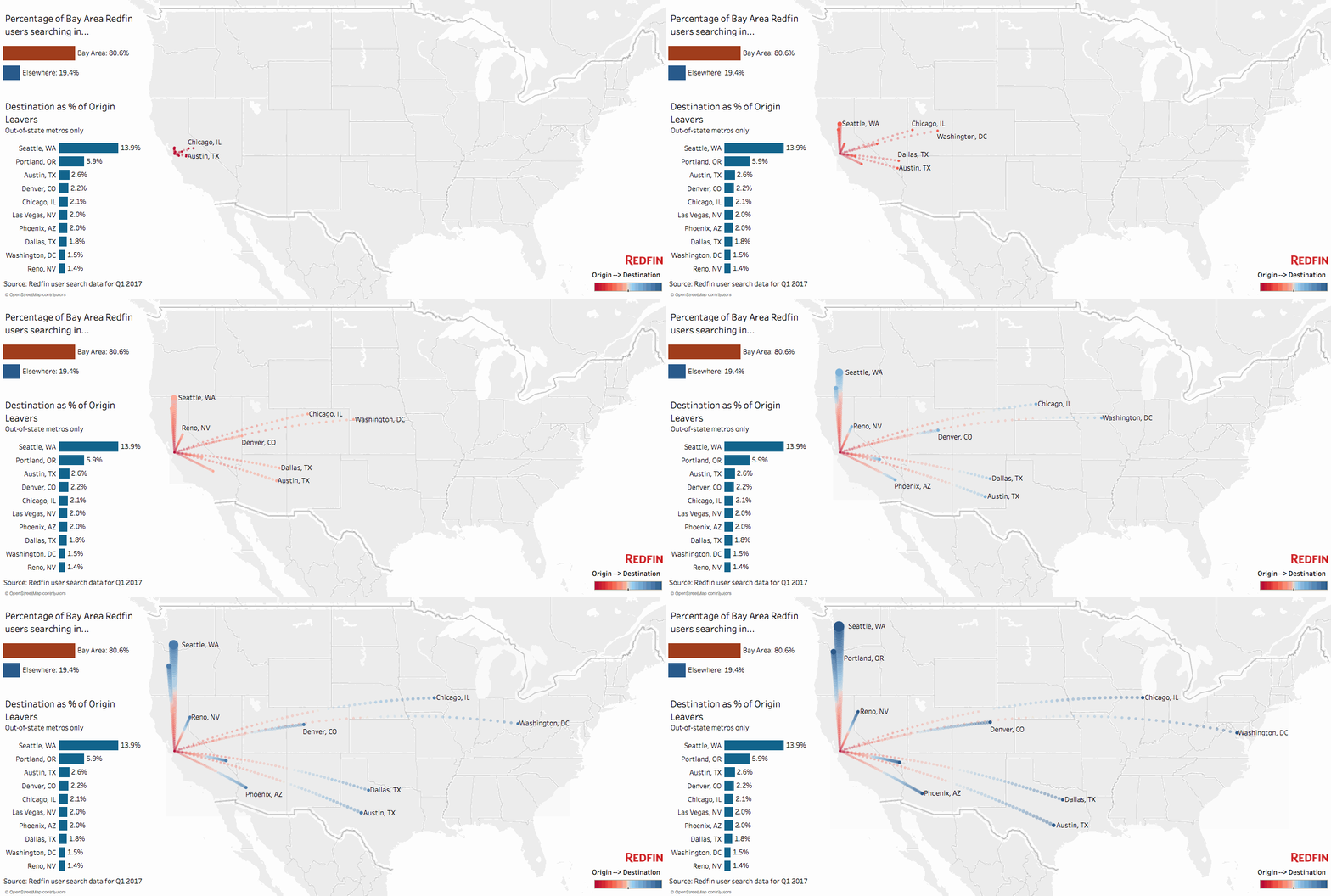
Redfin highlights migration patterns out of California. (Source)

For those who can't stomach a $2 million price or higher (and that includes us, by the way), buyers are looking elsewhere - to Seattle, Boulder, Austin, Portland, or even Washington DC, for alternatives. Seattle's home prices were up 16% in the last year alone, largely driven by migration out of California, which impacted the entire country. And while prices went up, more people were sent to the street - which has led to a spike in homeless deaths in the highest priced cities. (Source)

As I mentioned yesterday, the majority of children in school districts near Facebook headquarters are homeless. This is a new and growing crisis. Low to middle wage earners who can't afford to buy homes here are living in their cars and RVs. I see many of them when I walk the dog at night and recognize familiar faces who are just trying to make it to the next day. Even as Sunnyvale and other cities nearby are raising our minimum wages to $15 an hour, that is not a sustainable wage that can cover high rents that continue to grow. And there is always resistance from NIMBY (Not In My Backyard) neighbors who enjoy the high home values, but want to avoid rising traffic, taller buildings and crowds that come with job demand. Add on to these issues competition from foreign money like China, where many area buyers come from, and you have a recipe for disaster.

Silicon Valley's successes have had incredible impact on the world and the region. Some people have gotten obscenely rich from company successes and acquisitions, and have the option to buy these multi-million dollar homes for cash, or dual income couples with big bank accounts can float enough to solicit high bank loans to get there. But traffic on area streets is consistently thick as people drive further to daily routines. Highways are jammed as badly as Los Angeles - and commutes are worse.

California is where you look to see the future, from our inventions, to our forward thinking governments and social acceptances. The Bay Area is where you look to see what is coming to metropolitan areas throughout the country, and perhaps, the world.

Our high prices today are yours tomorrow, and we're erecting a massive "No Vacancy" sign to those who aren't here yet. Good luck to us all.

January 1, 2018

Silicon Valley's Lost Year Blends Fake With Future

Silicon Valley's Lost Year Blends Fake With Future


At the beginning of last year, as the Trump presidency sickeningly took hold, I worried his mere presence and daily volleys against what most of us thought to be good and proper, right and just, would dominate our every thought and conversation. His long shadow of darkness constantly loomed against any chance of progress and invention - taking the luster off usual excitement, demanding an unrelenting distraction, and regular dread.

I pushed pause on the blog because I felt like my comments on the day to day in Silicon Valley carried less weight in a world of crisis, as politics overwhelmed the usual storylines. But I realize silence is not the answer. Instead, we should ask more of ourselves when the wind is not at our back, but against us.

So what if we can make cars to drive themselves, only to find our streets hit by long-range missiles? So what if we could make it easier to connect people together on the Internet, all while seeing people turned away at the entrances to our countries, and see laws enacted that pitted people against each other in ways that we found abhorrently racist fifty years ago? So what if somebody could sprinkle some magical Internet dust on cryptocurrency and make a handful of desk jockeys rich (on paper), when trillions of real world dollars were being extracted out of the lower 90 percent of earners from an egregiously unequal tax bill jammed through congress, with chicken scratches in the margins?

It all seems pretty foolish sometimes, as we banter about over variations in cost per click on banner ads when retail supermarkets are going out of business and laying people off. It seems ridiculous that customers can debate the benefits of the latest food delivery startup when US senators openly debate eliminating food stamps for those who need them. And you can't get all that excited about meal replacements like Soylent and the highest tech juice squeezers in all the land when there are people just miles from the most valuable companies in the world who can't afford to both live and eat.

Remember "Everything's Amazing and Nobody's Happy?" Well, not only is the guy telling that story now tainted with his own awful reality, but not only is nobody truly happy, but there's a lot of crap that isn't amazing.

Nearly 60 percent of children in the city of East Palo Alto, buttressing Facebook headquarters in Menlo Park are homeless, victims of skyrocketing housing prices. Families have stuffed themselves into RVs, only to be told to move along, in Mountain View and Palo Alto, home to $3 million average home prices, bordering Google and Stanford. And yet, the big tech companies keep hiring, while Bay Area cities don't even come close to keeping up with the housing demand.

The Uncloaking of the Alt Right and the Me Too Phenomenon

As for those tech workers who have managed to find a way to live here? 2017 was a mess. Along with an emboldened racist and sexist wing in the Valley, with a new hero in the White House, and a self-promoting ex-Google engineer having penned a hateful screed that cast doubt to his colleagues' abilities solely due to their gender at birth, we also managed to get pummeled by regular news alerts to who the latest scumbags were who mistreated women and thought they could forever get away with it.

What a disaster to see people I considered friends in years past - like Robert Scoble and Dave McClure, to find some of their seedy behavior exposed to the world, and know that's just the tip of the iceberg, as others who have made sport of inappropriate behavior a practical part-time job are legion. While I am very glad to see that it seems, finally, women are being believed, and men are admitting they screwed up, it will take generations to see our workplaces truly be welcoming places for everyone - if it is ever to be.

(Time out: What a f---ing disaster Robert's non-apology post turned out to be. I was stunned at how bad it was, when the easiest thing to do would be to admit guilt, admit to being an ass and promise to work on making things right. I was horrified when I saw it...)

Bitcoin - A Bet or a Con?

So what did our best and brightest minds tend themselves to, instead of taking on hard work and pushing back on the vacuous fact deniers running the place? Many of them took to gambling their life savings on shiny internet tokens and watching prices rise like addicted penny stock chasers - making their own lingo, and debating the basis of specific coins, as if there were any real value in it - besides to get rich, and quick! Thanks for nothing, crypto nerds.

I'm old enough to remember the first dot com boom, with its own fake money games - Beenz and Flooz, that made up their own online currencies, only to go bankrupt at the first sign of weakness. At risk of being the last person on the crypto train, spare me the spam messages and emails and tweets, and please, get back to work. There are too many things you could have done with your time that helped the world, like we are supposed to do.

I apologize for my irregular notes here. When the Valley is really humming, and working on important tools and exciting ways to help us all learn, communicate and share, that's exciting. I see those flashes of brilliance, where I am, at Google, more than I tell you. But I worry many of the trends we've seen that reward bad behavior have become so entrenched, that the real value is being absorbed by the funders and the funded, more than the users. We have to share or the backlash will be stronger than we've already seen.

March 11, 2016

Stepping Out With the Fitbit Blaze Smartwatch

Stepping Out With the Fitbit Blaze Smartwatch


It has been years since I wore a watch regularly. Considering I’m rarely more than an arm’s length away from any smart device, I’d weaned myself away long ago — relying instead on my phone, laptop or tablet to give the time. And in the past few years, with many different smartwatch options popping up, from Apple’s offering and an array of Android Wear watches, I’ve browsed regularly, but not yet found the perfect fit for me for both utility and simplicity — until Fitbit announced the Blaze in January.

In the ensuing two months, I’ve been captivated by the Blaze watch.

Most smartwatches fall into two camps really, as I see it — too big or too tied to iOS. While this Christmas, I got my wife the Android Wear powered Moto 360, and she likes it, I didn’t get myself a matching set for two reasons — the first being that I hoped the watch’s profile would get even more slim in a newer generation, and second, I am really seeking functionality that goes beyond what I already get from my various Android devices — instead of just being a mirror of activity I already knew.

The Fitbit Blaze was different.

Not only did the Fitbit Blaze immediately extend my Fitbit activity tracking lifestyle, on which I’ve racked up millions of steps and hundreds of connected friends over the last few years, but the physical appearance of the device was slim and direct. Clean to look at. Light weight. And it didn’t try to do too much.

The Blaze is, at first, a timepiece, and second, a fitness tracker, easily displaying your daily step totals, heart rate, and calories burned, much like any other Fitbit device, but in a new and attractive way that got my attention unlike any of their other armbands ever have.

Also, in contrast to other smartwatches, the Blaze’s $199 price was actually very reasonable, compared with the least expensive Apple watch at $349 or the Moto 360 Sport at $299. While you can get cheaper options, like the Asus ZenWatch 2 for $149, you’ve got the idea.

So over the last couple months, I visited the Fitbit Blaze site so often it became one of the saved home pages on my Chrome browser’s start page — just in case I wanted to look again. And as March approached, when Fitbit said device would finally ship, I finally took the plunge and bought one.


I bought the Blaze on the 18th and it shipped only two days later.

And — get this. It shipped ahead of schedule. Like weeks ahead of schedule. So instead of having to wait all the way into March to get my hands on the Blaze, Fitbit exceeded expectations, like they always have for me, and the device showed up at my doorstep on February 23rd. So for just over the last two weeks, I’ve been tracking my steps and heart rate during all waking hours on my the Blaze.

Like any good data-driven geek (I work on Google Analytics, so data-driven equals yes), for the bulk of the first two weeks, I wore both my new Blaze watch and carried around the Fitbit One tracker I’ve used for the last few years. I believe Fitbit is the gold standard for step counts and daily activity, so if the two were to dramatically vary, that would not be cool.

From what I’ve found, the watch is within 5% of daily step count from the One. Like any good ego-driven activity enthusiast, my bias as to what number is “correct” is the higher one. But the same 2,000 or so steps still count as a mile and so on.

As for the features of the watch, they are very easy to grok.

The leftmost button on the included band and housing swaps between screens. Or you can just tap the Blaze with your finger and swipe left or right. The first option is their “Today” feature, which captures your step total, displays your current and resting heart rate, your accumulated mileage, estimated calories burned, and floors climbed on the day. You can also swipe track individual exercise activities, like Run, Bike, Weights, Treadmill, Elliptical and Workout. I’m no gym rat, so I probably won’t use most of those, but for others who do, it’s valuable.

The Fitbit Blaze also connects by Bluetooth with your phone, and can show a subset of notifications — namely integration with your calendar and text messaging. While other smartwatches give pretty much every phone notification equal access, the Blaze smartly knows when to stop. I don’t need social notifications or email notifications on the watch. Just alerts that are time relevant.

The true test of any new device is if you use it regularly beyond the honeymoon period — when you’re trying something out and justifying a purchase. After four years of wearing my Fitbit daily, proving my fanaticism and even racking up 100,000 steps in a single day, the device is pretty much an extension of me. It goes where I go and reports on whether I’ve been too sloth or burned off enough energy. I even lost 30 pounds in six months after first getting connected. No other device has had that kind of permanence for me.

The Fitbit Blaze is the first offering that had me consider trading up, and it hasn’t left my side, except to charge every few nights. I don’t need yet another email device, or yet another device to browse Twitter and make phone calls. I just wanted a smarter watch that looked good and pushed me to keep moving. For every Fitbit addict, this is the watch you’re looking for.

February 11, 2016

We Need Smart and Personal Streams, Not Just The Latest Updates

We Need Smart and Personal Streams, Not Just The Latest Updates


Once again, the tech web is aflutter about a proposed change in Twitter’s timeline — as they have finally made a choice to offer more than a simply chronological feed of updates displayed in the order they were posted. While a chronological order of tweets can be considered a hallmark definition of what Twitter is today, and truthfully, one of its most addictive features as each new Tweet rolls in, it’s also a detriment to those who aren’t ready to be constantly hooked to the information IV drip.


My 2010 Summary of a Personalized Web future

Twitter is 10 years old now. That’s fairly mature from a Web services standpoint. Its peers, LinkedIn and Facebook, are 14 and 12 respectively. The next generation? Pinterest is just over six. Instagram nearly six. Snapchat is five. And yet it often seems as people are still waiting for Twitter to make that big leap forward to properly sit at the adults’ table.

Twitter as a Media Network, not a Social Network


Ex Twitter PR and comms guy Sean Garrett, now running his own firm, commented yesterday that Twitter’s been done a disservice by being labeled as a social company instead of as a media network. Taking that summary seriously, it clarifies one of the major needs for a personal and intelligent ranking of content, rather than a raw feed of the latest updates. Media companies don’t just give you the very latest updates in order, with no external curation. Instead, they sort it, rank it and deliver them from the most important to least important — whether their medium is television, radio, print or online.

For the most aggressive media consumers, like myself, the idea of seeing content out of order may seem like pure heresy. We read every email, read every blog post in Feedly, and generally catch up on Twitter to the point where we left off. Scrambling that up seems abhorrent. But we’re not normal. We’re seeing that from the tippy top 1% of the bell curve, and hoping the rest of the world will catch up to us. But not only won’t they, but they don’t need to, and we should stop expecting it.

A successful network has an obligation to give its users the best possible experience and do it instantly. But surfacing the right updates for the right person at the right time is a tricky Venn diagram to figure out, be it based on the users’ topics of interest, their affection for the person posting the content, the recency of that content, and obviously, a mix of all those signals and more. Just sitting back and showing the latest stuff only solves for one of those qualities: recency — completely ignoring what I like, who I trust and so on.

Personalized Content Leads to Happier Users, More Usage

From 2009 to 2011, I worked with my6sense, first as a third party consultant, and later as the company’s VP of Marketing, before I joined Google. Their app surfaced content from your social streams in a personalized way, just for you, based on your own implicit behaviors — what you clicked on, what you chose not to, how long you read something, etc. The more you used the application, the smarter it got, and eventually, we would know your interest patterns so well, that we could take our user model and apply it to any stream on the web.


my6sense for Twitter

In early 2011, we delivered a Chrome extension for Twitter, which took the smarts we’d developed and displayed the results of that effort on the Twitter website — giving you two options: your standard timeline, ordered chronologically, and a smart, personalized timeline, from my6sense.

By no means were we the first company to try and bring sense to a social stream. In fact, in 2008, FriendFeed (RIP) offered users personalized recommendations as a feature to their service, aimed for those who’d been away and wanted to quickly catch up. But one aspect important to both of these examples is that they gave the user a choice. You could quickly switch between a chronological feed, which was the default, and the smart feed, personalized to your interests. You could always go back.

But as we found out, the more the user visited the app, and the more accurately we could determine their preferences (which we called digital intuition), the less likely they were to ever visit the unfiltered, unsorted feed. If you became accustomed to a curated feed tailored just for you, going back to one that wasn’t seemed unacceptable in comparison.

Quantity Isn’t Quality. Popular Isn’t Personal.

So imagine you’re one of the millions of users of Twitter (or Facebook, etc.) who doesn’t check in every day. On the rare occasion you do visit, you’re not seeing a feed of updates from people who matter to you most. You’re instead seeing a feed of updates from people who post the most. And quantity rarely was quality. When your selling action to those most likely to leave your service is to give them something low quality and off topic, that’s a problem. And yet, for many services, that’s the default.

Going even further, what many services provide as an option is a leaderboard of popular or “Top” content. It’s assumed the most engaged content is the “best”, but this alone is far from the truth. If you seek out a stream for intellectual curiosity and news, you won’t get that from viral videos and memes, jokes and celebrity news. But many people go to these services to turn their minds off or to relax, and their goal may be in direct contradiction with yours.

Twitter’s Success Really Isn’t the Topic of Debate

Now that Twitter has gone public and its financial success is being graded quarter by quarter, and Wall Street’s public vote on their valuation is there for the world to see, its success could be easily measured solely by stock price. Amid the hubbub of whether Twitter could sustain a billion person audience, like Facebook, or if it’s exceptionally valuable due to the role it plays in the world’s news dissemination and communication, the reality is that it has to do better both for its current user base and those yet to embrace it. And that requires change and evolution.

Twitter should be personal just for me. So should Facebook. And LinkedIn. And the web at large. And my phone and car and so on. If a dichotomy is set up between something that’s smart and personal against one that isn’t, I know I’m going to give the service a chance to give me a better experience — and if not, I should always be able to go back.

Disclosures: I work at Google, a partner and occasional competitor to Twitter. I’ve been an active Twitter user for eight-plus years. I was previously VP of Marketing at my6sense, which built a personalization engine.

December 17, 2014

Tablets, Touch and Talk: Technology Through the Eyes of a Child

Tablets, Touch and Talk: Technology Through the Eyes of a Child

Braden With my Nexus 5, Watching the MLB At Bat app.

My children have never known a world without high speed Internet, streaming movies on demand, and a seemingly all-knowing personal assistant, available to answer their every question when asked. They've grown accustomed to concepts which once seemed fanciful, like the ability to order all sorts of items on your tablet and have them delivered in the same day, having every photo you've ever taken available to you from any device, or having video chats with just about anyone instantly. For them, there is no such thing as technology. There's just the real world, which is directly impacted by pervasive Internet.

As the major enabler of this, and someone who largely has converted from analog to digital at every opportunity, I've been especially excited to see how this impacts the way they interact with each other, what they choose to learn, and how quickly they grasp ideas - even when, to them, there is no user manual. I'm naturally curious to see what they choose to do and choose not to do, and what simply proves too hard.

My twins are now six years old, and Braden (pictured) is four. The twins are in first grade, and Braden is in preschool. The older two can read well, and do some writing, but while Braden recognizes letters, it's not as if he's sitting down with a good book yet. Despite the mild illiteracy, all three can breeze through tablet usage - from memorizing a pin or lockscreen, to finding applications, launching apps, moving them to folders, and even downloading new ones from the Google Play store. And it's not far-fetched to say Braden is actively learning to read from applications you'd never expect, like Major League Baseball's At Bat, where he's working hard to memorize stats and names of players I've never even heard of. (See also: Wired: How Videogames Like Minecraft Actually Help Kids Learn to Read)

Braden Seeing Baseball Highlights from the Majors on my Nexus 7

Given my kids' capabilities, it should come as no surprise that their primary interaction with the Web is through touch on tablet or phones. They were exposed to iPads and Android tablets early on, and have grown familiar with the practice of touching an icon to launch and app and how to navigate the apps - including the always important ability to hit the small X in a corner to close ads. And when the app isn't what they are looking for, they just ask Google. Depending on how well they ask, Google should find them what they want, whether they are looking for "videos of cupcakes", "pictures of beagles" or whatever strikes their fancy that day.

It'd be easy to say kids, like us, use technology to be entertained. They each have favorite games, and frequently open Netflix or YouTube to watch videos - or, as Braden does, the MLB At Bat app, to see highlights from all of the previous days' games. But they also use applications to draw, or for education, whether they are matching games, flashcards, or adventures that teach them language or math. And on more than one occasion, I've found my Google Express shopping cart full, with hundreds of dollars of items, from everything to do with Disney's Frozen or Minecraft, to books, toys and food. Luckily, they haven't yet figured out the last steps of the purchase, so I've always been able to clear the cart before having to explain away crazy charges.

Sarah posts to YouTube, complete with titles and emoji.

They've each also figured out the tablets and phones are capable of creative work as well. I was recently surprised with an email notifying me that I'd successfully uploaded three new videos to YouTube. After momentarily thinking I'd been hacked, I realized my daughter had not only filmed three new videos, but correctly titled them and uploaded them to my account. Meanwhile, the automatic backup capabilities of Google+ come in handy when we want to see pictures the kids have taken with our devices, from their perspective. Sarah has also been known to tell me to take a photo of something she's proud of, with the intent of my sharing it on Google+ or Facebook, saying "Daddy, take my picture and put it on the Internet."

"My" invite to Brian to join Ingress, sent by Braden.

Last week, just before I wrote my post about Ingress, I got a note from my friend Brian Fitzpatrick, thanking me for inviting him to the game. But I hadn't. Braden did. While I was at the office, Braden had opened up Ingress, sent off a dozen or so invitations to people in my address book, and unhelpfully, dropped some of my equipment into the front yard, for me to reacquire when I got home. That was amusing, and luckily for me, he didn't mess up my account any further. And this Sunday, Braden jacked up our thermostat to 82 degrees, using the Nest app, before I realized things were more than a bit toasty.

On Sunday, we were a comfortable 80 degrees in our house. Thanks, Braden.

Just as important as seeing what they're doing with my devices is seeing what they aren't doing. Aside from the Ingress invites, I've never seen the kids interested in opening up Gmail, or posting to any of my social networks. No fun tweets or posts to delete. No mass apologies to coworkers for toddler missives to internal mailing lists, and no inadvertent likes of odd posts in the stream. They're not interested in Google Drive or browsing the Web, and they've only fired up Sonos to blast music in our house a couple times. For them, the tablets are purpose driven. They have a short time to delivery of the content they're looking for, and if they can't find it, they'll ask Google in a different way, or go back to what they know works.

Just like many of us find we struggle with handwriting after years of regular typing, I'm interested to see how my kids are going to operate with analog assignments that may require pencil and paper, or if textbooks might be the rule, instead of downloadable equivalents. I'm curious to see if they'll master speed typing at a faster age than I did, thanks to the availability of computers, or if touch and voice will rule the day so they might not have to make it a priority. But for now, they're especially handy on the tablet - be it a 5 inch phone, or my Nexus 9, which Braden calls my "big tablet", as opposed to my "medium tablet" Nexus 7. And as Google Now improves, time between what they want and what they find should even further decrease. It's a lot of fun to watch.

Disclosures: I work at Google and enjoy products of ours I mentioned in the post, from Android to YouTube, Gooogle Drive, Gmail and Ingress. So do my kids.

May 2, 2014

Staying Ahead of the Curve on Tech Trends Isn't Trivial

Staying Ahead of the Curve on Tech Trends Isn't Trivial

When it comes to picking choices in tech, making the wrong decision on formats, manufacturer, or version can set you back in terms of dollars, leave you with rapidly obsoleted hardware, or find you investing time in something that provides you with non-optimal returns.

As an early adopter, you have a higher tolerance for risk and you take bets on product direction before the rest of the population may agree with you, and your choice to move one direction can act as the initial spark in a good situation, or as the canary in the coal mine, in a negative one. This thought crossed my mind as we saw the news yesterday to Sony's recent struggles, largely tied to their ongoing challenges hawking Blu-ray.

As Sony was quoted in the Verge, "demand for physical media" was "contracting faster than anticipated," and they were left holding the bag. But this really shouldn't have come as a surprise. More than three years ago, I said I was through with physical media, and I haven't looked back. Between streaming video and audio services like Netflix, Spotify and Google Music, or eBooks from Google Play and Amazon, the Web has taken over where physical media couldn't compete.

And let's be honest for you Netflix users? How many of you still get the DVDs? Netflix is a perfect example of a company that saw the transition coming and pivoted to where the trend was going. Now they're overwhelmingly known for their streaming services instead the traditional red envelopes.

The last five years have seen pronounced trends that in hindsight are impossible to ignore, from the rise of smartphones and debut of functional, popular, tablets, and the integration of social networking in all aspects of society. You can debate the ebbs and flows of financials for some of the larger social networking sites, but you can't deny their immediate impact.

On the tablet and smartphone side, there were two obvious trends that people could recognize right away if they kept an open mind. The first was that the iPad was going to be a hit. The second was that Android, due to its partner-friendly approach and rapid iteration, was the horse to bet on.

Without pulling an +MG Siegler and calling this post "I was right. Let me tell you why...", I'll highlight a few bits from both topics.

Let's Talk iPad

Immediately reacting to the iPad's introduction in January 2010, I didn't go over the moon and claim the new consumer tablet would solve world hunger and eliminate illnesses in our lifetime. But I did see it for exactly what it was, concluding, "They are going to sell a ton of these machines, and you'll see them in places you never expected. Casual computing and content consumption are going to drive it." That's exactly what happened, with the hindsight of four-plus years.

The iPad may actually have sold too quickly and been too successful a product to keep Apple beating expectations, but it found a niche between the smartphone and the laptop, and set the stage for the tablet being the first computing experience for my young kids.

Companies that bet against the iPad (or tablets in general) have found themselves swimming upstream, defending an antiquated platform and in some cases, extracting revenue from fatigued customers, whose numbers are decreasing.

Let's Talk Android

While Apple was pushing the iPad and doing tremendously well, iOS wasn't the smartphone OS I ended up enjoying, for a whole bunch of reasons. Six months into the iPad's lifespan, I turned in my iPhone and turned to Android, saying at the time, "a bet on Android is a bet on the future. I am betting on an ecosystem and an application environment that encourages best of breed developers to move their product to a growing population of smartphones, and I expect to reap the benefits. "

There's no question in my mind now that was the right move - and you have to keep in mind that was more than a year before I entertained the opportunity of joining Google myself. I saw the trendlines that pointed to Android being the quantity leader, with greater partnerships and a fast-growing developer ecosystem that brought top apps to the hundreds of millions of users, and that's exactly what happened.

Let's Talk Smaller Tablets


Soon enough, the first generation iPads I bought aged, and another trend emerged - of the small form factor tablet, starting with the Samsung Galaxy Tab, which I preferred, and later the Nexus 7. This 6-7 inch form factor was a perfect fit for customers, as you could see with the rise of the Galaxy Note, ever larger standard smartphone sizes and the rise of the Kindle Fire and Nexus 7 line. Even Apple capitulated eventually with their own iPad Mini, although they're not usually the ones to admit they were late to an idea.

So what am I getting at? I'm not here to tell you I have a crystal ball that tells the future. But you can see, with your own eyes and experiences, what the trends are going to be, and being stubborn because something has always worked one way doesn't mean it's a good idea. You have to evolve as a user, as a developer, as a businessperson, or as a company, to make sure you're impacting that change and choosing wisely. Or you'll end up with a home full of VHS tapes. Don't forget to Rewind.

Usual Disclosures: I work at Google which is behind the Android operating system and is a partner or competitor with many of the companies in this post, like Samsung, Apple, Amazon, Netflix, Spotify and more.

January 31, 2014

In Tech, In Order for X to Win, Y Doesn't Have to Lose

In Tech, In Order for X to Win, Y Doesn't Have to Lose


While it's somewhat hard to imagine now, with Apple seeing incredible success, it was less than two decades ago when the company, facing a small market share, and minuscule developer interest, had to pull a rabbit out of its hat to ensure longtime survival. That surprise came from an unexpected partner - longtime nemesis Microsoft, who in 1997, not only gave the then-beleaguered company a much-needed cash injection of $150 million, but also promised continued updates to the then-essential Microsoft Office suite, required to keep Macintosh's hopes alive as a viable platform.

Amid the shocked faithful, who responded with boos over making Internet Explorer the default browser for the Macintosh, instead of the arguably more Mac-like Netscape Navigator, CEO Steve Jobs said the unforgettable phrase easy to forget in an environment where it's commonplace to pit technologies against one another:
“If we want to move forward, and see Apple healthy and prospering again, we have to let go of a few things here. We have to let go of this notion that for Apple to win, Microsoft has to lose.” (Source: YouTube)
Turns out, as with many things, he was right. Microsoft, despite the company's many challenges, still is worth more than $300 billion, and saw income of more than $16 billion in the most recent quarter. When it comes to operating system choices, usually one picks Macintosh or Windows (and not both), or mobile OS choices, one could pick iOS or Windows phone (and not both), but both companies have managed to have significant places in the tech world for the last two decades.

Rarely does the winner take all.
Fast forward from Steve's words in Boston in 1997 to today - a world where big companies like Google, Apple, Microsoft, Amazon, Facebook and others command significant visibility and influence - but comparably younger companies like Twitter, Dropbox, Tesla, Nest (pre-acquisiton), Uber and others manage to also carve out interesting opportunities and become big companies themselves.

It's often assumed that if one "wins", another has to "lose". If Facebook wins, does Twitter lose? If Android wins, does iOS lose? If Amazon wins, does Google lose?

As a user of these technologies, and someone who watches the market closely or writes about these technologies, I see lines forming - not just of people who prefer one technology or one company relative to another, but of people who also display an equal and opposite reaction, to strongly dislike the company or technologies less preferred.

Those decisions have odd echoes. It's assumed that if you like the iPhone, then you must prefer Apple Mail over Gmail. If you like Windows Phone, you must also prefer Bing search to Google search. And if you have a blog that covers the minutiae of Apple's comings and goings, that documenting any negative opinion about their perceived competition should be highlighted with equal or higher volume.

Simply stated: I disagree, and think we can do better. You can like one company's vision or products even if you purchase from another one. It can be possible that all the major players find a space where they are successful. And the best products are built when it's the users' values that are at the forefront, rather than a false battle started to strengthen the position against another player.

Larry Page, Google's CEO, addressed this point at Google I/O last summer, when he said:
"Every story I read about Google is 'us vs some other company' or some stupid thing, and I just don’t find that very interesting. We should be building great things that don’t exist. Being negative isn’t how we make progress. Most important things are not zero sum, there is a lot of opportunity out there."
Recently, The Verge wrote a great in-depth piece about being a fanboy, asking "Have you ever loved something so much it hurt?" showcasing a number of examples of people so consumed about making sure people knew which side of these battles they were on that they were unforgiving in their tone with anyone else who disagreed. I believe you can have a strong preference, and can evangelize a product or platform, like I do often with those I enjoy, without having to cut down alternatives or those who've selected a different way.

The world is a very large place. There are many millions of people who haven't yet purchased smartphones, tablets or PCs, let alone decided on their favorite OS or apps. There is room for many small companies and big companies alike to innovate and do incredible things. There's room for us all to intellectually choose to be fair and review each new product on its merits and stand for those things we believe and like without needing to tear down alternatives. It might be fun, but we can do better.

Disclosures for transparency's sake: I work at Google, which makes some of my personal favorite products, like Android, Gmail and ChromeOS. It can be assumed Google occasionally competes with other market participants like Apple, Facebook, and Microsoft.

(Images via Dreamstime, which is an excellent resource)

January 21, 2014

Either you are in Engineering, or you are in Sales.

Either you are in Engineering, or you are in Sales.


At BlueArc, our longtime CEO and executive chairman Gianluca Rattazzi had a saying which he often weaved into his presentations at our company all-hands meetings. "Either you are in engineering, or you are in sales."

The idea was to have employees from all corners of the company take ownership of our shared revenue goals, or think about what each of us could do, whether we were in Marketing, HR, Finance or Support, to encourage us to meet our number. Even if we weren't dialing for dollars or meeting with customers, if we weren't the people actually building the product ourselves, we had to think like salespeople. It also was aimed to reduce conflict between teams, as we wouldn't shake our heads at the antics of account managers, or point fingers when one territory or account proved harder than expected.

Meanwhile, engineers have to keep being focused on what they do best, which is design and deliver incredible products. Most engineers, as Dilbert often points out, make terrible sales people. They would likely rush to tell you the product's latest flaw or highlight the bug list of the week instead of working to find a way to make the current offering fit your needs - which would delay or block the sales cycle.

As I see it, product managers are the buffer between engineers and marketing. Marketing is the buffer between product management and the real world (aka the customers and press). Between those two hops, code turns into features, and features turn into benefits. If lucky, those benefits can turn into revenue, and as most companies tell you, revenue solves all problems.

Which brings us back to the split - either you are in engineering, or you are in sales. Even if you don't carry a quota-bearing number, as an employee of a company, you take some amount of pride from the work delivered there. When the company is having a hard time, you have a hard time. When the company is preparing a new product, you are probably eager to try that product, and tell the world about it.

At Google, as I mentioned last November, that process includes early access and beta testing, which we call dogfooding. Many of us are lucky enough to get early access to things like +Google Glass or the Chromebook Pixel. We are more likely to be using a Nexus 5, Nexus 7 or Moto X than the average +Android user, and have a more-encompassing understanding of the company's vision and products than those outside the company.

As an early adopter and technology enthusiast, promoting products I like is second nature. I've been touting ChromeOS for years. I switched to Android well before picking up a Google badge. I always tell people when products I like are fantastic. And that extends to visionary new ideas like Google Glass. I've recently seen some memes on various tech blogs about a perceived dropoff in use by Google employees of this early version of the product - saying the product should be so fantastic that people clamor to use it, and trying to read the tea leaves into saying the product won't succeed - a curious proposition considering it hasn't even launched yet beyond a small circle of Glass Explorers.

My Kids, Racing #throughglass

Without diving too deep into those weeds, I can say I do use it, and I find having a first-person view for recording video and taking photos incredibly valuable. I get instant notifications of email and texts and can respond by voice, hands-free. And wherever I go while wearing Glass, the questions are from excited people who are delighted to see how simple it is to use, not to mention how it non-intrusively lets me continue a conversation, while making eye contact, with the small viewer being out of the way. I take Glass with me on walks to the park with my kids. I took Glass with me to the +San Francisco Zoo on Monday. It becomes another lightweight way to capture the experience.

A View of My Wife and Twins #throughglass

If you're inclined to be skeptical, and that sounds like sales, that brings us back to the original thought - as an employee of a company that makes things, you represent the product. You can help others see how a product can be used, and if you're spotted using the competitor's phone or OS, or you prefer a competitive service or platform, people see that. That's part of why Steve Ballmer's kids weren't even allowed to have iPods and Bill Gates' kids used MSN search instead of Google. Those kids didn't work for Microsoft, but by extension, it would be a fairly bad case study to see them using competitive products.

The good news is I don't believe I'm at a place where I'm asked to use low-quality products like the Zune and MSN Search. It's easy to get excited about products that are making it easier to get information and share updates more quickly, or to get to my data no matter where I am, from any device. I can't go back twenty years and become an engineer, taking all the required computer science courses needed to be the true alpha geek, but I know I can do my part to improve the product from the inside, and tell the world about it on the outside. Think about yourself in your role. If you're not in engineering, aren't you in sales?

Disclosures: I work for Google, obviously. I often get to dogfood our products, like Glass, the Chromebook Pixel and others, free of charge. I paid retail price for my Nexus 5 and Nexus 7, and prefer Android to alternatives. If I forgot a disclosure, I should disclose that too.