Showing posts with label LinkedIn (56 posts). Show all posts

January 4, 2018

A Decade of Silos Has Throttled Open Content Distribution

A Decade of Silos Has Throttled Open Content Distribution

The 2018 Social Media Flow is Driven by Content Silos

In the ten-plus years since I started this blog, one of the clearest trends on the Web has been for destination sites to want to control the user session and experience. In parallel, sites focused on aggregating content from external sites or highlighting the best of the web - serving as a filtered pass through, have struggled. Many are gone.

While significant efforts were made during the forging of Web 2.0 to drive open standards and allow for data to flow from one site to another, through RSS, Pubsubhubbub, Atom, XMPP, or whatever your preference, 2018 on the social web is a much more challenging place to write once and publish everywhere.

As I view the publishing space, I often turn to four big challenges that have to be solved for a platform to be a success to both authors and readers:

1. Creation

A platform, be it for photos (Instagram, Flickr, Google Photos, etc.), short updates (Twitter), long form (Medium, Blogger, WordPress, etc.), video (YouTube) or a mishmash of all (Facebook, Google+, etc.), needs to make it easy for the content creator to share what they want, in the form they want, and have the output be what they intended. This is true whether we are talking about desktop or mobile creation.

2. Distribution

Once the content is created, it has to be sent somewhere. If you write a post and hit publish, how do people find it? Is it sent to a third party network where they are hanging out? Is it sent by email? Do they get a notification on their phone? Does it flow down their timeline, as they have new items to consume? Or is it just another flat file, waiting to be indexed by Google and other search engines?


3. Discovery

Readers want to find new content. They seek relevance, freshness, and community. This mirrors the three pillars of social sites I highlighted back in 2009, and echoes that readers want intriguing views that mirror their own preferences. Like I'd predicted in 2006, the Web has become a divided place, where we all flock to our groups of like minded people, and disavow opposing views, but we still are eager to find more who reinforce our position. We still crave new friends and stories and we want to find them quickly.

So how good a job do these apps and sites do of surfacing new people and ideas? Do they have an aggregated site with highlights and popular people or posts? Is there a place to find more obscure viewpoints and new voices?

4. Consumption

Since the smartphone revolution, kicked off by Blackberry and the iPhone and now led by Android, more people are constantly connected and reading news from their mobile devices. In many countries, the mobile device is the only window to the Web. Does the content flow well for mobile consumption and new ways to navigate from screen to screen, update to update? Or is it best suited for a leanback tablet experience or for the desktop?

What typically happens with content platforms is the content fills the available container. Twitter is a clear 140 or 280 characters. Social hubs like Facebook and Google+ favor large photos and a short introduction. Instagram is all about the photo with a small description. Blogger and WordPress and Medium are as long as you want to go. One has to consider if users and screens keep up.

2009's promise of sharing everywhere wasn't meant to be.

We've Come a Long Way from Aggregating Streams and Sharing the Web

As content started to be created in a wide array of social sites, aggregation services like FriendFeed helped bring people's streams together. Bookmark services like Delicious helped people save the highlights from the Web and amplify the world's favorites. Users voted up posts from Digg and passed them along with StumbleUpon. The most voracious consumers lived in Google Reader and didn't miss a single post from the RSS feeds they were subscribed to.

It was too good to last.

The largest social platforms were not content in simply being links to external sites. Facebook focused more on original content shared on the platform, with less priority given to send traffic off site. Google Reader shut down, and while Feedly and others stepped up, the world of RSS never recovered. Delicious died. Digg is a shadow of itself. FriendFeed was obliterated. LinkRiver closed. Socialmedian closed.

In the wake of all these gateways' demise, taking content from the open Web and getting it in front of new viewers is more challenging. While I've always said you need to be where the users are and can't force them to come to you, what could be automated is now requiring manual intervention at practically every step.

Just What Am I Talking About?

The alpha and omega, yin and yang of social outlets (for text, anyway) are Facebook and Twitter. Facebook is much bigger and much more profitable, but don't get distracted. People creating content for the Web also need to make sure that content fares well downstream on Facebook and Twitter. You can write it for the open Web, but you then have to take explicit action to share the content downstream - or set up automation to either site, usually backed by RSS. At that point, whether you get discovered or not is up to each site's algorithm, which has leaned more in favor of implied interest rather than chronology of late - meaning you can see viral content from hours or days ago before you get the newest stuff.

On a mobile phone, notifications are the holy grail of getting someone's attention. (See: Life by Numbers and Notifications from 2014) It's not uncommon to get notified when someone tweets, but it's very uncommon to ask for a notification when a site makes a post.

In parallel, the feedback loop from such networks, as well as Instagram or others, is near instant and acts as an incentive for the author to initiate their content on that silo natively. Post a 20-tweet storm to Twitter, and immediately start seeing those likes and retweets roll in. Post a story to Facebook and wait for the Likes and comments. Post a news story or a blog post, and ... wait. Wait for visitors in Google Analytics? Wait for the post to be shared downstream? Wait for the story to be indexed in Google News and search?

The elimination of Google Reader, FriendFeed, and Digg as amplifiers of Web content, alongside the attention absorption by Facebook and Twitter makes it harder for Web authors to get visibility - and they they aren't dropping their content into the real time stream.

So What Does the New Flow Look Like?


In 2009, it seemed pretty easy to me. Post on the blog. RSS would take it to FriendFeed and Google Reader. FriendFeed would post to Twitter. Twitter would post to Facebook. Then I'd run around and answer comments wherever they were distributed. (More on distributed conversations from 2009)

Now, I can still post on the blog. And the RSS link is the same. I even get the small bump of engagement on Google+ from the blog's page automatically adding my content there. But then, to make sure I cover all my bases, I then make another share of the same content to Medium, for those who love their site, and I've even found good engagement on LinkedIn, by making a third post of the same content on their channel. It's a different audience, but, if on topic, they share and engage.

So that's three posts. Meanwhile, I still have to share the story on Facebook and Twitter separately, hoping that someone will break their consumption flow and engage on my content downstream.

It feels like more work to get less return. And yes, I recognize that some may not miss FriendFeed because they never used it. Maybe others think Digg got replaced outright by Reddit, and gains similar traffic. Others prefer Hacker News. So aggregators do exist, obviously, but hubs aimed at surfacing new content, as opposed to highlight content on the site and keeping readers there, have declined.

To properly make the Web as desirable and viable a platform for publishing, we need to work together to fix the distribution and discovery gaps, make content fantastic on mobile for creation and consumption, and allow for engagement that is as simple as a Like. I applaud (there's the joke) Medium's approach to reward users with claps, for at least they're trying something. We should all be trying.

Disclosures: Yes, I work at Google. Sometimes, I help the Blogger team. I used to work on Google+ and have many friends on those teams still. I miss Google Reader every day. FriendFeed too.

February 11, 2016

We Need Smart and Personal Streams, Not Just The Latest Updates

We Need Smart and Personal Streams, Not Just The Latest Updates


Once again, the tech web is aflutter about a proposed change in Twitter’s timeline — as they have finally made a choice to offer more than a simply chronological feed of updates displayed in the order they were posted. While a chronological order of tweets can be considered a hallmark definition of what Twitter is today, and truthfully, one of its most addictive features as each new Tweet rolls in, it’s also a detriment to those who aren’t ready to be constantly hooked to the information IV drip.


My 2010 Summary of a Personalized Web future

Twitter is 10 years old now. That’s fairly mature from a Web services standpoint. Its peers, LinkedIn and Facebook, are 14 and 12 respectively. The next generation? Pinterest is just over six. Instagram nearly six. Snapchat is five. And yet it often seems as people are still waiting for Twitter to make that big leap forward to properly sit at the adults’ table.

Twitter as a Media Network, not a Social Network


Ex Twitter PR and comms guy Sean Garrett, now running his own firm, commented yesterday that Twitter’s been done a disservice by being labeled as a social company instead of as a media network. Taking that summary seriously, it clarifies one of the major needs for a personal and intelligent ranking of content, rather than a raw feed of the latest updates. Media companies don’t just give you the very latest updates in order, with no external curation. Instead, they sort it, rank it and deliver them from the most important to least important — whether their medium is television, radio, print or online.

For the most aggressive media consumers, like myself, the idea of seeing content out of order may seem like pure heresy. We read every email, read every blog post in Feedly, and generally catch up on Twitter to the point where we left off. Scrambling that up seems abhorrent. But we’re not normal. We’re seeing that from the tippy top 1% of the bell curve, and hoping the rest of the world will catch up to us. But not only won’t they, but they don’t need to, and we should stop expecting it.

A successful network has an obligation to give its users the best possible experience and do it instantly. But surfacing the right updates for the right person at the right time is a tricky Venn diagram to figure out, be it based on the users’ topics of interest, their affection for the person posting the content, the recency of that content, and obviously, a mix of all those signals and more. Just sitting back and showing the latest stuff only solves for one of those qualities: recency — completely ignoring what I like, who I trust and so on.

Personalized Content Leads to Happier Users, More Usage

From 2009 to 2011, I worked with my6sense, first as a third party consultant, and later as the company’s VP of Marketing, before I joined Google. Their app surfaced content from your social streams in a personalized way, just for you, based on your own implicit behaviors — what you clicked on, what you chose not to, how long you read something, etc. The more you used the application, the smarter it got, and eventually, we would know your interest patterns so well, that we could take our user model and apply it to any stream on the web.


my6sense for Twitter

In early 2011, we delivered a Chrome extension for Twitter, which took the smarts we’d developed and displayed the results of that effort on the Twitter website — giving you two options: your standard timeline, ordered chronologically, and a smart, personalized timeline, from my6sense.

By no means were we the first company to try and bring sense to a social stream. In fact, in 2008, FriendFeed (RIP) offered users personalized recommendations as a feature to their service, aimed for those who’d been away and wanted to quickly catch up. But one aspect important to both of these examples is that they gave the user a choice. You could quickly switch between a chronological feed, which was the default, and the smart feed, personalized to your interests. You could always go back.

But as we found out, the more the user visited the app, and the more accurately we could determine their preferences (which we called digital intuition), the less likely they were to ever visit the unfiltered, unsorted feed. If you became accustomed to a curated feed tailored just for you, going back to one that wasn’t seemed unacceptable in comparison.

Quantity Isn’t Quality. Popular Isn’t Personal.

So imagine you’re one of the millions of users of Twitter (or Facebook, etc.) who doesn’t check in every day. On the rare occasion you do visit, you’re not seeing a feed of updates from people who matter to you most. You’re instead seeing a feed of updates from people who post the most. And quantity rarely was quality. When your selling action to those most likely to leave your service is to give them something low quality and off topic, that’s a problem. And yet, for many services, that’s the default.

Going even further, what many services provide as an option is a leaderboard of popular or “Top” content. It’s assumed the most engaged content is the “best”, but this alone is far from the truth. If you seek out a stream for intellectual curiosity and news, you won’t get that from viral videos and memes, jokes and celebrity news. But many people go to these services to turn their minds off or to relax, and their goal may be in direct contradiction with yours.

Twitter’s Success Really Isn’t the Topic of Debate

Now that Twitter has gone public and its financial success is being graded quarter by quarter, and Wall Street’s public vote on their valuation is there for the world to see, its success could be easily measured solely by stock price. Amid the hubbub of whether Twitter could sustain a billion person audience, like Facebook, or if it’s exceptionally valuable due to the role it plays in the world’s news dissemination and communication, the reality is that it has to do better both for its current user base and those yet to embrace it. And that requires change and evolution.

Twitter should be personal just for me. So should Facebook. And LinkedIn. And the web at large. And my phone and car and so on. If a dichotomy is set up between something that’s smart and personal against one that isn’t, I know I’m going to give the service a chance to give me a better experience — and if not, I should always be able to go back.

Disclosures: I work at Google, a partner and occasional competitor to Twitter. I’ve been an active Twitter user for eight-plus years. I was previously VP of Marketing at my6sense, which built a personalization engine.

July 30, 2015

Tech Company Shifts Position Sunnyvale as Major Hub for Next Decade

Tech Company Shifts Position Sunnyvale as Major Hub for Next Decade

In Silicon Valley, some of the most prosperous cities and most sought after zip codes to live, raise a family and send kids to school, are directly dependent on the proximity to corporate headquarters of the leading technology companies. As some of the biggest companies are running out of room in their headquarter cities, the resulting demand for continued growth is putting pressure on neighboring communities. Sunnyvale looks like ground zero for this next wave.

Cupertino, home to Apple, the most valuable company on the planet, has a median home price north of $1.7 million dollars, up 15% year over year. Mountain View, home to Google, has a median home price above $1.3 million, up 20% year over year. And these high marks significantly trail the more upscale suburban locales such as Palo Alto ($2.44 million average) and Los Altos ($2.65 million average). Quietly sitting wedged between Mountain View and Cupertino, in a state of tug of war between Apple, Google and more companies, like Yahoo!, LinkedIn and NetApp, is Sunnyvale ($1.28 million average). Sunnyvale has not only seen the fastest increase in average home prices over the last 12 months, but is set up to see even more demand as jobs flow to the city. As a biased Sunnyvale homeowner and area employee, this is very interesting to watch.

Bay Area Housing Prices: High and Increasing

As the total land available to new workers entering the area or existing employees looking to leave apartments and find a home near their office stays static, the old rules of supply and demand are taking hold. Sunnyvale home prices are up 23% year over year, at a pace slightly above the surrounding neighborhoods, higher than the aforementioned Cupertino, Palo Alto, Mountain View and Los Altos, but even quicker than Facebook's home, Menlo Park (up 17% y/y), or San Francisco, home to Twitter and many others (up 13% y/y).

Sunnyvale's Average Increase Highest Over the Last 12 Months

So why is this? And who cares? As somebody who has been working in the Valley since the rise and fall of the first dotcom boom in the late 1990s, I've seen ebbs and flows in the economy impact hiring, funding, area traffic and housing prices. Big names that once were major land owners and employers, like Sun Microsystems and SGI, can virtually disappear. But when large companies present stability and prosperity, they can be a magnet for skilled workers. And in the last two years, you have seen major announcements from Valley leaders, like Google, Apple and LinkedIn, announcing new campuses or building into Sunnyvale, as offices in neighboring Mountain View and Cupertino become saturated.

While much press has been spilt over Apple's amazing spaceship campus under construction in Cupertino, what few note is that this work, taking over an older Hewlett Packard lot, is snugly cornered on the border of Sunnyvale city limits, and the company has been snapping up buildings all over the city to manage growth. LinkedIn has been building sparkling new buildings in downtown Sunnyvale and looks poised to move thousands of workers there soon. Google has made headlines as they've taken over buildings from Juniper Networks and even took over nearby Moffet Field.

This expanded pressure from Cupertino on the South border, and Mountain View to the West and North, is pushing Sunnyvale costs and demand upward, much like new mountain ranges are formed under pressure from moving tectonic plates. And this isn't to say that Sunnyvale doesn't already have significant employment hubs of their own. The city's largest employers include Lockheed Martin, Northrop Grumman, Synopsys, Broadcom, Infinera, Nokia, and and many of those I've already mentioned, like NetApp, Juniper and Yahoo!. But the new occupants in the city come armed with significant war chests and momentum, almost certainly strong enough to ward off any turndown in the hot tech economy or an eventual recession.

The stats are Sunnyvale are fairly pedestrian as Bay Area cities go. The last census reported just shy of 150,000 residents, and a workforce of nearly 120,000. The city has adapted to economic shifts, from agriculture to defense to microprocessing through Silicon Valley's first wave, and now, the Internet. With Google bordered to the East by water and marshlands, and Apple by rolling hills of past Highway 280, the growth point is aiming straight at Sunnyvale. Watch this space.

Disclosures: I work at Google, and live in Sunnyvale.

September 24, 2013

Two Paragraphs, a Link, and a Cloud of Dust

Two Paragraphs, a Link, and a Cloud of Dust

Our platforms, and their limitations, are changing the way we communicate. Rather than accommodating the many ways we as humans like to share and engage with others, most of the online services we use have limits in how much we can share, how items can be staged, and how easily others can discover or respond.

While Twitter's 140 character platform is only the most well-known of these hard limits, there is an easily observable trend away from long-form content, analysis and conversation, and more toward a brief moment with an ephemeral interaction. Blogs are one of the last outlets we have where the container, like liquid, expands to contain all into it which is poured, while most other outlets are often trying to make us something we're not - be it photographers, clever headline writers or meme artists.

We've moved away from thousand-plus word screeds and dozens of debatable comments over a single item, with a permalink discoverable through search, instead to a moment in a stream that is significantly less relevant tomorrow or next week than it is today. We're valuing our content not in real activity, but in microactivities - be it +1s, Likes, Retweets or Favorites. We're trading points and counterpoints for vague notions of follower counts and popularity.

While it can be a challenge to regularly upkeep an outlet like a blog or a news magazine, consider the permanence and discoverability of this content. One can, with a little effort, read an author's life as it changes, by poring through the archives. Authors can link to previous points and positions to make a deeper case for an idea, and show consistency or evolution of thought. And permalinks can serve as the point of engagement for us to talk something into the ground, or its natural conclusion - whatever comes first.

Consider, if you would, the last really important Tweet or Facebook post or LinkedIn update that you either made or saw. Where would that Tweet stand in the halls of history? While real-time is an amazing tool for the right now, it's not usually a great tool for the later or forever. There's no other solution out there for diving into the world's collective thoughts around television, sports and shared experiences, but it lacks for completeness.

Yet that's where practically all our effort is going.

The most visible entrants and quickly adopted mediums in the social sphere over the last few years are not centered around long-form content. Instagram, for the most part, is a photo sharing site with social interaction. Tumblr, despite the option for longer-form content, is usually a collection of photos or short excerpts -- links to links with the content on the other side. WhatsApp and Snapchat are different beasts altogether, focused on the right now, with the content never intended to have any true longevity.

So our thoughts and our communications are being forced into these neatly approved buckets, wrapping around the presentation of the medium. If you know your network looks best with a headline, a few hashtags, and a sentence, that's all you'll do. If you know it's a beautiful photo with three words at the top, that's what you'll do. Maybe you can make an infographic or a meme out of it and be the most shared image of the moment, only to fade into oblivion the next day.

That's why I'm optimistic about the plans for Ev Williams' work on Medium, as outlined in a dedicated piece for TechCrunch two weeks ago. We've also seen interesting attempts from Dustin Curtis' Svbtle network - a very well designed platform with hand-selected authors. I don't yet have accounts with either, as I'm quite loyal to my +Blogger platform and integrated Google+ comments, but both services seem to be fighting against the stream, so to speak, helping people with longer thoughts share in a better looking way.

I believe as social participants, we can and should do better than a picture with a few words, a tweet that summarizes a link, or a post with a headline and a paragraph. It may satisfy the right now, short attention span theater, but if that's all we have, then what do we tell history that we've done? Do we suggest that those in the future looking back on this age download our archived social stream to best understand who we were? Should they grok our automatically filtered photos and understand our taste for art, or see how many likes a post got to determine its impact?

I would hope we're not letting the containers impact our ability to share the entirety of the message. That's why even while I've got plenty of other work to do, the blog continues to be my foundation in a world of streams, which I first wrote more than four years ago and stand by. So if your favorite social outlet starts to reduce the number of ways you can express yourself, take it somewhere else. Don't cut yourself short, and become dust in the wind.

Usual boring disclosures: I work at Google on Developer Relations. Most of my work is on YouTube videos, short and long. This blog runs on Blogger and integrates Google+ comments. The post is not intended as a post in favor of or against our products or competitors' products. I also like writing long disclosures.

August 13, 2013

Connection Equals Endorsement: Reboot LinkedIn for Fun & Profit

Connection Equals Endorsement: Reboot LinkedIn for Fun & Profit

Your (500+) connections badge in LinkedIn never got you a great job. More likely, it was one specific person in your network who might have referred you into your new role, and the endorsement of a few others who helped cement your claimed skillset and validated your tenure - in addition to your storied resume and skill at interviewing.

But somehow, as we saw in the world of Facebook, Twitter and other social networks, the race to claim more connections, with the thought of higher numbers being better, took hold of many of us, as we accepted loose ties, be they connections from colleagues in other departments, partners, vendors, customers, or even non-work friends, as we saw our numbers pass the coveted 500+ maximum LinkedIn would display. After all, it could be thought, if one has 500+ connections, they must be an incredible networker and know everyone.


It's not that I only know 143 people. These are the best at what they do
and are the most relevant to me right now.

For those of us who don't regularly change jobs or titles, spending extensive time on LinkedIn is fairly rare. It's a "set it and forget it" model, keeping one's work history intact, and one's network stable. But as one stays in a role longer, and ties to old companies and roles become less relevant, it makes sense to periodically prune one's connections, with a mentality that "connection implies endorsement." Rather than connecting to all previous colleagues, but only supporting a few, why not use the LinkedIn network to be a showcase of the very best you know and can stand by if future opportunities arise for them, or for you?

A few weeks ago, I set out to tackle my long-ignored but often abused LinkedIn message box. I was faced with thousands of requests to connect from complete strangers, from freelancers and consultants to SEO specialists, with the occasional high quality individual thrown in for variety's sake. As I dutifully hit "Report as Spam" time and again, while watching the Oakland A's beat whatever team they were playing on TV, the big mess of invites and connections started to become more clear and a new pattern arose - turning my tired profile and network into something useful for me and others.

I Took LinkedIn Below 100 Before Rebuilding (via Twitter)

It wasn't just enough to deny the random people from getting into my non-open network. It was just as important to raise the bar on who was already on my list. The vendor I once used nine years ago, and actually liked, didn't make the cut. The sales rep in the industry I haven't been in for five years who has since worked for three different companies got the axe. The office manager who I gave all my CDs to when I ditched physical media and went all digital had to go. All nice people. All totally irrelevant now - and likely, insofar as LinkedIn is concerned, never to be relevant again.

Ten Years Of a Network Is a Pretty Good Chunk

It has been more than ten years since I first joined LinkedIn, having been invited in May of 2003, and snagging a four digit user number back when that mattered. Over that time, I've been promoted, laid off, started a new company, been referred to a new one and transferred roles. Each time, it made sense to revisit my business profile and give it a reboot. We could all show the world we know tons of people. I could scrape my Twitter followers, my Google+ connections, and race up the chart. But it wouldn't make sense any more. Take the time to give your LinkedIn a scrub and make the data useful. If we're not connected, and you think we should be, and I won't flag you as spam, go ahead and give it a try here: http://www.linkedin.com/in/louisgray

Standard Disclosure: Google is where I work. We have a social network called Google+. This post is not Google's idea and the words are mine. No bias, real or assumed, is intended.

March 30, 2012

Writing for Social, Defending for Court

Writing for Social, Defending for Court


Earlier this month, I had an interesting experience, being asked to participate in a deposition, taking questions from a legal team as part of an ongoing case. While I’ll skip the details out of deference for confidentiality, there were aspects of the morning that serve as a reminder for those of us who participate online that often, content we post is permanent, and it can be discovered and used for means far beyond those we originally intended.

For those unfamiliar with the process of a deposition, it’s essentially when an individual is called as part of a fact-finding mission, to bring information deemed relevant to a lawsuit or other legal matter, outside of court. The individual being deposed, in this case, me, fields questions from an attorney, and those answers are recorded as on the record, as they would be in court. The questions can draw from one’s memory and experience, or can come in response to exhibits entered into evidence.

In my example, beyond questions about my knowledge and experience, I was presented with four exhibits entered into evidence. As is procedure, I was first asked if I recognized the exhibits, and after acknowledging I was familiar, I fielded questions about their content. The source of these exhibits was intriguing, consisting of:

1. The main documents related to the case, as one would expect.
2. My own LinkedIn resume.
3. A Google+ post I made in 2011.
4. Multiple Quora posts I made in 2010 on a single topic.

Seeing my own words come back to me, in a new and unexpected setting, was initially unnerving. No doubt when I set up my LinkedIn resume and ongoing work history, I didn’t anticipate it forming the background for how I would be qualified in the legal process. When I posted to Google+ last year, I didn’t anticipate mining a few of the paragraphs to confirm what I had stated was accurate. I certainly didn’t expect posts I made on Quora two years ago would later be entered into the legal record.

As I revisited my own words, I was comforted to see they were not only accurate, but mirrored my testimony and helped answer the questions. I was intrigued to see the mix of content coming from LinkedIn, Google+ and Quora as forming the exhibit summary for the case, and glad that my honest and direct approach to social networking meant I didn’t have to explain away any hyperbole, sarcasm or misdirection.

The morning’s events wrapped and I was left thinking about the mountain of content I’ve brought to various social networking sites in the last several years - from the blog to Twitter, Facebook, Google+, LinkedIn, Quora and so many other places, as well as the activity many of my peers are consistently producing. We’ve all heard stories about how posting pictures from a party or slandering your boss online can have real world impact. But as social networking content becomes the grounds for evidence in law, it brings up new considerations for seriousness on the web.

As one friend of mine, who has also gone through the deposition process before, noted when I replayed the events, “People who work for a large company, yet insist on saying crazy things, probably haven't been through a deposition already.” I would have to agree. That doesn’t mean lose your sense of humor and personality, but it does mean that if you do participate online, consider where the words could eventually fall. You might be surprised.

August 30, 2011

Path.To Debuts for Meaningful Career Endorsements

Path.To Debuts for Meaningful Career Endorsements


With LinkedIn having established its central role for online business networkers, a flurry of startups have emerged to let people present a new, and often prettier, face to their work profiles - including About.me, Zerply (who I covered back in May), and starting today, Path.to, a network that aims to let you customize your business profile and tap into the power of your network for meaningful endorsements that will help you stand out from the crowd.

Like Zerply, Path.to starts with the new user pulling in their data from an previously-created profile elsewhere on the Web, and then prompts you to fill out the missing gaps in your profile to better tell the story in the way that you want it to be told, with as much information or as little as you like. Rather than simply listing the places you've worked and the titles you've held at various points in your career, Path.to gains value when you list particular skills that you have used at each stop, setting up the opportunity for your network to endorse you based on your shared experience.

My Path.To Profile: http://path.to/louisgray

But there's a little touch of magic behind the scenes at Path.to, which makes the endorsement game more than just a vote counter. Darren Bounds, who you also know from projects like Cliqset and Glow.io, writes, "In Path.To all endorsements are not created equal. We’ve built an algorithm that constantly reevaluates and scores each individual in the system. This scoring helps drive the weight of your endorsement within the system."

Endorsing Darren on Path.to

The Project Management Leaderboard on Path.to

Without diving to deep into that, which sounds a lot like how Klout assumes a certain value to each individual, Path.to hopes that its endorsement structure and leaderboards will surface the best and most qualified people at every skill, from product management to blogging. The site continually pushes users to get endorsed, saying, "Skill endorsements are the currency of Path.To. They help distinguish you from the crowd by increasing your weighting in and around the site."

Connections on Path.To

For beautiful looking glamor photos and a short personal description, About.me works well. But Zerply and Path.to are all about endorsements and an attractive UI that puts your resume in a friendly light. You can find my Path.to profile here: http://path.to/louisgray

July 12, 2011

I Gave Away My Web Identity. All I Got Was a T-Shirt.

I Gave Away My Web Identity. All I Got Was a T-Shirt.

With so many places to position your identity on the Web these days, from social networks to blogs, personal profiles, custom pages like About.me, resumes and so on, presenting one's central presence with a domain that bears your own name is increasingly valuable. While at times, I'd considered renaming this blog to not be so eponymous, it's served me well. Having louisgray.com for more than 10 years, and having registered it through the end of this decade, at least, means that when people put my name on the Web, they'll find content that I have created, in the way that I want it presented and ordered. And thanks to it being hosted on Blogger, backed by Google's strong "Takeout" project, which lets me easily export it and move it elsewhere if I need to, I am not bound to a third party network representing who I am. My domain is owned by me, and will be here for years to come.

The recent trend of some high profile folks, who have earned serious respect for their own entrepreneurial efforts already, to point their eponymous domains to Google+ or other networks seems short-sighted to me. While I am obviously a big supporter of Google+ and am voting with my own activity there, at the expense of other networks that are less engaged and rewarding, I do not have any plans to move my domain to redirect to that page, and suggest others don't as well.

If Google+ (or other networks like it) present an engaged audience with high quality content, and so far it does, the best way to reflect that on your own domain is to bring it to your domain, where you control it. With FriendFeed, Facebook, Google Reader, Twitter and even Google Buzz before it, tools have existed to help you share your feeds, your most recent items, and highlights on your own blog. As Google+ matures and tools emerge from the Mountain View mother ship or from the developer community, I will be bringing more than a "Follow Me" button to my site - hopefully my most recent posts and statistics will make it here as well. But when you look for "Louis Gray" on the Web, it should be my own domain that returns - not About.me, Google Profiles, Twitter, Facebook, LinkedIn or anybody else.

When FriendFeed catapulted on to the scene in late 2007 and early 2008, we heard some of the same rumblings of people saying they were going to stop blogging outright in exchange of using the network. Others found Twitter's 140 character style made the best sense for their output, and their blogging decreased or stopped. While I don't really mind people being comfortable with different styles and migrating to what seems fit, I am hesitant to endorse forwarding your identity to a third party domain you do not control. Of course, with Google being Google, Google+ is much more likely to be around and supported strongly in the long haul than was FriendFeed, which was essentially abandoned by Facebook to wither away like a rumpled jacket left on an elementary schoolyard playground.

Kevin Rose is a smart guy and has done some good for the Web and I expect this will continue. So too has Bill Gross. Tom Anderson has catapulted in visibility on Google+ from having almost disappeared after MySpace's fade, and that's fun to see. Google+ has captured the imagination of these top guys and many more who see it as a vibrant alternative to the boring status quo that we've been shovel-fed for the last few years. But I don't think they should give their identities and domains away to the service. Because in 10 years, 20 years, 30... you'll still be you, but services and companies evolve.

May 27, 2011

Zerply an Interesting Alternative to About.me, LinkedIn

Zerply an Interesting Alternative to About.me, LinkedIn

The market for centralized indentity-driven personal profile pages is getting increasingly interesting, with players like About.me (see writeup) and Google (see writeup) in the mix alongside established social networks such as LinkedIn, Facebook and Twitter. One of the newer entrants, nearing exit from private beta, having recently joined the well-regarded 500 Startups accelerator, is a service called Zerply, who aims to connect a hybrid of your professional background with your social profiles.

Like About.me, Zerply profiles are tightly designed. Unlike About.me, which relies heavily on creative background art from the profile owners themselves, Zerply presents multiple themes to select, and once you've provided your social profile accounts and vacuumed up your professional history from either LinkedIn or Facebook, lays out the content in a pleasant way.


Zerply profiles lead with a short one-line description, as you see in most places, including Twitter, and a short bio, which can be anything you like of course. Visitors can download your vCard, email you, or check out your activity from around the Web. Dozens of social sites are supported, including all the regulars.

One's profile is divided into three portions:
  • The Basics
  • Experience
  • Education
The basics is your bio and social networks. Experience includes your employment history. Education includes your degrees. If your LinkedIn already has all this, importing is a breeze, or you just add it yourself. Just takes a few minutes.

Setting Up Zerply With Services and Interests


Zerply bills itself as "The easiest way to present yourself professionally". It is pretty easy, to be honest. And it is fairly professional. Better looking than LinkedIn, more professional than About.me, reaching a safe middle ground. Of course, it helps Zerply that most folks have already added information about themselves in third party services, so importing is simple. Otherwise, data collection still takes time.

Pulling In My LinkedIn Profile to Zerply

But where they have a distinct disadvantage versus About.me is in the naming. About.me has a smart way to tell people about you. Zerply is a lot less catchy, and it will take some effort for people to do the crazy thing I did, like changing my Twitter "about me" link to Zerply over one of the other sites. Google, Facebook and LinkedIn are no slouches either when it comes to centralized profiles.

Want in to Zerply? I do have a few invites, and you'll get some too, once you sign up. Start with this URL: http://zerply.com/invite/6ANB7VPDCWTz1ng.

February 7, 2011

Mixtent Crowdsources Ranking Coworkers By Skill Set

Mixtent Crowdsources Ranking Coworkers By Skill Set

Last month, I was first to blog on the fun site, CubeDuel, which had you picking between pairs of current or former colleagues, selecting which one you would work with again, in a site that closely resembled the often copied but rarely matched, HotOrNot. Last week, a new site entered the foray, taking similar game mechanics, but aiming to apply them to how well you know people's skills, and seeing where you rank. The idea? Possibly using anonymous references to crowdsource the best people on the Web for corporate roles. mixtent asks simply "where do you stand in your industry?", hoping that your ego will push you to find out just how well you stack up against your peers, and possibly, what this means about you.

With LinkedIn setting the gold standard for online resume hoarding and business network connections, its unsurprising other career-oriented, recommendation flinging sites would start with one's LinkedIn network graph to have you start practicing natural selection in the workplace. But while CubeDuel seemed like a harmless game worth about 5 seconds per choice, mixtent hopes to be more.

Picking Colleagues on mixtent to Discover Where I Stand

Instead of the game starting and ending simply with picking one person versus another in a winner-takes-all battle for cubicle superiority, mixtent asks you to select the best individual dependent on a specific job skill or trait. The site mines your Linkedin profile for keywords, and quickly has you doing battle for the position of best writer, blogger, editor, director, manager or whatever else you want to be when you grow up. Post enough votes, or get voted on enough, and you can see how you rank relative to your peers. There are even global leaderboards and similar rankings just among your connections.

Chris Brogan: The Top Blogger on mixtent

Chris Brogan: The Top Social Media Person on mixtent

Like most services that dabble in collaborative community voting, the most visible people from external networks perform similarly well on mixtent. For example, the omnipresent Chris Brogan tops both social media and blogging, gaining approval rates (where he was picked over competition) of 96% and 100% respectively. As the site doesn't offer comments, and votes are initially anonymous, there's no insight into the voting, so one's familiar avatar could be all you need to spring to the top.

Where I Stand Against Peers in Blogging on mixtent

The site encourages you to participate by locking your own rankings' visibility until you make seven votes in the category to pick others. For example, of you have "Oracle DBA" as one of your traits, you need to pick between 7 pairs of people who is the best Oracle DBA. Then you see if you are at the top, around 60th percentile, or surprisingly lower.

Voting Up Mike Arrington on Editing in mixtent

Voting Up Bob Meese on Biz Dev in mixtent

Oddly, at least to me, you can even force open the ranking of another user simply by voting on them the same seven times. Navigate to another user's profile, click an unopened box, and seven votes later, you can see where they stand. I was able to unlock Google's Bob Meese for Business Development and TechCrunch's Mike Arrington on Editing. Theoretically, if one were to hold a grudge against someone, they could pick all the skills and drive them into the mud with a cute 0 for 7 score, but it appears the system anticipates truth-telling.

Who Is the Better Blogger? Mathew Ingram or Marc Farley? How Did I Vote?

Initial coverage of mixtent compared the service to another buzz-worthy launch of the last year, at Honestly.com, which was anticipated to provide unvarnished reviews of peers anonymously. (Hence its initial name unvarnished) But mixtent doesn't focus on longform reviews, instead just the raw clicks of the people. Maybe if there is significant volume, you can start to get an idea of who separates themselves as the great from the common, but it's early days. To start adding tallies to the system, head to mixtent.com.

January 12, 2011

Cubeduel Pushes You To Rank Colleagues Hot or Not Style

Cubeduel Pushes You To Rank Colleagues Hot or Not Style

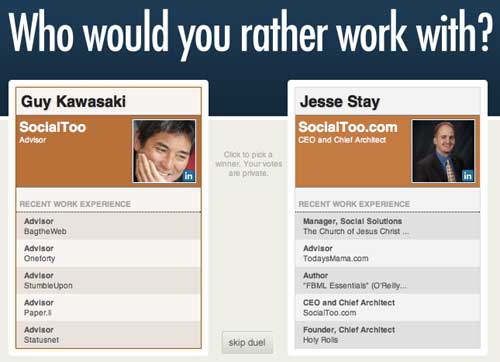
Even if you love your current job or your last job, there's a pretty good chance you had some favorite colleagues, and others who you probably wouldn't mind if they disappeared. You might even have quietly cheered when they were laid off. But most of the time, there's no way for people to know that. Mining your LinkedIn data only shows what companies you worked for and how long. A few more clicks can make it clear who was at the same companies at the same time, and little else. Cubeduel, for reasons unbeknownst to us so far, prompts you to pick who you would work again, one versus another, in a workplace Hot Or Not-like skirmish. Find yourself popular, and your record just might trump that of everyone else.

Cubeduel, which taps your LinkedIn database to find your previous colleagues, surfaces two from the same company and puts them up for you to choose - one or another, just like a duel, but one where a coveted seat in the cubicle farm is a reward. If you've lived a pedestrian career, like I have, you may find yourself faced with two differing degrees of mediocrity, or have to choose between two of your best friends, bringing one to the wonderful world of employment, while kicking the other one to the curb with little more than a cardboard sign and black magic marker.

Cubeduel Asks Who Would I Rather Work With? Guy or Jesse?

The site, first mentioned on Twitter by @daveschappell, was started by Tony Wright, the former founder and CEO of YCombinator-backed RescueTime, and Adam Doppelt, cofounder of Urbanspoon. Wright called it a "fun side project" and said it was "growing quite a bit faster" than expected.

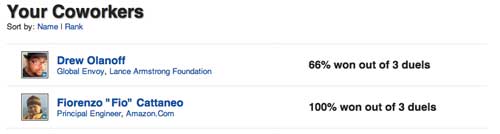
Top Coworkers On Cubeduel So Far...

One Result of A Vote on Cubeduel. Sorry, Ryan...

Anybody familiar with the tried and true model of Hot Or Not can figure out what to do immediately. Two faces come up, and you click who you would rather work with again. The person selected gets 1 vote in their favor, and the other does not. After you have ranked 20 different pairs, you unlock your own rank, assuming people are voting on you, and coworker scores. The game continues after that, begging you to complete 100 matchups, to unlock company specific scores. And who wouldn't want to know how popular one's colleagues ranked against their colleagues, or if you were doing well in the popularity game?

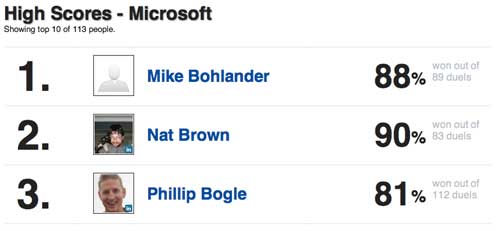
Top Microsoft Employees On Cubeduel

Like Honestly.com, one of the promises of Cubeduel is anonymity. Your colleagues won't know if you picked them or didn't pick them, but leaderboards of the results are public. You can already see how people rank at top companies like Microsoft and Apple, Yahoo! and Google. I'm somewhat pleased to see Phillip Bogle, formerly of Mergelab and Jobster atop the rankings for both Google and Microsoft, given my coverage of him in the past, but I obviously can't swear to his work habits. Maybe his time upon the pile is short lived.

Want to start ranking your former colleagues and push the best folks to the top, and the drones to the bottom? Start a Cubeduel, and go have some fun. It's hiding in public at http://cubeduel.com.

December 29, 2010

Hey LinkedIn, YooHav a Site Scraper Called YooHav.com

Hey LinkedIn, YooHav a Site Scraper Called YooHav.com


Editor's Note: Nicholas James reports YooHav is using the "LinkedIn" template by SocialEngine.

Mass e-mail spam to introduce a social network isn't usually the most advisable way to get press. But after multiple e-mails dripped into my in box today talking of YooHav.com, a new social network to connect with friends, I opted to give the newbie entrepreneur the benefit of the doubt and at least give them a look.

But the first page, asking me to sign up, tells me all I need to know about the service - which obviously and blatantly ripped off LinkedIn's look and feel, including colors, page layout and even the cheap looking clip art you see if you are not logged in. And it gets worse once you start to check out other pages on the site, including dead-end invitations and single-sourced "blog" entries. A total mess.

LinkedIn's Home Page (Logged Out)

YooHav.com's Sign Up Page (Look Familiar?)

Not interested in signing up to another site and providing yet another place to have my contact details misused, YooHav is going to get a big skip from me.

Just as Reeder claimed iPad RSS app copycat MobileRSS had mimicked practically every design attribute last week, LinkedIn will no doubt see the similarities between its own site and that of YooHav.

YooHav features a black text logo with its last few letters encapsulated in a blue box with rounded corners. So does LinkedIn. YooHav features soft blue text to explain its service. So does Linkedin. Yoohav features three bullets explaining its goals next to three pieces of clip art. So does LinkedIn. In fact it's the same three... YooHav's sign up form is in a rectangular box with a rounded blue top. So is LinkedIn's. YooHav then prompts for you to Search for someone by name. So does LinkedIn.

It's pretty obvious what's going on here. At the very least, YooHav has very clearly ripped off LinkedIn's look and feel in a shortcut to make what they bill as "an all-purpose tool for finding friends". I have no clue what they intend to do with your data if you register, or even if there's something legitimate going on underneath the illegitimate makeup.

I invited myself to sign up. Nice e-mail address and title, YooHav.

On Twitter, Shel Israel asked if new social networks like Yoohav get people to join by sending e-mail spam. Hopefully not, but this one is so obviously dirty, you'd have to be twelve degrees of naive to fall for it.