Showing posts with label Toluu (35 posts). Show all posts

January 6, 2014

Feedshare.net Debuts for OPML, RSS Feed Swapping

Feedshare.net Debuts for OPML, RSS Feed Swapping

Update: The previous version of this post said Brent Simmons, author of NetNewsWire, was also the author of FeedShare.net. Turns out I was very wrong! Arne Holzenburg was inspired by Brent's posts and did the work himself. Sorry about that, Arne and Brent!

While many people now get their news from social channels - making the feed subscription model seem rather quaint in a world surrounded by microupdates, RSS still plays an important role for those of us who never want to miss a single post.

One of the earliest tinkerers in RSS and the main coder behind the application which first got me addicted to feeds (See: RSS A Demanding Mistress), Brent Simmons, pointed to a retro OPML sharing service at Feedshare.net on to the Web, letting you share your news sources and find new sites through those posted from your peers. If you're starting to have flashbacks to 2006's Share Your OPML and 2008's Toluu (which debuted here), then that's because Feedshare.net performs essentially the same functionality - but unlike those other two sites, it actually still works here in 2014.

Share your OPML file on Feedshare.net

Arne Holzenburg, a frequent reader of Brent Simmons, like me, was inspired by Simmons' post Saturday that he lamented the lack of an OPML sharing service. Arne took the weekend and built Feedshare. You can find mine is at the expected URL: http://feedshare.net/louisgray/. You can walk through the list, get a direct link to the subscribed link, or hit Favorite to add it to your RSS reader of choice. Mine is Feedly.

Just the Feeds and Nothing but the Feeds.

To add your own OPML file to Feedshare.net, find your list of feeds in whatever RSS reader you use, and find where to export. Most make it pretty easy, which is one of the best things about supporting standards. Easy export, easy import. Take that OPML file and add it to Feedshare, and then tell people where they can find it. And maybe, if you tell enough people, your list will end up on Feedshare's popular page, which already has ten top participants.

That's it! You know what to do. Check out Feedshare.net, and if you've uploaded your OPML, share the link to your feeds and show me what sites I've been missing.

June 17, 2013

Video: How Startups Can Raise Their Visibility Seed Round

Video: How Startups Can Raise Their Visibility Seed Round

Startup success takes more than sharp vision and smart code. Early adopters of your product, along with excited press, bloggers and engaged social users spreading the word can mean the difference. In late March, I gained the opportunity to present to Devoxx France, in Paris, and talk about how startups can find these early first users, how to gain a relationship with top press and use all channels possible to get your word out.

Many of the examples are familiar to longtime readers of louisgray.com, highlighting companies launched here, from Feedly, TweetDeck and Toluu, to some of my own favorite products, like FriendFeed, BackType and Google Reader. The video just came online today. Hope you find it useful.

November 1, 2011

Google Reader Evolves, Gets Tighter With Google+

Google Reader Evolves, Gets Tighter With Google+

This afternoon saw the delivery of updates to Google Reader that brought the product's design in line with Google's simplified look across many properties, and added support for sharing to Google+. With the launch, which I've been participating in since shortly after arriving at Google in late August, the dedicated friending/following network within Reader, and dedicated shared link blogs from Reader, were shut down.

This last bit has gained the majority of feedback as users anticipated the changes in the last week-plus since the preannouncement, and impacts some of the most active users, myself included. But if one unwinds the immediate reaction of being reluctant to change, the product's direction was telegraphed as Google has promised an evolved product experience,  regularly adds features to Google+ and recently announced the planned wind-down of Google Buzz, which was closely tied with Reader's existing commenting model.

In discussing the changes, I walk a fine line of respecting the tremendous hard work that went into Google Reader from the products' founding team and core engineers in the last five years, while also recognizing its role in feeding the product where I am currently focused as an employee. As a user, I have spent more time with and more loyalty to Google Reader than any other product on the web in the last decade, with the only possible notable exception being a web browser, either Safari or Chrome.

In the last month, I've continued to crank through Reader, in the new interface.

At various times, I've said I'd give up my Gmail before Reader. I even wrote a blog post two years ago saying I wouldn't accept $25,000 in cash to give up Reader. This is because Reader has played a central role for me to find all the updates from around the web in a centralized way, and let me share out the best to my downstream network. In years past, as you've seen here, I've rallied for feature adds to Reader, and highlighted the ecosystem of products, from ReadBurner to RSSmeme, Feedly, Toluu, and my6sense.

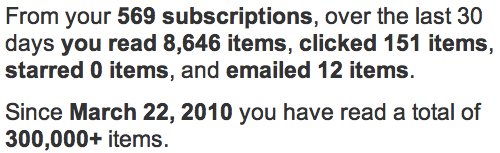
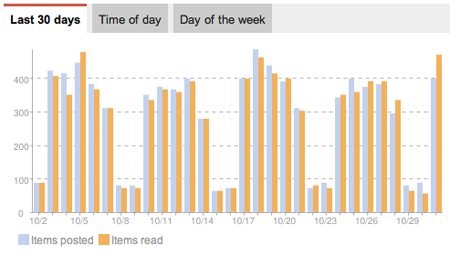
A Day In the Life of My Reader Feeds, Graphed

You can't be a bigger fan of information discovery and consumption than me, unless your name is Marshall Kirkpatrick. But one thing to note is that the web has changed quite a bit since I first started drooling over aggregators like FriendFeed and Google Buzz, and the shared items trackers that sparked to life in 2008 are universally dead. Users have voted on the web to share with social networks like Twitter, Facebook, LinkedIn and Google+, and the new additions to Reader make that easier.

Sharing from Google Reader to Google+ Includes Circles and Commentary

I've personally been using the new Reader, or something close to it, for more than a month, and every time I'd log into the existing version, the difference was notable. Change is hard, but like a new haircut or or new home furniture, it grows on you. Now, instead of sharing 10 or so items a day to the anonymous group of people following me in Reader, I selectively share less often, and to more targeted circles in Google+ which I built by hand. And if the item is interesting to an even wider group, I share it to Public. (More tips here on Google+)

Since the launch this afternoon, I am already seeing a lot more items shared to Google+ from others in my circles, and it's interesting to see how they have adapted to the new functionality, even though others are more wary about the changes. As Alan Green outlined in his blog posts this week and last, Google recognizes the changes may not mean the new product is perfect for all users, and the tools are there to let you take your data with you. But I hope people do see the value of leveraging Reader as a smart RSS feed engine and share selectively to Google+ circles. After a few shares, it becomes second nature, and the world could surely benefit from a streamlined social experience. Trust the team is listening to all feedback from all corners. It's a privilege to have an impact on a product that has played so large a role for me for so long.

June 22, 2011

NewsDrink Preps Next Generation Social Web RSS Reader

NewsDrink Preps Next Generation Social Web RSS Reader

While some noisy Web pundits have declared RSS dead, smart developers see expanded social sharing and connections as an opportunity to rethink news consumption, leveraging RSS as a utility and making it the backbone for new services. Amidst the rise of Twitter, Facebook and other networks, we've seen the launch and rapid adoption of products like Pulse, Feedly, Ninua, Flipboard and others who have taken the geeky parts out of RSS and presented new ways to consume news.

A new site you've never seen, which I've been watching since January, has finally cracked open the door with exclusive invites to its own take on RSS with social connections. The name is NewsDrink, which starts on the Web and will soon follow on with dedicated applications for mobile phones and tablets.

(Get in now at http://www.newsdrink.com with the invite code of "louis")

Scanning Recent News on NewsDrink from My Sources


Based in Bangalore, India, NewsDrink, like other RSS readers, can import an OPML file, synchronize with Google Reader, have you add feeds one by one, or select from their extensive topic-driven directory. Content can be viewed by individual source, or sorted for recency, with newest items at the top.

Reading louisgray.com on NewsDrink

Unlike Google Reader, which is biased toward full feeds, and has a wide array of sharing functionality and statistics for your own activity as well as the blog feeds themselves, NewsDrink favors a more minimalist approach, with feed items truncated to give you a glimpse into the story, but push for downstream views if interested. That said, you can make comments or likes directly on items that flow through your view in NewsDrink, and this site activity is collected on your central profile - which also displays feeds you add or delete.

Adding New Feeds, By Category, On NewsDrink

NewsDrink goes beyond Google Reader when it comes to social, reminding me a lot of RSS projects gone by, including AssetBar in 2008 and the follow-on Shyftr, best known for its aggregation of comments on full feeds, which in my view got them in an unfair share of trouble. You can follow friends on NewsDrink, find friends from Twitter and Facebook who are using the service, and see their activity. Find a feed they are reading that you like but don't have? Add it to your NewsDrink. You can also see people they follow and have an opportunity to discover new people with similar interests - much like the promise of Toluu, another 2008 debut that has seen its founder move on to new projects.

My NewsDrink Profile With Recent Activity On Feeds

Does the world need another RSS reader besides Google Reader, or does the world need RSS at a time when it seems that social sharing is king? I still think there is a place, absolutely. One that is built from the start to be social, but also allows you that solitary approach to get in and read your feeds, could be a solid alternative. NewsDrink is a just starting, so if there are some UI bugs that are not your favorite, or missing functionality, be sure to let them know. It's all part of the fun of beta products.

To get into NewsDrink, use the invite code of "louis", without quotes. There should be enough invites for everyone. You can find NewsDrink at http://www.newsdrink.com.

February 21, 2011

Yobongo: The Open Chat Room In Your Pocket (Preview)

Yobongo: The Open Chat Room In Your Pocket (Preview)

In the four months since Yobongo first gained attention, CEO and co-founder Caleb Elston has been working to prepare his product for the visibility and scale potentially demanded by what's potentially the world's biggest tech event, SXSW, an environment which can catapult new sites into the stratosphere, or should they fall flat, have them forced to regroup. The service, currently in private beta on the iOS platform, has seen increasing activity at practically all hours, the equivalent of an open bar for discussion with members of the local community, which never closes.

In the last few weeks, I've finally found a reason to keep my iPod Touch nearby, in a home full of Android devices. The magnet-like pull is from Yobongo, whose goal is to bring people, potentially perfect strangers, who share a geographic location, together to talk about anything. The application's real-time nature, enabling true conversations between friends and others, goes beyond the world of serve and volley status updates or Q&A, putting the focus back onto the world of conversation instead of performance and counting of replies, retweets and likes. In fact, there are no points of feedback for updates - just a constant flow.


Yobongo in Action. Note notifiers for private messages, number of people chatting.


The concept hasn't changed since October, with the idea being people in shared spaces may discover they have common interests and can engage in intriguing discussions. For the many of us who routinely bump into the same faces and avatars on every network, this could be refreshing. Yes, just like any other social situation, it's easier to talk to those you know than those you don't, but Yobongo eases that process by mixing everyone in a single space.

So each morning, after turning off the iPod's alarm, I peek at Yobongo to find Caleb talking with users in the private beta. Some folks I know, and others I don't, but I am getting to know. And it's incredibly easy to jump into the stream of consciousness. For one, your avatar displays when you open the app, so they can welcome you. Second, the app doesn't start with a blank screen, but shows all the text flowing through the river - with the newest updates below. Should you want to, you can scroll up and see how the conversation evolved, see updates from people whom you may have missed, and get caught up.

Posting to the site couldn't be easier. There are no groups to join, as with other apps, some I like a lot (including Beluga and TextPlus). There are no demands to friend folks, as you're already connected to everyone live. And once you start typing, everybody knows because the system lightly says "... is typing." If more than one person is typing, the system updates there too. So you immediately, even in a small space like the iPod Touch, get an idea for all the participants, the ongoing messages, you can get updated on private conversations and see the thread as it evolves. Not bad.


An active Yobongo chat and a separate private message.


Caleb, previously highlighted on this site for his work with Toluu, Kallow and Kickpost, started the project with fellow Justin.TV ex-colleague David Kasper, who is responsible for engineering while Caleb handles product, the "yin and yang" of the operation as it stands now, he told me. While the company has been mentioned in the same breath as big group chat monoliths like GroupMe and others who have raised millions, Yobongo has not yet taken any funding. Lucky for them, they do have free residence at Dogpatch Labs, courtesy of Mike Hirschland and Ryan Spoon of Polaris Ventures, who would probably have the first in to a round A if Yobongo wanted to be YoFunded.

Like Quora, Facebook and other sites, Yobongo holds a few rules to help avoid abuse of the system. It's preferred that guests use real photos and use their real names. The app's short community guidelines ask to "be friendly", "be respectful" and "be authentic".

Does the world need yet another place to chat beyond the big social networks, and new places like Convore or the host of group messaging participants, including Beluga, GroupMe, MessageParty and TextPlus? It seems to me there is room for a lightweight system that doesn't feel like work, that is open to all who arrive, and leverages proximity. Whether Yobongo is the solution to an event like SXSW or not, only reaching those on iOS, remains to be seen, but I can see clear value to talking with both the friends you know, and the friends you don't yet know.

You can get in on Yobongo's private beta list by heading to http://www.yobongo.com. The service's first official intro video is below.

October 9, 2010

Yobongo App Encourages You to Chat With Local Strangers

Yobongo App Encourages You to Chat With Local Strangers

Before the advent of personalized home pages, blogs, and social networks connected to our real identities, many of us participated in anonymous chat rooms, where we tried to connect with strangers with similar interests. These chat rooms were filled with intrigue of finding new conversations and insight from people we might never meet in real life. Some were about hobbies or careers, and many more were built with the goal of hooking up, but others were about location. Today, with our smartphones having the option to determine our location, and with virtually all of them having pervasive access to the Internet, there lies an opportunity to recreate the chat room experience on the mobile, with strangers, tied together by our GPS coordinates. An old friend to louisgray.com readers, Caleb Elston, has announced he is leaving a comfortable job at Justin.tv and striking it out on his own to spread the word about this new experience - and it's called Yobongo.

Caleb first crossed our radar more than two and a half years ago with the launch of his shared OPML site, Toluu. At the end of 2008, Elston started a gift recommendation site, called Kallow, and earlier this year, he launched a Techmeme-like site for top news, called Kickpost. But unlike those three projects, Yobongo is going to get his full attention - as he believes it "is going to be a big thing."


Starting a Yobongo Account, Alerting Local Friends


I spoke at length with Caleb Thursday night, before his announcement, to learn why Yobongo has got him changing his life path, and found not just what inspired its start, but also, details about how the product has been in open testing in Canada for several months.

The idea came about when Caleb was in a crowded movie theater. In advance of a showing, people were "fooling around" on their cell phones. As he recalls, people called out funny lines on the previews and microconversations started happening. As he thought about it, he realized there lay an opportunity to connect everyone in the theater, leveraging smartphones' location capabilities and introducing real-time chat for those connected. But existing solutions were almost exclusively explicit or sexually-based, and there remained an opportunity for a non-adult option, to connect complete strangers for whom location was the single link.


An Active Yobonbo Chat Room


"We thought there might be a possibility you could communicate with people you didn't yet know but shared a location, while using your real identity," Caleb said. "It has to be instant, with no rooms to join, all one one screen."

The algorithm behind the product starts with a basic premise of the target number of people who are active in a single room. The current target of 20 people feels full to users, and there are several dozen active Yobongo sessions, with 2-3 of them in Toronto. Why hasn't Yobongo yet come to the US? Caleb says the company doesn't yet want to launch in full in the country until the mechanics of being truly hyperlocal are solved.

"The big thing is that we believe chatrooms will live on in mobile phones, just as they lived in the late '90's," Caleb said. "The problem then was the bad actors were so motivated, and they had the technical ability to circumvent banning mechanisms, making regular people uncomfortable. But in the earliest days, it showed promise of connecting people."

With Yobongo, identity is tied to a unique phone. If a bad actor is banned, you would essentially have to buy a new phone. Also, in the last 20 years, the culture and technology of the Internet has evolved to make revealing one's true identity more comfortable and accepted.

"Authentic communication can happen between people you do not know," Caleb argued. "For the personal device you have with you all the time, connecting to people is an exciting mechanism. There are more mobile connected devices next year than PC devices."

The application is initially targeting iPhone users, but with time, one should suspect the app to hit more screens and more systems. As Caleb told me, it's "iPhone only right now - but that's not the end game".

July 18, 2010

KickPost Predicts Popular Posts for Top Tech News

KickPost Predicts Popular Posts for Top Tech News

As technology news sites have proliferated in the last few years, so too have technology news aggregators looking to find the best of the Web and surface it quickly - either through social voting mechanisms, insightful editorial picks, or complicated algorithms. In addition to the Diggs and Slashdots of the world, one finds Hacker News and Techmeme as the gold standards offering the front page of today's tech news. Now, there is a new site that has entered the fray - though minimalist for now - armed with what the founder calls a predictive algorithm which just might find top stories faster than anybody else.

The site is called KickPost (http://www.kickpost.com) and it comes from the hand of Caleb Elston @calebelston, the vice president of products at Justin.TV, who is also known to frequent blog readers here as the man behind Toluu, the RSS discovery site, and the gift recommendation site, Kallow.

One Item from KickPost Shows The Time of Post, Source and an Excerpt

In a discussion on Hacker News about the launch of KickPost, Elston describes the site as a "new tech news aggregator that uses a predictive algorithm based on historically popular stories to predict which stories will be popular in realtime." He adds, "We are about 20min faster at predicting hot stories than Techmeme."

Another Top Story on KickPost

The site displays the headlines of predicted top stories, as well as a short excerpt, the author's name and the post source - with the headline linking to the original story and the source to the blog's main page. Stories are ordered chronologically, with the most recent at the top, and older ones below, with a time stamp showing how recently the posts entered KickPost's index, and the page automatically refreshes when new stories enter the index.

From a quick perusal of the site, it's clear that top tech stories are making it into the index - and they are being found fast. But the site sources are very common to so-called A-List blogs that dominate many other sites, including VentureBeat, Gizmodo, TechCrunch, and Lifehacker. Where more editorially-driven sites, including Techmeme, have an advantage is through manual discovery - something a purely algorithm-driven site like KickPost can't catch. The one-off top stories from new sources will have a tough time making the index, from what I can tell, even after scrolling back 2 days into past KickPost content.

Given Caleb's history for parsing RSS feeds and finding how your own likes intersect with those from the community, I would anticipate where KickPost would really gain value over the competition is through personalization and building the top stories in near real-time based on individual's preferences, not just through beating Techmeme and others by a handful of minutes with headlines from top blogs. But it's a site we'll be watching.

Find KickPost at http://www.kickpost.com/ and on Twitter at @kickpost.

July 31, 2009

Five Blogs Under the Radar: July 2009 Edition

Five Blogs Under the Radar: July 2009 Edition

Seventeenth Edition Of a Monthly Series

As we wrap up July, it comes time again to highlight some enterprising bloggers who are practicing their craft with little attention - or at least a lot less than some of the brand names we frequently run up against. This month's edition, like the others, brings new voices into the sphere who you may want to start reading and follow. Each month, I try to find five new ones that you may not have heard, who are working hard in obscurity. Most are interested in a lot of the same things I am - including technology, information gathering, gadgetry and social networking.

To get on this list, bloggers need to post regularly, cover something resembling technology, and have less than 1,000 subscribers or so, with very rare exceptions. We are more than happy to take nominations as well, either here, by e-mail, FriendFeed or Twitter.

The July 2009 blogs are:

1) In the Mind of Damond Nollan (damondnollan.com)

Focus: IT Management, Education, Software, Internet Services
Three Recent Posts:RSS Feed: Subscribe Now

2) Victus Spiritus by Mark Essel ( victusspiritus,com)

Focus: Investment, Technology, Social Networking
Three Recent Posts:RSS Feed: Subscribe Now

3) Adam Sherk (www.adamsherk.com)

Focus: Publishing, SEO, Public Relations
Three Recent Posts:RSS Feed: Subscribe Now

4) TrendsSpotting (trendsspotting.com)
(This violates my rule of 1,000 or fewer subscribers, but I bet it's new to many of you)

Focus: Statistics, Trends, Social Media
Three Recent Posts:RSS Feed: Subscribe Now

5) Social Squared by Jess Sloss (socialsquared.com)

Focus: Social Media, Marketing, Lifestreaming
Three Recent Posts:RSS Feed: Subscribe Now

Want to be on this list? You can catch my eye by posting great information in the field of technology, social media, blogging and the Web. I'll be more likely to highlight you if you blog almost every day, and bring new stories to the table that don't repeat discussions launched elsewhere. And if you have more than 1,000 subscribers, you're usually too big for this.

To see even more new blogs I'm adding to my reader, or get a sneak peek for next month's highlighted blogs, follow my activity on Toluu. If you don't have a login to Toluu, send me an e-mail to louisgray@mac.com and I'll get that set up right away.

July 13, 2009

We Have Invites! Five Stages of Beta and Battling to Get Access

We Have Invites! Five Stages of Beta and Battling to Get Access

When launching a new service, entrepreneurs have a myriad of things that make them nervous. Maybe the product won't be seen as having value. Maybe competitive offerings are good enough. Maybe there are bugs that nobody has discovered yet. And sometimes, the rush of new users who arrive to kick the tires is enough to break the system, as the infrastructure is not ready. To help reduce such public outages, many products start out with a small audience, and there are many ways to grow slowly, each with their own pitfalls.

1. The Closed Private Beta

Often sites will have a private beta period, open only to a known set of users, typically starting with the company's inner-most friends and supporters. In order to get onto the list, you have to know somebody at the company, or be so influential to gain early access.

The upside for a private beta to the developers means that typically the product is in safe hands of people who understand what you are doing, and are willing to forgive rough edges and mistakes. Also, the small load means you can fix bugs leisurely without the threat of public exposure.

The downside for the private beta is that the site itself still isn't really being tested by a more natural audience, either in terms of how they plan to use the service, or in terms of scale. What might work during a closed private beta might not be good enough when the doors open.

2. The Private Beta With Open Invitations

Sometimes, a site will start with a private beta period, but users can invite their friends - often a limited number. You saw this with GMail back in 2004, when early users could invite others, but only a few at a time. Similarly, FriendFeed did the same in 2007, as did Toluu in 2008, closing their early sites off to the mainstream, but letting you in if you knew somebody who had already gotten through.

The upside for this process is much like the closed beta in that the audience is going to be relatively forgiving and small. Also, the influx of less-known people can give a more realistic expectation of what features are needed and which need to be improved.

The downside for this process is that there may be people who could help try the product who don't have an in, so their interest is muted. Also, the small group tends to be insular and will use the product differently than an open audience.

3. The Numerically Limited Invitation Beta

After internal testing, some products will release a known quantity of invites, either through their Web site, or the media, in an effort to expand the testing, and give early users a flavor of the site. The invites, often tied to specific sources for tracking purposes, can range from few dozen to hundreds or even thousands, depending on how robust a test, and how deep the infrastructure. We've recently seen this approach with the site Lazyfeed, which gave out a few hundred invites in the last week by way of TechCrunch, ReadWriteWeb and from me, both on FriendFeed and Twitter.

The upside in this case is that this wave of users best simulates actual usage of a product, to see what is working and what is not working, while stressing the system's back-end only to a predetermined level.

The downside is that users who don't get to the invites quickly can get discouraged, and often, the very first people to get in aren't necessarily the ones who will most deeply investigate your product, but instead, happen to be those who were fastest at getting to the news and signing up.

4. The Open Beta

For some services who don't want to limit the testing, they might open up a site to all who wish to register, but do so under the guise of a "beta" tag, explaining that some features might be missing and others might break. While anybody can enter, they should not assume full functionality. You could see this with GMail for years, even after the product went away from strict invites.

For developers, the upside here is that they have a perpetual excuse for problems. But it's beta! Also, any user who wants in can get in, without having to get on a list or know someone. It also can often give the ability to stress-test a product under the impact of a large audience.

Downside is more limited, but can be seen if users are more wary of beta products, preferring to wait until they are more stable for use.

5. No Beta

Some products might skip the beta process altogether. They are just open for business, period. This removes the guise of the testing period and lets the entire audience at them at once. I call this the "Open. Fail. Scale." method, because often there are bumps along the way that come with growing a product, and one can never anticipate them all. Twitter would be a fantastic example of this, although both its fail and scale have gone on more than anticipated.

So how do you choose, if you are an entrepreneur, how to get your product out the door? You can see, for instance, that Brizzly, by Thing Labs, is still in Private Beta. (And I want in) Lazy Feed is opening up more, and you can get an invite here. They each may have their own reasons. In the example of Brizzly, it's probably not ready yet. For Lazyfeed, maybe they aren't ready for a million support questions and they want to start slow.

I tend to believe you should open as big as you possibly can without breaking. If users want to get in to your service, don't stop them in their tracks. Just set expectations and work with them as partners to continue to improve. Don't insult them by using beta as an excuse, but instead as a stepping stone. And yes, get me in as early as possible. I promise I won't break anything.

June 30, 2009

Five Blogs Under the Radar: June 2009 Edition

Five Blogs Under the Radar: June 2009 Edition

Sixteenth Edition Of a Monthly Series

Even as many people are debating the importance of blogging, the number of active bloggers is still growing. And even if we have grown comfortable with the number of people we are reading, there are voices we are no doubt missing. Each month, I try to find five new ones that you may not have heard, who are working hard in obscurity. Most are interested in a lot of the same things I am - including technology, information gathering, gadgetry and social networking,

To get on this list, bloggers need to post regularly, cover something resembling technology, and have less than 1,000 subscribers or so. We are more than happy to take nominations as well, either here, by e-mail, FriendFeed or Twitter.

The June 2009 blogs are:

1) Jungle G by Jorge Escobar (jungleg.com)

Focus: Social networks, Influence, Technology
Three Recent Posts:RSS Feed: Subscribe Now

2) Spatially Relevant by Jon Gatrell (spatiallyrelevant.org)

Focus: Product development, Social media
Three Recent Posts:RSS Feed: Subscribe Now

3) Sticky Figure by Steve Woodruff (brandimpact.wordpress.com)

Focus: Social Networking, iPhone, Marketing
Three Recent Posts:RSS Feed: Subscribe Now

4) OwenGreaves.com (owengreaves.net)

Focus: High Tech, Business, Social Media
Three Recent Posts:RSS Feed: Subscribe Now

5) Twittercism (twittercism.com)

Focus: Twitter, Microblogging
Three Recent Posts:RSS Feed: Subscribe Now

Want to be on this list? You can catch my eye by posting great information in the field of technology, social media, blogging and the Web. I'll be more likely to highlight you if you blog almost every day, and bring new stories to the table that don't repeat discussions launched elsewhere. And if you have more than 1,000 subscribers, you're probably too big for this.

To see even more new blogs I'm adding to my reader, or get a sneak peek for next month's highlighted blogs, follow my activity on Toluu. If you don't have a login to Toluu, send me an e-mail to louisgray@mac.com and I'll get that set up right away.

May 31, 2009

Five Blogs Under the Radar: May 2009 Edition

Five Blogs Under the Radar: May 2009 Edition

Fifteenth Edition Of a Monthly Series

One of the more fun things I get to do on this blog is highlight other voices from around the world who crave tech or have insight into the Web we're all weaving. I recognize others made sure to give me airtime on their own sites, and the right thing to do is to return the favor. For the last year-plus, we have hand-selected five new blogs for you to review and, hopefully, subscribe. By following these new voices, you can get additional viewpoints outside the common echo chamber. And who knows, maybe some of these people will eventually become household names?

To get on this list, bloggers need to post regularly, cover something resembling technology, and have less than 1,000 subscribers or so. We are more than happy to take nominations as well, either here, by e-mail, FriendFeed or Twitter.

The May 2009 blogs are:

1) Almighty Link (almightylink.ksablan.com)

Focus: Social networks, hyperlinking, media, search
Three Recent Posts:RSS Feed: Subscribe Now

2) Advocate's Studio (advocatesstudio.wordpress.com)

Focus: Legal, Blogging, Technology
Three Recent Posts:RSS Feed: Subscribe Now

3) Blind Five Year Old (blindfiveyearold.com)

Focus: Google, RSS, Technology
Three Recent Posts:RSS Feed: Subscribe Now

4) Techgeist (techgeist.net)

Focus: Google, Web Browsers, Search
Three Recent Posts:RSS Feed: Subscribe Now

5) Deliberate Ambiguity (deliberateambiguity.typepad.com)

Focus: Search, Microsoft, Technology
Three Recent Posts:RSS Feed: Subscribe Now

It's amazing how more than a year after starting this process, I am still impressed by the high quality writing by some of these lesser-known blogs. Some of those highlighted this month are among the best I've seen in a long time. Want to be on this list? You can catch my eye by posting great information in the field of technology, social media, blogging and the Web. I'll be more likely to highlight you if you blog almost every day, and bring new stories to the table that don't repeat discussions launched elsewhere. And if you have more than 1,000 subscribers, you're probably too big for this.

To see even more new blogs I'm adding to my reader, or get a sneak peek for next month's highlighted blogs, follow my activity on Toluu. If you don't have a login to Toluu, send me an e-mail to louisgray@mac.com and I'll get that set up right away.

April 30, 2009

It's Not Too Late to Spring Into Reading 5 New Blogs

It's Not Too Late to Spring Into Reading 5 New Blogs

Fourteenth Edition Of a Monthly Series

The new tradition to our monthly highlighting of five less visible blogs appears to be delivering it at the very end of the month, rather than the beginning. Just because it's posted at the end of April doesn't make these selections any less relevant or important than any other month. This is a feature I look forward to every month, and it's always fun to make the selections.

If you are new to louisgray.com, we have been trying to extend the blogging ecosystem, finding what Tac Anderson calls "the good long tail blogs". We know many of you get tired of the the echochamber, so we are more than happy to bring you some new voices. To get on this list, bloggers need to post regularly, cover something resembling technology, and have less than 1,000 subscribers or so.

With that intro, here are this month's selections...

1) The AppsLab (theappslab.com)

Focus: Oracle, Web 2.0, Technology
Three Recent Posts:RSS Feed: Subscribe Now

2) Rick Klau's weblog (tins.rklau.com)

Focus: Blogger, Google, Twitter
Three Recent Posts:RSS Feed: Subscribe Now

3) The Programmer's Paradox (theprogrammersparadox.blogspot.com)

Focus: Software, Development
Three Recent Posts:RSS Feed: Subscribe Now

4) New Comm Biz (newcombizz.com)

Focus: Technology, Blogging, Social Networking
Three Recent Posts:RSS Feed: Subscribe Now

5) Guruvan (guruvan.gurus.net)

Focus: Social Networking, Marketing
Three Recent Posts:RSS Feed: Subscribe Now

Want to be on this list? You can catch my eye by posting great information in the field of technology, social media, blogging and the Web. I'll be more likely to highlight you if you blog almost every day, and bring new stories to the table that don't repeat discussions launched elsewhere. And if you have more than 1,000 subscribers, you're probably too big for this.

To see even more new blogs I'm adding to my reader, or get a sneak peek for next month's highlighted blogs, follow my activity on Toluu. If you don't have a login to Toluu, send me an e-mail to louisgray@mac.com and I'll get that set up right away.