Silicon Valley Technology Commentary & Archives · Est. 2006 3,045 Posts · 2006–2026
Showing posts with label Spam (23 posts). Show all posts

October 20, 2018

October 20, 2018 · 3 MIN READ · BY LOUIS GRAY

Comments as a Platform, Or Silencing the Trolls

Comments as a Platform, Or Silencing the Trolls


Web content has typically divided into three camps - those who create, those who react, and those who just watch. The lurkers, if you will. From the very earliest days of blogging, those first posts awaited the inevitable comments, and, given a clear revenue stream, you would see early participants like Fred Wilson say that "comments are how bloggers get paid."

[Source: https://vanelsas.wordpress.com/2008/06/02/the-real-value-of-social-media-interaction/#comment-2531]

The earliest engagements we had with people who read our site gave us incredible discussions, and spawned more posts and even, in rare cases, changed minds. Sites like Digg, Reddit, Slashdot and others became known for their diverse threads, and those in the comments are why you showed up.

But we've also seen the pendulum swing the other way. Everybody knows to "never read the comments" on popular news sites, as the most aggressive vitriol and ignorance floats to the top. YouTube comments have long been notorious for their lack of quality (though I feel this has improved of late). And Twitter, for many who should be able to use the platform, their every move can attract trolls who have a vendetta to take them down - but somehow don't get banned.

As social media sites eclipsed the momentum of blogs, conversations moved. We adapted by integrating social discussions from FriendFeed, Facebook and Twitter and appended them to our blogs. We would all share our posts on social, and then engage where the content landed. The best bloggers would find their readers wherever they were. But others simply turned comments off. Maybe it is because they were full of spam (they were) or the quality wasn't there (often true), but also, because the total quantity declined.

Let's go back to talking about Twitter. Twitter drives me nuts because it's fantastic and so poor at so many things. They seriously have real-time on lockdown. There is no better place to see what is happening right now. If there's a calamity, search Twitter. A breaking news event? Search Twitter. A sporting event? Twitter.

But Twitter has this awful habit of giving all users an equal voice. Now hear me out what I mean.

If you tweet publicly, anybody who you haven't blocked can reply, and their content is appended to your tweet. It follows you around. If a Republican politician posts, left-leaning posters race to take down their message, while the MAGA crowds prop it up and try to gain eyeballs. If the Kardashians say something, the crowds pounce on the valuable real estate quickly to show their adoration or pimp whatever link they've got going.

And down the publicity food chain, if you're a woman, especially a visible one, you get awful men saying foolish things. I guarantee it. They may call you names or question your ability. You block one and ten more pop up. If you're black, or Jewish, the racists will find you. They all know how to tweet.

So what I recommend above all other Twitter changes is the ability for people to reclaim their space. Hillary and Trump should both be able to post information without the crowd's replies being appended. Just like blogs and YouTube stars can turn comments off, Twitter users should be able to as well. The thing about social networks (and most products, to be honest) is that you should give the users control. But they haven't done it, and I think it delivers a great disservice to the platform, which has become a hotbed of harassment and hate - as Reddit and others have too.

If you can trust your commenters enough to give them a voice, by all means, amplify their voices. But when they have shown you time and again that they cannot be trusted, turn it off.

September 4, 2014

September 4, 2014 · 5 MIN READ · BY LOUIS GRAY

Striving for Streams of Serendipity or Inbox Zero?

Striving for Streams of Serendipity or Inbox Zero?

Nobody really likes spam - those unrequested commercial emails that join your email box. They interrupt you, distract you, mislead you, or maybe worse - trick you into giving up your money or personal information. And over time, most email services have been pretty good at determining just what is spam, and what's not, while we, as consumers, are getting better at refining just what content we want on all our screens, be it our email box, or our social streams.

With this experience, what we've labeled as spam now not only encompasses the obvious scam message, but practically anything that enters our view that we didn't explicitly ask for, or surprises us. Most of us living in a social media powered world have taken a lot of effort to refine our content sources, to the right sets of blogs, and the right friend groups on social networks. When we log in to Twitter, Facebook, Google+ or anywhere else, we pretty much know what we're going to get.

Many of these social networks, dating back to the first blogs, are sorted chronologically, with the newest content at the top. With some effort, you can quickly scan to where you last left off, and feel complete. There's no more to read, and you can move on to the next thing. It's a permuation of the famed "In Box Zero", which says your task is complete.

But increasingly, thanks to pressure to fill streams of less active users, or to increase engagement from regular users, it's become more commonplace to push content that's not explicitly requested into user streams. This can be "Friend of a Friend" content, like we saw back in early 2008 when FriendFeed first introduced the feature, or more recently, items that your friends on Twitter have retweeted or favorited, that Google+ friends have +1'd or Facebook friends have Liked.


It's assumed the more signals given to the network about what your friends like, the more likely it is that this piece of content is also relevant to you. It's not necessarily wrong, but it's a change, unwelcome to people who like to perfectly curate their streams - while possibly exciting to those who do want to take signals from the network - believing they aren't the one perfect arbiter on whether an item is interesting or not.

In 2008, FriendFeed spoke to this change, saying, "Our goal is to make the most interesting shared items more prominent so your FriendFeed has a higher percentage of interesting stuff and active discussions." And it worked. If I believed +Paul Buchheit had high quality interactions, I could be alerted to items on the stream that he had liked. But FriendFeed also gave me the option to turn it off, and many people did.

In 2014, Twitter is a lot bigger than FriendFeed was six years ago. It's a world-recognized stream for real time communication, so their moves get a lot of attention. Every minor change in the stream is especially scrutinized. After already taking for granted the fact that retweets from friends would be sent to my stream, the occasional tweet now appears, simply because someone I follow added it to their favorites. Unsurprisingly, this experiment, which is easy to spot on their mobile app, set the tech blog debates abuzz again - trying to figure out how it worked, and whether it was good or bad.


It's widely assumed putting content in user streams benefits the service provider. Twitter should see higher engagement, higher relevance and more clicks. For the OCD "In box zero" types, these serendipitous pieces disrupt their worldview, and, unsurprisingly, those who write about tech and social media all day are more likely to be of this type than the general population.

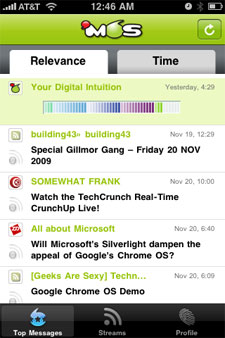
When +Barak Hachamov and I were working on my6sense, we were more than happy to rank social streams based on your activity and implicit interests. The solution, in my view, hasn't seen an equal, even in the three plus years it's been gone from consumer's hands. We offered a stream based on relevance, with your interests playing a huge role, a toggle to view the stream chronologically, and yes, we promised occasional serendipity to deliver surprise - to get you out of a knowledge rut, which can come from seeing the same topics debated and shared by like minded thinkers.

Relevance vs Time in my6sense

What we've learned from the Web is that we tend to gravitate to people who reinforce our own views and agree with us. Debate happens, but we don't actively seek out opinions from those with opposing takes on political, religious or even sports. (I wrote about this in 2006: Blogging Bifurcation - A Web Divided) The Web, despite being especially diverse, leads to us forming cliques, with friends, with what we read, and where we choose to congregate. Our three social pillars are what I called out back in 2009: Technology, Community, Relevancy. Most of us active in social streams have bought into the technology, and crafted our community, assuming the community's thoughts are themselves relevant. And by seeing new content, we immediately question its relevance.

For the 95%+ of people who haven't put hundreds of hours into scanning their streams to never miss a post, and who haven't taken time to set up lists, form circles, or fully understand Facebook sharing settings, the serendipity of surprise is as important as what they've explicitly asked for. While those of us on the tech edges react to the surprise with shock, we should know this is something we give in exchange for participation in somebody else's stream. The only thing I'd ask is that, like FriendFeed, we always have the option to please, kindly, be able to turn something off. Then we'll all be happy.

Standard Disclosures: I work on the Google Analytics team at Google, which provides Google+. Various services from Google partner with or can be assumed to compete with products from Twitter and Facebook. Also, from 2009 to 2011, I had a consulting relationship with my6sense as part of my work with Paladin Advisors Group. Disclosures are fun.

July 23, 2011

July 23, 2011 · 1 MIN READ · BY LOUIS GRAY

Automating Spam Removal Is A Tricky Challenge

Automating Spam Removal Is A Tricky Challenge

Automating the detection and removal of spam accounts, fake profiles and other similar tasks is a tricky one. Assuming you have a 99% detection and response rate, the 1% "false positive" can be a humongous headache. With many people debating the right approach to taking down accounts, flagging spam and the like as this network evolves, check out this great article from the oddly titled "Laughing Meme".

See: Cost of False Positives on Laughing Meme

/via My Google+ Profile.

March 8, 2010

March 8, 2010 · 2 MIN READ · BY LOUIS GRAY

SocialToo Expands Twitter Phishing Protection to All Users

SocialToo Expands Twitter Phishing Protection to All Users

Increased use of Twitter has made the users sharing and clicking on links more attractive to both legitimate businesses and ill intended people looking to steal passwords or guide you to unsavory sites. Seemingly each week there are new stories about phishing attempts that prey on direct messages (DMs) from trusted people, and if compromised, these accounts could lead to more spam, just spreading the mess further. SocialToo, a company led by Jesse Stay, and one where I am an advisor, has opted to take a proactive approach to enable phishing protection for all users, not just those with a premium setup, or those who had manually enabled filters themselves. The result is a much-improved, and safer, Twitter environment.

The move, as outlined in Jesse's post from this morning, means that anybody who has ever created a SocialToo account, even a free one, is protected from receiving direct messages that contain known phishing attempts.

Prior to today's move, SocialToo had already blocked nearly 20,000 malicious messages, just on the 2,000 users who had enabled the feature, an average of about 10 per user. With phishing protection now enabled for 60,000+ accounts, the volume should similarly scale thirty-fold.

Over the time Jesse has been working on SocialToo, there have been multiple instances where his application has publicly noted phishing attempts faster than any official word from Twitter, or the press covering Twitter. Rather than leverage this opportunity to extract money from users, we agreed it made more sense to do the right thing and get these protections out to the much wider audience.

"As has always been a priority, we feel keeping your stream clean and the web in general a cleaner place is important," he writes. "Hopefully this makes a significant change in how clean the streams of Twitter users are."

As an advisor, and as a SocialToo user, I have had phishing protection enabled on my account for quite some time, and the coverage of such attacks almost catches me amused, as I never see the ill-intended direct messages targeting my mail box. In fact, SocialToo tells me more than 140 direct messages to me have already been filtered, automatically.

I believe that using Twitter without having SocialToo enabled would be as silly as running a Windows computer without having antivirus enabled. Even if you won't convert to the premium plans offered by SocialToo, you should set up an account to get your Twitter messages protected.

DISCLOSURE: I am an unpaid advisor to SocialToo. I hold a small equity stake in the company.

December 9, 2009

December 9, 2009 · 3 MIN READ · BY LOUIS GRAY

Fighting Bots With Bots on Twitter, Leveraging SocialToo

Fighting Bots With Bots on Twitter, Leveraging SocialToo

Many Twitter users are caught in an odd conundrum - between being open to random connections and being open to a glut of unfocused spam-like bot behavior. While I believe the allure of high follower counts has largely been eroded, thanks due in part to the controversial Suggested User List and growth of spam accounts with high connection numbers, many still see higher "value" in the raw numbers of the network. So how does one maintain an open door policy that allows for two way direct messaging all while keeping one's stream clean? the answer is different for everyone, it seems, but I thought I would share some of the ways I am leveraging SocialToo, a service I advise, to improve my Twitter experience.

When I first started using Twitter, I enabled autofollow by SocialToo, so I could automatically be connected to people, enable two way direct messaging, and not look disconnected. But as junk followers figured this out, my steam became overwhelmed with direct marketers and news repeaters that didn't add to the conversation. So, while avoiding the option to do a mass unfollowing of all (see a post on that from September), I first turned off the autofollow option and have taken subsequent steps to clean up the results.


TwitterCounter Shows the Drop In My Following Counts


First Step: Block all direct messages that are spam or for viral games.

SocialToo lets me block DMs that contain keywords or search strings like "Mafia Wars". I can either block those DMs outright, or have that person be unfollowed.

Second Step: Block all direct messages that are for phishing schemes.

SocialToo, once notified of an ongoing scam, blocks all direct messages that match a specified string for all SocialToo users, myself included. This way, even though I use a Mac instead of Windows, I won't even be tempted to click on a fake URL, because I'll never even see it.

But even then, I still saw a lot of marketing and garbage in my feed. Preferring not to unfollow everybody and make a mess of things, I started to unfollow junk one by one in my stream, separating the bots from the people. That worked, but it doesn't scale to the thousands of folks who might need 1-1 attention this way. But what I did notice was a pattern. The spammers and repeat Tweeters were almost all using automated tools to generate their dreck, usually from "API" or from TwitterFeed.

Third Step: Ask SocialToo to unfollow all Twitterfeed or Blip.fm or API bots.

I reached out to Jesse and asked him if he could enable SocialToo to automatically unfollow the bots in my stream who I identified were using these tools. In the first two days, more than 1,000 bots were cleaned up, and in the last few months, as I've used this unreleased feature, about 3-4,000 followed have evaporated, leaving me with a still large following count, but a much more relevant count.

Yes, there are some legitimate people using Twitterfeed, and so they too got unfollowed, which leads to stage four.

Fourth Step: Add people to my SocialToo whitelist to never unfollow.


Some of the people I automatically unfollowed noticed and let me know. On other occasions, I found it out myself, and thought that was silly, so I just logged into SocialToo and added them to my whitelist which means no matter the tool they use, they will still be connected.

In the few months of reducing the noise on Twitter, I have reduced the people I have been following from almost 15,000 at peak, to just over 10,000 today. I expect that barring my following more groups of people, this week I should drop below 10,000 total and the service will look better and better.

I may advise SocialToo, but I do so for reasons just like this. Sometimes issues I find can lead to real product features. And while Jesse hasn't yet rolled out the option to unfollow based on a specific source, he may in the future, and you'll see real benefit.

Disclosure: I am an unpaid advisor to SocialToo and have a minor percentage equity stake.

September 14, 2009

September 14, 2009 · 3 MIN READ · BY LOUIS GRAY

Automated Tweets Don't Always Mean Less Genuine Tweets

Automated Tweets Don't Always Mean Less Genuine Tweets

With the introduction of an updated terms of service last week, Twitter once again had people buzzing about what was accepted behavior on the fast-growing microblogging site, and what crossed the line. In one of the site's frequent list-based articles dedicated to the San Francisco company, Mashable claimed one of the targets of the update was what they termed "bots", which were updated by RSS feeds moreso than by humans. In the post, Jennifer Van Grove specifically used the popular IMDB account as an example of one that should "live in fear of death". But all drama aside, I don't think that's Twitter's intent, nor do I believe that the sole delineation of whether an account is pulled by RSS instead of through text, for example, calls for the label of "Spam".

The truth is that a significant number of news-based accounts are clearly automated, very often by the use of RSS, because Twitter has become more than just a place to send updates. It's infrastructure. And even if these accounts aren't automated through RSS, practically all of the top accounts are full of a stream containing only headlines and links, with Mashable being no exception. (See also: TechCrunch, Techmeme Firehose and ReadWriteWeb for example)

It's clear that while "The Twitter Rules" say that "If your updates consist mainly of links, and not personal updates" is one criteria for being labeled spam, it cannot be the only criteria. We must believe, and I do, that Twitter would know how to separate the good from the bad in this type of a case.

The truth is, and I have said this many times, that you should participate and make your data available where your audience may be. And often, even if you are initiating content in one place, the audience may be somewhere else - like Twitter. As a result, it makes sense to move that content to Twitter to give them access.


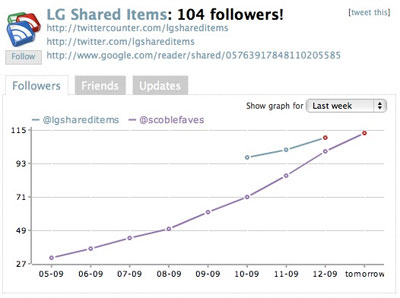
TwitterCounter Shows Growth for @lgshareditems and @scoblefaves

A recent experiment I kicked off on Wednesday was creating a dedicated Twitter account for my Google Reader shares and Delicious bookmarks at @lgshareditems. This combination has always been available on FriendFeed (and Facebook), but not Twitter. In parallel, Robert Scoble, also a guy well known for trying new things with social networks and data, has been tracking favorite tweets from those he follows with a dedicated account called @scoblefaves.

I have watched both accounts creep past the 100+ follower stage, even though both accounts are new, and both are exclusively feed-based. Each is a new way to try and utilize human filters and pass the results to Twitter, with the difference being that I am betting on content from outside of Twitter, and Robert is betting on other Tweeters. I bet both have strong value to separate audiences looking for news and tech updates - even though our data sets are different.

My shares to @lgshareditems are equally as genuine as my posts to @louisgray. While I may have more personal updates at the @louisgray feed, I do also post my new blog updates there, as well as my Delicious bookmarks, to give those authors additional exposure. And as noted above, practically every self-respecting blog and news source can see their Twitter feed to be extremely link heavy. So I expect it will take a lot more than you seeing a lot of blue underlines in my feed to be in danger of getting the big boot from Twitter, no matter what their TOS says.

September 3, 2009

September 3, 2009 · 1 MIN READ · BY LOUIS GRAY

SocialToo Extends Battle Against Twitter DM Spam With New Feature

SocialToo Extends Battle Against Twitter DM Spam With New Feature

SocialToo, a social Web utility aimed at enhancing your experience on Twitter, Facebook and other sites, is well known for its autofollowing capabilities. But with the rise of marketing and spam on some sites, Twitter especially, the noise has gotten out of control for some people - as you have seen a small number unfollow all their connections, in effect rebooting their accounts, and others complain mightily about the noise that has arisen from junk direct messages. With a new feature introduced today, SocialToo has made it very easy to stop those broadcasting junk into your stream with one click.

The new feature extends Twitter's capability of bringing direct messages to your e-mail, and adds options below to let you report the sender as spam, block them, or report them as sending automated direct messages. And unlike competitors, including Topify, it can be done without having to send this specific message to one of their dedicated e-mail addresses.

As an advisor to SocialToo, I often get access to some of the features early, and this enhancement has already paid dividends. Now, instead of just manually deleting the DM, I can click and send the person's annoyance away forever.


One DM via SocialToo I Was Ready to Zap


More than just this utility, SocialToo lets you set up a blacklist of keywords from within the site that you may never want to see in DMs, ever. That means you never have to see updates from Mafia Wars or Spymaster or whatever your least favorite junk spam of the week is. That can be found in your SocialToo account's preference tab here: http://socialtoo.com/twitter

If there is a way to communicate with people, spammers will do their part to find an exploit. SocialToo is trying to be part of the solution and helping to clean up your social networking experience.


Disclosure: I am an advisor to SocialToo

July 22, 2009

July 22, 2009 · 2 MIN READ · BY LOUIS GRAY

Proxifeed Delivers Automated Tweets and Ads Based on Keywords

Proxifeed Delivers Automated Tweets and Ads Based on Keywords

Whether you think Twitter is about conversation or about broadcasting, there is no doubt many people use it to help distribute links to share with their followers. Marketers, PR people and spammers alike have also found the social network a strong place to congregate, as they track for mentions of their name, their competition or potential buyers. (See also Travis Murdock's Marketing In the Feed post)

Proxifeed, a new tool released by Stéphane Osmont, who you might remember from his work on YokWay, automates much of the process, creating a Twitter feed built on links related to keywords you feed, including some for revenue - should you be interested.


The Proxifeed Process: A Proxy For Human Input

Upon logging into Proxifeed with your Twitter credentials, the service asks you to provide some keywords for automated postings. The more specific the keywords, the more unique your content could be. You also have the option to present three types of feeds: Content only, advertising, or a mix. You can also add one or more RSS feeds to the mix, be they blogs or from any source.

To complete the feed, choose an update frequency, and Proxifeed will then do the work on the back end to keep your automated Twitter feed going around the clock, whether you publish once an hour or less often.


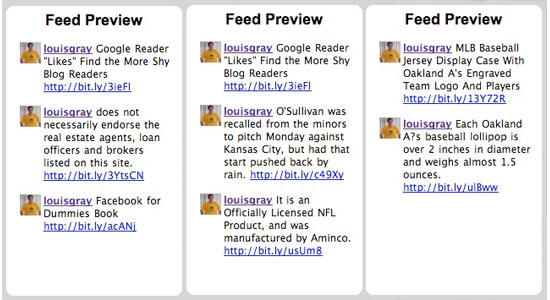
Three Potential Twitter Feeds From Me Based On My Keyword Choices

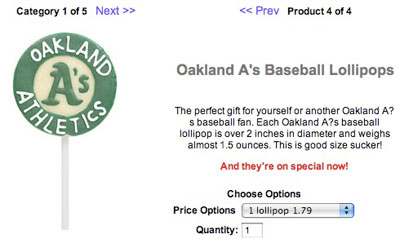
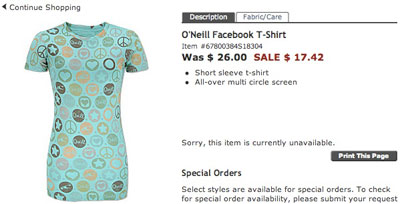
Curious what would happen if I turned over my Twitter posting to a machine filled with keywords, I tested Proxifeed with technology terms and sports terms, to see what would happen. Not surprisingly, Proxifeed searched through its bank of RSS feeds and selected specific items to go along my natural activity. By putting in the keyword "Facebook", I had an ad for a dress with the name Facebook. By putting in "Oakland A's", I got an Oakland A's lollipop.


Proxifeed Would Offer My Followers This Lollipop


Proxifeed Also Found a Facebook Dress for Sale

Proxifeed says its offering can create "exciting and engaging" Twitter streams that will get people with similar interests to follow and make your "follower base grow", so I can see how this might be enticing to a spray and pray marketer, or somebody who opts to turn off ads and then becomes a master aggregator on a specific topic. But for people who want to remain personal on Twitter, the most likely option would be to possibly use Proxifeed instead of TwitterFeed to distribute blog posts automatically. Otherwise, the clear non-authenticity of the updates and implied personal endorsement would be quickly exposed.

If you think creating an automated Twitter feed based on keywords and a few RSS feeds is right for you, Proxifeed absolutely fits the bill. But if you want your Twitter to be updated by a human (hopefully you), you can pass.

July 10, 2009

July 10, 2009 · 3 MIN READ · BY LOUIS GRAY

Real-time Search: What's Most Important Now, Not Most Accurate

Real-time Search: What's Most Important Now, Not Most Accurate

This afternoon, at TechCrunch's Real-Time Crunchup event, representatives from many of the innovators in the real-time search space had a quick round table aimed at furthering the discussion, framed by a question by moderator Erick Schonfeld, who said that some on the panel may believe real-time search is defined by Twitter Search, while others believe it is "everything on the Internet, but with a freshness or recency component". And while many different companies, including the standard-bearers, like Google and Microsoft, are looking to take on this new challenge, how they are doing it differs greatly.

Danny Sullivan, author of Search Engine Land, said, "We need better definitions of what it is, so as consumers and users, we understand what we are interacting with. Through Twitter and a few other services, you have the option to publish in a few seconds. Maybe you call it social sharing search." (He also posted a summary of the players last night)

Some of the participants could be defined by how large a percentage of their data was initiated through Twitter, and how they worked with the data, including filtering.

"I would define it as what are people saying in real time about my topic," said Gerry Campbell of Collecta. "It's not what is most important, but it's what is in real time now."

This bifurcation of the "one right answer", often championed by the existing search leaders, versus what's most right "now" is helping to separate the old school search engines from this new breed. But don't think that the more-established companies are taking this lying down.

Google's Matt Cutts, who has been at the company since 2000, said "we have always talked about freshness of content." He relayed a history of his time at Google, saying they once had a "war room" of how they could refresh their search index as frequently as a month. By 2003, the company had moved from monthly updates to daily updates, and a few years later, in 2007, integrated the company's Blog Search product into its main search results. "We have rearchitected our system to be as recent as possible," Cutts said.

As updates flow in at an ever-increasing pace from all corners of the Web, search engines have the daunting task of getting accurate responses out there, while ignoring off-topic or harmful data, such as spam. And those who manage to get the formula right will have a serious leg up over those who don't filter well, making their results more noise than signal.

"Drinking from the firehose is a ticking time bomb," said Kimbal Musk of OneRiot. "Even by filtering 90 percent of what is going on with the Iran election, you're still only going to get a tiny slice, and a good portion of that is spam. If you don't filter content, you are going to get more and more spam." He later added, "If you stick to Twitter alone, you will have a spam-filled and biased data set."

With Twitter's API getting to a point where more and more companies are relying on it as their engine and data source, each is working of a common data set, and how they interact with the information will make the difference. And yes, Microsoft or Google may give you one result that is most accurate, but not for this moment, and not with any kind of impact from your friends or in terms of how that data is being interacted with in real time.

Sean Stutcher of Microsoft clearly stated this information is becoming more relevant, saying, "The sentiment around a link could be changing, and that might become very relevant to a user."

In an isolated search world, where an index is an index and the right answer is the right answer, that might not matter. But in real-time, it could matter immensely. As each of these companies works through their user interfaces, their data sets, and improves filters and social aspects, it should be very interesting to see how they separate from the pack and help define their goal.

May 18, 2009

May 18, 2009 · 1 MIN READ · BY LOUIS GRAY

Alright, When I Say Go, Hit the Spam Twitter Button With All Accounts

Alright, When I Say Go, Hit the Spam Twitter Button With All Accounts

When a product becomes ubiquitous, it means you get the good with the bad, the well-meaning with the nefarious, the intellectual with the sloppy. As we saw with e-mail being overtaken with aggressive marketers, spam and eventually, viruses, the same activity has propogated to every social network with momentum - including the 419 scam on Facebook we discussed in January, and the many different reports of spam on Twitter. (See: TechCrunch's coverage of similar nonsense earlier today: A Bunch Of Hot Spammers Had The Day Off Of Work LOL.)

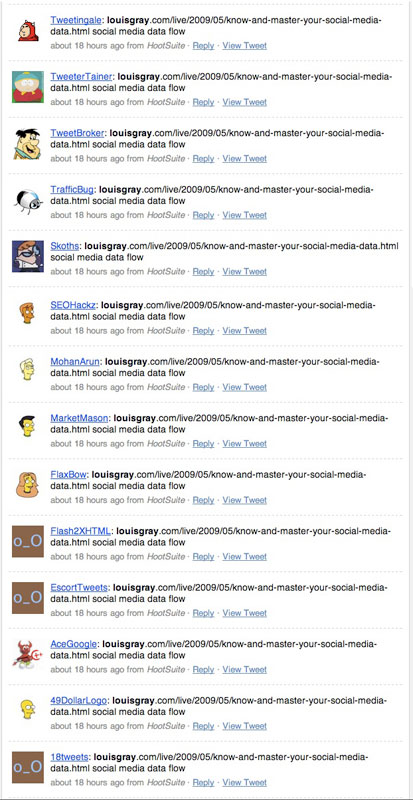
Like any good egotist, I regularly check references back to the site, be they on Google, in my referral stats, and the two T's - Technorati and Twitter. Today, I was amused to find that simultaneously, nearly two dozen different accounts referenced an article this I wrote this last weekend. Never mind that their link didn't work. Never mind that they all used the same exact way to write it, including the exact same description or tags. Even more interesting was the fact that all of the accounts (be they robots or real people) used the exact same Twitter client, HootSuite, and the automated messages look like they were executed in alphabetical order, starting with the account labeled "18tweets" and finishing with "Tweetingale".


The last time we talked about Twitter spam, it was with the issue of repeated following. In that example, theories suggested the repeated followers were to gain visibility and more real followers from duped Twitter accounts. So what are the purposes of this type of nonsense this time? Is it thought that those people searching for these keywords would find these accounts and sign up? It's not as if they pushed any traffic to my story, thanks to their not providing HTTP code.

Yet another "stupid human trick" executed on an increasingly sketchy network.

April 22, 2009

April 22, 2009 · 1 MIN READ · BY LOUIS GRAY

Google Reader Limits Your RSS Article Spam Potential

Google Reader Limits Your RSS Article Spam Potential

As Google Reader is my main jumping off point to gather all the news of the day, it's no secret the RSS reader also plays a major role in how I help distribute the news, be it through hitting share to add items to my link blog, or by e-mailing articles out to others. In October I mentioned how e-mailing RSS pieces can help to evangelize the service, and I've continued to make it something I do, for friends or for colleagues. But of late, I've found more restrictions being added that make it seem people have maliciously mass distributed articles out of Reader, so more safeguards have been added to slow me down.


Captcha me if you can

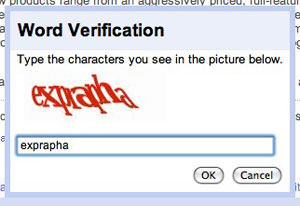
The first and most noticeable addition is that of a captcha, which requires you to fill it out each time you e-mail an article out of Google Reader. The minor annoyance didn't use to be there until recently, and presents the opportunity to test how well you read words that are slanted and blurred every which way.


Thou shalt not e-mail your entire address book this article

The second addition, which I just ran into today, is a cap to the number of people you can send an article to. While at the office it's no rarity to forward news to a dozen or more people, Google Reader now stops you once you pass ten recipients. This means that I will have to be more selective for whom I choose to send updates, and just maybe those left off will feel left out.

Having said limits in Google Reader won't dramatically change the way I use the service, with the exception of being more picky about my recipient lists, but I have to wonder who was violating protocol so much that this became a necessity. What robots do you think were mass e-mailing articles to all of their cyber buddies?

March 7, 2009

March 7, 2009 · 2 MIN READ · BY LOUIS GRAY

The Newest Annoyance on Twitter: Follow and Refollow Spam

The Newest Annoyance on Twitter: Follow and Refollow Spam

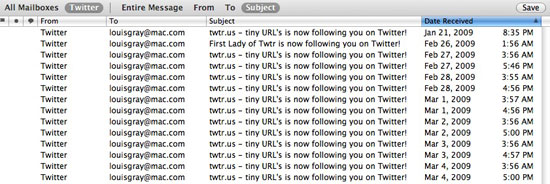
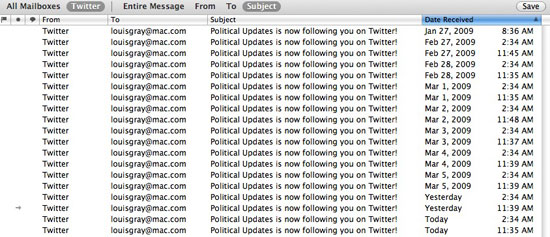
Unless you've turned off notifications when users follow you on Twitter, you are no doubt used to the e-mail messages you get when somebody has opted into seeing your updates. Follower updates are a staple of social services - and if you are maniacal about keeping e-mail like I am, you can start to see trends on the data, including when people are oddly manipulating the system, in a way that's not normal. And for whatever reason, a small number of Twitter accounts look like they regularly follow me multiple times a day.

I use auto-follow capabilities from SocialToo, letting me automatically opt in to see followers' updates. The way I use Twitter means there is little downside to having new incremental users in my feeds. So, in theory, if the user follows me just once - it's one and done. And I just don't see too much benefit to these new follow and refollow bots, even if I try to get creative.

Take a look at two examples: @PoliticalUpdate and @twtr.us.

Twice a day, starting on February 27th, I have been followed by @twtr.us, the first time at 3:56 a.m. my time, and a second time, at 5 p.m. that same day. Every day.


Also starting on February 27th, the account @PoliticalUpdate has been following twice a day - at 2:34 a.m. my time, and a second time after 11:35 a.m. (only nine hours later). Again, every single day.


So what is the benefit of such a clearly robotic practice? Is the idea that the follow notifications are a form of advertising, giving me a chance to see their name more than once, and increasing the times I'll go to check out their Twitter page? Do they also think we're naive enough to not notice?

Whatever product it is that both @PoliticalUpdate and @twtr.us are using does not contribute to the community in any way, and should be turned off. There is some good news, I guess, in that the twtr.us account looks to have been suspended, but my bet is that there are more accounts out there using the same service, and it should be stopped.

Know any other accounts who are using follow and refollow spam? Let me know in the comments. Jesse Stay, who runs SocialToo, and I would absolutely be interested in keeping them out of your in box.

(Also: See an earlier discussion on FriendFeed)