Silicon Valley Technology Commentary & Archives · Est. 2006 3,045 Posts · 2006–2026
Showing posts with label AssetBar (29 posts). Show all posts

June 22, 2011

June 22, 2011 · 3 MIN READ · BY LOUIS GRAY

NewsDrink Preps Next Generation Social Web RSS Reader

NewsDrink Preps Next Generation Social Web RSS Reader

While some noisy Web pundits have declared RSS dead, smart developers see expanded social sharing and connections as an opportunity to rethink news consumption, leveraging RSS as a utility and making it the backbone for new services. Amidst the rise of Twitter, Facebook and other networks, we've seen the launch and rapid adoption of products like Pulse, Feedly, Ninua, Flipboard and others who have taken the geeky parts out of RSS and presented new ways to consume news.

A new site you've never seen, which I've been watching since January, has finally cracked open the door with exclusive invites to its own take on RSS with social connections. The name is NewsDrink, which starts on the Web and will soon follow on with dedicated applications for mobile phones and tablets.

(Get in now at http://www.newsdrink.com with the invite code of "louis")

Scanning Recent News on NewsDrink from My Sources


Based in Bangalore, India, NewsDrink, like other RSS readers, can import an OPML file, synchronize with Google Reader, have you add feeds one by one, or select from their extensive topic-driven directory. Content can be viewed by individual source, or sorted for recency, with newest items at the top.

Reading louisgray.com on NewsDrink

Unlike Google Reader, which is biased toward full feeds, and has a wide array of sharing functionality and statistics for your own activity as well as the blog feeds themselves, NewsDrink favors a more minimalist approach, with feed items truncated to give you a glimpse into the story, but push for downstream views if interested. That said, you can make comments or likes directly on items that flow through your view in NewsDrink, and this site activity is collected on your central profile - which also displays feeds you add or delete.

Adding New Feeds, By Category, On NewsDrink

NewsDrink goes beyond Google Reader when it comes to social, reminding me a lot of RSS projects gone by, including AssetBar in 2008 and the follow-on Shyftr, best known for its aggregation of comments on full feeds, which in my view got them in an unfair share of trouble. You can follow friends on NewsDrink, find friends from Twitter and Facebook who are using the service, and see their activity. Find a feed they are reading that you like but don't have? Add it to your NewsDrink. You can also see people they follow and have an opportunity to discover new people with similar interests - much like the promise of Toluu, another 2008 debut that has seen its founder move on to new projects.

My NewsDrink Profile With Recent Activity On Feeds

Does the world need another RSS reader besides Google Reader, or does the world need RSS at a time when it seems that social sharing is king? I still think there is a place, absolutely. One that is built from the start to be social, but also allows you that solitary approach to get in and read your feeds, could be a solid alternative. NewsDrink is a just starting, so if there are some UI bugs that are not your favorite, or missing functionality, be sure to let them know. It's all part of the fun of beta products.

To get into NewsDrink, use the invite code of "louis", without quotes. There should be enough invites for everyone. You can find NewsDrink at http://www.newsdrink.com.

August 2, 2009

August 2, 2009 · 3 MIN READ · BY LOUIS GRAY

RSS Is Doing Great, But Stand-Alone Feed Readers Are Collapsing

RSS Is Doing Great, But Stand-Alone Feed Readers Are Collapsing

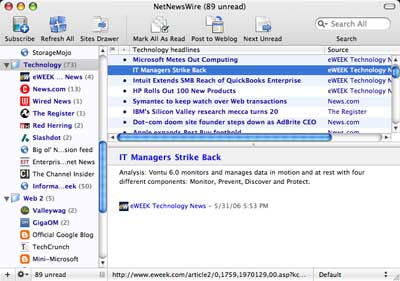
Three years in technology can be an eternity. I marvel that just over three years ago, I was telling you that "RSS Is a Demanding Mistress", showing off a screen capture of my NetNewswire application, powered by Newsgator. At the time, as I complained about having nearly 100 articles to read, I didn't anticipate the impact Google's entering the market with Google Reader would be, and my screenshot now seems quaint. By 2007, I had switched to Google Reader, and despite multiple assaults on Reader in the ensuing two years, you can tell most challengers apart by their epitaph.

In the past few years, I've helped champion more than a few new approaches to the RSS feed reader market, each with its own approach to making the stand-alone process more social. First there was Assetbar, who had tremendous technology, but a clunky interface, and never really got off the ground. Not too long afterward, we saw Shyftr debut, but following a highly visible controversy over shared comments on full feeds, the company eventually shut down their interesting product as well, moving instead to RSS filters. Even last week we saw NewsGator turn off their synching functionality, pointing customers to Google Reader. Yes, NetNewsWire is still around, and now points to Google Reader, but it's pretty much a legacy app at this point. (In my opinion, of course)


Isn't this cute? (From back in 2006 on NetNewsWire)

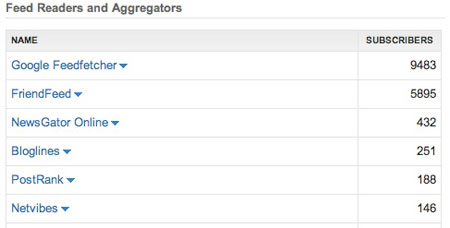
While some are debating RSS' role in a new world of real-time information discovery, there is no question that Google Reader has won this specific battle. If I exclude FriendFeed data from my own FeedBurner statistics, the combination of Google Reader and iGoogle accounts for 84 percent of all my RSS readers. In contrast, NewsGator is below 4 percent, and BlogLines checks in at just above 2 percent, with PostRank and Netvibes coming in at just over 1 percent each. Mice nuts.


My FeedBurner Stats Show Google Reader and FriendFeed Dominate

That's not to mean the RSS ecosystem is in anything resembling a freefall. The recent launches of My6sense for the iPhone, looking to find the most relevant content, and Lazyfeed for real-time blog search by topic, show me that not only is innovation alive and well, but blogs and RSS are key components in creating new products. And while Caleb Elston has been quiet of late, I am still using Toluu every day to share my OPML, and keep track of new blogs I am adding to Reader. Also, Feedly, which builds upon Google Reader with some very interesting social options, continues to plug away, gaining loyal fans.

But just think of what's happened over the last three years.

In 2006, folks like Jeremy Zawodny reported Bloglines' share at between 30 and 50 percent. Steve Rubel cited a Pheedo report showing Bloglines "slipping" from 37 percent to 30. Go back far enough, and you can see it even had the majority of the market way back in 2004, according to ReadwriteWeb.

By early 2007, Hitwise said that Bloglines had three times the market share of its nearest competitor, which was Rojo. Interestingly, that report mentioned Google Reader in passing, saying "as of the week ending 1/13/07, it had only 1/13 of the market share of visits of Bloglines." That's right. One thirteenth the share of Bloglines. I should mention that not everybody saw the gulf that wide, as others, including Bob Lee reported the two were in a practical dead heat the next month.

The last two years have been all about Google Reader, as the search leader and RSS distribution leader, through the acquisition of FeedBurner, also became the RSS consumption leader. Rojo disappeared in July of 2008, and Bloglines' own stumbles made it that much easier to switch, forcing Marshall Kirpatrick of ReadWriteWeb to say, "Do you really want Google to nail down complete dominance over the world of RSS? We sure don't."

The onetime debate about whether Google Reader is number one or not is pretty much gone, and Newsgator's turning off their online synching essentially throws in the towel. The once promising Feedeachother.com has turned off its lights. Shyftr and Assetbar aren't coming back. A new entrant called Fever is interesting, but looks more like My6sense than a traditional client. RSS is powering aggregation sites like FriendFeed, which in theory, provides 30 to 40 percent of my feed reader count, but when it comes to stand alone, all must stand in awe of Google Reader, for to do battle is futile.

June 1, 2009

June 1, 2009 · 2 MIN READ · BY LOUIS GRAY

LiveFlows Highlights Popular Posts from Your Blog and Network

LiveFlows Highlights Popular Posts from Your Blog and Network

Ever visit a blog for the first time, and wonder if they have other posts that might be interesting to you, or wonder what other readers like you found popular? What about wondering if there were other blogs like the one you were reading that had similar content? A new offering called LiveFlows, from the team behind AssetBar and FanFlows, is now available to do just that - hoping to show each visitor the most enticing posts for them, based on how they found your site.

Companies like Outbrain are working to help readers see related items from your own blog and others in their network, while Lijit is working to show you related items that are in your social graph. LiveFlows' approach breaks up the potential content based on whether you have a new visitor, one who found you from search, or even to track what they call "dedicated fans", showing them stories they haven't yet read.

The LiveFlows widget, rather than being tacked on to each post or positioned in your sidebar, operates in a thin bottom bar at the base of each blog using it, just like you can see here on louisgray.com, on the liveflows.com blog and on other trial sites, including Jesse Stay's Staynalive.com and on Bryce Roney's blog.


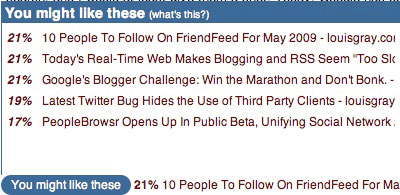
LiveFlows Says "You Might Like These" Popular Posts

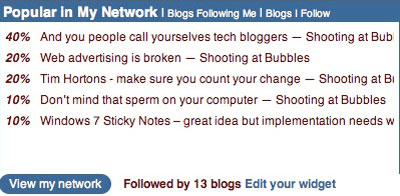
The widget has two parts. The first says "You might like these", showing other pages from the site, with a % probability based on other readers' statistics and your own history. The second says "View my network", highlighting the best content found in blogs that are connected using LiveFlows.


LiveFlows Highlights Other Top Posts In My Network

If you add LiveFlows to your blog, you can connect with other LiveFlows users just by clicking "Join My Network" on any widget you find on the Web, and you can see statistics for how many times users across the LiveFlows network clicked through to your content. LiveFlows' goal is to find your best content, feature it and promote it to new users, both of your site and of others. It's a solid way to get your posts more visibility, as you see fit.


You Can Check On Your Network at LiveFlows.com

Check out LiveFlows at http://www.liveflows.com.

December 14, 2008

December 14, 2008 · 4 MIN READ · BY LOUIS GRAY

My 2008 Tech Predictions Look Bad As Year Nears a Close

My 2008 Tech Predictions Look Bad As Year Nears a Close

It's a year-end tradition for many media, blogs and individuals, to predict what will happen over the next year. Some prefer to make their guesses fairly straight-forward in an effort to be right (Example: Apple will release new notebooks with a faster processor at MacWorld) and others will make their guesses seemingly outlandish, so that if they're right, they're seen as virtual psychics. Others, somewhere in between. At the conclusion of 2007, I made ten predictions that I thought would be fun, and as we're coming on the one year anniversary of that post, it's a good thing you didn't bet your home mortgage on my list. (What? You say there are other issues with your mortgage? Oh.)

See: 10 Predictions for 2008 In the World of Tech

In the spirit of reducing my ego, here are how those ten predictions in the world of tech stand:

1) Google Will Trump Both TechMeme and FeedHeads

Wrong. I expected that Google would start to tabulate its shared items and most popular feeds via Google Reader, and that using this data, Google could provide a democratic version of Techmeme, or at least pull Feedheads outside of Facebook. Instead of Google doing this however, it was ReadBurner, followed by RSSMeme and others, including Feedheads, who started a site at www.feedheads.com. Later in the year, Google Blog Search did introduce the option to show hot topics in tech, but it's largely been a stale effort. At this point, Techmeme is still more important than Google in this regard, and Google Reader has declined to show most popular feeds or shared items.

(Disclosure: I am an advisor to ReadBurner and took the position in August.)

2) Facebook Will Buy Digg in an All-Stock Transaction

Wrong. I thought Facebook would use its expensive stock and buy up some smaller companies. Digg continually sounded like it was shopping itself, but it never sold, and the company's CEO often denied talks were occuring with anyone. Also, given the stock market crash, Facebook is no doubt valued much lower these days, making a stock transaction less likely.

3) eBay Will Sell StumbleUpon to Yahoo! or News Corporation

Wrong. So Far. In September, TechCrunch and others reported that eBay planned to sell StumbleUpon, but no sale has taken place yet. At this point, also, with Yahoo! crumbling, they are less likely to take on the service.

4) Twitter Will Add Video, Photography Support

Wrong. Twitter focused on growing and not crashing this year. Still just text.

5) Apple Boot Camp Will Morph to Be Like Parallels, VMWare Fusion

Wrong. I hardly hear anything about Boot Camp these days, likely because VMWare Fusion and Parallels have become entrenched, and nobody cared about Apple's "restart" alternative. My comment that Apple would "slowly take over the market" in this space also looks quite dumb, as did the expectation that Windows applications could boot alongside Mac apps. The question is, why not?

6) At Least One Major Browser Will Embed Ad-Blocking

Wrong. And it's too bad! Sure would change things a bit if somebody could figure out how to check a box and have graphical ads or text ads disappear.

7) Assetbar and FriendFeed Will Gain Early Adopter Audiences

Wrong and Right. AssetBar, in its attempt to replace Google Reader, failed fast. FriendFeed, however, did much better than I could have guessed at the time I wrote the post. Obviously, I played a small role in evangelizing FriendFeed through it coming out of beta in early 2008, but it got bigger than even I expected. My comment saying that "neither would be acquired by the end of 2008" did manage to be true.

8) Video Blogging Will Remain Unpopular, Unprofitable

Right. While there are some bloggers who prefer video and are using it, from Robert Scoble at FastCompany TV to Loic LeMeur at Seesmic, it hasn't become as second-nature as standard blogging or mciroblogging. And so far as I know, nobody is making money on this in a consistent way.

9) iTunes Video Rentals Will Decimate Netflix, Blockbuster, Hurt Box Office

Mostly Wrong. Netflix didn't blink against iTunes' charge. They instead branched out with their "watch instantly" feature and partnered up with TiVo and others. Blockbuster is still a disaster, and I certainly am not going to the box office thanks to so many alternatives. But iTunes video rentals cannot be said to have hit Netflix and others all that much.

10) Fast Company Will be a Fast Stay for Robert Scoble

Wrong, So Far. Robert joined FastCompany at the beginning of the year, and is putting up some interesting content. That said, FastCompany has seen changes in focus and leadership, and I am curious to see how his show evolves in 2009. Scoble continues to be a mainstay on the social Web and at industry events of course, so even if 2009 sees him somewhere else, it won't be far from the limelight.

So wasn't that fun? Now you see you can largely ignore my predictions, or maybe, I should try harder to be right. Maybe, if I'm good, I can put a 2009 prediction list up by the end of the year...

July 4, 2008

July 4, 2008 · 3 MIN READ · BY LOUIS GRAY

AssetBar Launches Fanflow for Premium Messaging and Content

AssetBar Launches Fanflow for Premium Messaging and Content

One of the major issues hindering the growth of many Web services today is that users are not willing to pay. We don't want to pay for using their service, we don't want to pay for content, and we usually don't want to see or click through ads. Yet, free services, like Twitter, Google Reader, or any other Web activity aggregator have a cost of creating an infrastructure to support user growth. The more popular the service, the more expensive it can be to develop and deploy the underlying technology. And if they don't get it right, outages and slowness are inevitable, as we've seen many times.

So, how can this be solved? Is it possible to try and make money from a Web microblogging and messaging service, when everyone else out there is giving away the store for free? AssetBar is working to find out.


AssetBar first reached my radar about nine months ago, when they were in the process of developing a next-generation RSS feed reader, with all the bells and whistles thought needed to compete with Google Reader. But in the months they worked to release their initial product, a rising number of external services became hooked into Google Reader shared link blogs, and other social aggregation sites, like FriendFeed, debuted, making their social RSS feed reading experience less differentiated and less appealing. Combined with some slowness and an unpolished GUI, the product didn't take off, despite early promise, and it was officially closed last week, even for the small handful of us who kept checking in.

But through this fast failure, the team learned a few things, including the need to build an infrastructure that could scale, and the need, especially, to monetize. And they think they've found a way to monetize content and microblogging, with a service called Fanflow.

Fanflow lets anybody who believes their content has value sell it directly to those who would like to subscribe. Fanflow lets people sell anything, from pictures, to messages, videos, or even MP3s and PDFs directly to paying users, while also maintaining access controls. In its first iteration, Fanflow is targeting those who have "fans", who are willing to pay a premium for content directly from the originator, be they celebrities, sports personalities, or musicians.


As they write in their launch post, The Profit Equation of Twitter-style Messages, today's Twitter users are focused on sending status updates, but their content has not yet been monetized, as Apple has done with iTunes. Fanflow is aiming to separate free messaging from premium messaging, and helping to create an opt-in "fan club" that brings fans together and lets them share and discuss the content with other fans.

Are they on to something? They certainly talk a big game, and they've already got paying customers. As their initial post says:
"Bringing payments and commerce to twitter-style messaging is too large to ignore. You just can’t have mobile + web this close together and ignore the great potent for fans and stars with lightweight commerce. There’s zero doubt that a secure commerce solution would enhance the value of Twitter and chart a path to profitability."
Their first test site is a comic strip called Achewood, which has been running on AssetBar's engine for more than a year.

As creator Israel LHeureux wrote me yesterday, there is a market for paid services over a Twitter-like engine. He writes:
"We started selling premium twitter-style messages a few hours ago, and our first customer literally signed up and paid for a 3 month subscription 2 minutes after we posted the banner... it feels SO FANTASTIC to be able to help fans and stars make some money, and help them connect in new ways."
Assetbar is looking to do more than become a micro-payments engine for Twitter-like services. They talked about being a proxy for Twitter back in February, and their initial attempt at a feed reader amassed 20 million unique assets from 100,000 publishers, but as they write, they're "bored of free", and want to turn the Web on its ear, from relying on cost centers, instead developing a way to leverage their infrastructure and make a digital sales system for anybody making content to make money. And they're not afraid. As they wrote, "It would be a shame to not take a shot at this beast and try for something better than free. I would rather try–and fail hard– than to not try."

We'll be watching.

May 14, 2008

May 14, 2008 · 6 MIN READ · BY LOUIS GRAY

Where Are They Now? A Look at A Dozen Services That Debuted Here

Where Are They Now? A Look at A Dozen Services That Debuted Here

Near the end of 2007, I first came across a service I had hoped would one day challenge Google Reader for the throne of coolest RSS feed reader, Assetbar. With social aspects including shared statistics and comments, it had the potential to become the future of where RSS feed readers were going. While that hasn't yet come to pass, it did mark the first time a service debuted on LouisGray.com.

In the ensuing 9 months or so, I've been lucky enough to either stumble upon, or get engaged with entrepreneurs early enough in the process, such that this site was where they first got started. Some of them have gone on to incredible visibility and success. One has already closed shop. Another looks dormant, and others, somewhere in between. I'll hold off on giving a rating, or "stars" assigned to their success, but believe me, it's tempting.


Assetbar
Debut: September 17, 2007
Post: Assetbar Set to Launch With Google Reader Inspiration

The Goal: To deliver a next-generation RSS feed reader with integrated commenting, shared link lists, and the ability to see if friends had seen or liked an article.

Status: After gaining the attention of ReadWriteWeb and Mashable, as well as a few follow-up stories here, Assetbar gained several hundred users, but rather than rocketing upward in popularity, issues with the confusing user interface, and prioritizing features over speed had even early adopters not sticking around. The site's gone into something of hibernation and maintenance mode, while the developers consider where to take their participatory social media platform next.


BlogRize
Debut: April 7, 2008
Post: BlogRize Builds A Community Around Your Blog and its Readers

The Goal: Build a community around a blog, and find new interesting items.

Status: Recently profiled by ReadWriteWeb's Sarah Perez, who is everywhere, BlogRize has hundreds of users joining communities like ReadWriteWeb, TechCrunch and LouisGray.com to see what others like them are sharing and commenting on. Updates so far have been somewhat quiet, thanks to developer Jesse Spaulding's recent move to Seattle.


LinkRiver
Debut: February 13, 2008
Post: LinkRiver Enters Life Streaming Fray, Focused on Link Blogs

The Goal: To let friends follow shared items activity from multiple people in one place.

Status: LinkRiver has a big fan in Corvida of SheGeeks (LinkRiver Is My Personal Techmeme), and with interesting wrinkles including Attention data, which tracks what you share most often, and the ability to tag items for later viewing, developer Adam Stiles has created a lightweight (in a good way), informative site to find the most popular items of the day, or to see what friends are sharing, without the noise of some other social aggregators.


MergeLab
Debut: March 4, 2008
Post: Mergelab Emerges to Streamline Friends' Web Updates

The Goal: To follow friends' activity on the Web in a single location.

Status: Mergelab announced last Friday that the site would close down by the end of June. Without revenue, and with competition, the decision was made to exit the game early.


Rating Burner
Debut: January 30, 2008
Post: Rating Burner Debuts With RSS Feed Ranking, Growth Stats

The Goal: To show the most popular FeedBurner feeds, and daily changes.

Status: While not widely known, Rating Burner is quietly doing its job, adding more and more feeds to its library. The developer even added the option to display a Rating Burner badge on your blog so you can show your own ranking from the site.


ReadBurner
Debut: January 7, 2008
Post: ReadBurner, In Stealth Mode, Looking to Sort Shared Feed Items

The Goal: Find the most common shared items in Google Reader.

Status: ReadBurner took off like a phoenix, but after gaining rave reviews from across the Web, the site's lead developer shut down the site, only to see a trio of entrepreneurs, including Mashable's Adam Ostrow, buy its technology and get it up and running again. ReadBurner 2.0 debuted on April 15th and has continued to innovate, issuing an iPhone version of the site, and today, adding support for shared items from NetVibes.


RSSmeme
Debut: February 6, 2008
Post: RSSmeme Debuts as ReadBurner Clone

The Goal: Find the most common shared items in Google Reader

Status: RSSmeme took advantage of ReadBurner's downtime, and has more shared link blogs in play than anybody else on the Web. RSSmeme also debuted helpful integration for bloggers who want to show how often their items have been shared, and recently integrated notes from Google Reader.


Shyftr
Debut: March 4, 2008
Post: Shyftr Offers Social RSS Reading, Including Comments, Rankings

The Goal: Develop a RSS Feed Reader for friends to share favorite items and make comments.

Status: Shyftr recently added OPML importing, on the back of debuting shared link blogs, making it even more competitive with Google Reader, as Mark Hopkins of Mashable and the Download Squad noted. The service still has a way to go to get in the mainstream, and it will take some time for them to escape the dubious honor of getting Bitchmemed last month, but they continue to work hard.


SocialMedian
Debut: April 8, 2008
Post: Former Jobster CEO's Social|Median Incubating in Alpha

The Goal: A social news service, personalized based on your favorite topics.

Status: As mentioned Tuesday, SocialMedian is seeing strong growth, even in their alpha stage, growing to 2,599 alpha users, as of this post. The growth in the user base has resulted in a higher amount of interesting news, more clipped items, and the GUI has gotten much stronger in the last month.


TheStatBot
Debut: May 1, 2008
Post: The StatBot Launches to Analyze Blog and Web Trends, Statistics

The Goal: To analyze blog trends and statistics with insightful commentary.

Status: Yuvi Panda is now posting 2 to 3 new articles a week, starting with Scoble's Twitter feed, and now, dissecting Digg and the Techmeme Leaderboard. His latest post, from Tuesday, highlights those sites most likely to be in the "Discussion" section of TechMeme, not a featured item.


Toluu
Debut: March 24, 2008
Post: Toluu Offers Gateway to Friends' RSS Feeds, Recommends New Ones

The Goal: Share your OPML with friends and find new feeds.

Status: Growing like a weed, Caleb Elston's pet project has ReadWriteWeb's Sarah Perez enamored and just yesterday, Elston announced he continues to upgrade the site, deleting more than 60,000 duplicate feeds, the kind of attention to important detail that has people coming back again and again.


Yokway
Debut: March 2, 2008
Post: YokWay! Weeks Away from Launching "Digg for Friends"-like Service

The Goal: Share items, videos, and pictures with friends and have conversations.

Status: According to Yokway insiders, traffic to the site is catching up to FriendFeed and beating out SocialMedian, but aside from my coverage, and that from the Last Podcast, they haven't had nearly the exposure of FriendFeed, so that would be a surprise to me. The site has a few hundred visitors, from what I can tell, most activity is still from a select few dozen. Over the last 24 hours, there were 25 items shared for discussion. While the user interface is interesting, as is the application, it hasn't yet gained a lot of public awareness.


While this list is long, it's certainly a speck compared to that which blog powers like TechCrunch could debut. I've been lucky to play the role of early adopter, and there are a few more items out there cooking which should show up soon. But on the whole, I'm pretty pleased with the efforts made by just about every single one of the players above. ReadBurner and Toluu for starters, changed the game. Others are must-visit sites for me. But in this fast-moving industry, if you're not fast-moving, you might as well quit. I'm looking forward to keeping this going.

April 24, 2008

April 24, 2008 · 5 MIN READ · BY LOUIS GRAY

Profy Rolls Out Combined RSS Reader, Blogging Platform

Profy Rolls Out Combined RSS Reader, Blogging Platform

Profy wasn't satisfied by simply rolling out a brand-new online RSS feed reader to challenge the established leaders, including Google Reader, NewsGator and Bloglines. With one massive update, the new service, launched in beta yesterday, not only gives Web users a new option for RSS feed consumption, but also, a new blogging platform, with interesting features that integrate the two, as well as linking in to other Web services, including Blogger.

While the world isn't lacking for RSS readers, Profy's combined offering is very interesting. With some fine-tuning as the company moves out of the beta process, the service could be very compelling to both established bloggers and new ones looking for a simplified platform to get started.

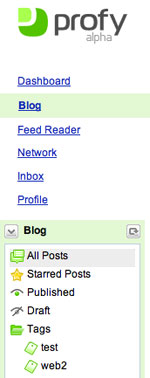
There are a few facets to Profy to focus on, including the "Feed Reader", the "Blog", the "Dashboard" and their messaging system or "Inbox".

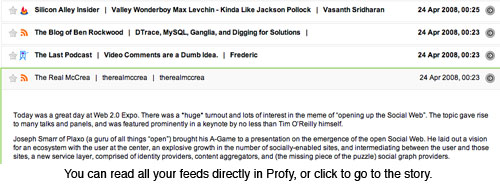
The Feed Reader operates much like others out there. I imported my 260 or so feeds from Google Reader, and Profy recognized the folder structure. The Feed Reader is laid out cleanly with multiple tabs, enabling me to select from "Posts", reading the available items, "Feeds", showing me the name of the feed, its URL, and giving me the option to make edits, and "Folders", matching those I had in my OPML file.

I can read posts in list view, showing the source, feed name and author, or I can select expanded view, showing the entire post in the reader. Those are the basics. And aside from adding keyboard shortcuts, like Google Reader and AssetBar, there's not too much to demand before the company hits 1.0.


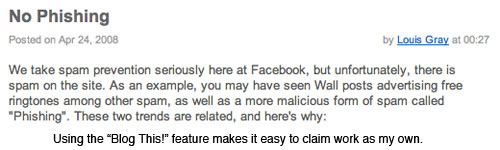
In the Feed Reader, I can "Add Star" to highlight a post, E-mail it to a friend, add tags, or most interestingly, I can hit "Blog It!", which pre-populates a post in my complementing Profy blog, including the full text and links of the post. Profy essentially copies the full text and headline of the post in my own blog, with me as the author, leaving the deleting to me. It's a cool tool, but one I could see abused by spam bloggers, should they ever get into the system. In my testing, it was easy to use, and I could simply post a Facebook story as my own (See the below screenshot). Profy does give credit to the source in the bottom right corner of your own post, but I expect it'd be a bit better to tweak "Blog It!" to instead focus on the headline and URL.


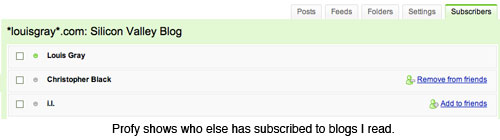
The Feed Reader also offers some strong flexibility. I can search my feeds for keywords, and I can look at the "Subscribers" link on any feed to see if other Profy readers are subscribed to that same blog. From those results, I can even "Add to friends" to get connected to similar Profy users who like reading what I do.


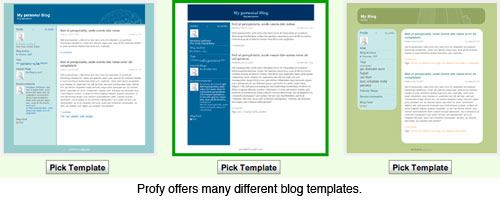
The Blog operates like those in TypePad and Blogger. There are a wide array of blogging templates provided by Profy, and you're given a Profy URL, like TypePad, with your own username: (For example: louisgray.profy.com)


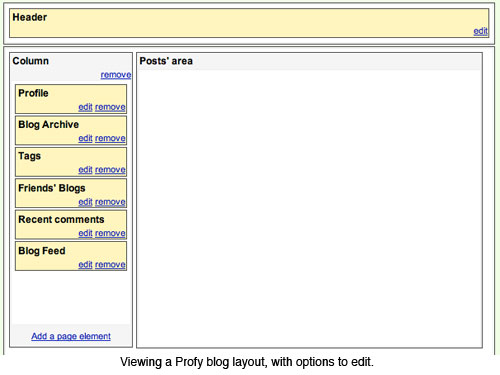
Once you've selected a blog template, you can edit the layout of your blog, make new posts, or further down the road, read or moderate comments on the site.


Posting to Profy is simple for any TypePad or Blogger user. There's the option to post in either WYSIWYG or HTML, and you can use helpful buttons for styling or for adding images and YouTube video.

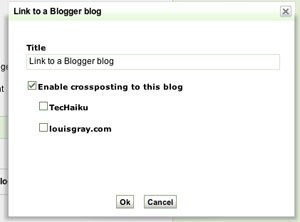
But most interesting to me is the ability to cross-post to Blogger or other platforms from Profy. If I were to move to Profy as my RSS reader or blogging platform, I wouldn't have to change a thing on louisgray.com. I wouldn't have to move files from the FTP site, or tweak Blogger in any way, as Profy could cross-populate both the Profy.com hosted blog and my own, just by linking the two. In testing, it was transparent to me that both posts from my Profy blog hit the louisgray.com site. To be honest, I was hoping to make it less transparent, so I could "push" individual posts to louisgray.com or Techaiku, instead of it happening automatically, but I expect either I was missing a step, or they'll make that option in the future by the 1.0 release.

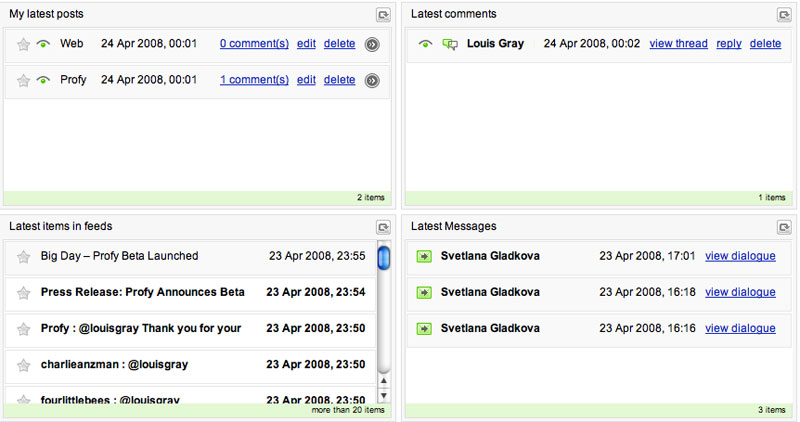
Once the Feed Reader and Blog are up and running, you can manage all activity via Profy's Dashboard. From the Dashboard, I can view blog posts, read feeds, see comments made on my blog, or exchange messages with other Profy users. And any friends I've found through Profy automatically populate my Network, which assuming service growth, would expand over time.


Click for larger Dashboard image

For a beta product, Profy has done a solid job in introducing a lot of good functionality not usually found even in some of the more established feed readers, or blogging platforms. The idea of linking the feed reader and blog, while not abandoning existing services, is a good one. Obstacles in their way, aside from the usual efforts of growing awareness, and keeping up with user expectations, would be to follow the lead of Fav.or.it or others to enable commenting from RSS feed readers to the original blog, integration of Disqus in either area, and the ultra-important area of keyboard feed navigation.

The question is, can Profy rise up, in 2008, to challenge the established leadership of TypePad, WordPress and Blogger? The big three hold a commanding mindshare and user base, which is formidable. But so long as Profy makes it transparent and easy to move data into their service from others, and continues on the path of innovating and linking their disparate services, they have as good a chance as any.

If you're interested in getting your hands on Profy, it is in limited invite-only beta. I believe I have five available, but with any luck, I can get more. Let me know if you're interested!

April 11, 2008

April 11, 2008 · 3 MIN READ · BY LOUIS GRAY

Should Fractured Feed Reader Comments Raise Blog Owners' Ire?

Should Fractured Feed Reader Comments Raise Blog Owners' Ire?

One of the more frequently mentioned suggestions for avid Google Reader users is the addition of comments to the service, so RSS readers could respond to blog posts, either directly from the reader and back to the originating blog, or within the Google Reader community itself, in effect, becoming a social network. But while Google Reader has not yet enabled comments, other services are, and it seems the excitement of adding this capability is hardly universal - and its opponents have gone so far as to call it "outrageous" or "theft".

While the discussion around where a blog's comments should reside has raised its head before, especially around services like FriendFeed, (See: Sarah Perez of Read Write Web: Blog Comments Still Matter) it flared up again this afternoon when I had (innocently, I thought) highlighted how one friend's blog post from earlier in the week was getting a lot of comments, and had become the most popular story on Shyftr, a next-generation RSS feed reader that enables comments within its service.

While I had hoped the author (Eric Berlin of Online Media Cultist, who I highlighted on Monday and like quite a bit) would be pleased to see his post had gained traction, the reaction was not what I had expected. He said he was uneasy about seeing his posts generate activity and community for somebody else. Another FriendFeed user called it "content theft" and said "if they ever pull my feed and use it there, they can expect to get hit with a DMCA take-down notice". (See the discussion here)

I can see how content creators can feel threatened or wary of services who leverage full RSS feeds, or might actually have a case if they have publicly asked for no repurposing of their content, via Creative Commons or other methods. But I also see that the whole idea of reading feeds in isolation, without engaging, is going to soon be something of the past. AssetBar, Social|Median and Shyftr have been among the first to add comments in their site. Fav.or.it, via Disqus, offers the ability to post comments to the originating blogs. FriendFeed, RSSMeme and many, many others offer links to the content but contents on their site. And that's not even touching on the social news sites like Slashdot, Digg, Reddit, etc., where comments and community are generated, essentially through leveraging third party headlines.

As a blogger, I am a content creator. I don't want my content stolen, or reposted without attribution or under somebody else's name. But I am also a huge advocate of RSS and continuing to adapt where the conversation is being held. Just as my blog's RSS views have undoubtedly eclipsed my blog page views, I would not be surprised to see that more comments on my posts might eventually live outside of my blog. It would behoove me and other bloggers to be aware of the other places the conversation will be taking place, and to engage there, in my opinion, rather than railing against the continued evolution of how we're consuming content and engaging online.

Even the conversation about this issue has escaped the blogosphere. Eric, on FriendFeed writes, "It's slightly troubling that this conversation is taking place here instead of on one of our blogs," but it's not so much troubling in my mind, but instead requires a changing mindset.

The Web as a whole has clamored for full RSS feeds, not partial, so we don't have to return to the originating site. Some of us have just as loudly asked for comments and conversations to enter the world of the RSS feed reader. Now that we're starting to see what it's like, maybe it's not what we had fully anticipated. But it's the way things are headed, and rather than label innovators like Matt Shaulis (Twitter | FriendFeed) and Dave Stanley of Shyftr (Twitter | FriendFeed) as outrageous or possibly illegitimate, we should engage and speak up about what we think is right. As for the developers who enable these services, there are definitely ways they can help raise the visibility of the practice - through e-mail alerts, trackbacks, or even giving the option to opt out. But we'll be seeing this more and more going forward. I promise you that.

April 4, 2008

April 4, 2008 · 5 MIN READ · BY LOUIS GRAY

Fav.or.it Beta Effort is Not My Favorite. Not Even Close.

Fav.or.it Beta Effort is Not My Favorite. Not Even Close.

Sometimes the concept behind a new service ends up being much better than the actual experience. And try as I might to find out what it is I'm missing about a "good on paper" product, it occasionally happens that holes in the product, a confusing user interface, or a smattering of bugs can get in the way of recognizing its true potential. Unfortunately, so far my experience with Fav.or.it, a new next generation RSS feed reader, has been one disappointment after another, taking what should be an evolutionary step in the way we share data and interoperate with feeds and instead, throwing roadblocks and confusing processes that will surely thwart the site's ability to attract significant users.

I first became excited about Fav.or.it's potential to compete with Google Reader after seeing Robert Scoble's initial gushing back in December. The concept behind Fav.or.it sounds wonderful - offering a fully-developed RSS feed reader with a river of news interface, integrated commenting which feeds back to the originating blog, and a detailed directory of blogs, from technology to news and even sports.

When Fav.or.it opened its public beta in late February, I was excited to see that blogs with Disqus could integrate comments. Also promising attention data and a full API, it seemed the service would be well on its way to being a serious challenger.

But from day one, I've had issues getting Fav.or.it to even function at a basic level. I'm no stranger to beta products with raw edges or underbaked features, but trying to figure out Fav.or.it, or get the service to even find my RSS subscriptions has been one headache after another - one major reason I'd held off discussing Fav.or.it until now, hoping I was just missing something.

In March, I traded e-mails with Fav.or.it founder Nick Halstead, saying it didn't seem "100% transparent to me", and he mentioned having "teething problems" common to any new site, so again, I figured the site would eventually come around. But it hasn't yet been the case.


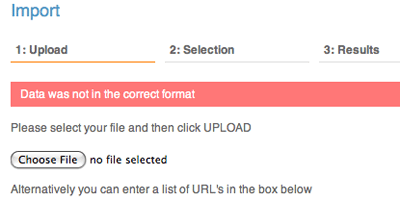
Fav.or.it choked on my Google Reader OPML every time.

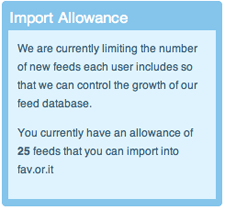
The very first step to creating a service that can compete with Google Reader is enabling simple OPML import to get the feeds I read today into another system. Fav.or.it makes me think it would be easy, but every time I would upload my Google Reader subscription list, I was told the data was in the wrong format - nothing more. Just a failure. There was also the option to add URLs one by one, so I tried that, adding a handful of my favorite sites. Only then did I see a warning that Fav.or.it was only allowing upwards of 25 feeds to be added, less than 5 percent of what Google Reader is handling today for me.


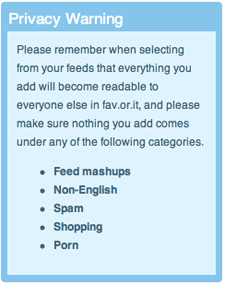
Everywhere I turned, more limits and warnings...

Even nuttier, I was met with warnings when I imported my sites, being told every feed I added would be available to the community at large, not just to me. Further, I was told I couldn't upload feed mashups, Non-English feeds, Spam, Shopping or Porn. While I hadn't planned to do so, the feeling within Fav.or.it was extremely hostile, without the feelings of security you get in Google Reader or other feed readers.

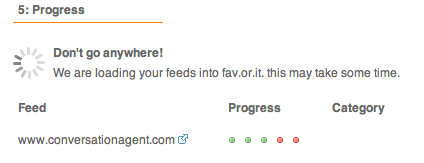
Fav.or.it also wasn't very bright as to handling the few sites I did put in by hand. I had provided upwards of a dozen unique feed URLs, of which half were from FeedBurner. Fav.or.it tried to resolve the feeds, and lumped all those that started with "http://feeds.feedburner.com/" as one single feed. Obviously, that didn't work, so I saw the dozen I tried to put in quickly whittled down to about five. And in contrast to the near-instant adding of feeds to Google Reader, Toluu, Shyftr or AssetBar, Fav.or.it showed a lengthy progress bar, testing my patience.

Slowly, but surely, Fav.or.it managed to import one feed...


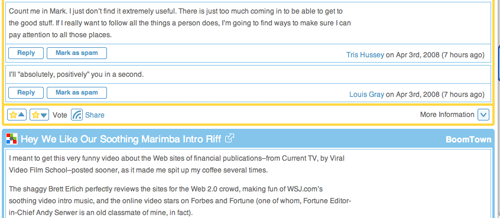
But, eventually they did import, and I could add these new feeds to what Fav.or.it calls a "slice". I can view the RSS feeds, in river view, and even see integrated comments for those who use Disqus. One of the major selling points of Fav.or.it has been the ability to defragment the conversation and bring comments back to the original blog.


Fav.or.it in action, showing comments in line...


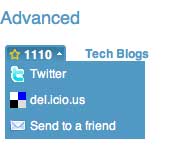
But while that's nice, and noble, it certainly couldn't overcome the interface oddities I seemingly encountered at every turn. My slice "Tech Blogs" was marked with a number of 1110, with no seeming rhyme or reason, and clicking the 1110 showed Twitter, del.icio.us or send to a friend, without any indication of what clicking those items would do. Clicking the first two items gave me a checkmark, but no action.

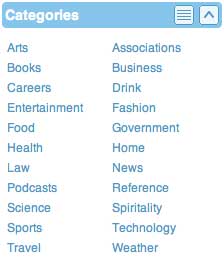
What fav.or.it does bring to the table is a detailed blog directory, organized by humans, into categories, much like Jason Calacanis' Mahalo. But for me, I'm not all that interested in finding new sites for Drink, Spirituality, Government and Weather, among the options shown. For an RSS feeder really to blow me away, I need to be able to read my feeds, and take action. On Google Reader, that action is sharing or e-mailing. On AssetBar, that action is sharing, talking with others or rating an item. On FriendFeed and Yokway, it's commenting and liking or giving stars. But while fav.or.it does enable comments back to the blog, unlike the other services, who delivered on their core mission, they never gave me what I really wanted in the first place, a solid feed reader that could handle more than 25 feeds.


Help! Wait... there is no help.

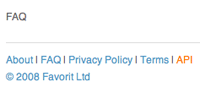
And if that wasn't bad enough, when I finally gave up and went looking for help, giving in to the possibility I'm such a tech dummy that I was missing the obvious, I clicked through to the Frequently Asked Questions area (FAQ). Sure enough, it was blank.

So I guess nobody has any questions. But I sure do - how can you take a service with such good design, slap on so many features that sound compelling, and then reverse optimize it so I'm completely incapable of using it? I'm typically fairly forgiving for well-intended entrepreneurs that are working hard on what could be excellent products, but things have to change dramatically for me to give fav.or.it another run. I need to get all my Google Reader feeds into the system. And the system needs to be ready for people to use it, not for people to be stuck due to its many limitations.

March 24, 2008

March 24, 2008 · 3 MIN READ · BY LOUIS GRAY

Toluu Offers Gateway to Friends' RSS Feeds, Recommends New Ones

Toluu Offers Gateway to Friends' RSS Feeds, Recommends New Ones

While Google Reader, Shyftr, AssetBar and others have developed strong options for online RSS feed reading, it's still not easy to learn what feeds your friends read, and what feeds you're missing, which could be of interest to you. Now, a new entrant into the market, Toluu, aims to fit this niche, giving you a new resource to match your RSS OPML exploits against those of your contacts, or even find new people who share the same interests, or new feeds.

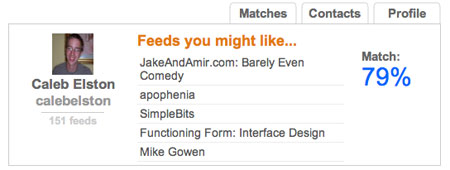
The concept behind Toluu is fairly simple. First, login. Second, upload an OPML file you've exported from your current feed reader. Third, mark which of your feeds are your favorites. Then, by clicking "matches", you can learn which other Toluu users share your interests, indicated by a %. You can browse those individuals' feeds, see which you are most likely to appreciate, those feeds you both share, and which you aren't viewing.


Toluu says Caleb and I are 79% compatible...

While you can choose to browse feeds in Toluu, it's not aiming to fully replace your feed reader of choice just yet. Its beginnings arose not with the intent of becoming a world power, but instead, to enable you and your friends to share and discover new feeds.


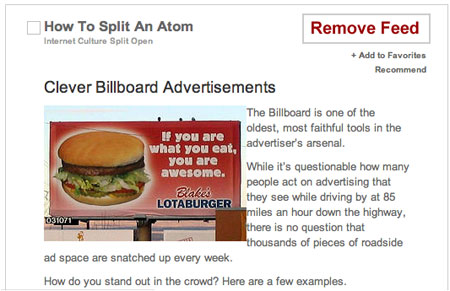
The Toluu feed reader in action on How to Split an Atom

"Toluu got started one day at work when some friends at the office sent me some posts from blogs I had never heard of before. It seemed remarkable that I read over 150 feeds in Google Reader and yet my friends had found blogs that I really enjoyed, but had never read before," lead developer Caleb Elston wrote in an e-mail. "I set out to create a site that was focused on sharing the feeds you read with friends and discovering new interesting feeds. I did not want to create another feed reader, there are many fantastic feed readers out there and new ones being launched and updated everyday."


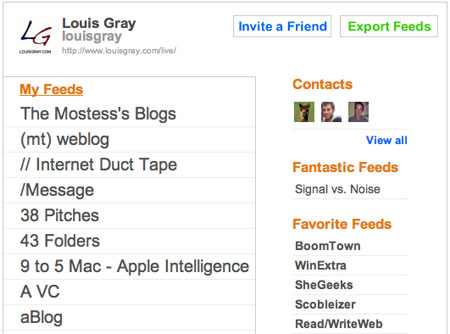
My Toluu Profile, with Favorites...

Toluu is a lightweight utility that sits between the original source of the information, and your primary feed reader. Toluu even offers a simple solution enabling users to add a feed to both Toluu and their feed reader of choice, by adding a bookmarklet, which first adds the feed to Toluu, and then continues to your preferred solution. In the weeks I've been trying Toluu out, it's been remarkably easy to add feeds to both Toluu and Google Reader, rather than worrying my various OPML files were all getting out of sync.

Toluu also gets smarter as activity increases, thanks to collaborative filtering. Based on your reading habits, and those of your friends, individual feeds can be tagged as "favorites" or "fantastic", rising throughout the user community, also letting you find new recommended feeds you might not have known ever existed. And over time, Toluu is designed, not to find the blogs that are one-hit wonders, with the occasional interesting story, but instead, to find those you'll be returning to time and again - this time, with a little help from your friends.

Discover the feeds I read. Follow me on http://www.toluu.com to see!Learn more about Toluu on the Toluu Blog, see my profile at http://www.toluu.com/louisgray, or request a beta invite. Of course, you can always leave a note in the comments with your e-mail, and we'll be sure to get you in the door. After all, for social services like Toluu, the more friends we have actively participating, the better the service will get.

March 9, 2008

March 9, 2008 · 6 MIN READ · BY LOUIS GRAY

10 Suggestions for Google Reader, One Year Later

10 Suggestions for Google Reader, One Year Later

On March 3rd of last year, I posted one of the more active and popular posts in louisgray.com's history, offering my thoughts on where I hoped Google Reader would take the service. In a simple "10 suggestions" format, I listed some ideas that were small enhancements, and others, more broad. Now that we've had just over a year go by, I thought it'd be interesting to check back in with Google Reader and see what's changed. How many of the 10 did they hit, and if they didn't get it, who did?

In my opinion, you'll see that due to Google Reader's not filling all the gaps I laid out a year ago, a cottage industry of RSS readers and link aggregators has emerged - great for the Web, not always so great for Google.

1. "More Like This" Suggestions

I asked Google to recommend feeds based on those I subscribed to.

Google added a broad "Suggestions" feature, based on all my feeds in aggregate. They haven't implemented this feature on a feed by feed basis, as in my example: "Others who subscribed to Jeremy Zawodny also subscribed to Don Dodge or Robert Scoble.", but they do get partial credit here.

Who did implement something like this the way I asked? Nobody, really. AssetBar claimed to have solved this in their initial product description, but I haven't yet seen it. NewsGator, Shyftr, Fav.or.it, also don't do it, as far as I can tell. Neither does RSSMeme, although the service does try to find similar posts, and FriendFeed offers recommended user subscriptions.

(Of interest, I'm beta testing one solution that does exactly this. More on that soon.)

2. Eliminate Duplicate Feed Items

Nobody likes getting the same feed item over and over. Over the year, Google has done a lot of work here to have this fixed. There are still issues with seeing duplicate items if you have subscribed to a friend's shared items feed, or if you've subscribed to keywords via Google News, but largely, this is not as big an issue in 2008 as it was in 2007.

Who else fixed the duplicate items issue? Shyftr's implementation here is flawless. AssetBar also does a fantastic job showing just one item, though if I look at an item I've already viewed, through a friend's shared link list, it doesn't always know I've already seen it. The issue of duplicate items continues to be a major point of discussion on FriendFeed and elsewhere.

3. Add Negative Keywords

For some folks, I'd like the option to get almost all their posts, except when they talk about politics (Dave Winer), fatblogging (Jason Calacanis), or if they just post a series of del.icio.us links (Steve Rubel and Chris Brogan come to mind).

Google hasn't done anything here. But Ionut at Google Operating System highlighted a new Greasemonkey script that works in FireFox to approach this by highlighting posts with keywords you select and grays out those you would like to exclude (See the post: Filters for Google Reader).

Who does do this right? AssetBar again claimed to when introducing their product, but if it's integrated, I haven't seen it.

4. Share Items Without Subscriptions

I'd like to add items to my shared link items feed without subscribing.

While Google didn't do anything about this, I discussed a work-around back in January.

Who does this right? Just about all the link aggregators, including LinkRiver, AssetBar and FriendFeed let you share items without subscriptions. ReadBurner had implemented this as well before Alexander Marktl had to take the site down.

5. Aggregate Reader Statistics

I wanted to know the most frequently read blogs, and what were the most shared items that day.

Google Reader recently added a "Details" item, showing how many Google Reader users were subscribed to a specific blog, but they're nowhere on showing rankings or seeing the most popular shared items in a single day.

Who does this now? As discussed a ton here in 2008, the shared items space took off like a rocket. FeedHeads had done a fantastic job and pioneered this space, on FaceBook, while ReadBurner, RSSMeme, Shared Reader, and LinkRiver all offer details on most popular shared items. Amusingly, in an attempt to discover the most popular items by Google Reader, everybody from Scoble to TechCrunch was fighting to add the data they did have by hand.

6. Addition of Search

At the time, Google Reader was missing core Google functionality - search!

The Google Reader team solved this one in a big way back in September. Nice job.

Who else offers search through feeds? LinkRiver, AssetBar, RSSMeme, and Shyftr all do this very well. So far, Fav.or.it does not, and FriendFeed I'm sure will, but hasn't gotten there yet.

7. Create a Link Blogs Directory

I wanted to see a directory of Google Reader link blogs both ranked by name and by interest.

Google Reader, so far, has largely neglected the power and discovery of link blogs, so this is nowhere.

Who does do this? RSSMeme offers a directory of the most active link bloggers, based on total number of shared items, as did ReadBurner. AssetBar integrates shared link blogs and shows which ones are most read by individuals, but doesn't yet have aggregate data. Nobody has mastered a directory by name, by topic, or by subscriber count yet.

8. Further Integrate "Trends"

I wanted my trends data to be easily accessible from Google Reader.

Google Reader integrated Trends relatively quickly. It was an easy fix.

Who else does this? LinkRiver, as noted last night, features a page called "Attention" on who I share more often and what are the top keywords. FriendFeed offers a "Stats" page showing who I interact with the most, and who interacts with me. RSSMeme integrated global statistics, but not by user. And AssetBar shows all my stats on my profile, in aggregate.

9. Expand Individual Feed Statistics

I'd love to see stats by feed as to their schedule, and if things have changed.

Google Reader has shown basic statistics on how often a feed publishes. (i.e. loisgray.com publishes 10.7 stories per week) But beyond this, more data is missing.

Who else does this? RSSMeme offers the ability to see what the most popular shared items were, by source, which is very interesting, considering individual post popularity, but nobody that I'm aware of has tackled the expanded feed statistics set.

10. Customization Everywhere

Google Reader, unlike iGoogle or other portals, comes in one flavor. So does their link blog.

In the year since my initial post, Google added the ability to customize a small profile to include in my link blog, with links out to other sites, but with that exception, there remains no customization for my application interface or the shared items blog.

Who does do this? Not really anybody comes to mind. iGoogle, My Yahoo! and portal sites that have integrated RSS feeds enable a great deal of customization, but as far as the main application's interface is concerned, it's usually a take it or leave it strategy.

It can be seen that Google has made some strides toward my 10 suggestions. They integrated trends. They nailed Search. They added suggestions. They improved by reducing duplicates. But they dramatically fell short when it came to harnessing the power of link blogs, and this gap enabled more focused services to emerge to fill the hole - services which are now growing and becoming very interesting. The Reader team has also largely stayed quiet, making it uncertain as to whether we should look to them for innovation, or elsewhere. There's no question Google Reader is a fantastic application, one I use multiple times a day, and one I haven't yet seen eclipsed, even by the next generation readers, enough so to get me to switch. But if they get out-innovated, that time may eventually pass.

March 4, 2008

March 4, 2008 · 4 MIN READ · BY LOUIS GRAY

Shyftr Offers Social RSS Reading, Including Comments, Rankings

Shyftr Offers Social RSS Reading, Including Comments, Rankings

In the world of online RSS feed readers, there are the most popular options, like Google Reader, BlogLines and NewsGator, and just below the radar, there lies a group of new entrants to the market, who are looking to change the game through more interactive features - using innovation to potentially gain ground on the big brand names. One interesting entrant is Shyftr, which combines the ease of an online feed reader with the ability to find friends, make shared comments on feed items, and see which are the most popular feeds.


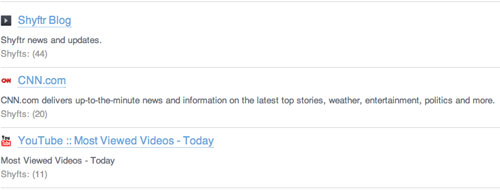
Most popular feeds, and how many have them "Shyfted".


In early beta now, Shyftr has only a few dozen users, and isn't yet overloaded with tech heads, showing a good mix of sports fans, offbeat news and a smattering of gadget lust. What it lacks so far in a thriving user community, it makes up for in potential, echoing some of the pleas I made almost a year ago in 10 Suggestions to Improve Google Reader, when I first asked for the ability to aggregate user statistics, and mirrors some of the work AssetBar has done in this space, through offering comments to RSS items, and shared comments that can be viewed by all the service's users, along with displaying the most frequently commented items or most popularly subscribed feeds.


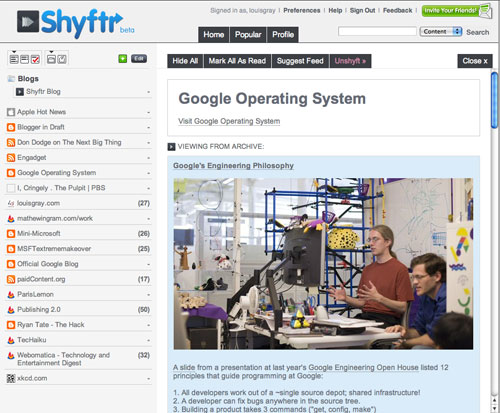
Shyftr in action, reading posts in line, with feeds on the left.


Dave Stanley, the founder of Shyftr, came up with his concept for the site about a year and a half ago. As he wrote me in an e-mail last month, he wanted to see what feeds his friends were reading, "and have the ability to quickly add a feed of interest to the list of feeds that I read - a social rss reader." But six months after his idea didn't come to pass from anywhere else, he set out on his own, and with a small team, Dave has seen the service develop to where it is today, offering to give users a single place to read all feeds, share with friends, and discover new sites.

As I stated in December, "Reading one's RSS feeds today is a journey of isolation." Shyftr now breaks through that isolation booth, letting you add friends, make comments on their profiles, or even suggest feeds directly from Shyftr. In fact, Dave, now the proud father of a 5-month old daughter, saw my wife and I are expecting twins, and suggested I check out the feed for Babygadget. We'll see about that, but I liked his thinking. From within Shyftr, I too can suggest any subscribed feed to any friend.

The best way to get feeds into Shyftr is to export an OPML file from whatever feed reader you're using now, and copy/paste the best ones in one at a time, for now, or add sites' RSS feeds as you run into them. They're working on full OPML import, but it's not yet here, something I forgot more than once. :-)

When you've added a feed, clicking on the feed name with new items displays the items in line, with all new items from a specific feed in the viewing pane, much like AssetBar or Google Reader. If others have seen an item before you, it will show you're viewing from archive, and if you make a comment, future Shyftrs will see your note, as you would theirs if you weren't first to the game. Most frequently commented items rise to the top of Shyftr's "Popular" page, and if you find somebody who often comments on sites you read, you can add them as a friend, or view their own profile to see their friends or what feeds they read.
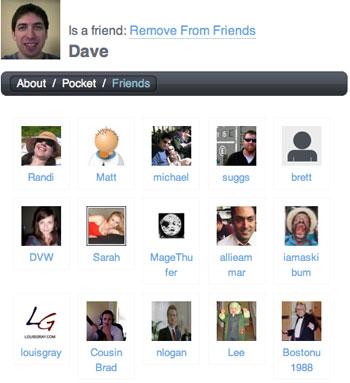
Interestingly, you can even choose to read the feeds your friends have added to Shyftr. All of them. As I had added Dave as a friend, I can walk through the blogs he has subscribed to, see which sports teams he is following, or catch up on his gossip sites. This is a feature called "Their Feeds". Clicking back to "My Feeds" takes me back to those I've added.

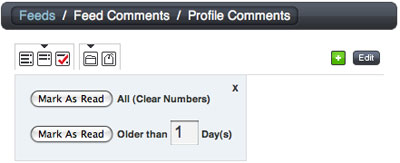
Shyftr also is very public about recent activity, displaying the most recent blogs added, or "Shyfted", and the most recent comments. The site also keeps a running tab on the most frequently subscribed feeds, which so far is led by CNN and the New York Times. And like AssetBar, Shyftr wants you to not feel overwhelmed by RSS feeds as they rack up. Offering more options than just a "read all" or "mark all as read", Shyftr lets you mark all items read that are older than a certain point, letting you reduce your feed glut down to a smaller time period. AssetBar said this makes you not a liar. Shyftr makes no claims to your morality, but it is a tidy way to clean up.


Choosing to mark some items makes sense if you're behind.


Can Shyftr gain traction in what's obviously becoming a crowded market? Sure, assuming more people know about their service, find the shared comment streams and popular items compelling. Given the site seems a bit overweighted, thus far, with sports fans, and not enough with the Twitter pushing, TechMeme worshipping digerati, there's significant room for growth from those who have been actively calling out for a more interactive way to consume the news and RSS. As the site grows, adding new features, like OPML importing, improved feed searches and additional social features, it could carve out a space for itself.

Feel free to join in. Shyftr is open for business now. No sign-up codes, and no waiting. You can find me at the ID of "louisgray".