Showing posts with label Beta (3 posts). Show all posts

November 8, 2010

RockMelt's Social Hooks Put Users In Control Of Invite Flow

RockMelt's Social Hooks Put Users In Control Of Invite Flow

Capping initial access to one's service has long proven to be one of the most successful ways to drive buzz around the product. Whether limiting the number of users is designed to reduce strain on the system, to reduce initial support demands during the beta period, or just to get people talking about the product as they beg friends and strangers for access, the process of launching a product to a subset of people has practically become second nature - with multiple layers of "beta" evolving. Today's launch of RockMelt is an interesting tweak on the old model, and a first test of the browser's real integration with Facebook as your social engine.

It is not too uncommon for users who gain early access to a product to have a limited number of invites to pass to their friends. You often see a flurry of posts on blogs or Twitter, or pings via e-mail that amount to "Who wants into Service X? I have 10 invites!" or the invites can be given away in a first come first serve raffle system. Alternatively, the service can do a first in and first out approach, whereby the faster you are to register, the faster you get let in behind the firewall, but all flexibility resides with the service itself. This is the "request and wait and wait and wait" method.

RockMelt has created a unique hybrid of the two, worth noting.

The site, if you don't have access, asks you to connect to Facebook, and request an invite. That puts you in the queue - but not one solely controlled by the company.

Once you have made such a request, a friend of yours who already has access to the browser can see that you have asked to get in, and can, through RockMelt, pass you a code that is exclusive for you. This presents an interesting dilemma, especially if demand far outstrips supply.

In my case, as with all standard new users of RockMelt, I was given three invites to hand out to Facebook friends who wanted to take the new browser for a spin. But dozens and dozens had already made the request, meaning I couldn't give out access to everyone I would like to and forcing me to hand pick three - for whatever reasons I felt.

Should I reward close friends? Family? Business colleagues? Partners? A-Listers who I want to impress? The choice was mine alone.

The dilemma is an intriguing one. I wouldn't want to pass along my invite to someone who I thought wouldn't benefit from access. I wouldn't want to pass an invite to a Facebook connection who was a practical stranger. So I made my choices.

Three folks got RockMelt invites, and the rest didn't. Maybe someone else will take kindly to them later. Maybe I'll get more invites. But RockMelt's twist is an interesting one - which will ensure you aren't giving out codes to people you have no connection with. If the graph is truly to be social, a missing link is just a miss.

August 25, 2009

No More Beta Codes: Lazyfeed Is Open for Everyone

No More Beta Codes: Lazyfeed Is Open for Everyone

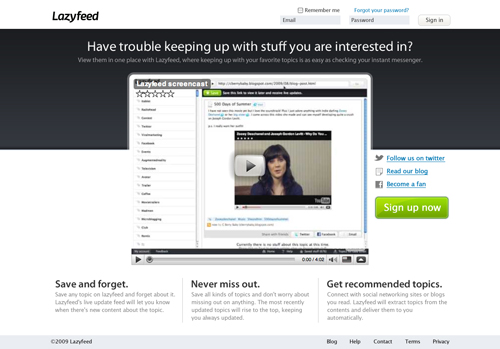
Almost two months ago, we first introduced Lazyfeed, a real-time blog search and feeds engine, which has grown to be a big part of my information gathering process, following topics which I like, rather than people, or specific RSS feeds. The product's uniqueness is one of the more innovative services I have seen in 2009, which was a big part of why I practically have had a part-time job as a beta code broker, trying to gain people access to the site. As of today, that unpaid gig is done, for Lazyfeed has removed the beta wall, and opened the site to all who want to enter. If you didn't get access to the site, I strongly recommend you go and try it, as you will find the wave of interesting news and blog posts from around the Web addicting.


Topics for Lazy Me from Lazyfeed

As I've mentioned in my previous coverage of Lazyfeed, including a quick how-to video on the service, the site does two major things - first, finding blog posts and news articles relevant to me based on topics I have provided, and second, find related items to those entries I have added to my own social sites, including this blog and my Twitter account. Blog posts that have tags will generate new items, while hashtags on Twitter will do the same. This second portion is what Lazyfeed says gets you the lazy portion of the name, because in "Topics for Lazy Louis", I haven't even had to enter the topics into Lazyfeed - it just happens on my behalf.


The New Lazyfeed Home Page Is Open for Business


Ethan Gahng, CEO of Lazyfeed, uses his own product in a much different way than I do, leveraging the search engine for entertainment, sports, TV and other things, where as I just continue to feed my tech obsession like a bright orange RSS-powered IV drip. But that's what makes a site like Lazyfeed so powerful - it can be whatever you want it to be, and hopefully, without too much work. Stay lazy.

July 13, 2009

We Have Invites! Five Stages of Beta and Battling to Get Access

We Have Invites! Five Stages of Beta and Battling to Get Access

When launching a new service, entrepreneurs have a myriad of things that make them nervous. Maybe the product won't be seen as having value. Maybe competitive offerings are good enough. Maybe there are bugs that nobody has discovered yet. And sometimes, the rush of new users who arrive to kick the tires is enough to break the system, as the infrastructure is not ready. To help reduce such public outages, many products start out with a small audience, and there are many ways to grow slowly, each with their own pitfalls.

1. The Closed Private Beta

Often sites will have a private beta period, open only to a known set of users, typically starting with the company's inner-most friends and supporters. In order to get onto the list, you have to know somebody at the company, or be so influential to gain early access.

The upside for a private beta to the developers means that typically the product is in safe hands of people who understand what you are doing, and are willing to forgive rough edges and mistakes. Also, the small load means you can fix bugs leisurely without the threat of public exposure.

The downside for the private beta is that the site itself still isn't really being tested by a more natural audience, either in terms of how they plan to use the service, or in terms of scale. What might work during a closed private beta might not be good enough when the doors open.

2. The Private Beta With Open Invitations

Sometimes, a site will start with a private beta period, but users can invite their friends - often a limited number. You saw this with GMail back in 2004, when early users could invite others, but only a few at a time. Similarly, FriendFeed did the same in 2007, as did Toluu in 2008, closing their early sites off to the mainstream, but letting you in if you knew somebody who had already gotten through.

The upside for this process is much like the closed beta in that the audience is going to be relatively forgiving and small. Also, the influx of less-known people can give a more realistic expectation of what features are needed and which need to be improved.

The downside for this process is that there may be people who could help try the product who don't have an in, so their interest is muted. Also, the small group tends to be insular and will use the product differently than an open audience.

3. The Numerically Limited Invitation Beta

After internal testing, some products will release a known quantity of invites, either through their Web site, or the media, in an effort to expand the testing, and give early users a flavor of the site. The invites, often tied to specific sources for tracking purposes, can range from few dozen to hundreds or even thousands, depending on how robust a test, and how deep the infrastructure. We've recently seen this approach with the site Lazyfeed, which gave out a few hundred invites in the last week by way of TechCrunch, ReadWriteWeb and from me, both on FriendFeed and Twitter.

The upside in this case is that this wave of users best simulates actual usage of a product, to see what is working and what is not working, while stressing the system's back-end only to a predetermined level.

The downside is that users who don't get to the invites quickly can get discouraged, and often, the very first people to get in aren't necessarily the ones who will most deeply investigate your product, but instead, happen to be those who were fastest at getting to the news and signing up.

4. The Open Beta

For some services who don't want to limit the testing, they might open up a site to all who wish to register, but do so under the guise of a "beta" tag, explaining that some features might be missing and others might break. While anybody can enter, they should not assume full functionality. You could see this with GMail for years, even after the product went away from strict invites.

For developers, the upside here is that they have a perpetual excuse for problems. But it's beta! Also, any user who wants in can get in, without having to get on a list or know someone. It also can often give the ability to stress-test a product under the impact of a large audience.

Downside is more limited, but can be seen if users are more wary of beta products, preferring to wait until they are more stable for use.

5. No Beta

Some products might skip the beta process altogether. They are just open for business, period. This removes the guise of the testing period and lets the entire audience at them at once. I call this the "Open. Fail. Scale." method, because often there are bumps along the way that come with growing a product, and one can never anticipate them all. Twitter would be a fantastic example of this, although both its fail and scale have gone on more than anticipated.

So how do you choose, if you are an entrepreneur, how to get your product out the door? You can see, for instance, that Brizzly, by Thing Labs, is still in Private Beta. (And I want in) Lazy Feed is opening up more, and you can get an invite here. They each may have their own reasons. In the example of Brizzly, it's probably not ready yet. For Lazyfeed, maybe they aren't ready for a million support questions and they want to start slow.

I tend to believe you should open as big as you possibly can without breaking. If users want to get in to your service, don't stop them in their tracks. Just set expectations and work with them as partners to continue to improve. Don't insult them by using beta as an excuse, but instead as a stepping stone. And yes, get me in as early as possible. I promise I won't break anything.