Silicon Valley Technology Commentary & Archives · Est. 2006 3,045 Posts · 2006–2026
Showing posts with label Aggregation (6 posts). Show all posts

November 1, 2011

November 1, 2011 · 3 MIN READ · BY LOUIS GRAY

Google Reader Evolves, Gets Tighter With Google+

Google Reader Evolves, Gets Tighter With Google+

This afternoon saw the delivery of updates to Google Reader that brought the product's design in line with Google's simplified look across many properties, and added support for sharing to Google+. With the launch, which I've been participating in since shortly after arriving at Google in late August, the dedicated friending/following network within Reader, and dedicated shared link blogs from Reader, were shut down.

This last bit has gained the majority of feedback as users anticipated the changes in the last week-plus since the preannouncement, and impacts some of the most active users, myself included. But if one unwinds the immediate reaction of being reluctant to change, the product's direction was telegraphed as Google has promised an evolved product experience,  regularly adds features to Google+ and recently announced the planned wind-down of Google Buzz, which was closely tied with Reader's existing commenting model.

In discussing the changes, I walk a fine line of respecting the tremendous hard work that went into Google Reader from the products' founding team and core engineers in the last five years, while also recognizing its role in feeding the product where I am currently focused as an employee. As a user, I have spent more time with and more loyalty to Google Reader than any other product on the web in the last decade, with the only possible notable exception being a web browser, either Safari or Chrome.
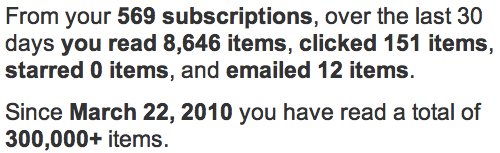
In the last month, I've continued to crank through Reader, in the new interface.

At various times, I've said I'd give up my Gmail before Reader. I even wrote a blog post two years ago saying I wouldn't accept $25,000 in cash to give up Reader. This is because Reader has played a central role for me to find all the updates from around the web in a centralized way, and let me share out the best to my downstream network. In years past, as you've seen here, I've rallied for feature adds to Reader, and highlighted the ecosystem of products, from ReadBurner to RSSmeme, Feedly, Toluu, and my6sense.
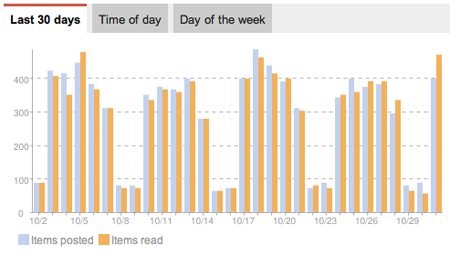
A Day In the Life of My Reader Feeds, Graphed

You can't be a bigger fan of information discovery and consumption than me, unless your name is Marshall Kirkpatrick. But one thing to note is that the web has changed quite a bit since I first started drooling over aggregators like FriendFeed and Google Buzz, and the shared items trackers that sparked to life in 2008 are universally dead. Users have voted on the web to share with social networks like Twitter, Facebook, LinkedIn and Google+, and the new additions to Reader make that easier.

Sharing from Google Reader to Google+ Includes Circles and Commentary

I've personally been using the new Reader, or something close to it, for more than a month, and every time I'd log into the existing version, the difference was notable. Change is hard, but like a new haircut or or new home furniture, it grows on you. Now, instead of sharing 10 or so items a day to the anonymous group of people following me in Reader, I selectively share less often, and to more targeted circles in Google+ which I built by hand. And if the item is interesting to an even wider group, I share it to Public. (More tips here on Google+)

Since the launch this afternoon, I am already seeing a lot more items shared to Google+ from others in my circles, and it's interesting to see how they have adapted to the new functionality, even though others are more wary about the changes. As Alan Green outlined in his blog posts this week and last, Google recognizes the changes may not mean the new product is perfect for all users, and the tools are there to let you take your data with you. But I hope people do see the value of leveraging Reader as a smart RSS feed engine and share selectively to Google+ circles. After a few shares, it becomes second nature, and the world could surely benefit from a streamlined social experience. Trust the team is listening to all feedback from all corners. It's a privilege to have an impact on a product that has played so large a role for me for so long.

September 23, 2011

September 23, 2011 · 2 MIN READ · BY LOUIS GRAY

Subscribing to the Stream of Consciousness

Subscribing to the Stream of Consciousness

There's no question more people are on the Web, consuming greater amounts of content, sharing more and expanding their networks online. Social networking has eclipsed previous web pasttimes, including email and porn, in sheer use. As many different activities become social, different services have emerged to center around specific niche activity - for example, Foursquare for location sharing and discovery, Last.fm for music listening and artist discovery, and at least for a while, Blippy, which tracked my spending habits.

As an early adopter and one who likes sharing, I've embraced practically all these sites. I enjoy sharing and learning from the community, finding friends and shared interests. I like that I can explicitly use my NOOKColor to tell you I finished a book. I like that I can explicitly use Spotify to share playlists and my favorite tunes of the day, and I like that I can explicitly share from Google Reader to bring you the best from the Web I am reading. The human element, I believe, is an important one, where I signal to you what I find most valuable of all these things - what I have hand-selected for you and you specifically, to know.

There are two defining attributes of the services I've mentioned that I think are critical to enabling a positive user experience. The first is that the users who I am sharing with know just what they are getting into. They joined Foursquare to follow location updates. They joined Blippy to see purchases. They joined Last.fm to see music plays. The second, if the site is more of an aggregator, like FriendFeed in its heyday for example, is that filters exist, so I can avoid seeing your tweets, or your Foursquare updates, or your Flickr photos. Both of these ensure that the user, as the consumer, maintains control over what content they see and the publisher has a choice as to what they publish.

There is value in explicit sharing with selective audiences. There is value in the audience anticipating what they will see when they choose to connect with you, and in you having the opportunity to share what you want, when you want - an inherent, unwritten, contract, that if you violate by sharing too much, too often, or too off-topic, means your connection can be broken.

Spending a lot of time listening to mainstream social networkers, such as my wife, who is not quite as embedded as I am, I hear a lot about the minutiae of people's lives that go into these networks, and the resulting annoyances about such updates. Initial responses to sites like Twitter or Foursquare was typically skeptical, in terms of why people would want the small updates, seemingly unfiltered. Obviously, as both services have reached a good level of traction, thanks in part to power users and casual alike, there is some value to microsharing, and some are on the services constantly. But quality and filtering adds value - something I've obviously been focused on with my work at my6sense and constant testing of new products to make our social networking even smarter.

Sharing is going up. This is fantastic. Enabling more apps to share and people to connect is great too. But I hope quality and curation don't fall by the wayside.

June 29, 2011

June 29, 2011 · 2 MIN READ · BY LOUIS GRAY

Aggregation Is Invisible In Google+. Thank Goodness.

Aggregation Is Invisible In Google+. Thank Goodness.


The true value of a social network is the product of the people participating and the content being shared. There's no doubt some sort of mathematical program smarter geeks can compile to show just how that works, but it's true. You will participate on one service or another because of what is said and who is saying it. If the content doesn't match your interests, or the people aren't those you care about, there's little pull for you to be there. One corollary to this which evolved over the last three-plus years is that social networks gain power through being the originator of the content. While I once was a major proponent of aggregation products that pulled from many corners of the Web, the value downstream is vastly diluted, and adds to noise. This was a major problem for late adopters of FriendFeed, was immediately a problem for Google Buzz on day one, and is an ongoing problem for Facebook users, who often struggle to find ways to delete specific services' access to their feed and wall.

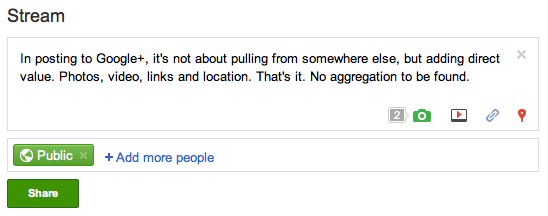
Google+, at least on day one, has absolutely no way to push content into the site from a third party network. This means you don't see a stream of people's Twitter updates, you don't see their blog posts automatically added, you don't see their Foursquare checkins, their Instagram photos, TurnTable spins or any of the other various update virii that flood most streams. Instead, the site is an open whiteboard for status updates, link sharing and photos, all requiring manual input. The inference, and correct assumption, is that those updates on Google+, were written by the person with specific intent for a specific audience. You don't get that feeling that they posted elsewhere and aren't participating locally - a common complaint on other services, like FriendFeed and Buzz.

At the end of 2009, my two-year fascination with aggregation-centric parlays coming to a close, I said aggregation was better in theory, arguing cross-posting should be reduced. This didn't stop Google Buzz from launching with aggregation at its core a few months later. Unfortunately, the ease at which you could pull in content from third party networks like Twitter meant many people, including Google employees, added these feeds and didn't return. It made for a subpar experience, and initial requests for updates included the ability to mute these services as a whole or from specific users.

I would bet that in time as the Google+ API is completed and released, we could soon see the opportunity for mobile and desktop clients (like Seesmic for example) to write to Google+ as a new service. I am betting Seesmic's Ping.fm is already thinking of how they can make Google+ yet another supported service. But I would push for caution in this. I've seen how the deluge of activity from sites like Twitter (and Facebook if they opened up) can drown the downstream aggregator and help it lose its identity.

Some first users of Google+ today commented about the similarities of it to FriendFeed, with nested comments, lists and real time at the core. But honestly, it's the opposite. FriendFeed launched as a major aggregator, supporting dozens of sites. Google+ starts with just one. It's refreshing.

March 21, 2011

March 21, 2011 · 2 MIN READ · BY LOUIS GRAY

Cliqly in Alpha: Visual Interface, Filters for Top Tech News

Cliqly in Alpha: Visual Interface, Filters for Top Tech News

Curated news sites are so prevalent, it seems practically everybody has one. With simple tools like paper.li and others, you can even have them automatically generated from the social connections you have on Twitter and other networks. But there's still room for ingenious alternatives that play with highly visual layouts, filters, search and personalization. It looks like we're close to having a new one on our hands with the imminent launch of Cliq.ly, currently ruminating at the longer domain of http://gocliqly.com/, which rolls out top tech news in a tiled format, searchable by keyword.

While that in itself is interesting for fast browsing and article discovery, the service teases with a not yet active menubar for "Popular Scenes", "Views" and "Account", which theoretically lets you select your own keywords, sources or other tweaks that would let this potentially become your start page, providing an alternative to the more traditional RSS reader.

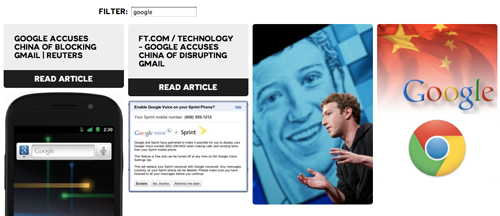
Cliqly Filtered With Google as a Keyword

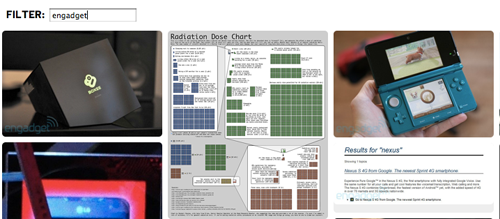
If you visit the incubating http://gocliqly.com/ now, you'll see graphics from top news sources showing updates on Web services, browsers, and gadgets. A small textbox lets you filter by keyword, be it from the article's title, content or tags. I tried searches for many top tech terms, from "apple" to "google", "Android", "t-mobile" and blogs like Engadget and TechCrunch, all of which returned multiple results, clickable to the main original link.

Cliqly on "Tech"

One assumes that as Cliq.ly gets built, one get the opportunity to tweak views to be more graphical or less so, depending on one's preferences. Given the option for "Popular Scenes", it's possible you could create a personal scene with customized feeds and views and save it for others to view. But it's early days. In fact, DomainTools suggests Craig Condon, one of two behind the project, just snagged the URL yesterday. He mentions a designer, Tim, as a partner on the site, but he is providing the majority of the code.

Cliqly Showing Engadget Stories

What we're seeing from Cliqly on day one is a sneak peek tease of what's to come, no doubt, so bookmark this one, and watch the work develop.

November 22, 2010

November 22, 2010 · 2 MIN READ · BY LOUIS GRAY

Founders Moving On from Social Aggregator Cliqset

Founders Moving On from Social Aggregator Cliqset

Taking on Facebook, Twitter and Google in the fiercely competitive world of social networking and community building is a tremendous challenge that can be practically impossible to overcome, even with superior technology leadership and adherence to federated open standards. Cliqset, the wildly innovative social networking aggregator that was among the first pioneers to adopt Pubsubhubbub for real-time updates, and Salmon for cross-network comment posting, faces a murky future with news today that the company's founders, Darren Bounds and Charlie Cauthen, are going to be leaving the company, following an unsuccessful round of funding.

Despite a number of smart moves to make the site increasingly useful, such as the launch of social search in September, and the addition of Groups and Activity Streams in January, the site struggled to grow a consistent and growing community of users, with a short-lived Turkish invasion drawing a traffic bump and some amusement.

Speaking with Darren today, he said that he and Charlie are not moving on to a new project, nor have they sold the company, saying as founders of the company, it didn't seem appropriate to seek out other opportunities while simultaneously growing the site. But there are no regrets about the adherence to cutting-edge open standards with the site, which were ahead of practically any other service on the Web.

"A federated social Web agenda at Cliqset is something we chose to promote," he said. "The open standards aspect is something I believe is still the future. The roadmap to getting there is going to be a little longer than we would have liked. But where these standards can be implemented and improve efficiencies, they deliver real value."


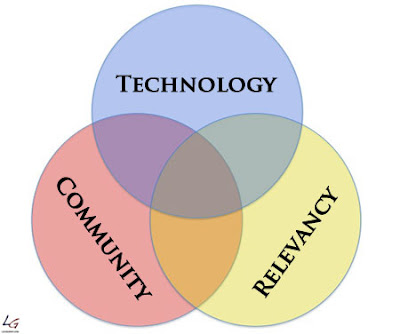
As I wrote a year ago in a post on the 3 social pillars needed for any successful network, one needs to find leading technology, community and relevancy to make a site a must-visit each day. For Cliqset, their technology was never in question, but scrapping for users was a challenge that didn't find a great deal of traction. Darren agreed.

"In order to build a community, you need massive differentiation today," he said. "It's fairly obvious in hindsight. Projects I would be working on in the future would be leveraging the existing social graph, and the need for success wouldn't be contingent on relationships and community within itself. In no means do I think Facebook is impenetrable and somebody can't build something to compete with it, but it's not an easy task."

There are no plans to shut down Cliqset.com immediately, as the company's investors have opted to keep it up and running, despite a lack of engineering and operational support. In the event the service were to be acquired, Charlie and Darren could theoretically be pulled back in, but that scenario is unlikely. As I have been saying for a year aggregation is great in theory, but sites like FriendFeed, Cliqset and Arktan haven't been able to find a unique voice that makes people go their way instead of the original sources of content - Twitter and Facebook. I am eager to learn about the team's next move - they're very sharp and were focused on pushing open standards forward. In an ideal world, their work will not have been in vain.

April 22, 2010

April 22, 2010 · 5 MIN READ · BY LOUIS GRAY

The Buzz Bots Brouhaha and Other Empty Statistics

The Buzz Bots Brouhaha and Other Empty Statistics

On Tuesday, ReadWriteWeb and a number of other tech blogs (including Mashable) stirred themselves into a tizzy around a report from social media measurement firm PostRank, who reported that almost 90 percent of content in Google Buzz, the company's nascent social network, came from news feeds and other non-native sources. Their self-congratulatory conclusions, kicking dirt on the service which hasn't hardly had a chance to grasp for air following body blow after body blow after a stumble out of the gate around privacy, came with phrases saying Buzz had "fallen short of capturing the hearts and minds of the social web", and another, "Much of Buzz’s content may be hand-crafted — it just doesn’t originate on Buzz."

Oh dear! What a terrible thing! Prepare the wake! I would be honored to act as a pallbearer, if given the opportunity.

PostRank's data served only one purpose - to count the total number of entries from all individual services being aggregated by the downstream collection service (Buzz). It is no secret, and I don't think anybody has successfully ever argued against it, that every single network that has the potential to import Twitter entries can easily be dominated by updates from that service. It was true with FriendFeed. It is true with Ecademy. It can be true with Facebook, depending on who you follow, and there is also that potential with Buzz. Twitter entries are light, easy, and update often. Even the most avid bloggers post more entries to Twitter than they do on their own site - as they post their own blog entries in addition to other updates, so it is no surprise that many people see their own feeds dominated by their Twitter. Add in Google Reader shares, which are very well tied in with Buzz, and you can see how this so-called "automated" "bot" behavior can start to ratchet up the stat-o-meter.

But the data (and reporting) was an inch deep, and it very poorly associated the world of automated feeds with the world of automated non-human behavior on other social networks which is nefarious. (Twitter bots, for example)

Aggregation services are built to aggregate data from disparate networks. It's practically their core definition. However, many of them also offer the option to create net new content. Buzz lets you make very detailed blog-like posts if you like. It's a great engine for sharing pictures, or YouTube videos, or simply adding a link from a Web page, and adding your observations. These so-called native entries are what amassed the approximately 10% of all updates seen as non-bot behavior by the survey.

As I mentioned back in March, native entries to Buzz get the most engagement. Some people, such as DeWitt Clinton from Google, make fantastic high quality posts on Buzz, and can get dozens to hundreds of comments. So do native entries from highly-visible people like Robert Scoble, and very active supporters of the community, including svartling and Leo Laporte.

I recognize that the vast majority of my own updates on Buzz are feeds. I love feeds. RSS or Atom, whatever you like, I recognize they are great tools. I will not stop sharing my items from Google Reader on Buzz unless the community goes silent, or tells me to stop - but between my Reader shares and my native blog entries, my own 4 native Buzz entries represent a miniscule 2% of my last 185 Buzz updates (according to Buzz-Charts).

This doesn't mean I haven't supported the platform, and it doesn't mean people are not engaging. In fact, according to the Buzz-Charts site, the last 185 posts received 478 total comments, or between 2 and 3 replies for every single entry. Some got none, and others got much more. But every single share was originated by a human, and every single comment was a so-called native entry.

PostRank surveyed Buzz with the subtlety of a political pollster operating under payment by the Committee to Re-Elect the President. (CREEP) While it may be factual that many people imported their Twitter entries and other automated feeds to Buzz, the Buzz community knows to largely ignore those items, or to not follow those people who are using the service in a poor way.

Real Buzz Data That Shows Real Engagement By Source

Buzz-Charts shows a much different story. In their graph of actual replies (comments) on all entries in Buzz, they found that of 24,584 posts that gained comments, 13,520 of them were native Buzz entries, a full 55%, not the measly 10% created. In second place, Google Reader shares showed 3,978 entries with comments, or 16%. Add on Buzz Mobile's 1,572 active threads (6.4%) and those top three conversation starters represent more than three quarters of all active threads, more than 18,000 of the total 24,000.

In contrast, all those automated Twitter entries that PostRank said was 62% of Buzz? They only had 837 active threads, or just over 3% of active threads. That means more than 90% of all Twitter entries that hit Buzz are ignored. Given you can't really have conversations in Twitter in the same way you can Buzz, and the person's entries already seem disjointed, that's probably just fine.

So we now know the community can self-select and self-filter, and that Buzz users comment on native entries and Google Reader shares more than anything. But let's go back to what a "bot" is anyway.

According to Tweetmeme, that ReadWriteWeb story was retweeted 662 times on Twitter. Is that any different than making a share in Google Reader? Even if a human clicked that button, are those not 662 bot entries into Twitter? In addition, the main RWW feed (@rww) is dominated by entries from TwitterFeed. That very post about Google Buzz bots was fed by a bot to their Twitter account. So the underlying hint of "Buzz loses and Twitter wins" is dead on its face, if this is the measure.

Do I want Twitter updates in my Buzz? Not really. I can go to Twitter for that. Also, in March, I talked about the trend toward disaggregation and putting native data in native sites. There is a huge benefit of getting that right. I took Twitter out of my Buzz for a reason. But Reader shares obviously have a good role in the community, and they are part of my curation activity.

Want to get a real good idea of what is happening on Buzz, with real people? Spend some time with a statistical site that really knows Buzz at http://buzz-stats.appspot.com/. Run your own chart to see if you're as feed-crazy as me, or who the top 100 people are on Buzz for getting replies to their content. PostRank didn't do themselves a service with their shallow report, and neither did the guys who regurgitated their data, and then retweeted it, or let their bots do the dirty work for them.