Two major pillars feeding my views on technology since the beginning of the Web 2.0 era have been especially consistent: first, there is no information overload, as you control the levers of what you view and engage with, and second, true personalized feeds that you understand and prefer over a chronological or curated experience are ideal. You should be delighted and informed from the content you engage with. It shouldn't feel uninvited, and it shouldn't feel strange to you. Yet the last decade-plus, as many services, applications, devices, channels, and influencers have fought for our attention, and we have become deeply aware of how tailored algorithms have changed to keep us engaged, we have given in to quick hits of entertainment instead of deep information.
The dizzying array of podcasts, newsletters, TikToks, Instagram Reels, subreddits, Spotify recommendations, YouTubers and Twitch streamers, all asking us to tune in, like and subscribe has ensured we don't have a common thread of media consumption, a shared reality and foundation for discussion with a common experience. It became inevitable, as I predicted this attention crisis back in 2010, saying there was "no off button, ever", with our devices "in a state of constant connectivity." When given a choice between bitter truths and dopamine, we as a population have been begging for the sweet stuff every time.
Each revolution in media creation and consumption has followed technological innovation that enabled it. It took the printing press to make books cheap and abundant, leading to a sharp rise in literacy five-plus centuries ago. The telegraph, the radio, the television followed. Eventually, the Web.
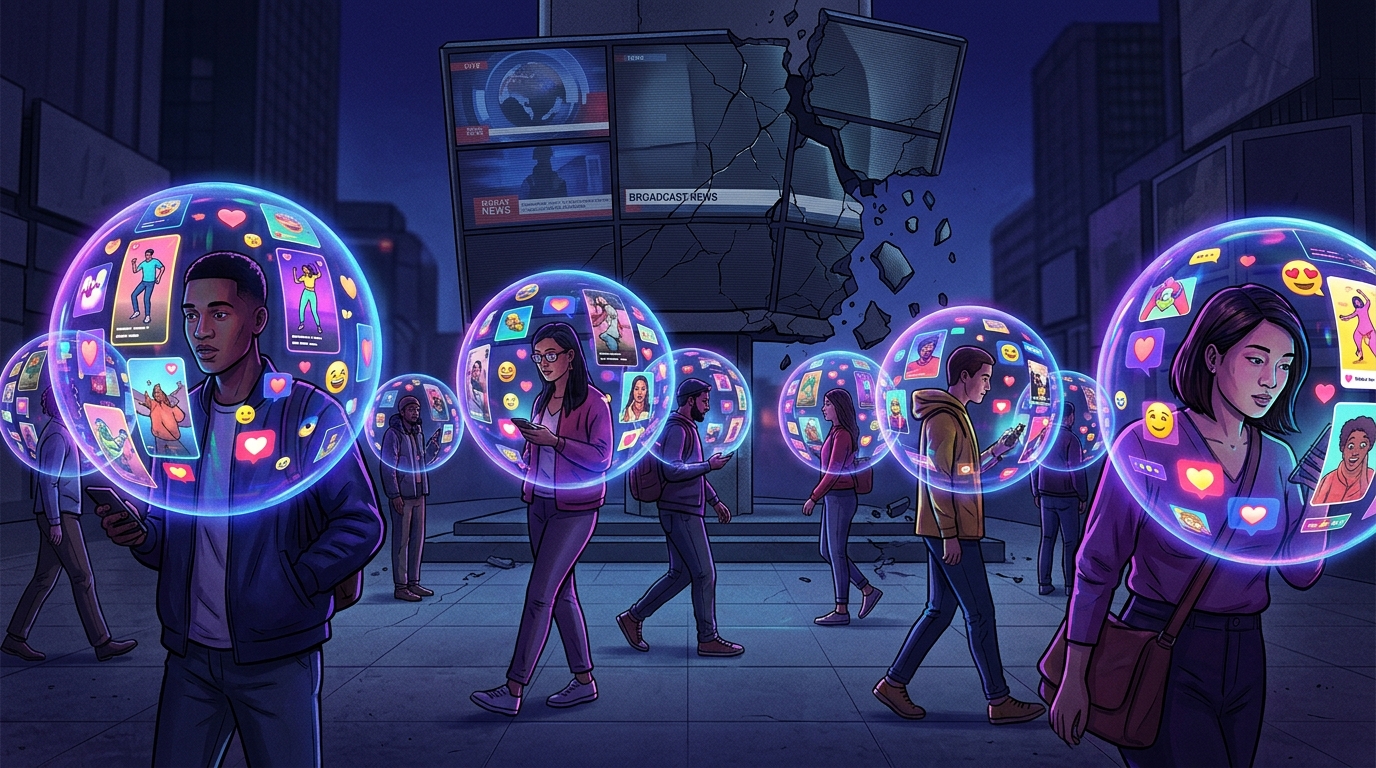
Constant connectivity, infinite choice. [Image via Gemini]
Initially a simple text medium with low quality images and buffering sound, the Web later expanded to include video, though not great at first. As bandwidths increased at home and at work, and wireless broadband became ubiquitous, we have always found a way to fill the container. As those containers filled, the media consuming them evolved as well, from static text sites we discovered through links and forwarded emails, to user generated content, up to the high fidelity real time multi-camera experiences we can experience today from practically anywhere.
The Gen Z early career entrants to today's work force have only known a world where everything is available all the time, on demand, where anybody can become famous for a moment, and being an influencer is a totally normal thing. Their first phones were smartphones. They never had to know what channel something was on, or when it aired. For them, news channels have always been 24/7 and hyper partisan, with no need to wait around for evening updates that just recapped everything they might have already seen online.
As Garbage Day (no really, that's the name of it) has pointed out regularly, the monoculture has essentially gone away. Even the top songs topping the Spotify charts seem foreign. We don't all participate in the same trends. We don't follow the same people. Even as people vainly wished the web would bring us together to shared experiences, I knew twenty years ago the web would enable us to retreat to safe spaces with like minded individuals. When given the chance to participate with people who agree with us and share our views, we will choose them, instead of engaging with communities we may not enjoy or feel contentious.
The vast array of choices, and our decision tree, means our small sliver of space is uniquely our own. Fatigued by the real world, people have found comfort in the hamster wheel of short form videos, memeification of pretty much everything, and the collapse of discussions to finding the perfect reaction emoji as the smallest gesture available to avoid leaving the other party on read. As we see everyone with their earbuds in, staring at their phones, flipping from one piece of content to the next, vaguely approximating the humans in Wall-E, we get it. It's the result of the containers, the personalization, and the need to feel connected and entertained. The apps do an incredible job of giving you what you want. If they didn't, you would find another way to kill the time.