Silicon Valley Technology Commentary & Archives · Est. 2006 3,045 Posts · 2006–2026
Showing posts with label Funding (5 posts). Show all posts

May 10, 2011

May 10, 2011 · 3 MIN READ · BY LOUIS GRAY

Reaching 1 Billion Monthly Users, Clearspring Adds On $20M

Reaching 1 Billion Monthly Users, Clearspring Adds On $20M

Alongside the boom in social media consumption, the world of social sharing, delivering content from a siloed source to a social destination has exploded in the last few years, as casual and professional media alike are scrapping for ways to bring their content to the fast-flowing streams of Twitter, Facebook, LinkedIn and more. A chief benefactor of this trend has been Clearspring, the company behind the practically ubiquitous AddThis buttons, which you see adorning Web sites of all types. The company, recognizing more than a billion unique users across the nine million sites where its buttons are installed, announced this morning the raise of $20 million to help harness the data being gathered and providing the next generation of analytics.

A few months ago, during the company's semi-regular swings to Silicon Valley, I met with Hooman Radfar, co-founder and CEO of Clearspring for dinner here in Sunnyvale, and was struck by the reach of Clearspring's properties, which has to be one of the few Internet names to touch ten digits worth of people. With Facebook counting user numbers well into the 600 million and beyond, for Clearspring to talk up a _billion_ users is quite an accomplishment. Of course, a widget on a Web site is not the same as a fully immersive experience, but in a world focused on data, and the extraction of meaning from that data, he with the biggest numbers wins.

Unsurprisingly, this morning's announcement focuses on how the gathered data will "accelerate Clearspring’s next-generation publisher products and continued growth of its advertising offerings, as well as to help fuel strategic acquisitions." There's no telling if $20 million will be enough to drive a big acquisition of any kind, but in a phone conversation yesterday, Radfar told me the company already had a good amount of money in the bank prior to the raise, while the new round brought "additional powder" for engaging in M&A, giving the company more flexibility for future expansion.

The AddThis platform, thanks to its universal visibility, has already become an interesting stopping point for statistics on which of the many social networks out there are gaining traction month by month, as I had highlighted back in late 2009 with the launch of their service directory. Interestingly, as captured in that post from 18 months or so ago, Facebook at the time accounted for 28 percent of all social sharing. Today, that number has increased 50 percent to 43 percent of all sharing throughout the AddThis network. In the same period, Twitter expanded from 8 percent to nearly 10 percent, and Myspace fell from having just over 8 percent to just over 2 percent, a 75 percent decrease.

AddThis' big numbers make it one of the top ten largest audiences online today, according to their press release, claiming also that revenue is on pace to triple from the previous year, and staffing is expanding at the rate of one new hire per week, on pace to double staff. Math suggests the doubling brings the team from just over 50 to more than 100 to exit 2011, and for AddThis, the future looks to be all about numbers.

“We’ve always held the view that big data would be one of the most valuable assets to come out of the social web,” said Ted Leonsis, Clearspring’s Chairman in today's release. “It is no surprise to anyone close to the company that we have parlayed our expertise in social sharing to achieve a reach surpassing Yahoo!."

AddThis supports more than 300 disparate social networks, so if you're like me and want to bring attention to the edge cases, you can find their orange squared buttons with the white plus symbol and share anywhere you like. Having $20 million more available makes it more likely you'll find these buttons in more places.

December 9, 2009

December 9, 2009 · 1 MIN READ · BY LOUIS GRAY

Gowalla Raises $8.4 Million for Location Check-in Service

Gowalla Raises $8.4 Million for Location Check-in Service

Much of the talk from LeWeb and other Silicon Valley get-togethers of late has centered around geolocation and the future of how geolocation is going to be integrated in social activity, search, advertising and communication. To date, the most visible company centered on geolocation has been Foursquare. But Gowalla, based in Austin, Texas, has gained significant traction over the last three months, and today, announced the completion of a Series B funding round for more than $8 million, bringing their total funding to date to more than $10 million.

According to the company's press release, Greylock Partners led the round, which will be used to accelerate the company's growth and enable future development.

Despite Foursquare's share of voice, Gowalla has managed to attract 50,000 active users, who have checked in at 150,000 locations in nearly 100 countries. Unlike Foursquare, which requires the service to support specific cities, Gowalla users can participate anywhere they are connected. Gowalla is available for both Apple's iPhone and the Android platform, and all this growth has taken place in only ten weeks.

In contrast, Foursquare raised $1.35 million in September of 2009.

September 28, 2009

September 28, 2009 · 9 MIN READ · BY LOUIS GRAY

On Raising Money: Goals, Valuations and Pressure

On Raising Money: Goals, Valuations and Pressure

For the most part, starting a successful business in Silicon Valley and having to raise money from venture capitalists (VCs) practically go hand in hand. Like most things here in the Valley, there are no guarantees. Raising $100 million doesn't guarantee success. Raising funding from specific venture firms with solid track records doesn't guarantee success. And, depending on the stage of a company's lifespan, raising money can be viewed negatively as much as it can be a positive thing. Meanwhile, if you're curious as to how much attention should be paid to valuations of private companies, well, trust me, that too can vary widely, depending on market conditions, momentum, founders' goals, and individual firm's enthusiasm.

Since starting my career in the Valley back in 1998, I've seen much of this process up close. I've worked at a company that once raised a $1 million seed round of funding, but I've also worked at one that raised $72 million in a single round - part of more than $200 million raised, thus far. I once saw a company I worked at close down because investors stopped funding outright, worked at another that found itself acquired by a big name tech firm months after I left, and also worked at one that filed, and later withdrew, its IPO bid. And while I wasn't sitting across the table from the VCs asking for their funds, in most cases, I certainly helped position each company in advance, and saw the effects each round played in the company's lifecycle. I mention this to add some level of background for why I thought to add my two cents to some of the discussion has been teetering in the blogosphere of late, especially following the news of Twitter's latest round of funding, rumored to be as much as $100 million.

Why would investors put money into a company to begin with? There are a few most-common outcomes:
  1. The company could later merge with another firm, or be purchased outright (M&A)
  2. The company could eventually go public and have an IPO.
  3. The company could remain private and be self-sustaining.
  4. The company could eventually close down, through bankruptcy or other means.
Of these scenarios, investors are most interested in potential M&A opportunities or the potential for going public. Obviously, investing in a company that will shut down is not a good way to use one's funds, and a company that has no real "exit strategy" but plans to meander forward, private and independent, will not provide the big returns hoped for by venture capitalists. In the reverse scenario, why would a company raise money?
  1. To gain initial capital to start the business.
  2. To gain capital necessary to expand the business, be it through marketing, human capital, new product lines, through geographical expansion, or even through acquiring other companies.
  3. To avoid running out of money and needing to close its doors.
  4. To obtain a level of valuation that sets a mark for potential acquirers.
As tempting as it can be for a company to raise the largest amount of funds possible, to have this cash available in the bank, the greater the amount raised typically also means the greater the reduction in control - as the company's initial founders see third party VCs take a higher percentage stake in the company. They may gain multiple seats on the board of directors, and gain influence that can be used to push the company toward one direction or another. Should they gain enough of a stake, it can be possible they end up pushing out the company's CEO or management team altogether, especially if expectations are not being met.

Thus, many entrepreneurs suggest a company raise as little money as is necessary to run the core business - and no more. In many cases, as soon as venture capitalists are involved, the pressure to reach stages one or two (M&A or an IPO) increases, and as time goes forward, or more capital is invested, the heat can intensify.

In parallel, if a company has determined it should raise a specific amount of capital, and has been fortunate enough to gain access to it, the preference would be to give away as little of the company as possible, essentially valuing the company at a higher rate than if more were sold for less. This valuation can be set based on the company's current sales numbers, its projections for the future, market competition, market dynamics and often, a combination of all factors.

Given this, if you examine the news around Twitter from last week, it has been written that Twitter sold ten percent of the company for $100 million, which valued the company at $1 billion. It has been said that Twitter raised the $100 million despite having a significant amount of money in the bank (up to $30 million) from its previous funds. So why would they raise now, and why this amount? Without having asked Ev, Biz and the team myself, you can see above just why now would be the time. First, the company, despite having little to no revenue to speak of, is in an incredible position. The service's growth over the last two years has been nothing short of phenomenal. Second, the company's internal projections, as we understand them, are aggressive - and third, many different news stories have shown practically all the large players in the Valley, from Microsoft to Facebook to Google, as having been interested in acquiring the microblogging company.

Similarly, we saw Facebook raise a massive $200 million in May of 2009 at a $10 billion valuation, following a $240 million round raised from Microsoft in 2007 that valued the social networking giant at $15 billion. Huge numbers on all counts, from the amount raised to the total valuation - again meaning how much would be needed to buy the entire company at that price.

For Twitter, raising the $100 million sets the company up to expand their business in terms of human capital and its technology infrastructure in a big way. While $100 million is not a bottomless trough of cash, it certainly helps. It puts the idea of the company running out of cash far out of the picture, and absolutely succeeds in driving the price higher for potential acquirers, should the service not be aiming to go public in the near future.

For Twitter's leadership, raising money now is a fantastic move. It's improbable that the company could find remarkably better terms in the coming months, and it sets in stone now where potential suitors would need to begin to even entertain discussions. Meanwhile, those investors who just ponied up the $100 million would want to see a positive return on their investment, and thus, would expect Twitter to hold out for an even greater number.

But once the money is in the bank, so begins the pressure. It may not be visible in three months or six months, but outside observers, and no doubt, internal participants are going to want to see plans for that cash, not just in how it is being spent, but in terms of how it will be converted, either into a large acquisition, be it to Google or another player, or if the company finds its way into reaching the public markets.

So what could go wrong? If neither of the above were to happen, and in parallel, Twitter were incapable of growing revenues to approach its level of expenses, the company would remain private, and see its cash balance decrease. Over time, as pressure grew inside the firm, they would be forced to raise money again - likely at a lower valuation, given reduced prospects, meaning the company would have to give up more to get less. You can see this often as you watch companies in the Valley go from the euphoria of their seed and A rounds, followed by less-enthusiastic B, C, D rounds and beyond. And if you hear about a "mezzanine" round, that's the one that truly, finally, should bring the company to break even, or catapult it into position for a near-term public offering. And if it doesn't, let's just say that's not good - as the "burn rate", the monthly expenses that draw down the company's finances, force action, and it won't be at a level the company had hoped for, especially after such lofty beginnings.

In the wake of 37 Signals' tongue in cheek press release that they were valued at $100 billion (with a B) following a brazen 1 dollar investment, one can scoff at revenue-light companies like Twitter saying they should be measured on par with public companies that have real revenues and real growth. But part of being a venture capitalist is that first word, "venture". It's an adventure. It's a risk, and a gamble, and one that relies on promises and potential. Twitter is worth $1 billion dollars, according to these investors, not because of what it is today, as strong as it is, but because of what it is in the future. Had Twitter chosen to sit on its laurels and not raise the money it did, at the valuation it did, the company could not expand to the level it has planned, and it would be at a much higher risk for potential acquisition, something they look disinterested in doing.

Ev Williams and Biz Stone, as well as the other Twitter employees and investors, know they are on to something. Be it vapor or be it real, the company has seized the minds of the Valley in a way unseen probably since the debut of Google on the stock market earlier this decade. Not even Facebook, who is larger and better funded, seems to be as visible as the scrappy San Francisco startup best known for its limitations - 140 characters. With $100 million in tow, the company is set to continue its growth independently, set to work on reducing its burn rate, with a much longer runway.

Meanwhile, don't let the nine-figure number fool you into thinking this is now a slam dunk. The valley is littered with companies that have gone this route. Procket Networks, which raised $272 million from VCs, sold to Cisco for $89 million in 2004. Caspian Networks raised more than $300 million and closed its doors in 2006. And that doesn't even get into the $800 million raised for WebVan or the $250 million for Kozmo.com in the headier Web 1.0 days. (See also: The 20 Worst Venture Capital Investments of All Time)

While we have seen the internal strategy of Twitter "laid bare" earlier this year, we won't be the ones spending Twitter's money, or staving off their burn rate. That's up to them, and up to their board. Gaining the $100 million on top of their preexisting cash horde was the right thing to do to potentially reward some of their founders, who may have sold stock in this round, and also to prop the company up and make it stronger against formidable competition. This Valley is more than just a hub for innovative technology. It's also home for some of the greatest wealth creation the world has ever seen. Now, we get to see, in public, how this particular investment plays out.

For more reading on this, please see:

October 29, 2008

October 29, 2008 · 4 MIN READ · BY LOUIS GRAY

SportsBlogs Nation Raises Funding Round to Expand Platform

SportsBlogs Nation Raises Funding Round to Expand Platform


Long-time readers of louisgray.com know that behind tech, one of my most avid passions is that of sports. Be it baseball, college football, or basketball, I'm a huge fan. I have my team loyalties and want to know all I can about my favorite teams. As part of this sports obsession, I found Web communities like SportsBlogs Nation and Ballhype to help me get the latest and best sports news from fellow fans around the world, as well as engage in community around our shared passion. As I recounted in July, the Ballhype team was acquired by Future US for $3 million, and yesterday, the SportsBlogs Nation team announced they raised a funding round in the single-digit millions of dollars, without more details being disclosed. The funding round was led by Accel Partners, the same team who helped bankroll Facebook, and by Jim Bankoff, former AOL programming chief. The funds will be used to further expand the rapidly growing sports blogs network, and help improve the platform.

Overnight, I connected with SportsBlogs Nation president Tyler Bleszinksi, who I've known through his family of sites since 2005, and consider a personal friend. Below is part of that Q&A done over e-mail:

LG: How large is SportsBlogs Nation today in terms of individual sites and users?

TB: We currently have 152 and we are growing that number weekly. We are very deliberate in our approach in that we only invite the highest quality bloggers, with established track-records, to join our network. Therefore, we will never rush to launch sites just to grow our blog numbers. We don't release any details about our registration base. I can tell you that internal numbers show that we have about 2.5MM people using the sites each month and that we're seen explosive growth across our entire network in all metric categories (in some cases doubling our metrics every six months.)

LG: What is helping to drive the growth of the network?

TB: The growth is likely driven by several factors:
  1. positive macro-trends as new people discover and engage with our blogs each day
  2. more engagement with our existing users as we add great new writers, features and technology - including our new blogging platform which is a huge success. Just last week for instance, we added two of the top sports bloggers on the web: Jeff Clark/Celticsblog and James Mirtle/From The Rink
  3. the declining investment by newspapers and other media in local sports coverage, which makes us the go-to source, particularly for mid and smaller market teams like Oakland for instance
  4. the traffic-driving network effect of intelligent cross-promotion across our network and the general sports and blogging ecosystem
  5. our team/tribe focus where we enable fans to publish and discuss within specific communities built around their passion.
On that note, one important and overlooked fact is that we are the leading regional independent sports network in many areas. For instance, in the Bay Area we have the top sites (Athletics Nation, McCovey Chronicles, Golden State of Mind, Niners Nation, etc) for just about every team, add it up and we're bigger than just about any other media property focused on Bay Area sports. Same can be said for other markets like Chicago, Texas, etc.

LG: How much funding did you raise, and what will it be used for?

TB: We're not releasing the amount, but we basically went after an amount that would allow us to become the top sports social community on the Internet. We're still cheap, even more so in this economic climate, and running this company on a shoestring, only spending where there is a measurable return.

We plan on using the money to further advance our sports-centric social media and publishing platform, which is already, in my opinion, the best blogging platform ever created for sports publishers, contributors and audiences. We want to iterate on it and continue to invest in advancing an open platform for sports fan activity streams.

It will also allow us to expand our leagues much more quickly by getting more man hours working on bringing the best bloggers on board. Our aim is to truly have the best team blog for every team in every sport and we need our league managers to be spending more time working on bringing the best bloggers in.

The other thing is that it gives us a talent like Jim Bankoff on board. And Bankoff is a supremely skilled executive who is laser-focused on making SportsBlogs Nation a large and profitable business. He knows this space well considering his past experience at AOL. He's already working to bring aboard other executives who will be focusing on business partnerships and generating revenue opportunities.


I have been an active participant on SportsBlog Nation for the better part of four years now, and have enjoyed the community at sites including Athletics Nation, Sactown Royalty and California Golden Blogs. My user ID can be found here: http://www.sbnation.com/users/louismg.

Also see:
SportsBusiness Journal: Tech Leaders Back Sports Blog Network

August 16, 2008

August 16, 2008 · 4 MIN READ · BY LOUIS GRAY

Is There Less Funding Or Are Startups Just Cheaper?

Is There Less Funding Or Are Startups Just Cheaper?

By Rob Diana of Regular Geek (Twitter/FriendFeed)


As an early adopter, I have an interest in startups. As a software developer and a developer of Web sites and services, I have additional interest in funding and the whole entrepreneur idea. Because of this, I tend to read a few "business" blogs as well as the usual technical fare. One of these blogs is A VC. Recently, Fred Wilson started writing a series of posts on the venture fund economics that is amazing. If you are trying your hand at a startup, I highly recommend you start looking at these posts. Just getting a fundamental understanding of the VC process is helpful in determining whether VC funding is worthwhile to your startup. In his Venture Fund Economics post he concludes with a very interesting point:
Some will read this and suggest that our business is all about swinging for the fences. But I don't think so. There are hitters in baseball, the best hitters in fact, that hit balls out of the park when they are just trying to make good contact. That's how you have to do it in the venture business. You try to make 20 great investments and you work with them closely in hopes that four years in you have six or seven that have home run potential, and after ten years, you maybe hit one or two out of the park. If you try to hit every one out of the park day one, you'll strike out way too much and the fund won't work out very well.
I think this logic can also be applied to startups in general. If you always try to do something that will turn out to be a home run, you will strike out too much. In the technology world, a home run would be a Google competitor, an iPhone competitor or even a Facebook competitor.

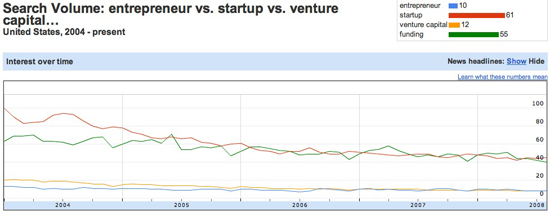
So, what if you are just trying to make contact? We have already heard in various places that venture funding is hard to get in general, and even harder in today's economy. Is this discouraging startups? Or are the startups focusing on the "major" technical hub cities? Paul Kedrosky must have been thinking this recently when he found that California is not a big entrepreneur state. Granted this is just an analysis using Google Insights for Search, but it does yield some interesting information. I was not enamored with the search terms that Paul used, so I tried a different set (entrepreneur, startup, venture capital and funding) and found some really interesting results.


Google Insight: Entrepreneur, Startup, Venture Capital and Funding

Interestingly enough, entrepreneur is not a big search term compare to startup or funding. Initially I thought this could be due to the generic nature of these terms, but the locations tend to match up with significant technical presences. As you can see from the chart, there is an obvious downward trend for all of the search terms. We can assume that this is due to the economy because if you read TechCrunch, Mashable or ReadWriteWeb, you will see plenty of Web sites getting initial startup coverage. In any economy like the one we are in currently, investments suffer and people invest less. Therefore it is likely that venture capitalists are being much more careful regarding what they invest in. Many people wanting to be an entrepreneur are probably taking less risks as well. So, we could be seeing a rise in startups being a weekend job until revenue or major funding becomes a reality.

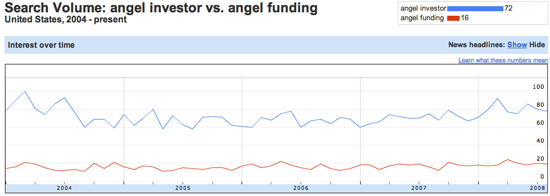
However, some of these startups do require some significant money in order to operate on a daily basis because cloud computing is not free. Are people getting more angel funding? Following the same logic as the entrepreneur search, I compared the search terms angel investor and angel funding.


Google Insight: Angel Investor and Angel Funding

Here you can see that angel investor and funding have flat or slightly rising trends. Again there is a definite relation to the major technical locations and the "interest" of searches. Given the trend lines for the "angel" search terms and the comparison to the previously explained trends, it does look like there is more interest in angel funding.

Why would we be seeing this difference in trends, besides the economy? Well, many of the newer web services do not require major hardware infrastructure in order to get started. Cloud computing and even cheap hosting make the hardware investment something that can be put off until there is a true need. Using the cloud is also very cost effective initially because you do not need to hire a server or network administrator. This is all handled for you by the cloud provider. The cloud also gives you the ability to handle spikes in traffic signifcantly better than with a traditional hosting provider. Given these reduced costs, a good round of $100,000 of angel financing could fund a startup for two years. At that point, there could be real revenue being generated or even a venture captial funding round. Money is easier to raise when you are a somewhat proven startup compared to when you first start and only have a few thousand page views per month.

It looks like the combination of the economy, cloud computing and the generally lower technical barrier for new services is creating a new environment for startups. People are finding cheaper ways to get started. Startups are also using the existing information on the web to define more interesting services. So, what is coming next and where do we go from here?