Silicon Valley Technology Commentary & Archives · Est. 2006 3,045 Posts · 2006–2026
Showing posts with label Profiles (9 posts). Show all posts

June 6, 2011

June 6, 2011 · 2 MIN READ · BY LOUIS GRAY

Zerply Opens to the Public, Adds an Array of Features

Zerply Opens to the Public, Adds an Array of Features


At the end of last month, I highlighted Zerply as an intriguing alternative to About.me or LinkedIn. The professional-looking personal profile network, then in invite-only beta, is now open to the public, so anybody can join and start adding business contacts. While still retaining the beta tag, the site's founders have added a whole list of features that should aid in expanding one's network, seeing site activity, and serendipitous discovery.

While the company is billing the upgrade as a redesign, the improvements are more about function over form in this round.


New Stats and Notifications on Zerply


As any business network is more powerful with connections to others, the site, like many others, offers the option to connect to Facebook and Twitter to find friends elsewhere on the site, where you can easily save people from these search results to your network/address book. You can now search based on the location of other members, and can click on others' listed location to see additional users in a radius of 50 kilometers, wrote cofounder Christofer Karltop in an email to me last night.

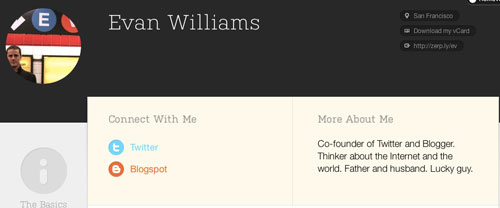
Ev Williams' Zerply Profile: http://www.zerply.com/profile/ev

One of the twists to Zerply upon registration is self-tagging with keywords that describe your background. Users can endorse your tags, and these updates are now shown in a notifications tab upon logging into the site. Coming soon, possibly even in the next 24 hours, is the option to receive email notifications when others endorse you or your profile is saved to another's network.

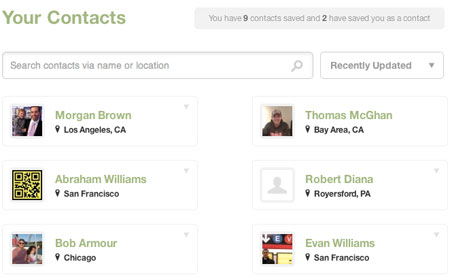
The Zerply Contacts List/Address Book

True to practically every social network, casual or business, is the craving for statistics. Zerply now tees this up as well, letting you see how many unique profile visits you have received in the last calendar month or all time, and how many clickthroughs your listed services (such as your downstream social networks) have received.

I liked Zerply enough that I made it my personal profile link on Twitter and you can find me here: http://www.zerply.com/profile/louisgray. If you didn't get an account the last time I wrote up the site, now's the time. The door's open at http://www.zerply.com/.

June 5, 2011

June 5, 2011 · 2 MIN READ · BY LOUIS GRAY

New Chrome Extension Lets You +1 Tweets on Twitter

New Chrome Extension Lets You +1 Tweets on Twitter

Following the release of the Google +1 button for Web sites (such as this one) last week, the search giant's answer to the Facebook Like button is popping up everywhere. Seth Ladd, a developer advocate for Google, has gone the extra mile, posting a Chrome extension that adds the +1 functionality to Twitter.com, so you can +1 tweets you like, and have them displayed on your Google Profile. This is a lot like Jesse Stay's hack with Kynetx which added a Like button to tweets late last year.

As Twitter's Web site becomes more versatile, Twitter.com has become a target for innovative development for developers looking to bring more functionality to users, including my6sense's relevance tab which we introduced in February, and the word filter posted by Mike Grace, tapping the Kynetx platform. Seth's proximity to the +1 launch as well as his fondness for Google Chrome and HTML 5 (he's one of the more ardent advocates and presented at Google IO this year) no doubt made the interest to bring +1's to Twitter a must-do.

+1 Buttons and Share Counts In the Twitter Stream

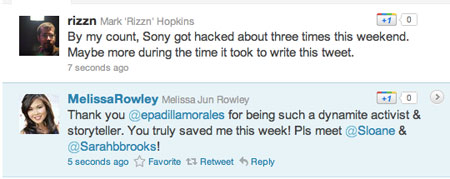
The +1 extension for Twitter not only displays +1 next to tweets in the stream, letting you +1 them, but also shows how many other people across the platform have also done so. It's a lot like seeing how many people have favorited or retweeted a tweet within the tweet itself, data which can be harder to find. The extension itself is open source.

Seth's Tweet has Been +1'd 3 Times

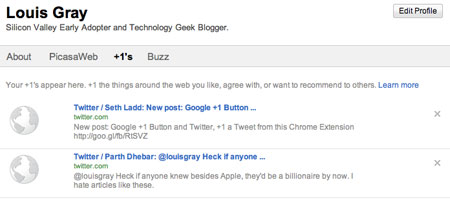
Tweets I +1 Show on My Google Profile


The extension itself is JavaScript-based and only is active when on the Twitter.com domain. Seth goes into detail on his post explaining how the +1 extension works, and how he needs to wait for the entire Twitter page to load before displaying the +1 buttons, while also explaining some shortcomings that apply to polling for new tweets in the timeline. Surely beyond version 1.0, those tweaks will come. Luckily, for those who have already grabbed the extension, it should update automatically. Go get it.

March 2, 2011

March 2, 2011 · 2 MIN READ · BY LOUIS GRAY

Google Profiles Upgrades, PM Klau Heads to YouTube

Google Profiles Upgrades, PM Klau Heads to YouTube

Nearly a year after former Blogger product manager Rick Klau took on the important, if not glamorous, role of heading Google Profiles, the product of his efforts debuted today, letting users make their profiles much more personal than before, with greater customization, improved layout and photo options, presenting an alternative to the Facebook profile or AOL's About.me, for the open Web. The new profiles put the users in control, are more fun, and keep Google Buzz front and center.

Interestingly, as the new profiles debut (mine's here), Rick has simultaneously announced he is moving elsewhere within Google, to act as a new product manager at YouTube, where he's responsible for the video service's home page and social strategy. I know Rick well and consider him a friend, so I hope we see more launches out of YouTube with his fingerprints on it that just might take less than 11 months.

My New Google Profile With a Scrapbook, Info and Introduction

In April of last year, following Rick's move, I suggested ten ideas to redesign the profile and postulated the tie-in with Profiles and Buzz would help the company compete more directly with Facebook. That Buzz remains a center of the new Profiles shows the company may continue this hope, despite some skepticism from the greater tech Web, and as I count down those items I suggested versus what was delivered, it's clear there is still more work to do, which Rick hints at on his blog, where he says there's "a lot more to come in the weeks and months ahead."

The Buzz Tab Remains Key to Google Profiles

Without speculating on the future of Buzz or Google's greater social strategy, the addition of the new Profiles is absolutely welcome. You can see the new profiles bear a profiles.google.com subdomain, while for now at least, the old ones remain at the google.com/profiles subdirectory. (New vs. Old)

Having learned from the Buzz privacy flareups last Spring, sensitive data on the Profile is only shared at your behest, so you can share as much or as little about yourself online as you like. So go check out your new profile, upload some great pics, and take ownership of the way Google presents you.

August 5, 2010

August 5, 2010 · 5 MIN READ · BY LOUIS GRAY

Don't Look for Hints of Buzz Demise After Wave's Closure

Don't Look for Hints of Buzz Demise After Wave's Closure

During last fall's debut of Google Wave, which seemed to be a launch of a complicated solution in search of a problem, I was immediately struck by the overwhelming nature of the platform, which inundated me with update after update and parallel conversations all vying for my attention. Not unsurprisingly, I stepped back from the product, as many people did - hoping it would improve in simplicity and utility over time, eventually becoming a product I could use for collaboration and real-time messaging. But that day never came. Like many products, much of Wave ended up being all about itself - as people first were attracted to its novelty, and later, many threads were all about how to best utilize it, with tips and tricks. It was there because it could be, not because it should be.

Wednesday's announcement that Google Wave has been discontinued as a stand-alone product is not dramatic for almost all people, as it wasn't being used all that much, beyond tire kicking, as people seeking social outlets went one way, and those seeking collaboration stuck to more traditional tools. Wave didn't kill e-mail or any social tool, and pieces of it will live on in other Google products as the company says they have learned from the episode.

With rumors of Google Me flying about, and Google Buzz still not having entirely recovered from some early misguided press and unclear utility in a social world dominated by Facebook and Twitter, it is logical to wonder, for some, if the Mountain View owned aggregation and sharing site will follow Wave to an early end. I would not be so fast to reach this conclusion, even if Google hasn't done as solid a job in marking product milestones the way they have finally determined how to make big splash launch announcements. The product, as best as I can tell, sees regular updates, with more features in the queue, and has a good, if not overwhelming, level of use from casual to devoted participants. And it seems very logical that even if Google doubles down with a new product like "Me", as rumored, that Buzz would play a major part in its development - as would the company's expanded Google Profiles.

At its end, Google Wave, for Google, was as much an application environment as it was a destination. Thus, its closure should not have elicited any more of a response than if we learned Google had abandoned the Go programming language, or Closure tools. But Wave wasn't hyped as a development platform or a bucket of features. It was thought of as potentially disrupting e-mail, and as recently as the South By Southwest conference (SXSW), the company's GMail team was being asked questions about competing with Wave for attention and resources at Google, and the panel called it "a leapfrog project" for the future Web, not today's Web.

Google Buzz is not a leapfrog project. It's hard for Google to force a leapfrog when it is they who are playing catchup in the social space. Google CEO Eric Schmidt has repeatedly stated the world does not need a Facebook clone, but it does seriously need a real alternative. Today, Buzz is not that alternative, and the team's developers never positioned it as a Facebook killer, Twitter killer or anything of that nature - instead focusing on building the product on open standards for sharing of content, and we have seen the Buzz buttons populate the Web in a way that less-successful products, FriendFeed included, never did.

Multiple sites, including TechCrunch and GigaOM, have reported Google has a new head of social in the company's VP of Engineering, Vic Gundotra. Vic was present at blogger pre-briefings of Google Buzz back in February, and participated in the official launch on stage at their Mountain View campus, so he is very close to the team. Additionally, as I've previously mentioned, Google co-founder Sergey Brin is particularly keen on Buzz's success, and the company most certainly does not want to lose even more page views and advertising opportunities to social competitors.

That said, Google Buzz hasn't immediately captured the imagination of users and seen dramatic growth some have expected for it, although statistics for its use are practically impossible to find. Even as Google said it was not intended to be a head-on competitor to Facebook, it has instead been regarded internally as an extension of Gmail, and that likely isn't the best place to have an active social network, even as Schmidt says the team "is doing very well".

Following Buzz's debut and initial privacy bumps, the team discussed introducing new features as regularly as once a week - and visible introductions, ranging from the official Buzz buttons to integrated comment and like histories by account, have popped up, but the fanfare from Google has been minimal - as the company continues to do a less than stellar job of continuing to get press from iterative updates.

In a discussion I had with Google employees recently about why they choose to stay at the company instead of going to an IPO-bound alternative, most notably Facebook and Twitter, one responded that working at Google was like working with future technology that was anywhere from 12 to 18 months away, and that, like light reaching the Earth from stars extremely far away, we are working on technology that is itself somewhat dated.

With one foot deep in speculation and the other on more firm ground, I can't help but believe some of the relative quiet around Buzz from the Google team is related to their being focused on something else that leverages their work in a big way - the next social volley, whatever it turns out to be. But Buzz isn't going to get eighty-sixed only six months after launch. I think what we are seeing instead is the emergence out of the "Trough of Disillusionment" so popularized by Gartner's Hype cycle, and a slope toward productivity. When it climbs that slope, it might still be called Buzz, or it may have a new name, but it isn't going away soon.

You can, of course, find me on Buzz here: http://www.google.com/profiles/louisgray.

June 27, 2010

June 27, 2010 · 4 MIN READ · BY LOUIS GRAY

Google Me This, Google Me That. Can Google Me Trump Facebook, Or Will It Fall Flat?

Google Me This, Google Me That. Can Google Me Trump Facebook, Or Will It Fall Flat?

Tomorrow's Web seems to be shaping up for a battle between two major players - Facebook and Google, with Apple and Microsoft holding down their own tangential fiefdoms, and smaller services, like Twitter and LinkedIn, chugging away with their utility-like products. Make no mistake of it - while there is room for innovation and success at these smaller levels, Facebook's goal is to own as much of the Web as they can, and Google would like to make sure they don't. An open Web, however you define it, is good for Google, presenting a myriad of opportunities for search ads everywhere, while a Facebook-controlled universe is not. And the latest rumors, spawning from a simple update by Digg's Kevin Rose hinting at a direct Facebook competitor, dubbed Google Me, have people wondering if Mountain View is preparing another major assault aimed to keep Zuckerberg and crew off the top pedestal.

Google's ventures into the social realm, thus far, have been less successful than their more data-centric programs. The idea that Google is all brain and no heart seems to follow the search giant around the Web, echoed by David Kirpatrick in The Facebook Effect, and the many naysayers who point to the slow development of Google Wave and initial stumbles of Google Buzz as proof that Google can't do social, making a new attempt, no matter how thorough, ripe for instant punditry aiming to be the first to claim its demise.

As someone who has watched the launch and growth of Buzz closely, what has been clear from the beginning are two major things relevant to the new discussion. First, the company never said this was a Twitter or Facebook competitor. They were clear to separate Buzz from being a challenger to those social titans. Second, the company has been banging the drum on open standards, from Activity Streams to Pubsubhubbub, Salmon, OAuth and many others.

In the meantime, in the wake of former Blogger product manager Rick Klau joining the Google Profiles team, I talked about ten ways the Google Profile could be improved, and later, how Google could tag team Profiles with Buzz, and its myriad of other social objects, and battle for your ID against Facebook. Even if Google's social solution is not fully baked yet, we can watch it cook, and we know many of its ingredients already.

For those saying Google Buzz has not met expectations, or in more strong terms, that it has failed, I can't say that I agree. I have heard anecdotal comments that Sergey Brin is especially focused on making sure Buzz is a success, and I have personally seen the breadth of the team working on the project, in an area on campus that requires a second level of clearance beyond the standard Google employee's badge. Whether Buzz remains the flagship social item for Google or becomes a key ingredient into a real bona fide Facebook competitor remains to be seen, but I see Buzz as the parallel for the newsfeed popularized first by FriendFeed, and later, folded in as the most visible part of Facebook today.

You've also seen previous rumors of Google looking for a head of Social, whatever that job entails. For a company who is driven by data over emotion, it seems they are fighting for the future of the Web against their blue-toned brethren, many of whom used to be Google employees. It's also widely known that if you do work for Google and announce you are leaving to join Facebook, you are whisked out of the building faster than a hoodie gathers nervous sweat. The tension between the two companies is very real.

The question becomes then, can Google, or anyone, provide a social environment that is attractive enough to get users to sign up en masse, or to change their behavior away from Facebook? Facebook's origins, based on a true identity, have helped connect people with former school peers, family members around the world, colleagues, and yes, complete strangers. To rebuild one's social graph is hard to do, even if Google has a ton of data on you and who you like to connect with and follow. It could be that this is a valiant attempt, with incredible technology that solves a problem which for the most part is lacking. I am not hearing my mainstream relatives who don't drink tech for a living say they want to leave Facebook. They are happy with a blog to communicate together and Facebook for more casual updates.

I don't know if Google Me exists or not. I would not be surprised if it does, but I also would not be surprised if this simply relates to the continued evolution of Profiles, with Klau and team on watch. Google didn't hire Chris Messina and Joseph Smarr and Brett Slatkin and Brad Fitzpatrick and Don Dodge just to keep them away from Microsoft, Facebook, Twitter and others. They brought these guys, and many more, on to make something happen. No matter what does happen, there's no question that social Web participants will benefit with more options and opportunities. Who knows? Maybe Google can set the Web on its collective ear again like they did with the introduction of GMail. I for one will never count them out.

May 8, 2010

May 8, 2010 · 6 MIN READ · BY LOUIS GRAY

Why I am Using Google Buzz as An Alternative to Facebook

Why I am Using Google Buzz as An Alternative to Facebook

The Internet is a big place, and there are a lot of opportunities for me to find places to spend time. But I am increasingly spending my time in Google Buzz. Google Buzz made sense to me from the first day it was launched, and it continues to improve. This is not a surprise to those of you who have been using the service in the last few months, but I thought I would explain why I am choosing to devote more of my social networking activity there, and why I think it is critical that the product succeed.

I often hear people call me a "power user" of Buzz, if there is such a thing. I've been called an active power user of other great products, including Google Reader and FriendFeed for a few years now, so I can't fight the label. What this does mean is that I get an opportunity to engage with a greater number of people than most, and I get more feedback on data that I share than most. But I hope this also means that I am working to make the experience I help provide in Buzz a better one, not just for me, but for all those people who are impacted by my activity there - whether you are reading the shared content provided, whether you run into my comments from various others, or even if you are a content provider who has seen visitors to your site come from Buzz thanks to my recommendations.

As social networkers, solicitations for our attention and time from various networks are constant. Various friends of ours may participate in one network, and some in others. Some Web services may make it easy to provide short updates, and other platforms make it easy to share longer thoughts. Some Web services are dedicated to specific use cases for rich media - be it videos, photos or audio. Each of us has to choose where we spend our time - and whether we think that our actions are being seen by the right people at the right time in the right context. We also need to think about whether our participating in a specific place is an endorsement of the platform, the community or the company providing the service.

For me, it is important that a social network where I want to spend time:
  1. Doesn't try to limit what I can share, in terms of content type or length.
  2. Makes the content that I share open and discoverable by anyone.
  3. Has a community of similar people interested in similar things.
  4. Has an intelligent community willing to discuss new ideas and technology.
  5. Is led by a sharp team committed to improving the platform.
Given the above, I am also separating what I see as "tools" and "communities".

For example: I think Twitter is a fantastic tool, and it is one of the best tools for sending short updates as a broadcast medium to share links and to communicate with others, in public. But it is not a community where I want to spend a lot of time. Its very limits in terms of characters, and the inability to share rich media in line are severe limitations. I believe Twitter is much like a dial tone for short-message social networking, and is as necessary as an e-mail address, but it is not a platform where I want to spend a lot of time.

Similarly, Facebook is a necessary evil. The vast network is not a place where I want to spend a lot of time. It is, however, a place where my family and other close friends choose to operate, so I can quickly glance at their activity there and be updated. But my visits there are brief and superficial, as I do not participate in their viral gaming platform, and do not rally around events, causes, and fan pages.

In 2008 especially, and through the first half of 2009, I thought that answer was FriendFeed. FriendFeed offered a major alternative to limited social networking. The ability to grab all my updates in one place, and follow my friends' updates in the same network, was a game changer. It was the first to get aggregation right, add smart filters, intelligent search, lists, real-time and much more. The community on FriendFeed, was fantastic, and many good people still use it. But momentum on the site dragged, and the sale to Facebook pretty much confirmed what many thought - that it would never achieve its potential. Still a fantastic site with great features, it's practically been abandoned by its core development team and left to coast.

Google Buzz offers the same potential FriendFeed once had, but is driven by a company that appears committed to making it succeed. There are regular updates to Buzz. I have seen some of the sharpest engineers on Google working to make this a success, and the community regularly has interesting discussions on a wide variety of topics. Rather than take potshots at the Buzz team for missing features I once enjoyed at FriendFeed, I trust they know of the current product gaps, and are pushing them through a rigorous development cycle.

Meanwhile, the other major players in this space aren't going the way I want. Twitter is becoming a more robust and extensible platform, but they seem married to their limitations in terms of content. Facebook has added many FriendFeed-like features, but they have also acted in a way that makes me uncomfortable in terms of changing the rules of privacy in the middle of the game, while also locking away other pieces of content that should, in my mind, be public. In my position as somebody who manages Facebook pages for multiple clients, I could never delete my account (and leave them rudderless), but simply expect that all my data there will be discoverable and public and searchable, despite their promises to the contrary.

The world of social networking is not a zero-sum game. For Buzz to succeed does not mean that either of the other networks have to fail. In fact, it doesn't even mean that Buzz has to be the biggest network on the planet. But it does mean that it should have the potential to be the best. I need a powerful aggregation tool that watches my activity on Google Reader and native blogs, but also offers the option to share photos and videos in a public way. Buzz does that. I need a powerful tool that lets me find friends' updates from around the Web and engage with them in a central location. Buzz does that.

Many people have voiced concern about Google being a large company that has an incredible amount of our data already, or is a platform for many of the applications and Web services we use every day. While this is true, the tremendous amount of openness I have seen from the company and its employees on this network and on others is something unparalleled by any of its competitors. These employees, many of whom I consider acquaintances and friends now, share the same ideals I do - working to expand open standards and keep us in control of our data.

I do not want a world where the only social networks available are Facebook and Twitter. I don't trust Microsoft or Yahoo! to do a good enough job to provide a real alternative, and I don't think Apple wants to. LinkedIn won't transform overnight, and Plaxo is not a candidate. Cisco and other companies aren't even close. So Google provides us the only real alternative to these two networks, and looks to be on the right path, talking openly about privacy, data security, and openness.

I am committed to using the best tools for the job. I am not paid by any of the companies I mentioned, and don't expect to be. I am increasingly using Buzz instead of FriendFeed, and have not been attracted to use Facebook more in the ensuing months. Yes, I have many ideas for Buzz to improve, and I have shared with them some of those ideas. But even as they continue to slave away at their code and make the product place better and better, I will keep sharing and discussing solid content there. You can find me at http://www.google.com/profiles/louisgray.

April 20, 2010

April 20, 2010 · 4 MIN READ · BY LOUIS GRAY

Google's Battle For Your ID Against Facebook Heating Up

Google's Battle For Your ID Against Facebook Heating Up


With the news last week that Blogger product manager Rick Klau was transitioning to a similar role leading the Google Profiles team, I have been doing some thinking around how Google could improve the utility of its Profile property, and the more I think about it, I really believe the Profile could be a major front in the company's battle with Facebook and other networks to act as the central hub for your online persona. Today, Google Profiles seem to be something of an afterthought, although their integration with Google Search and now Buzz in the last two years have raised their prominence. But given Google's mountain of data being amassed on you and your preferences, and the opportunity to build a new feature set, I see significant opportunity for them to get the content right and the deployment right. Strike early enough with our suggestions, and we just might actually have an impact on what they do as well...

At the end of 2007, in one of my more speculative posts, I asked, Will There be One Profile to Rule Them All?, highlighting three of the most prominent Web profile services at the time: Google, MyBlogLog and FriendFeed. Nearly 30 months later, MyBlogLog is practically dust, squished by its Yahoo! overlords, FriendFeed was similarly absorbed into Facebook, though the site continues to run, and Google hasn't changed all that much, to be honest, featuring the same collection of third party links that hint at who I am online.

At the time, I asked of the three services, "which one knows me best?" In the last 30 months, those three services didn't do much to answer that question, offering a minimum of personalization, and letting the content from third party sites tell the story. In their place, Facebook became the dominant player in the space, transitioning from a student-only site to one inviting all Web users to input information about themselves, their likes, preferences and connections. Now, the answer is obvious - Facebook is the dominant profile online, with others possibly answering LinkedIn, and a smaller percentage pointing to Twitter, assuming your one-line description, profile picture and tweets encompass the true you.

But Facebook's goal, thus far, has not been so much to encapsulate the entire you, built from content created on other sites. While you can pull in blog posts and bookmarks and third party activity, the majority of action is created from within what people call the walled garden, and unless you have connections with the individual, the data is not fully open and available. Google's approach, to have all profiles viewable, open, indexable and discoverable, opens up new opportunities to make the Google Profile the Web's reference guide for you as an individual.

Today, Google Profiles have six distinct sections:
  1. About Me: Includes a short biography, which you write yourself, which can include links or e-mail addresses. It also has a summary section for "Where I grew up", "Places I've lived", "Companies I've worked for" and "Schools I've attended". Not too much detail on positions held there, or years served... just the basics.
  2. Buzz: If you are populating Buzz, the content will be shown in a tab on your profile.
  3. Contact Info: You can make your e-mail, phone, birthday, and address visible to contacts and friends, or keep it private.
  4. Sidewiki: If you make entries in Sidewiki, they can be displayed on your profile.
  5. Photos: You can display photos from Flickr, Picasa or other services below your avatar.
  6. External links to social services: The same logo farm provided in many places, where you can customize what external sites you use.
Also included are some small random elements including "Something I still can't find on Google", "My superpower" and "Interests".

All told, it's a pretty casual approach, but not one that would have me returning often.

That said, the ingredients appear to be in place for Profiles to expand beyond their current role and possibly take a more direct assault on Facebook, LinkedIn and other personal hubs. In this scenario, a public site, built from Buzz entries from those you follow, take the place of Facebook's current newsfeed, and your profile becomes your Facebook Wall. Facebook Photos are replaced by Picasa photos, and the many connections you've found in Facebook are similar friend connections through Google, only in an asynchronous mode, not a synchronous one, a public one, and not a private one.

Does this mean that the experience of Facebook could be directly duplicated through some brilliant massaging of Profiles and the extraction of Buzz from Gmail into a more public, dedicated site? Of course not. For one, the work on Groups, Networks, Causes, and the many apps that have people coming back to Facebook, if for nothing else than doing battle on Lexulous, takes some work to replicate. Also, it can be assumed that one's social graph will vary from network to network, so those friends from high school might be your links on Facebook, but your colleagues might be linked to you through Google.

Google, seemingly caught flat-footed in the world of social for the last few years as Facebook and Twitter ran circles around them, is trying to win this game through following the Web's trends - toward open standards, public content and discoverability. Even if they don't get people to stop using Facebook, they can deliver an alternative that is a distributable URL that you can share with people to say "This is me" on the Web. I may use my blog for that, but for many, one's Google Profile truly could be the real "Me". They have an opportunity to compete and take visibility and share from these services by eliminating the holes in their lineup, and then innovating to go beyond what others are providing today.

The question is - are people interested, and does Google want to win this thing?
April 20, 2010 · 6 MIN READ · BY LOUIS GRAY

10 Suggestions for Redesigning the Google Profile

10 Suggestions for Redesigning the Google Profile

Have you looked at your Google profile lately? (Here's mine) Pretty boring, right? Just a white page with a bunch of blue links, like much of the rest of Google? You might not look at your Profile all that often, but with Profiles being discoverable in Google Search and made more central to your online activity with the introduction of Buzz, it's possible that this page could be a major hub for your personal presence on the Web. Given the recent addition of Rick Klau to the team, it's clear Google wants to get this product right. It's also a great opportunity to give Rick and his entourage a little helpful advice. So here's what I would do if I got the opportunity to design the ultimate Google Profile:

1. Unhook Buzz from GMail and Open a Dedicated Buzz Site

This one is screamingly obvious - and something I anticipate to be a near-certainty, unless the criticism of Buzz had Google reconsidering its focus, which I don't think it will. If Buzz and Profile are to be paired, there has to be a way to get to Buzz on its own domain, outside of my e-mail. This, I believe, would dramatically raise engagement and ease of access. As each Buzz user's entry and comments link back to their profile, this in turn raises the visibility of the Profile itself.

2. Enable the Option to Remove Buzz Without Killing Your Profile

A corollary to the above is that in order to completely opt out of Buzz and disable it completely is that you need to delete your Google Profile too. That's crazy. That's almost punitive judgment for somebody who doesn't see things the Google way. That Buzz and Profiles are connected in the same way that Facebook's News Feed and Facebook's Profiles are connected is one thing, but to require the deletion of one to unlink the other should be fixed immediately.

3. Add the Ability To Import One's LinkedIn Resume to Google Profiles

Today, Google Profiles asks you where you've previously worked, but it's scarcely an inch deep. I would want the option to import my LinkedIn profile, complete with titles, companies and summaries, and be able to display that in a tab called "My Career", "Work" or "Professional". Of course, for those who don't have existing LinkedIn resumes, the option would be to populate this tab from scratch, but have it display on Google.

While this would not immediately gain you the relationship and recommendation portion of LinkedIn, it could easily be a new place for your online resume.

4. Introduce an Ability to Customize the Google Profile With Templates

The look and feel of today's Google Profiles is extremely sterile. Like many other Google properties, the wisdom has been data over design, and users don't have much, if any, opportunity to tailor the content in the way they would like. Rick Klau, having just watched fellow PM Siobhan Quinn launch Blogger's new Template Designer, would do well to tap into that option, giving people more ownership of how they are presented online. In fact, Rick's quote: "How you express yourself online is a lot more than just a blog," from the interview we had on the day he announced the move, hints that he feels the same way.

I would want the option to change background colors, sidebar designs and reformat the page's elements - things that even Facebook gives you little opportunity to do - but others have done well.

5. Think Global, Act Mobile

All the trends are pointing toward increased Web consumption on our mobile devices, be they Android, iPhone or some other variety. Facebook's iPhone application has gained tremendous traction and is quite usable. Buzz was designed with mobile in mind. However, Google Profiles simply scrunch the text down in a small way for a smaller screen. It wouldn't hurt to have Profiles recognize mobile browsers and provide a superior mobile experience.

6. Highlight My Streams By Category - Like Status Updates!

Google Profiles do a good job of featuring links out to other third-party services where I participate. If I register dozens of social sites, and you know I have them, these disparate icons will litter the right side of my Profile. But like MyBlogLog and FriendFeed, the icons themselves don't tell a story. The story comes from the content being created at each of those sites. While some of my streams might be flowing through my Buzz tab, I should also be able to choose to share my Tweets, native FriendFeed updates or GChat status updates on my profile, as a lifestream, in a "Status Updates" tab in my profile, which would show the most recent shares at the top. Similarly, if you have multiple photo site accounts, you could pull in the latest updates from Flickr, Smugmug and Picasa in a tab called "Photos".

7. Raise the Visibility of Contact Information, and Remove the Tab

Today, my Google Profile says my name, my title, and features my latest status update at the top, generated through GMail's GChat feature - and even that status message is not visible to anyone who is not a connected "chat buddy". The contact information I have provided, including e-mail, phone, and address, optionally posted by me, is tucked behind a tab. If I have opted to make this information public, it should have higher visibility, and could easily take the spot where the bulky status message is today.

8. Reduce The Automatic Behavior and Placement of Photos

In today's Google Profile, your title and avatar are immediately underwritten with a strip of photos. It's a cool feature, to be sure, but their is no option to put them somewhere else, to resize them, to add any relevant information about photos, etc. If photos are not something I think should be a lead part of my experience, then I would want to minimize their focus, or even tuck them behind one of the tabs at my disposal. Today, these photos pull from Flickr, Picasa, or from other hand-entered photo streams, but they all look the same - disconnected and unrelated.

Facebook has become the king of photo uploads not just because of the network's relevance and reach, but also thanks to the option to leave comments on these photos, or to tag other people. Google Profiles do nothing but link out, making the photos vestigal. Unless Google wants us to upload photos directly to our Profiles, they should get lower visibility.

9. Sidewiki Doesn't Deserve the High Profile on My Profile

Sidewiki entries are one of the four tabs on my Profile today. I've made one Sidewiki entry, ever, and while it may have been a good one, it certainly doesn't rate equally with my "About" and "Contact" sections, yet it gets the same billing. That's silly. And for whatever reason, I cannot remove Sidewiki from my profile within my profile settings. It's impossible. If you're a huge Sidewiki fan, then sure, add it, but it shouldn't be there automatically.

10. Modular Permissions By Section

Google's default approach, and mine, is to make content visible to all, so that it is indexable and discoverable. If we have learned anything from the tumult around Buzz's entry to the marketplace, it is that one size does not fit all when it comes to public content vs. private content. But today, I don't even have the option to make my Gmail chat messages public if I wanted to, and others don't have the option to provide comments on their Google Reader shares to the public, but only invited friends. In reverse, if I chose to, I should be able to hide my photos from the public, or any other item, making that only visible to synchronous friends. If this can be managed in a simple way, it could go a long way to getting people comfortable in providing even more personal information to a company that already knows a lot about us.


Have you given a lot of thought to your Google Profile? I see this as a key weapon in Google's assualt on Facebook. More on that soon, of course. What else would you do to make this a better product?

April 12, 2010

April 12, 2010 · 2 MIN READ · BY LOUIS GRAY

Google's Blogger PM Rick Klau Moves to Google Profiles

Google's Blogger PM Rick Klau Moves to Google Profiles

Prior to their integration with Google Buzz, individual Google Profiles have not had a high level of visibility, falling fairly low on the social ecosystem ladder when contrasted with more siloed services, including Twitter and Facebook. Yet, as Google looks to further integrate social elements into their platform, it appears that Profiles will play an ever-greater role in how both individuals and companies represent themselves online. Today, Profiles snagged a notable convert, adding Rick Klau, a product manager for Google's Blogger platform, to the team.

Klau, who joined the Blogger team in 2008 following Google's acquisition of FeedBurner the previous year, has largely been the service's public face - playing a visible role in the company's feature roll-outs around Blogger's 10th anniversary, which took place in late 2009, and more recently, tackling the challenge of migrating a large installed base of users off FTP-hosted blogs - which proved to be taxing, even for a company with the resources of Google. Klau served as one of now three Blogger product managers, accompanied by Siobhan Quinn, a 7-year Google veteran, and Chang Kim, based in Seoul, Korea, who joined the team after Google acquired his company, TNC, in September of 2008.


In a conversation I had with Rick this afternoon, day one of his time on the Profiles team, he said the move was the result of a "confluence of need and opportunity". Assuming increased importance for Profiles over time, this role may mean direct impact on a swelling number of Google users, not just those who blog, and appears to be another step in Google's march to becoming a more social company.

"With the Buzz launch, and an increased focus of getting social right, this was a huge opportunity where we weren't doing as much as we could," Rick said.

Rick said that even prior to the Buzz integration with Profiles, the product gained more prominence thanks to Google Profiles results being displayed in core Google search results. This makes the content on your own profile increasingly more important, whether Buzz succeeds or falls flat. And similar to the work on Blogger, he saw an opportunity to let users be more creative in terms of how they were represented, but in a new place.

"How you express yourself online is a lot more than just a blog," Rick said. "We want to give people an option for how they are presented in that context."

To spread more light on the transition, and what this means for Google's properties, both Blogger and Profiles, I interviewed Rick this afternoon using CinchCast. He was gracious enough to participate, and the conversation is embedded below.


You can find all my CinchCast recordings, including this one, at http://www.cinchcast.com/louisgray. Also, Rick has now posted on the news on his blog: New role - Google Profiles