
Silicon Valley Technology Commentary & Archives · Est. 2006 3,045 Posts · 2006–2026
Showing posts with label Apple TV (43 posts). Show all posts

October 3, 2011

October 3, 2011 · 5 MIN READ · BY LOUIS GRAY

Web Video's Challenge of Inventory, Portability

Web Video's Challenge of Inventory, Portability


Last month, Netflix CEO Reed Hastings set off a tech media firestorm with the announcement of a split between the company's streaming business, which would bear the original Netflix name, and its DVD by mail business, now known as Qwikster. Much of the discussion centered around two parts - the first being Netflix's price increases announced this summer, and the second, focus on the name of the new business, which sounded way too much like Amway's sub-brand, Quixtar. But both flareups circumvented the real trajectory of Netflix making a choice to decrease its attention on the physical media world, one I publicly said I walked away from this Spring. With a smart combination of online video properties, including Netflix, YouTube, iTunes and Hulu, you can have your entertainment needs satiated practically any time. However, there remain gaps of content and availability from site to site, thanks to exclusivity deals with entertainment owners, copyright and who knows what else.

Apple's initial foray into renting movies (and later television shows) online, combined with the release of Apple TV units, made it easy for me and my family to select movies on demand, and watch them almost instantly. After some buffering, the selected title would be in our living room and could play that evening. Back in 2007, when Netflix was not streaming, the opportunity was available, in my opinion, for Apple to seize the market, through introducing a subscription service. (See: How Apple Could Crush Netflix Now) But it didn't happen. Apple didn't go the subscription route, Netflix evolved, and no doubt Hollywood studios were afraid of Steve Jobs having as much power over their titles' success as he did in the music business. In time, Netflix figured out streaming, kept the subscription model intact, and presented another choice for online video. Even better, Netflix did something that Apple chose not to do - embracing the Web by allowing for in-browser movie plays, and releasing mobile apps for practically every phone and tablet. (See: Netflix Edges Closer to Making the Perfect Web Video Site)

While Apple did a great job of bringing films and TV into my living room or laptop, Netflix did a better job of making them portable. In addition to box office wins, I've seen full seasons of shows like Dexter and Mad Men through Netflix, available on any laptop and through most connected TV devices, such as Google TV, TiVo and the Nintendo Wii. Netflix gets the Web, and is so simple to use that my 3 year old twins spend a lot of time running the Netflix app on our iPads. I'm often amused to see the recommendations that come my way from Netflix after Matthew or Sarah have spent an hour with Nickelodeon and Sprout shows for toddlers.

Similarly, YouTube's tie-in with the Android Market has also embraced the cloud for streaming video. As I wrote in June, you can rent films on the Android Market, and watch them on YouTube from any computer. That too is very convenient, and there's no entrance fee requiring subscription. Meanwhile, Hulu has access to some shows (like my personal favorite, Peep Show) that you can't get anywhere else - and there's the catch. Much like in the old days of instant messaging, where services were splintered without standards for interoperability, consumers are left to have multiple accounts from multiple places and remember which shows and titles are where. An evening's entertainment can come down to which device you have in which room, which services are supported and which titles are available for which place. It's easier to deal with for the cloud-backed properties, like Netflix and YouTube, but less great for the others. Nobody's yet got it 100% nailed.

Additionally, what all of these services miss is the opportunity to satisfy the home viewer who wants to see movies currently playing in theaters. I've been begging for this for more than three years now. (See: Think Apple Would Dare To Take On the Movie Theaters?) As a parent of three kids three and under, planning for a babysitter to cover the hours when my wife and I would attend a movie is a challenge, one that will no doubt cost much more than the face value of the tickets. So most of the time, the theater experience is unavailable. Meanwhile, most families' home theater systems are getting even better. I would have to bet the availability of in-theater titles to play at home would have real value and I know I would pay a premium for it. I would have seen Moneyball this weekend, if it was available, but being homebound means either we have to wait, or we have to seek out illegal downloading alternatives - which aren't ever a good option.

Spotify delivered the reality of a near-infinite music library on demand. Practically any title in the world (or so it seems) in high quality with no downloads or delays. The movie equivalent is still missing. No doubt this is a harder quest, but it's one worth conquering. Any time you see knowledgeable people debating Netflix's streaming movie inventory online, you hear concerns about its library. The company is closing deals to make that better, but they're quite expensive. Apple hasn't budged on a subscription model. YouTube remains best known for amateur videos, while that's expected to improve. And who knows what's happening with Hulu? Not me.

As broadband becomes more ubiquitous, and traditional entertainment leaders get innovative on their own about reaching customers, partnering with all services, I expect the portable cloud model to win, as it always does. Things are much better now than they were two or three years ago, but there's much more room to go. I hope in two or three more years in the future, we'll be laughing about how hard it was to get the titles we wanted anywhere.

Disclosures: I work at Google, of course, and you can decide if that impacts how I discuss Google TV, Android, YouTube or any of Google's perceived partners or competitors. :)
June 23, 2011

June 23, 2011 · 3 MIN READ · BY LOUIS GRAY

YouTube, Android Offer Alternative to iTunes Film Rentals

YouTube, Android Offer Alternative to iTunes Film Rentals

One of the new product announcements at Google IO in May was the introduction of movie rentals from the Android Market. Following the path beaten by Apple with its iTunes and Apple TV pairing, popular movie rentals can be picked up for the typical price of $2.99 or $3.99 each, are watchable in the next month and playable for 24 hours after you start. It's familiar, but new for Google, who added the option to their marketplace a month ago, making one less reason one has to be shackled to iTunes. The video rental service is powered by YouTube, who has clearly shown they know how to push Web video content to hundreds of millions of homes worldwide, and is ready to try longer-length content.

As mentioned frequently here, I've been a longtime iTunes user, and have slowly migrated away from the platform, thanks to increased use of Spotify and Google Music on one side, NOOK on the other, and now, movies, by way of Android Market, on top of Netflix Instant. The focus is not so much an anti-Apple vendetta, but just finding new ways to consume rich media on my changing array of devices. The more Android and Chrome I have in my house, the less iTunes is an option - until Apple changes its mind.

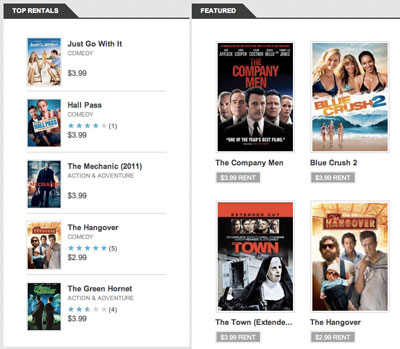
Some Top Titles On Android Market (Powered by YouTube)

The promise of the Android Market offering is to play these movies right in your Web browser, on any of your Google account-enabled devices. There's no need to download the movie (as iTunes does), but you instead start streaming after an extremely minimal amount of buffering, at either 320p or 480p. Purchases are sent to the account you have registered with Google Checkout, and the item shows in your Android Market purchase history. All straight forward.

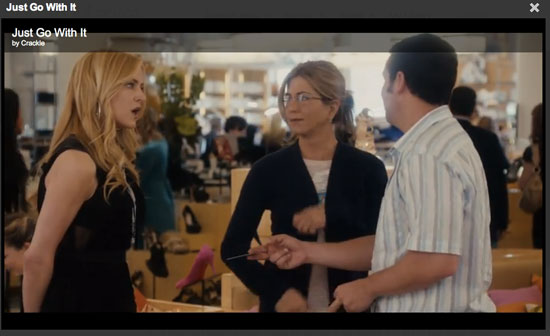
Streaming "Just Go With It" On Chrome Via Android Market

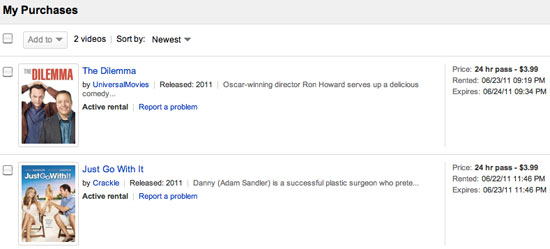
In the last two days, I pulled down Adam Sandler's romantic comedy "Just Go With It" and Vince Vaughn's "The Dilemma". Both $3.99, I can play these videos on the Web (and even Google TV's Chrome App) and expand to full screen. In our on demand world, the experience is on par with Apple TV or Netflix Instant, and your service preference depends on the device you're using or the title you want. Using the Android Market interface is actually just a front end for YouTube's full-length feature movie rentals (see all of them here), including films like The Hangover, Harry Potter and The Deathly Hallows, The King's Speech, Knocked Up and many others. It's yet another example of Google trying to push to the browser what traditionally has been handled with desktop client software.

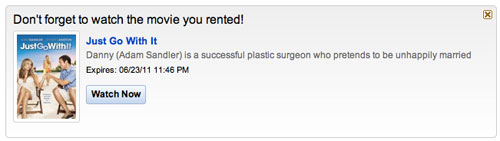
YouTube Reminds Me to Watch The Movie I Rented

My Rented Films Visible on YouTube

I tested the video rentals on my Mac, in both Chrome and Safari and on the CR-48, as well as on Google TV. Essentially, if the app can play YouTube videos and you can sign in with you're Google credentials, you're good to go.

My Receipt Delivered Via Email, Like Any Other Google Checkout Purchase

At Google I/O, it was promised that ChromeOS (and these rentals specifically) would bring more offline access for those outside of broadband streaming. I assume those will come soon, to solve for the poor souls stuck on airplanes who still want access, and might still be going to Apple to shell out three or four bucks at a time.

April 19, 2011

April 19, 2011 · 3 MIN READ · BY LOUIS GRAY

Physical Media Has To Go. I'm Digital Only From Here.

Physical Media Has To Go. I'm Digital Only From Here.

Moving across town last summer was a real eye opener in terms of seeing how tied we still are to physical things. Beyond all our sundry items needed to survive, there were boxes upon boxes of nice-looking and possibly interesting books and other media - DVDs, CDs, the occasional VHS tape nobody had bothered to toss. All of them took up room, and made for heavy lifting. But there's no real good reason, beyond nostalgia, to ever get any more. I want all my music, photos, videos and books to be electronic, and I want everything else gone - even if it looks great on the bookshelf. Same goes for my kids. Once they're done with their board books, I want them to get used to eReaders. By the time they reach school, textbooks should be relics of the past anyway.

Thirteen years ago, Apple did away with floppy drives on the iMac, ushering in a world where people did well enough to email items via attachment, or in later years, burn copies to compact discs. Ten years ago, I dumped my hundreds of cassette tapes in the garbage moving from one home to another on the Peninsula. Three years ago, I donated hundreds of my CDs to a coworker who liked the same music, and emptied my bookshelf to another friend who didn't mind dog-eared Stephen King and John Grisham novels. Even DVDs are too unwieldy at this point. For software installations, one installs once and the DVD is subsequently irrelevant. Purchasing DVD movies is completely silly in a world with significant storage space, and Blu-Ray never even entered my mind.

Now practically the only physical media I bump into is when a book author wants me to do a review, or when coffee table books are passed along as questionable gifts. Even USB flash drives are starting to feel like old media to me at this point.

In a world where I am constantly connected to some gadget, be it a phone, a tablet or a laptop, it takes serious will power to unplug and dust off an old tome whose number of uses is limited. The books I've been sent to review are piled in a corner on my desk - some probably good, but I might even buy the digital version rather than lug around a heavier three-dimensional copy. The stray Netflix DVD we have around the house just causes me to nag my wife into making our subscription digital only, and everything else I just want to give away in a massive garage sale - cheap!

The long-desired paperless office remains elusive, but for much of the home, it can be obtained. My music is streamed on Spotify, with some playlists and artists saved as digital files. My movies have a short shelf life, typically the 24 hours allotted by Apple TV before they disappear. And I've been reading all my books on the NOOKColor and on the Google Books app. There was a time when people would argue it was worth paying a premium for the physical copy of an item, but now it seems they should have to pay me for the inconvenience.

Being digital only means that exceptions to the rule can fall through the cracks. Bills delivered in the physical mail don't get paid as quickly. Notifications from the DMV can get missed, and late fees occur. It's a problem that hasn't been perfectly solved, and it could just be me making an excuse. But as I see it, if there's an option to go digital, that's my choice. With bandwidth and storage space being what they are, my infrastructure isn't optimized for yesterday's media delivery.

April 17, 2011

April 17, 2011 · 5 MIN READ · BY LOUIS GRAY

Apple TV, Google TV, TiVo: Crowded Theater, All Good

Apple TV, Google TV, TiVo: Crowded Theater, All Good


There is no one perfect home entertainment gadget. No single gadget manages to record all your favorite shows on demand, has access to the deepest online library for new and older titles, syncs perfectly with services like Netflix and finds all the Web's video at once. Devices ranging from set top boxes like Apple TV, TiVo, Google TV, Roku, and Boxxee, and game centers including the Nintendo Wii, XBox 360 and Sony Playstation, and single-purpose devices like the Slingbox have been working hard to make our entertainment consumption world ideal, but each has its strengths and holes. In our home, we've tried to fill all the holes, and this requires multiple devices, each one finding a perfect niche that can't be replaced by an alternative.

We moved beyond the traditional VCR/DVD world in 2003 with the arrival of our first TiVo DVR -a series one. Since then, we added two newer boxes, the TiVo HD device and the TiVo XL, the bigger brother of the HD, with a terabyte of storage. While the Premiere line of TiVos emerged last year, it wasn't compelling enough an upgrade to make the move, but we're very happy with the pair we have.

In 2007, with Apple's release of the first generation Apple TV, we snapped up a 40 gigabyte model, which is in use today. Last year, I also picked up the newest model Apple TV, which is stream centric. Meanwhile, last month, after some delay, I added Google TV to the mix with a Logitech Revue. Having seen it panned by much of the tech press, and the multiple demos I'd received falling short, it took some hands-on testing at a local Best Buy to push me to bring it home.

So with all these boxes and companion remotes, how do I choose what to use? Like I mentioned last May with mobile phones, you have to look to the core of each device to find their specialty.

Each Product Has Its Own Core Focus

For the Apple TV, the product's strength is its tie to the iTunes store, specifically, the vast video library which contains more new releases for rent or purchase than alternatives. Google and TiVo have close links to the Amazon video store, but the experience has never matched that of iTunes. When we want to rent a movie for an evening, or purchase a video for my kids to watch (like Toy Story or Cars), it's on the Apple TV.

For TiVo, the product's strength has always been around its ability to time shift videos and record my favorites. A companion benefit is its show guide and search, to find future shows and set them to record. The TiVos upstairs and downstairs run our scheduled programming, and having tried crappy DVRs from Comcast, Dish and others, there's simply no parallel to what TiVo offers.

For Google TV, the device is Web centric, much like Android, of course, and most things Google touches. There's something fun about browsing the Twitter app on the full screen, browsing Web sites, and enjoying YouTube on a screen much larger than a laptop. Tired of my kids running into videos on YouTube with the iPad that weren't exactly my favorite, browsing YouTube myself with them in the room puts me back in control and reduces their digital ADD.

Another much-overlooked feature of Google TV is the ability to browse what's on, automatically sorted by genre. Like most of you with kids, being stuck with baskets of laundry is made much easier when watching something entertaining. Yesterday, owning this task, I checked what movies were on, found Knocked Up just started and amused myself through three baskets of whites and colored laundry. It's similarly very good for finding out what sports are playing anywhere on the TV dial.

Is Google TV Any Good? I Say Absolutely.

As the Google TV is the newest gadget for us, and I've covered Apple TV and TiVo many times before, it's worth saying how good the experience has been. Reading scads of reviews that slammed its utility, or the keyboard remote, I was very surprised how easy it was to setup and how immediate its benefits were. I was most concerned that putting the Logitech box between the TiVo and TV would somehow impact the TiVo's ability to schedule recordings. This turned out not to be a problem at all. The keyboard remote was as simple as any other laptop keyboard, and the Home key always puts me to home base, the center of applications, what's on TV, and is the conduit to browsing the Web.

Even more futuristic is the ability to use any Android device as the remote control with the Google TV app. There's some fun to using the Galaxy Tab as the remote control, with part of the app's screen space devoted to playing the role of trackpad. If you haven't done it, surfing the Web from the tablet to the big screen is pretty cool.

Obviously, each experience could improve some. The Apple TV doesn't know anything about live TV and doesn't have Safari running on it like Chrome does for Google. Google TV makes no attempt to record shows, even though it knows they're on. Meanwhile, the TiVo doesn't really know the real Web exists, despite tie-ins on Premiere with Web widgets and third parties like Netflix, Amazon and Blockbuster. But in our home, if we have an entertainment need to fill, we have a box to do the job.

PR around the Google TV has been pretty light since its initial launch, and one could guess that maybe we'll hear more about the product at Google I/O in May, the one year anniversary of its introduction. Maybe new hardware and TVs will be announced, or new content partnerships, after months of hearing that sites (like Hulu) want to keep Google out of their kitchen. TiVo is due for a big upgrade that maybe makes me update the older boxes. And Apple TV only really gets talked about when you hear rumors that Apple could go the true television route and release an HDTV line. They've certainly got the relationships with suppliers, and the best UI team on the planet. But if you know what you want out of TV, Google TV, Apple TV and TiVo all have a fit and each one brings value. So don't get caught up the tech news grumpiness you find elsewhere. Considering how inexpensive each device is, you just might get all three.

February 27, 2011

February 27, 2011 · 4 MIN READ · BY LOUIS GRAY

My 2012 Plan: Full Home Automation, System Integration

My 2012 Plan: Full Home Automation, System Integration


If you're anything like me, you've got a ton of gadgets from different sources that should talk to each other well and interoperate, but often don't. From laptops to cell phones to video game systems, TVs, stereo equipment, wireless hubs, DVRs to the more mundane home electronic systems, you probably wish things worked together a lot better - with fewer remote controls and less regimented ways of getting things done. As for me, I'm great about buying the best stuff, but terrible about optimizing it. I know my strengths, and that's never been one of them. The good thing is that other people are, and I've teamed up with a good friend of mine to help get my house wired - the right way - over the next year.

Tom Abell, who runs the great blog Home System Integration (subscribe now), is focused on making all the devices in your home work together. So when I told him that I'd moved into a new place last summer and hadn't even taken the baby steps like putting our flat screen TVs on the walls, he knew I would be a long-term project. So I put my trust in him, and between us both, we've completely revamped my home entertainment system, both downstairs and upstairs (in my office, which doubles as a den).

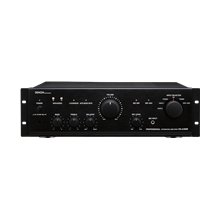
Starting downstairs, with our family room, we added a Denon amplifier as the centerpiece to the system, plus a Dolby surround sound 5.1 theater system with an amazing subwoofer. The front speakers are wired from the TV, with the rear speakers getting audio wirelessly via bluetooth (from Rocketfish), suspended off our walls, masked by molding that matched the room so their connections are inconspicuous.

We then connected it all with a Logitech device that lets us control the TV, TiVo, DVD player, Apple TV and Nintendo Wii from a single screen. And wherever we could use HDMI, we did. Last night, the rumbling during Inception was enough to make my wife ask if we had an earthquake. So consider that a success.

Upstairs wasn't as big a job, but a place where I spend a lot more hours, so it had to be solid. As with downstairs, Tom and I posted the TV on the wall with a new wall mount and we also got a new entertainment center that matches my desk and is capable of locking to keep my kids' fingers out. We again leveraged HDMI everywhere, and now have the TiVo, Wii, DVD/VCR combo, Airport Extreme, Apple Time Capsule and Sonos ZoneBridge all in one place, neatly cabled. The difference is incredible. We also salvaged the Bose subwoofer and speaker setup from downstairs and brought it upstairs, so the sound is great up here too. In time, I'll probably purchase an all-in-one remote from Logitech to run the place.


Now that the entertainment side is in great shape, I wonder about being able to manage the rest of my home by computer or by any one of my mobile gadgets, be it via iPad or Android phone. Between Tom and me, there's got to be a good way to mess with the thermostat or turn off lights around the house without leaving my seat. I lust after Google Powermeter, but haven't seen that widely used yet. There should be a Web interface for the dishwasher to see how full it is and set a regular schedule. Same with the sprinklers in our front and back yard, or the lights that come on by our driveway that should start at dusk, but usually come on around midnight and stay lit until four a.m.

So yes, there is work to be done. While I may be more focused on mobile apps, trends and Web services, Tom has put together a number of solid pieces on the connected home, the home theater PC (HTPC), and Windows Home Server. He's also a contributor to Hometoys.com, which I started reading the last few months, and is on Twitter at @home_integrate.

If you're in the Bay Area, and suffer from gadget glut or just want to get them connected, it's my pleasure to recommend Tom. He promised to use me as a guinea pig, and our entire family has benefited from his strategy and physical labor, without a question. For the rest of you outside the area, make sure to check out his blog to get caught up on the world of home automation. I'm hoping to become more of an expert myself in the next 12 months, and filling some of my own knowledge holes in this space. Should be a fun challenge.

December 25, 2010

December 25, 2010 · 6 MIN READ · BY LOUIS GRAY

2010 In Hardware: Top Ten New Gadgets In Our Home

2010 In Hardware: Top Ten New Gadgets In Our Home

2010 has been a fantastic time to be a tech geek and gadgets fan. Led by the rise of tablets to give technophiles another item between a phone and a laptop to take with them constantly, and flamed by the fans of competition between Google's Android and Apple's iOS, the users are reaping the rewards.
We now expect to have always-on connections to high speed Internet. We expect to have access to all our data in the world from any device, and to be able to find practically any media and play it anywhere. With this backdrop, I'd like to briefly outline the top ten new devices that entered our world in 2010 in hardware, and why they made the list. The order may surprise you. Keep in mind that this reflects my personal experience and preference, and doesn't suggest one is any more "successful" than the rest in terms of sales or market penetration. Sometimes, as an early adopter geek, it makes sense to go a different way.

1) Sonos S5

The addition of the Sonos S5 wireless music system to our home has been transformative. I liked the first demo unit I received, that I purchased it, and later bought two more, when my family and I traded up our living space and finally had room to support excellent sound in every corner of the house. Now, I take it for granted that I can tap into my computer, my iPad, or any of my Android devices and pull down streaming radio, satellite radio, Last.fm or even Spotify.

The Sonos S5 sound and form factor is such a dramatic win that it has been the centerpiece of many gatherings with friends and family who marvel at how great the sound is and how fast I can get almost any song in the world, all managed from a mobile device. The addition of a Wireless Dock to support iPods or iPhones is a big boost too for those living in a world of iTunes.


2) MacBook Air

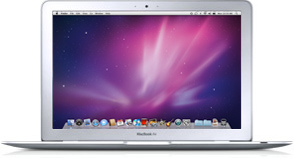
At the beginning of the year, I shed a few pounds, not from some New Year's Resolution, but from going down from a MacBook Pro to my MacBook Air. The Air is speedy, light and is the first step at moving to the cloud, almost by necessity, thanks to its 128 GB SSD disk, about half what the Pro offered. While the Air was a 2009 model, and is already out of date compared to the newest offerings from Cupertino, it is running great and goes everywhere with me.

3) Samsung Galaxy Tab

Regardless of Steve Jobs' comments, the 7 inch tablet form factor is impressive. I haven't fully written up my experience with the Galaxy Tab yet, but it brings the best of the world of Android in a design that fits simply in one hand - perfect for e-mail, photography, surfing the Web, Facebook, or reading books. It starts on the fly with full access to the Android Market, and actually fits in your jeans pocket, or inside jacket pocket. The device is actually very fast as well. It is inevitable to be compared to the iPad, which came first, and some may find it crazy to choose the Galaxy Tab over the iPad, but I've never really warmed up to the iPad, which is used much more by my kids than me. With the Air and Galaxy Tab, the iPad is essentially the odd one out.

4) Apple iPad

The iPad is going to be #1 on many different lists this year, from sales to innovation. For years, Apple was rumored to be working on a tablet device, and in 2010, it finally came, to tremendous success, just as the iMac and iPod and iPhone before it had. It replicated the iPod experience in a much larger screen, and is the go-to device for my toddlers. The sheer weight and bulk of the device made it less of a fit for me, especially when squeezed by the MacBook Air, but I'd be naive in saying the iPad didn't break open the market for tablets in a big way.


5) Samsung Epic 4G

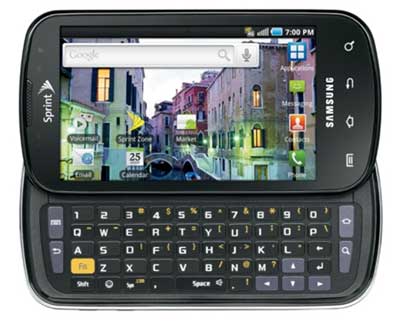
Having caught the Android bug, and finally having found a phone network (Sprint) that didn't drop every other call (I'm looking at you, AT&T), I was excited by the great number of solid reviews of the Epic 4G, and its inclusion of a full-featured keyboard. The device runs all my Android apps, connects to all my email services in the cloud, takes great video and photos, and yes, lets me type very quickly when answering longer emails or chat sessions. The biggest major drawback I have with the Epic is its poor GPS support, which art times can be debilitating. Regardless of this, I am quite happy with the Epic.

6) Barnes and Noble NOOKColor

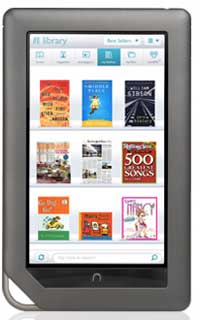
I recently wrote up my experience with the NOOKColor, which delivers a nice slim 7-inch Android tablet masquerading as an eReader. It's got smart integration with Barnes and Noble's book supermarket, and syncs with the NOOK app, so I can begin reading a book on one device and pick it up on a second. Added support to transfer my own music and rich media files via USB make it smarter than a dumb eReader and getting to the Web is a few clicks away. While it doesn't come with full Android Market, it has proven extensible, so I would watch this space closely.

7) Google Chrome CR-48 Notebook

Reviewing or ranking my experience with this 2010 device isn't really fair. Turns out I got it today. I have high expectations with the direction Google is taking with the ChromeOS and making our lives more cloud-centric. It's a big reason I started migrating to the Air in the first place at the beginning of the year. My initial impressions are as expected, with tight integration to the Chrome browser (essentially the full experience), a great thin frame and nice keyboard. The trackpad, pilloried by others, still needs some work. Putting a beta product on a pedestal against established innovative leaders like the MacBook Air is not fair, but I would bet that a mix of ChromeOS and Android features will lead to some interesting product pushes in 2011 and 2012 from these teams.

8) HTC Evo 4G

The Evo 4G I picked up at Google I/O this Spring was my first dive into the world of Android, and the way it performed against my aging iPhone 3G was remarkable - giving fast performance and real multitasking in a place I had never expected. The Evo's GPS and access to the Android Market made it very solid, and put me on a strong phone network for voice for the first time in years. The drawbacks to the Evo, including bulk and low battery life, mixed with the lack of a hardware keyboard had me switching to the Epic with no hard feelings.

9) Apple TV (2010 Edition)

Established Apple TV owners since the first 40 GB generation, the long-awaited development of the new Apple TV was well anticipated, and landed with a mixed experience. The machine is incredibly small and fast access to Netflix or streamed videos and TV is great, but the greatly reduced library was a disappointment. Truth be told, the best Netflix access in our home is actually with our Nintendo Wii, so the Apple TV only really gets use when we want a movie in the evening.

10) TyPad for iPad

With the launch of the iPad came the launch of iPad accessories. One of the more useful for me was the TyPad, which combined an elegant looking iPad case with a full-fledged bluetooth keyboard. If you're one to type out full e-mails on the iPad, the TyPad is very cool. The only downside is that once I had a keyboard, I found myself also reaching for a mouse or trackpad. Old habits die hard.

Christmas also brought a second NOOKColor into our home as I bought one for my wife, so now we have two iPads, two NOOKColor devices, and one Samsung Galaxy Tab, so we have 5 tablets to go with our three laptops (counting the CR-48). I am curious to see if 2011 will be as strong. But if you haven't checked out the Sonos S5, Galaxy Tab or are in the market for a new laptop, try out the Air or CR-48. Great stuff this year.

October 1, 2010

October 1, 2010 · 3 MIN READ · BY LOUIS GRAY

New Apple TV Extends Fragmentation, Cupertino Style

New Apple TV Extends Fragmentation, Cupertino Style

For all the noise around fragmentation in the world of Android, one would think the state of affairs on the other side of the technology aisle would be perfectly unified - with one operating system, one user environment, and one experience where all things play nice. But while it's not as often discussed, my plethora of Apple devices is increasingly fragmented. The newest culprit? The brand new Apple TV, which has an incredible form factor, and some surprises in terms of what's simply not there - making me have to remember what media plays on what devices, and what devices are capable of doing what.

Despite my switch to Android on the phone, I still have plenty of Apple products in my house - from my wife and my laptops, our iPads (shared with the twins), a first generation Apple TV and second generation Apple TV and the newest iPod Touch.

After getting the new Apple TV, and attaching an entirely too expensive HDMI cable (not included) from Radio Shack, I set up the device and browsed to available TV shows to rent or buy.

The first search I made was for "Dexter", the Showtime drama I've become addicted to in the last month or so. Having already pulled down seasons one through three on my Mac, I wanted to pull down season four on the Apple TV. No dice. No results found.

Browsing the available TV networks quickly displayed why this was the case. Apple TV only offers selections from Fox, ABC, BBC and Disney. With Fox being the lowest in the alphabet, I thought it was a bug, but it wasn't that I missed Showtime outright, it just flat-out doesn't exist. CNET highlights how only 3 of the top 25 shows are available, but there's just something odd about knowing content is in the iTunes store (like Dexter) but my new Apple TV can't get to it, while the old first gen one (downstairs) can.

The capability gap between different devices from Apple is already clearly felt within iTunes. The iPad has started a cottage industry of high quality application development for the larger screened devices, which is great, but the backwards compatibility is practically invisible. In fact, if you have iPhone and iPad, you might find yourself buying an application twice, on the same account, for each device, with no discount. With the promise of applications being developed for the new Apple TV, you can see the potential for yet another purchase looming on the horizon.

While Android is clearly struggling with the challenge of bringing 2.2 support to all the latest handsets (and making progress), we see Apple TV running a variant of iOS (mixed with the traditional Apple TV OS), different than that of the iPhone/iPod Touch, with iPads still not having iOS 4, and yes, Macs still being Macs. I don't think it's too crazy, for a company focused on the Open Web (courtesy Daring Fireball) to find a way to tap into the Internet in a very real way and unify access to media and applications.

For now, until this is solved, it seems we need to expect the new Apple TV to have a different set of titles from iTunes than its older cousin, and the iPod Touch or iPhone to have a different set of applications than the iPad or Mac OS. This is real fragmentation, and it's a drag.

June 29, 2010

June 29, 2010 · 2 MIN READ · BY LOUIS GRAY

iVI Brings More Web Video to iTunes, iDevices

iVI Brings More Web Video to iTunes, iDevices

If you purchase all your Web video from iTunes, having those shows and films available to your Apple TV and iPhones is pretty simple. But video from other sources, be it through camera and smartphone recordings, or even BitTorrent downloads, can sometimes be a challenge to get into the iTunes ecosystem. A simple piece of Mac software, called iVI (short for iTunes Video Importer) can bring all those videos from all those places and bring them back to iTunes, complete with cool extras, including season and episode data for TV shows, and standard or high definition content into one file.

Despite Apple's success in the video downloads market, the reality is that many people still tap into peer to peer networks to get individual episodes of TV shows, or even full-length feature films. Often, even after these files are downloaded, it can be difficult to find a way to even play the files. iVI converts many different file types, from the standard .mp4, mpg and .mov files to other less Mac-friendly options, including .3gp and .avi and makes them iTunes ready.

iVI Hard At Work Cranking on TV Shows and Films to iTunes

Getting files to iVI is billed as being as simple as drag and drop. It recognizes if files are movies or TV episodes. Later, if instructed, it can scan for new video files in regular directories, and will go so far as to suggest TV show episode and season information if not automatically applied.

Files from iVI In SD/HD In My iTunes

Many people are turning away from the TV set and their DVRs to the computer for videos. For some, the solution is Hulu or other sanctioned outlets, while for others, BitTorrent and other networks continue to reign supreme. iVI looks like it does the hard work to make the data meaningful and get it on all those Apple devices built to play video.

I've already tapped iVI to pull the 3GP files from my HTC EVO into iTunes so I could build a new iMovie project for posting to YouTube. (See Matthew Walk to the Store With Me) iVI simply works, so check it out from South Pole Software.

May 20, 2010

May 20, 2010 · 4 MIN READ · BY LOUIS GRAY

While Apple Slept On Their Hobby, Google Executed

While Apple Slept On Their Hobby, Google Executed


After noting Apple practically being a zero in terms of mentions in yesterday's keynote at Google I/O, today saw the gloves come off as Google came out swinging against its competitor - and it had to be noted, even from this longtime Mac customer - that many of the punches landed, again and again. Most damning? Google actually took TV seriously - instead of teasing customers with a streamlined device, like the Apple TV, which looked great, and functioned well, but was often dismissed as not being a central focus. The result, despite the occasional bumps in the morning's demo, is the latest and most credible offering yet that could unify the worlds of Web and television in one place - on the biggest screen in the house. (See the official Google TV site)

Back in 2007, I had high hopes for the Apple TV. I openly questioned those naysayers on the device, celebrated its small feature updates, such as adding YouTube support, and postulated how it could compete and defeat other businesses, such as Netflix. But it seemed Apple had other ideas for the device - pretty much ignoring it, even as the company saw tremendous focus in other places - first with the iPhone, and now with the iPad.

Yes, the Apple TV still works. Yes, it can still show photos and YouTube and my music and pull down films from iTunes. But it's a siloed dinosaur.

Google made its antiquity especially clear today, as instead of using Apple's divide and conquer mentality, with Apple TV being completely separate from your TV, the company promises to bring the Web to the TV, complete with a search box that finds content, no matter where the source. The reason this has a much better chance to succeed than Apple TV ever could? Commitment. Commitment from the company's leadership, from partners, and to the word they keep smacking us with - openness.


Rishi Chandra, product manager for Google TV, says the company's new offering is about "taking the best of what TV has to offer today and what the Web has to offer today and give a seamless experience", which should result in the ability to find playable content - no matter where it is and bring it to the big screen.

Built following a history of unsuccessful challengers, such as Web TV, Google's massive potential comes from several points - including the immediate leverage of the Android platform, including the application marketplace and command from any Android mobile device, the full-fledged Google Chrome browser, the obvious support of YouTube, and alliances with Adobe for Flash and teaming with leading industry partners like Sony, Logitech, Best Buy and Intel to make the entire ecosystem do its thing.

As an Apple user, and as a TiVo customer, I have grown used to those two companies playing a significant role in my TV entertainment experience. Those two companies are exceptional when it comes to getting user experience right and making things feel smooth. Google hasn't managed to replicate that feeling of seamless integration yet, but their ability to display bookmarks on TV, to download apps from a PC and have them hit the TV, and manage the TV from multiple devices at once all look like they are getting so many features into this thing that there is really no way somebody like Apple can compete, even if they were to buckle down and try for real this time.

Google and its partners promised that the first television sets, set top boxes and input devices will all start hitting shelves by Fall of this year - in time for the holiday shopping season. It will remain to be seen how customers take to a new platform with devices coming from different sources, but it looks like it is Google that is "Thinking Different" about the TV and trying to open it up as a platform for its many developers to leverage - all while Cupertino pretends its Apple TV doesn't exist. As an Apple TV owner, I am disappointed in the lack of attention paid to this product, and think often my loyalty may have been taken for granted. But Google is executing so well in so many areas, it is obvious we have an alternative, one that, if the UI is excellent, could change the game.

Best Buy CEO Bryan Dunn, speaking with Google CEO Eric Schmidt, referred to the new Google TV platform as "not just a new aisle but a new category". Rishi Chandra echoed his comments saying, "Our goal is to have the same impact on the TV experience as the smart phone did with the mobile experience."

The TV looks like it finally may get smart. I just want to know why Cupertino played dumb for so long.

October 29, 2009

October 29, 2009 · 5 MIN READ · BY LOUIS GRAY

Could A Real Apple Fan Completely "Go Google"?

Could A Real Apple Fan Completely "Go Google"?


As a Mac fan in the 1990s, it was a lot easier to understand who the good guys were and who the bad guys were. Apple was very good. Intel was bad. Adobe was usually good. Microsoft was bad. Very bad. Evil. But over time as we have morphed into the latter part of this decade, Intel switched teams and became good. Meanwhile, Adobe looked less like a close friend and more like a despised ex, as Microsoft went from hated bully and thief to playing the role of crazy uncle who nobody really likes but puts up with because he's not going to disappear. The hardest to label? Google, a younger cousin who everybody really likes, but just might be too smooth to be trusted, even as it gets too popular. Now the stage is set for an awkward family reunion - as Google and Apple are so overlapped, tech fans have the option to choose between the two for practically their entire digital life, and the loyalty once sent Cupertino's way, exclusively, is getting some serious competition.

Over the last few years, if one can look beyond the striking hardware and arguable operating system differentiation between Mac OS X and Windows PCs, Apple has unquestionably led the way in terms of seamless integration between applications and devices. The company's iLife package ensures that media is treated in a similar way across multiple applications, and its user interface guidelines protect the users from odd menu behaviors that change between each program. Meanwhile, the company's iTunes/iPod/iPhone juggernaut has made managing media easier than ever before, especially when one considers the addition of the fast-growing App Store and the good, even if not given much respect, Apple TV, which brings the core of the store to the core of the home.

But while we Mac fans may have been resting comfortably as the Mac vs. PC commercials made us giggle with egotistical self-pride, and the company's balance sheet has grown ever stronger with quarter after very profitable quarter, Google has been changing its spots - morphing from search engine and advertising powerhouse to a Web services monolith that can go head to head with almost every single Apple product out there. As the company integrates its many different products, they too may offer the integration we have always come to expect from Apple, but in an open, Web-focused way. And with every single new announcement, Apple fans have to start thinking if their future is one that is Google as much as it ever was Mac - and if "Going Google" would be that bad anyway.

If Mac OS X is the platform on which all Apple software starts, so too will be Google's Chrome OS. We know it's coming, and some sharp engineers are slaving away in Mountain View to capture the flexibility of the Web and make the cloud the equivalent of your hard disk.

Apple's Safari browser, the built-in Web browser for Mac and for iPhones, is equally matched by the Chrome browser on all major operating systems and on Android as well.

The iPhone and its 80,000 to 100,000 applications in the iTunes Store are being challenged by Android's new fleet of phones, led by the Droid from Motorola, and its rumored 10,000+ apps.

Apple's Mail? Easily matched by GMail. iCal? See Google Calendar. iChat? Google Chat. iMovie and iDVD? Well, it's not the same thing, but you would be hard-pressed to say YouTube doesn't win that battle. iWeb? Really? See Blogger.

On the professional side, Apple's iWork sports Keynote, Pages and Numbers. One has to wonder why they even released these apps, as they're not exactly keeping Microsoft at bay, and I don't know anybody who uses the last two. I use Pages once a year to do our Holiday letters home, and that's it! You better believe that Google's online office suite of Google Docs, Spreadsheets and Presentations is the real deal. Beyond that, do you expect Apple's iDisk to trump GDrive? Will Mac OS X Server beat out the Google File System (GFS) or can you expect XServes to replace Google's commodity rack servers in their datacenters around the globe? Not likely.

This isn't a rant stating that Apple is doomed. Far from it. After all, Google doesn't "yet" make excellent laptops. But I've tried the Motorola Droid with Android 2.0 and it's good enough that if iPhone were not an option, it would be an easy second choice. I find that I am using my Apple OS and my Apple Web browser to go Google, not just for the search engine, but all the downstream Google services. (10 of which I highlighted last month)

Google spokesperson and king of anti-spam Matt Cutts said his October goal was to avoid Microsoft software, a task made easier than ever now with Google providing an alternative just about everywhere. But I wonder if it's possible to do something very different - use ONLY Google software for a month. That would mean using the company's Web browser exclusively, and their office suite exclusively, and their mobile phone OS exclusively. That would mean using GMail and Google Talk and Google Wave and Google Calendar and Google Reader instead of Outlook or Mac Mail. I bet we're very close to this happening.

On Wednesday, Google also announced some of their first forays into Music search. This is an area where Apple still has the clear advantage - with iTunes. But Google offers Pandora on the Android platform, so iTunes isn't needed. Maybe I could push them to buy Spotify, and set up a killer alternative to iTunes with the Google logo? That would be something indeed.

I am a Mac guy. Maybe I'm less of a Mac guy than I once was, but I still trust Cupertino. That said, Google is growing on me in a big way, and they are the real alternative - something Microsoft never really was. Maybe soon I'll also be going Google in a way I never expected.

December 25, 2008

December 25, 2008 · 2 MIN READ · BY LOUIS GRAY

You Can Never Have Enough Bandwidth. Ever.

You Can Never Have Enough Bandwidth. Ever.

On most days, I don't consider myself a real bandwidth hog. Most of my online activity consists of e-mail, Web browsing and the occasional YouTube video. I'll use FTP to upload and download files to my Web site or the server at the office, but nothing too intensive. Practically the most-intense things I'll do would be uploading videos to YouTube or sending photos to SmugMug or Flickr. I can practically guarantee that Comcast doesn't blink an eye at my activity. But on the rare occasion I hit a wall on bandwidth, and see slowdowns, it reminds me I don't have infinite throughput - just like I don't have infinite storage capacity. (See: Terabytes and Terabytes of Data At Home. Petabytes Next.)
Tonight, as we were winding down from Christmas and putting the twins to bed, my wife and I realized we finally had some time to relax. After a holiday rush and full days, we surprisingly haven't had too many hours to take in entertainment. So I checked in on the TiVo, and headed back to Amazon Unbox to give the service another chance. We found one movie and set it up for download.

Not done, I hit "Input" on the TV, and checked the Apple TV, finding two films to download. One started to download immediately, and the other was queued up.

Meanwhile, the TiVo light glowed red to record a program at 8. The blue light signalling a download from Amazon stayed lit. As no program was done, I checked and found a Law and Order episode on one TiVo which I could transfer from the bedroom unit to the living room unit. We're watching that now as the films download.

If that wasn't enough, I opened up my laptop and... shock and surprise... none of my Web sites are loading. But that won't stop Apple's Time Machine from doing its regular backup to my Time Capsule in the other room.

So, in tally, my bandwidth is being hogged by:
  • 1 movie download from TiVo/Amazon
  • 1 standard definition television show download via TiVo
  • 1 high definition movie download on Apple TV
  • 1 standard definition TV show transfer between TiVos
  • Backup from my laptop to Apple's Time Capsule
Even if I have top of the line broadband access here at home, it's no surprise we saw failures on the Web and inaccessible e-mail, as I had flooded my available pipe. Even though I'm not a P2P or BitTorrent junkie, I can still find a ceiling.

So, is the fault mine for hitting the "order" button too many times on the TV? Should I buy once at a time, in order, to do a favor to the cable company, or should I push the limits and always expect more?

December 8, 2008

December 8, 2008 · 2 MIN READ · BY LOUIS GRAY

TiVo and Netflix Hook Up for Instant Video Gratification

TiVo and Netflix Hook Up for Instant Video Gratification


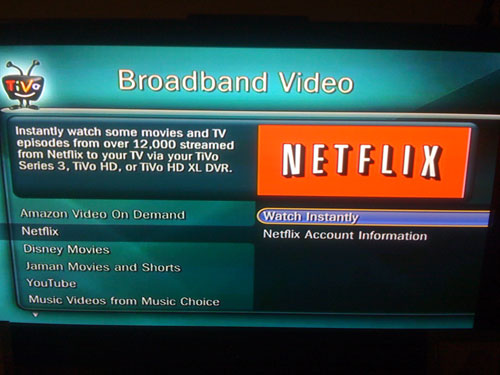
It was once expected that the fight for video and Internet content in the living room would feature major players like Microsoft, Apple, TiVo, Netflix, Amazon, DirectTV and others vying for a share, each with their own proprietary formats and devices. But as time has progressed, we have seen vendors partner and collaborate with one another so nearly all content, with some major exceptions, is available on each device. YouTube is on both the AppleTV and TiVo, for instance. Amazon can be found on TiVo. And now, after much anticipation, TiVo users can now link in to their Netflix accounts and stream videos from their queue instantly.

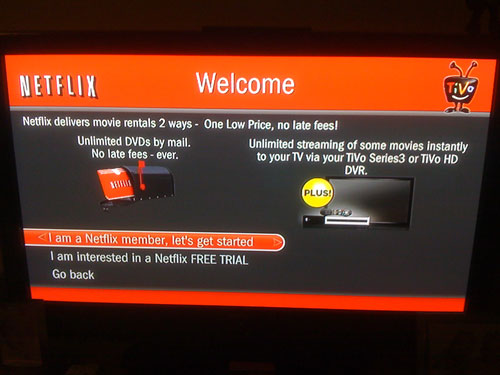
With the latest Fall 2008 update, TiVo Series 3, HD and HD XLR DVR owners can use the "Video On Demand" menu option and see Netflix sitting alongside Amazon and YouTube. As NetFlix has tried to reinvent itself from the order by mail company with scads of bright red envelopes, and be instead known for having the widest array of online video available, they rightfully demanded a seat at the table on TiVo's menu, connecting some of the most loyal customers in the entertainment business in the process.


Netflix and TiVo Together at Last

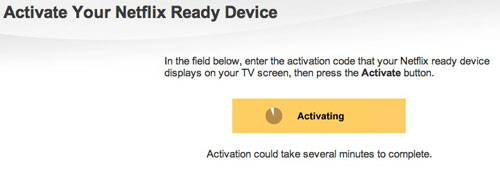
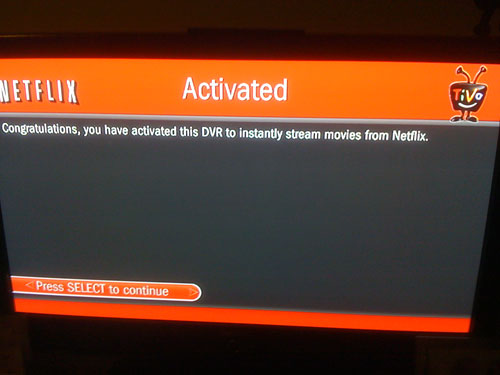
For existing Netflix account owners, adding the service to TiVo is fairly straight forward. First, you either click "Watch Instantly" or "Netflix Account Information". Then, you are presented with an activation code which you need to enter on your computer by way of the Netflix Web site. When the activation code is entered, your DVR recognizes the code, and you get clearance to your account.


Yes! I am a Netflix Customer


Activating Via the Web...


Activation is Successful!

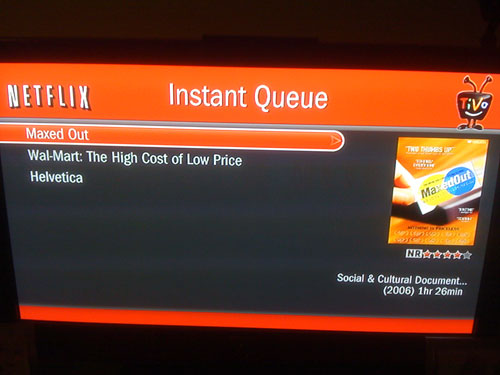
If you already have an instant queue set up from earlier use, it is automatically shown on your TiVo. Otherwise, just go to the Netflix.com site, and add a few items to your queue. The next time you look at the "Watch Instantly" menu item on your TiVo, the movies will be right there.


My Instant Queue Is Ready.

Just last week, I wrote about how I had used my TiVo to watch a pair of films from Amazon.com's UnBox service, and had run into video quality issues. But so far, I've had nothing but good things to say about the quality from Netflix, and wouldn't expect this to be any different. While the catalog of films available from the "Watch Instantly" menu isn't the biggest I've ever seen, even the most stingy of film aficionados should be able to find a movie on demand to their liking.

At this rate, it looks like I'll never see movies in the theater, get the new releases off Apple TV, and the old archival films off Netflix. But between the two boxes, I'm probably covered. It's a great time to be an entertainment technology junkie.