Silicon Valley Technology Commentary & Archives · Est. 2006 3,045 Posts · 2006–2026
Showing posts with label WebFinger (4 posts). Show all posts

March 19, 2010

March 19, 2010 · 4 MIN READ · BY LOUIS GRAY

Hey @You! We are Talking About @You Over Here!

Hey @You! We are Talking About @You Over Here!

Over the last few years, I have enjoyed watching new sites spring up built around conversations and social engagement. These new social networks, be they about friends (Facebook), business colleagues (LinkedIn or Brazen Careerist), shared interests (MyLikes), shared items (Google Buzz and FriendFeed) or even shared purchases (Blippy), are primarily architected around posted items, and various groupings of gestures (likes) and comments. Practically all of the best sites are now following this model to varying degrees. But some are doing a better job than others of alerting you to your being mentioned or pulling new voices into the conversation. I believe that we are on the cusp of even better improvements to connect people across the Web, no matter where they are.

Take, for example, a basic share on Facebook. Today, when a shared item is added to Facebook, you can add a person's name to the item through their own twist on the familiar Twitter address of an "@reply". You can also tag photos or notes with people's IDs and they will be alerted, either by e-mail, or in their message box.

Facebook Lets You Tag People As You Post Updates

That's a great addition. But if I am making a comment on this entry, I can't refer to anybody in the same way (an @reply), and nor can anybody else. This is the same issue on FriendFeed, where I can copy a connected friend on a native entry, but can't do any kind of @reply to add them after the fact, nor can anybody else.

Facebook and FriendFeed Don't Let You Tag in Conversations

Two sites that do this very well are Google Buzz and Blippy.

Google Buzz has it set up so you can notify somebody they are being talked about by adding the @ symbol ahead of their e-mail address. For example, you can tag me by writing @louisgray@gmail.com in the middle of any thread, and it will resolve to something that looks like @Louis Gray. The catch here is that you need to know the individual's e-mail address, have previously messaged them before through GMail, or you have to open up the person's Google Profile and use their username ahead of Gmail.com to get it right. It absolutely works, but is clunky, with too many steps.

Google Leverages WebFinger in Buzz for Mentions

Blippy's is the very best I've seen so far. Forget about e-mail addresses. If you want to reference another Blippy user, just enter @ and their ID, and a link is added to their profile. For me, as usual, that's just an @louisgray away. I will get notified you mention me, and no doubt, jump into the conversation, or at least see what you were saying. I used that just today to pull Jason Shellen of Thing Labs into a conversation on Brizzly, and in minutes, he was there.

Blippy Lets You @ Users In the Thread

By using this kind of @reply functionality, it takes out some of the guesswork and overdone ego-searching and vanity-searching from network to network. Just as Twitter has integrated mentions as part of their service, this mention functionality is becoming part of how we communicate - and I think we're about to see this taken up a notch thanks to two movements - one being WebFinger and the second being Twitter's @anywhere platform, even if it's not the goal right away for the latter service.

WebFinger is essentially supposed to leverage your e-mail address to aid in providing one true identity that is yours, across the Web. Google Buzz leverages WebFinger to tie back your mentions to your GMail account. If more services were to leverage WebFinger, I could tag your "true identity" in a comment, a blog post, a tweet, a photo, or practically anything else, and there would be no ambiguity in terms of whether I meant you or another person with your name (just like the easy confusion between Louis Gray, tech geek blogger and Louis Gray, Osage Indian senator). The open standard, being promoted by Google engineers, and some others, leverages public profile data to be made complete.

Meanwhile, Twitter's @Anywhere platform is looking to put a thin skin of Twitter on top of some major partner sites, at least at first, letting you follow people from 3rd party sites or let you perform Twitter-related actions outside of Twitter.com. I can see a future where this functionality could in theory be embedded as part of major Web browsers, or via plugins, or on enough sites whereby my mentioning of @ and then your Twitter ID would tie back to your Twitter account. Once that gets turned on, you can forget about just counting @replies and @mentions on Twitter.com, and you would instead get, for example, 2 @mentions from ESPN.com, 3 @mentions from The Huffington Post and 1 @mention on TechCrunch. At this point, Twitter's @anywhere could become the @mention and @reply engine for entire Web.

Any good social media maven knows the best ways to search for their own mentions and see if people are talking about them or linking to their content across the Web. I get real-time notifications if I get mentioned on BackType, and I use IceRocket to see links from around the Web or mentions on Twitter. Google News and Blog alerts still work, even if they seem stale. And yes, Technorati is still alive. But if more sites leveraged the kind of @mention and @reply functionality in a great way, as Blippy and Buzz are starting, and Twitter and WebFinger are promising, we could have an even better, more connected, more participatory Web without demanding constant searching. I'm ready.

Are you ready to see this work, @chrismessina @dewitt @ev @biz @scobleizer @parislemon @kevinrose @paultoo @btaylor @finkd @elatable @daveman692 and @pud?

March 4, 2010

March 4, 2010 · 6 MIN READ · BY LOUIS GRAY

Designing Buzz for a Google-Free World

Designing Buzz for a Google-Free World

If you haven't seen a lot of applications built in the last few weeks that leverage the Google Buzz API, it's because there aren't any. In fact, Google hasn't yet rolled out any API for Buzz. According to the company, this isn't due to any backroom dealings where they plan to introduce proprietary code and hooks that tie activity to their platform, but instead, because they wanted to be sure they could first build a product that in fullness leveraged open Web standards, and start with that foundation to deliver an interoperable system that could continue to function even if Google were to "disappear off the face of the earth".

In a presentation to the Silicon Valley Google Technology Users Group last night, held at the Google campus, DeWitt Clinton, a software engineer for the company, talked to developers and other tech enthusiasts about the company's API strategy and approach to Buzz, and explained that Buzz is designed not to increase lock-in to Google, but instead, to leverage open technologies that will let data flow to and from sites without central ownership. While a Buzz API will eventually be released, it will leverage the same open standards that power it today.

"The first principle of Buzz is that we can build this on protocols that are open and free, but not centralized," DeWitt said. "Can Google disappear off the face of the earth and Buzz still works? We need to make this data federated and distributed."

On the day Buzz launched, I referenced much of the foundation for Buzz in a quick article about the open tools and APIs that "make Buzz hum". But last night, DeWitt expanded that story to include 9 major open APIs, briefly outlined below.

1. Atom

DeWitt called Atom "the lingua franca of the programmable Web today", explaining that Atom contains entries that are "well structured", and include source entry, GUIDs that enable deduplication, and specification of the content type. He said, "You are able to pass rich data in that Atom feed in a way that is more specific than other feed types."

2. AtomPub

DeWitt said AtomPub "has become the most popular paradigm for restful APIs on the Web." AtomPub expanded the original Atom format to include the ability to both create and update feeds, not just passively read.

3. ActivityStreams

ActivityStreams essentially watch users' activity and can specify rich verbs and actions within those feeds. This enables feeds for all comments posted on Buzz, all likes, or even alerts that one person following you on Buzz also follows you on another network. DeWitt's examples hint at future developments for the platform, as these specific feeds are not yet clearly visible.

4. Pubsubhubbub

Much discussed here on the blog, Pubsubhubbub reduces the need for sites to poll for updates, and powers real-time updates between services. DeWitt reiterated "the hub is decided on by the publisher" and "there is nothing Google-specific about that.", saying that the infrastructure and plumbing for Buzz has been laid for the last few years. Pubsubhubbub has been pioneered by Brad Fitzpatrick and Brett Slatkin, both Google employees.

5. MediaRSS

Developed by Flickr, MediaRSS syndicates rich media through both RSS and atom feeds, creating a structured namespace inside RSS for content and a thumbnail. Buzz leverages MediaRSS, letting you pull rich content, like Flickr photos, into the platform. Of course, PicasaWeb, a Google property, also supports MediaRSS.

6. OAuth

The product of engineers from all corners, including Twitter, OAuth was engineered "to solve a vexing problem in the industry," Dewitt said, explaining OAuth prevents the need to ask users for their name and passwords on third party sites, acting as a delegated authorization protocol that gives permission to the application. Google Buzz, like Twitter, leverages OAuth to provide authenticated access to your data.

7. WebFinger

A new-age version of the old command-line prompted, text responding Finger protocol, WebFinger aims to be a way to get public information tied to an individual, through their identity, assigned to an e-mail address. "We want people to identify themselves, and we want people to discover people," DeWitt said.

WebFinger is similar to the strategy of OpenID, but OpenID hasn't had massive adoption by end-users who have found it unwieldy. WebFinger, aiming to be less arcane, enables the independent nature of Buzz, helping to federate the data and distribute it by domain, owned by the end user. DeWitt said, "The profile lookup and notification mechanism can be in the hands of the user being addressed."

8. Salmon

Still in earliest stages of development, Salmon is an extension or replacement for the old PingBack model that had blogs informing the other about references or links. This "flawed" model only provided minimal data, and could not be verified, letting me send PingBacks anywhere I wish if I chose. Salmon's goal is to leverage what's being called "Magic Signatures", signed with a public key to prove and verify linkage.

The first approach for Salmon will be to migrate comments from aggregators to originating posts, as covered a few times on this blog. But DeWitt said that "Likes" are similar activities that could flow back with Salmon, or be used to notify users of "following" or other activity. DeWitt forecast that sites like Blogger and StatusNet would rapidly adopt and federate Salmon to transmit data updates.

9. Portable Contacts

Simply described, Portable Contacts show your information and that of the friends who you follow, providing users a secure way to get access to address books and friends lists without having to request credentials or scrape the data.

DeWitt also noted XFN, the XHTML Friend Network, and FOAF (Friend Of a Friend) as being key contributors to the Buzz technology stack today, adding that he was "glad smart people were working on this ten years ago because we are all benefiting from it now."

DeWitt, on his Buzz feed, has been talking a lot about open standards and their importance to the Google team at large. See @Jesse Stay A few points of clarification to your most recent post [1], because I believe getting the details right matters. and "The thing I find most attractive about Google Buzz is its stated commitment to open standards.", as well as his first post from February 21st, which thanked the standard developers: Standing on the shoulders of giants—a look at the people behind the protocols behind Google Buzz:

Given Google's size, there is a good amount of distrust on the Web from people who think they own too much of your data, know too much about you, or have goals that run contrary to your own ideals on privacy, communication and sharing. Not even DeWitt's detailed presentations and explanations and promises of openness and data portability will convince everyone that they are on the right path. But I personally believe the frankness and detail that is being shown here is not just promising a strong future for this individual product (Buzz), but also in extending the groundwork done for the entire Web, for products and services we haven't even seen yet.

DeWitt adds: "All of these protocols are open. They are literally also all free. They are intended to be used by everybody, with or without Google being involved. You don't have to ask us if you can use Salmon or Pubsubhububb. We have a liberal and permissive patent license."

Is Google going away? Not today, and not this year. Is Buzz perfect? No. Of course not. Can it do all the things I can do on other sites, like FriendFeed? No. Not yet. But it seems that the Buzz team has opted to make tradeoffs that favor fast shipping and openness over completeness and individual features. And if you don't trust Google, it sounds like you can do something about it.

"We are pretty adamant about not building this on proprietary technology," DeWitt said last night. "If any of you feel that it is not going in the right direction, you have the power to change its direction and Google will not stop you."

You can find me on Buzz here and can follow DeWitt Clinton on Buzz here.

February 9, 2010

February 9, 2010 · 2 MIN READ · BY LOUIS GRAY

Google's Open Tools and APIs Make Buzz Hum

Google's Open Tools and APIs Make Buzz Hum

The debut of Google's new social venture, Buzz, came with all the subtlety of a freight train. Like a freight train, you could hear the rumbling of Buzz as its launch approached, fueled by the vast array of open social tools that the company has been championing over the last few years, and a number of key hires that show Mountain View's commitment to making users' data portable and non-siloed, in visible contrast to alternative networks, most notably Facebook, who has made it notoriously difficult to export data in its six year history.

Though clearly a 1.0 version product today, Buzz is primed for significant improvement in the next several months, which will be driven by data measured within Google, gathering users' feedback - as they no doubt will be demanding the ability to share updates to downstream services, the introduction of an enterprise version, limited by domain, and other enhancements. But from the beginning, Buzz is built to be open.

"We are committed to open standards, and we want to build a non-siloed product at every turn," said Bradley Horowitz, vice president of product management at Google on Monday. "You will see us take all these open standards, like Pubsubhubbub, Webfinger, Salmon, and use this as a vehicle to demonstrate to the world what it means to use them."

Buzz also fits in nicely with the Social Graph API being worked on by data portability pusher Brad Fitzpatrick, which also powers your Google Social Circle. While the social circle learns how many direct contacts you have in Google chat, and finds other connections through registered links, Buzz tracks your most frequent connections by e-mail and chat within Gmail, taking a step further and surfacing active "friend of a friend" content, should it be deemed relevant.

"Social media today is a fiefdom of friends," said Vic Gundotra, vice president of engineering at Google on Monday. "We believe your updates will go where you want them to. We are going to work hard to enable that."

Of note, despite the highly visible business development relationship forged by Google with Twitter to power the company's real-time search, Buzz simply taps Twitter's standard API to gain access to users' updates, and it is expected this access will be sufficient.

August 16, 2009

August 16, 2009 · 2 MIN READ · BY LOUIS GRAY

Google Engineer Tests WebFinger Client for E-mail Identity Lookup

Google Engineer Tests WebFinger Client for E-mail Identity Lookup


More than a decade ago, I could open up a simple program that tapped into the Finger protocol, and see individual's information, or their status, such as the last time somebody had logged into their e-mail account, or if they had new messages. Whether it bordered on stalking or was simply informational, it was a good way for me to figure out why people hadn't responded to e-mails I had sent - deducing whether they were just ignoring the account, or if it was, in fact, me, they were ignoring. But over time, as people became more connected, and less comfortable with this, the protocol fell away.

Last week, some enterprising engineers at Google, including those behind the very cool Pubsubhubbub protocol, announced they were looking to bring back the Finger protocol - but in a modernized way. First, the new protocol would leverage HTTP instead of TCP, and second, the goal would be to provide user-defined identifiable information based on public profile data. The project's name: WebFinger.

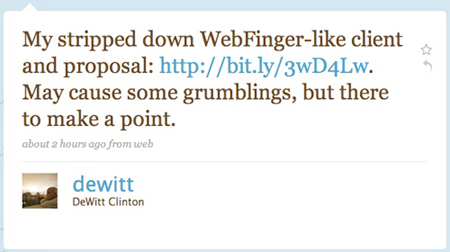
A scant two days later, we already have the first test client, authored by DeWitt Clinton, which shows how WebFinger could work. (Update: He followed up on Twitter to clarify that this is "WebFinger-like", not an implementation of the official protocol itself.)


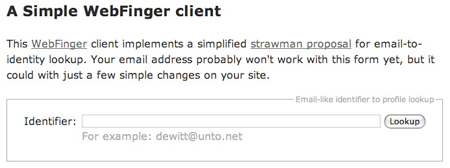
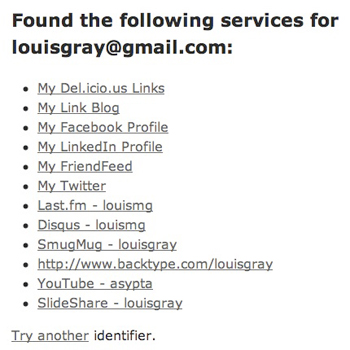
While DeWitt says "Your email address probably won't work" yet, it does work for GMail accounts, most likely those where you have enabled a Public Profile. For example, here are the results when you search for me.


DeWitt's First WebFinger Client Search Box


WebFinger Results On My E-Mail, Using DeWitt's Testbed

The results in today's WebFinger-like client vary quite a bit from what we used to see in Finger back in the last decade. In one e-mail I sent a friend in February of 1997, I wrote: "The last time you logged into your e-mail here was at 5:40 pm Sunday. Right? You got mail at 7:07 from somebody else. Check the time." Not too unsurprisingly, I got this response the next day: "I've never felt the need to protect myself....and you're making me doubt my security." Twelve years later, WebFinger is supposed to help find less about data you don't want people to see, and more about helping your e-mail become your true identity, shaping just what they would find.

DeWitt's implementation is just a first step in what we can expect to see from WebFinger. Dewitt also spells out in a post on the site's Google Group that he wants to make sure the project is not overcome with complexity - outlining what he called an even simpler proposal for discovery and response formats. He notes both @gmail.com and @friendfeed.com e-mail addresses work with his trial, but more may soon. I won't even pretend to say I get the rest. That's why he does what he does and I do what I do.

So the project is in its earliest stages - just getting under way. To check it out, go to http://webfingerclient-dclinton.appspot.com/.