Silicon Valley Technology Commentary & Archives · Est. 2006 3,045 Posts · 2006–2026
Showing posts with label Nokia (3 posts). Show all posts

March 2, 2010

March 2, 2010 · 2 MIN READ · BY LOUIS GRAY

Beware Apple Fanboys Interpreting Apple Lawsuits

Beware Apple Fanboys Interpreting Apple Lawsuits

The news this morning of Apple filing suit against HTC for allegedly infringing on 20 patents related to the iPhone is making its rounds through the Web, as Cupertino fights back against what it perceives to be unfair copying of its intellectual property. The suit, related to specific functionality of the phone, as well as user interface issues, is largely seen as Apple trying to slow the growth of Google's Android mobile OS, without suing Mountain View directly. And while precious few of us carry law degrees, and can offer deep analysis of why this suit has more merit than any other, the gut feeling is one I recognize from my decades as an Apple fanboy - Steve must be right and Go Apple!

John Paczkowski of All Things Digital explains the suit's array of patents, and which HTC phones, namely the HTC Hero, the Droid Eris, T-Mobile G1 and Google's vaunted Nexus One, are impacted by the suit.

Regardless of which mobile handset camp you sit in, the question that the iPhone dramatically changed the marketplace cannot be debated. From Apple's position, the many smartphones that have followed have increasingly approached the iPhone's previously unique capabilities, and no doubt, one must respect Apple's innovation in the space, which had previously one of compromise and mediocrity - with the possible exception of BlackBerry's product line. That Apple is allowed to protect their intellectual property is serious business, and if they truly find their work was infringed upon, then serious business says lawsuits can be required.

But that exact same voice that tells us Apple fanboys to root on Cupertino is the same one that laughed in the face of Nokia's lawsuits, which similarly claimed the iPhone infringed on ten patents of their own last fall. In that case, one can smirk and look at Nokia as a has-been handset maker who fell behind the times to a more nimble Silicon Valley legend.

Could it possibly be that Nokia's lawsuit is every bit as valid as Apple's against HTC? Ask any Mac fanboy, and the answer should be no - regardless of the visible data. In an Apple fanboy's mind, there are two eras of phone: Before the iPhone and After the iPhone. All phones prior to the iPhone are irrelevant, and all smartphones after it are mere copies.

In Silicon Valley, and many parts of the world, there is a saying: "Small companies innovate and large companies litigate." So what to make of a large company like Apple who somehow manages to innovate but plays the courtroom as well as Perry Mason? And how would the Web react if Steve Jobs and team had gone all in and filed suit against Google? Relationships and families would be torn asunder as people scrambled to choose sides. So while this morning's news makes us all raise our eyebrows, and think again about the world of innovation, patents, and business, don't expect those of us who have been drinking the holy water of Cupertino to see things on a level playing field - because when Apple is involved, they're on another field altogether.
March 26, 2009

March 26, 2009 · 3 MIN READ · BY LOUIS GRAY

Location, Location... Mobile

Location, Location... Mobile

By Corvida Raven of SheGeeks.net (FriendFeed/Twitter)

Two years ago the mobile web was not a huge deal to me. I hated the way Pocket Internet Explorer (PIE) displayed web pages. Add that to the fact that I was deeply committed to graphic design at the time, and you'll understand why I ignored this market. It was frustrating to look at, and even harder to interact with. At the time, no one could reach me there. It was...(gasp!) a dead zone! (Dun, dun, duuuuuun!)

Today in Mobile

Fast forward to today when I'm checking my e-mails and RSS feeds from my iPhone. I'm getting directions from the Google Maps app on both my iPhone and Nokia E-75. I prefer Live Search Mobile on Motorola Q9c running Windows Mobile. Now that the mobile landscape is changing I've been changing with it. You almost have to have a mobile app or optimized site in order to pitch me.

I have three cell phones utilizing two of the best mobile web browsers available: Skyfire (Nokia, Windows Mobile) and Mobile Safari (iPhone). I'm also a lot more mobile than I was two years ago. Mobile optimized sites are simply becoming a must in this day and age. I'm here to let you know that you'd better hop on the bandwagon. However, don't just hop on the iPhone's bandwagon, Instead, make your services available to every mobile platform.

Mainstream Web Compatibility

With three devices running three different Mobile OS' and browsers, it should come as no surprise as to why mobile web cross-platform support is important to me. However, this isn't just personal. Mainstream users are dying to catch on to the mobile web too. The problem: the junk doesn't work on their phones. You can blame it on the handset all you want, but your users shouldn't be forced into buying a specific phone just to play with your service. In the same breath, they shouldn't be tied to their computer either.

Of course this doesn't apply to everyone. Limited functionality is a given with the mobile web, but you can't expect it to improve if you don't at least attempt to improve it. My friends are really trying to get into accessing information on the go while we're out and about. They see me do it all the time on my iPhone and think the iPhone is some sort of gadget god. They should be thinking that your app or service is great, not just the iPhone. They can't do that because if you take the iPhone out of the picture, they still wouldn't be able to use quite a few of the services I use.

Mobile Me & You

My location is ever-changing. I'm deeply invested in accessing information on the go. It's making my work more flexible and allowing me to make my day more productive. Now I can still go outside and socialize, with everything I need only a tap away on my phones, and I hate when I encounter something that can't be done until I'm back home with my laptop.

These days I'm waiting for Skype's iPhone App to be released. Can we say unlimited calling for cheap? I'm loving all the location awareness and Geo-tagging features that are being rolled out into mobile apps. However, the sites need the same love people. Not everyone owns an iPhone, you know.

Read more by Corvida Raven at SheGeeks.net.

October 11, 2008

October 11, 2008 · 2 MIN READ · BY LOUIS GRAY

Microsoft and RIM? I Don't Think So.

Microsoft and RIM? I Don't Think So.

By Mona Nomura of Pixel Bits (FriendFeed/Twitter)

There's speculation of a possible Microsoft-RIM marriage. It sounds appealing, but highly unlikely. Steven Hodson points out Microsoft has never been in hardware. I agree hardware is a factor but the bigger question is: can a MSFT-RIM team compete in the Mobile Market?


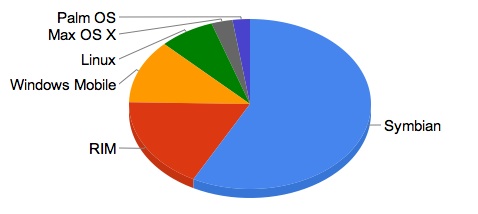
(Pie chart via jkOnTheRun. Thank You!)

In 2007, the mobile world was heavily Symbian dominated at 57.1% of the share. WinMo was 2nd with 11.5%, followed by RIM at 8.9%. Currently, the leader board is Symbian = 57.1%, RIM = 17.4%, and WinMo = 12%. In just one year, RIM shot past Microsoft with a 126.4% growth rate.

Phenomenal.

If MSFT and RIM merged, they would take 29.6% of the market, and still be only half of Symbian - with two separate platforms. RIM's number one selling point is its push mail and server. As Electronista points out, server integration would be a potential nightmare. With iPhone's increasing momentum, would Microsoft and RIM risk potential loss while the integration takes place? Not to mention, RIM's co-CEOs are heavily involved. I highly doubt they would agree to Microsoft taking over the solid system they built. And even if the merger isn't hostile, would it make sense for Microsoft to obtain two different platforms?

Then, there's the issue of software. Android is Open Source. Linux is Open Source. Max OS X is Open Platform. Symbian-Nokia announced in June they will go Open Source. I'm guessing Microsoft will eventually go Open Source. (Perhaps sooner than we all think, since Gates departed in June.)

BUT

If Microsoft joins the Open Source game too late, RIM and WinMo would most likely be left behind. Why would anyone choose devices that aren't as flexible as Open Source / Platform ones? Would it make sense for RIM to join forces with anti-Open Source Microsoft? Especially since we're seeing tremendous growth rates?

I don't think so.

What I do know is this. The mobile market is changing, and this is only the beginning. Exciting times for us geeks! So what's your current phone? Are you waiting for a particular handset?

Read more by Mona Nomura at Pixel Bits.