
Like many other social applications, Cascaad asks you to connect using Twitter OAuth or Facebook Connect. Cascaad then pulls in recent links shared by friends, and aims to find popular items that are gaining conversation (tracked by Twitter replies, for instance), or groups them by keyword.



One Popular Cascaad Item and Related Conversation
Items flow in from the top, like a cascading waterfall, similar to Lazyfeed's new approach, and leading to Cascaad's name. You can click any item and make a response, or "like" the item with a simple thumbs up. You can also share the messages by e-mail or on Twitter and Facebook.
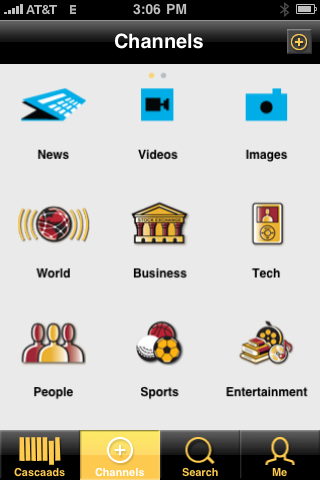
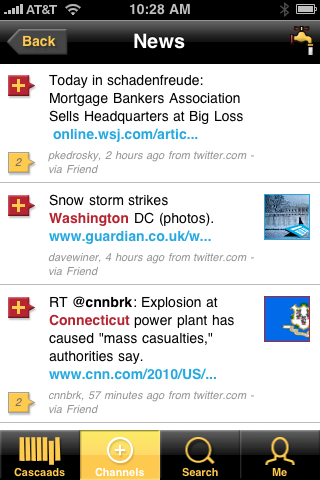
Cascaad Channels and News In Focus
Cascaad's power, aside from bringing shared links from friends, is in the channels section, coming preinstalled with a number of topical channels, while also letting you create your own. Cascaad bundles channels from top topics like News, Business, Tech, Sports and Entertainment. With the addition of a few keywords, such as "Apple iPad" or "Super Bowl", you can make your own personalized channel that taps your social streams to show you related links, and who originated those links. You can also search the real time stream and show shared links on Cascaad.


Cascaad Custom Channels and Search
Cascaad says you can train the application to improve filters, based on those items you like, much as my6sense's digital intuition creates a tailored stream. Thus far, I haven't seen a dramatic personalization from the product, as I did with my6sense, but it may come with more use. Cascaad's benefits largely lie in the ability to see conversations from Twitter, connecting initial links with nested replies, and in being able to filter the real-time conversations by topic.
You can try Cascaad on the Web at http://cascaad.com/, or on the iPhone by downloading free from the iTunes store. I have also embedded a video from Robert Scoble interviewing Cascaad founder Erik Lumer below:
Disclosures: my6sense is a client of Paladin Advisors Group, where I am Managing Editor of New Media. In addition, I have previously done work for Kosmix.com, creator of MeeHive. My comments on the companies' products are always independent, and do not pass their way in advance.
 For as much content as I might be creating, with new blog posts, and social media updates scattered across a myriad of networks, I am still far from satiated when it comes to data flowing the other way. My days are spent embedded in




 With printed newspapers going the way of the dodo, Web services have long battled to find a replacement for the ink-stained papers of yesteryear, hoping to leverage the rapidity of the Web with personalized customization. In the 90s, many search engines turned into Web portals, hoping to find readers' eyeballs would be "sticky" and spend lots of time on their site. In this decade, the move has been more to RSS-powered solutions, like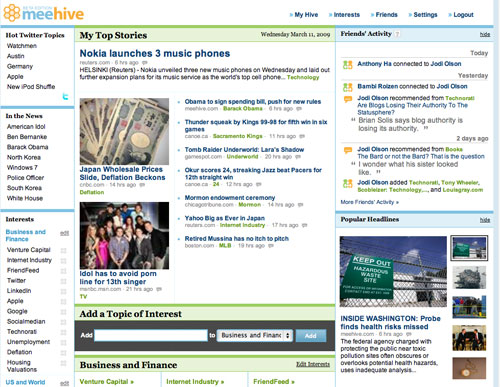
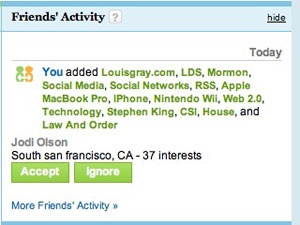 And as you can expect, like practically every other social site out there, you can find friends on Meehive and get connected, to see their own interests. I can click through to a personalized page for