Silicon Valley Technology Commentary & Archives · Est. 2006 3,045 Posts · 2006–2026
Showing posts with label CNN (3 posts). Show all posts

August 19, 2010

August 19, 2010 · 4 MIN READ · BY LOUIS GRAY

Real-Time News Needs to Reward Authenticity, Curation

Real-Time News Needs to Reward Authenticity, Curation

At the Search Engine Strategies San Francisco event Wednesday, Echo's Khris Loux sat down with me and representatives from UltraKnowledge, CBS Interactive (formerly CNET) and CNN.com to discuss the rise of citizen journalism and social media, intertwined with traditional journalism, and how mainstream media outlets can adapt their practices to include curation as part of their offerings. Our panel's determination could be summarized as saying the ability for the public to launch stories and extend storylines related to realtime has removed the ability for mainstream media to be gatekeepers, furthering the need to accurately determine authenticity and truth. And where mainstream media cannot have exceptional access, be it to geography, sources or timing, part of their new role is to discover and highlight high quality content, regardless of its source, in effect, adopting the role of curator.

Best exemplified by CNN.com's iReport, citizen journalists are being given a chance to report on equal footing with the mainstream media. While iReport gives these would-be reporters a place to piggyback on a major brand, many others have taken to their own blogs, social networks or Twitter to report live, and unlike the traditional approach where media authors would issue a story and call it a day, the life of a story now often starts when it hits the Web, spawning comments, shares and retweets. But as citizen journalists and bloggers are given the same capability to gain visibility, mainstream media's much-celebrated structure to put articles and stories through the vetting process sometimes falls astray in the race to get the story out quickly.

CNN's iReport Has "Vetted" about 5% of all Submissions Today

All time, about 7% of all Submissions are "Vetted".

A little over two years ago, I highlighted how quickly incorrect news can spread in the age of microblogging. (See: Smart People, Stupid Tweets. Fake News Spreads Fast on Twitter.) While many of us know not to believe everything on the Web, even if it is in Wikipedia, there remains a need to separate fact from fiction. With so many publications out there reporting on the same information at the same time, without having additional insight, the task of curating the very best of the analysis and repeaters can become a very serious task.

In January, I broached this issue, asking, "Can You Filter for Quality News Amidst Instant Analysis?" and earlier still, in December, highlighting how some news organizations are in fact incentivized for behavior which may lead away from taking the extra effort sometimes required to get the story right. (See: Growing Grumblings on Tech News Don't Address Incentives)

As excited and promotional as I am about the ability for anyone to create and share content, I am equally worried that incentives to promote the discovery of accuracy are not clearly defined, and it is often very difficult to find a real authority on a given topic in a world of instant analysis. When a story breaks in a real-time platform, like Twitter, the person who first reported the earthquake, or was present on the scene of an event, is only an expert for a short time, and when that topic has faded, new influencers for new stories are needed. This leads to a need for trusted sources to harness the truth from the originator of news, wherever it may be, mass media or citizen journalism, and rapidly verify accuracy.

But the sheer volume of feedback can overwhelm even the most well-intended. CNN.com reported one recent popular article achieved more than 30,000 comments - a practical impossibility to moderate by humans, leading to the desire to somehow separate the wheat from the chaff and surface the most accurate and supported insight. As one knows, trusting the community is possible, but usually results in an across the board maligning of those who share opposing views. See any political blog or sports blog for this particular variety of trench warfare. See any comment stream on Yahoo! News or on YouTube to see the quality of the masses at work.

The answer lies in finding a way to reward the truth-seekers in the real-time Web, and to reward media, be they an established brand or an emerging one, for discovering accurate insights, or simply harnessing them. The world of real-time storytelling is evolving before our eyes, and in some cases, its sheer ephemeral nature promises to introduce as many issues as it solves. We, as readers, creators and sharers, should be working diligently to keep our streams clean and provide value to all those who come in contact with our content.

For more thoughts, see Echo's essay: Real-time Storytelling

June 15, 2009

June 15, 2009 · 2 MIN READ · BY LOUIS GRAY

Die? Thrive? Are You Conflicted On What You Want from Old Media?

Die? Thrive? Are You Conflicted On What You Want from Old Media?

If you’re one of the millions who saw the Daily Show last week, you probably saw a clip where Jason Jones took apart the New York Times, asking a staffer to find any news that happened “today”. The paper, exemplifying the “yesterday’s news” mentality that has a rapidly-increasing chasm between it and today’s real-time world, is bleeding red ink as news consumers turn elsewhere for their updates – including many of us to the Web and to blogs. But over the weekend, as the situation in Iran unfolded, and old media, including CNN, was famously slow to respond, there were practically digital pitchforks out – highlighting what was characterized as a massive failure, compared to the personal 1-1 immediate reports we got from Twitter and elsewhere.

So help me understand… Many of us are flat-out refusing to be consumers of the world’s news media, from newspapers like the New York Times and news channels like CNN, chewing away at their ad revenue. Some exult in the bad news as it streams forth – as newspapers close and journalists are sent packing. Others revel when old media makes stupid mistakes in the new world, like the AP demanding you not excerpt their stories, or other sites threatening to sue when linked to. But when a real newsworthy event hits, we hold them accountable for not being there, first to respond.

Journalism is not a charity event. Its reporters cost money, as do papers and stations’ branch offices, travel expenses, and equipment, yet many of us on the bleeding edge are all too excited to mention how we’re not paying them a dime.

There are really two ways I can look at this. One is that CNN and others are being ripped on as a way to further show how out of touch and useless they are compared with first-person reports. The second is that we want to bash the old media when we don’t need them, but flock to them when we do.

So which is it? The New York Times, Newsweek and other print publications made a name for themselves often not because of the speed of their reporting, but because of their access and their willingness to go into harms way, delivering the news in detail, often with many different reporters contributing to the story. Are individual bloggers, stationed around the world, going to pick up the slack? Can the top blogs like a Huffington Post or a TechCrunch replace the type of detailed reporting and unfettered access the mainstream old media has historically enjoyed?

That CNN did not lead the way in covering the Iran conflict this week, after decades of our relying on them to be there, as they were in Desert Storm, Operation: Iraqi Freedom, Somalia, Bosnia and others, is not up for debate. But the question is – did we really not want them to fail, or are you happy that they did?

May 28, 2009

May 28, 2009 · 2 MIN READ · BY LOUIS GRAY

RakedIn Takes On Portals With Focused Finance Site

RakedIn Takes On Portals With Focused Finance Site

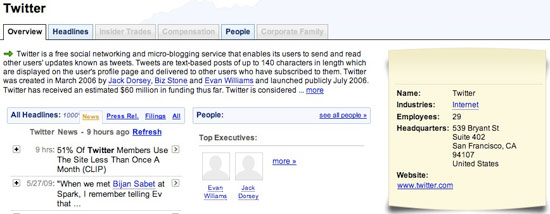
Today, a good amount of the news we get about businesses and the individuals at these companies comes from horizontal portals and news organizations that have other priorities - be it search at Yahoo! and Google, or politics and entertainment, like at CNN. Meanwhile, social sites like LinkedIn and business tools like Jigsaw and Hoovers are accruing personal details about many companies. A new site, debuting today, called RakedIn, has launched, trying to interweave the personalities behind the businesses you watch with up to date stock and financial information, as well as company overviews, with key leaders and board members.
RakedIn, launched by Mike Yavonditte, the former CEO of Quigo, who left AOL following that company's $340 million acquisition at the end of 2007, says it now has a collection of more than 200,000 companies and half a million people covered on its site, on day one, a number it anticipates to continue growing over time.


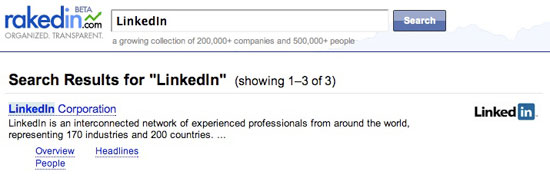
RakedIn's Search Engine Finds Data On LinkedIn


RakedIn's Profile of Twitter, the Company

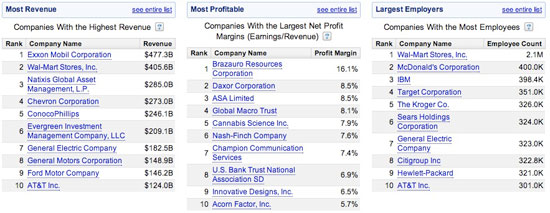
The site's front page displays featured headlines and an update on the day's stock markets, headlines from across a wide range of industries, and the day's biggest losers or gainers. Aiming to have the most up to date information available, you can dice the information by industry, or even by press releases, company filings, or other news. The site even helpfully tells you if there are more headlines that have loaded as you read the current news - saying they have "raked in" new updates.


A Sample from RakedIn's Financial Data Headlines


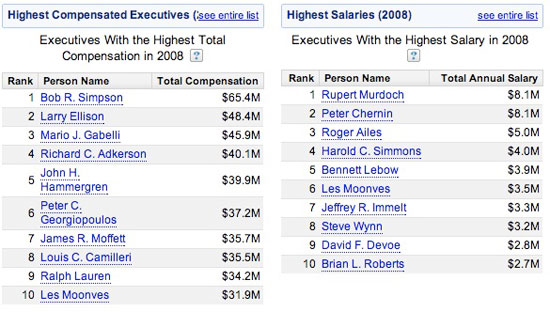
RakedIn Also Shows Detail On Individuals Across Companies

Like Yahoo! Finance and Google Finance, you can dive down into any specific company, such as Microsoft, Google, Yahoo! or any of the Dow components. A company page, assuming it is public, will highlight the latest news, insider trades, employee compensation and other personnel highlights - as well as where the company ranks versus its peers. (For example, Microsoft has the highest earnings in Washington State and is the 88th largest employer overall tracked)


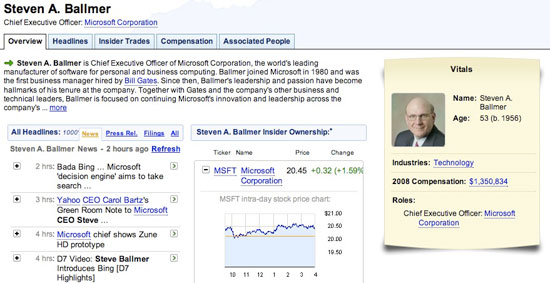
RakedIn's Profile of Microsoft's Steve Ballmer

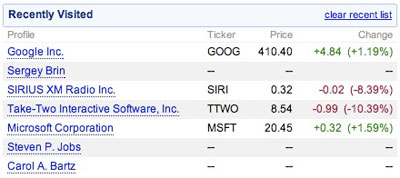
One of the biggest aspects of RakedIn is the benefits of near real-time. During market hours, you can see stocks rise and fall, and headlines slot their way in to company pages. And the site even tracks your most recently viewed pages, giving you fast access should you want to return.


My Recent Activity on RakedIn Is Tracked

And for the largest companies, you can see how their extended families operate. For example, for EMC Corporation, you can see its related businesses, including VMware, Iomega and Documentum, as well as their estimated revenues, profits and employee counts.

RakedIn has a wealth of information, especially for a inaugural debut. And their focus might give people a very real alternative to the portals who are simply aggregating data from everywhere. Check it out at www.rakedin.com.