Silicon Valley Technology Commentary & Archives · Est. 2006 3,045 Posts · 2006–2026

April 14, 2012

April 14, 2012 · 2 MIN READ · BY LOUIS GRAY

Private Companies, Stock Splits and Taxes

Private Companies, Stock Splits and Taxes

From 2001 to 2009, I worked at a private company in various roles, from marketing manager to director. Over my eight years there, I gained stock options from my hire date in January of 2001, to my last option grant in the fall of 2008. In addition, I purchased stock as an individual in 2005 and 2006. While we filed to go public in 2007, we eventually had to withdraw this plan, and the company never did see those options become public.

Last fall, after I joined Google, the company was finally acquired, for cash. I was given some payout from my time there, and separate investing, but due to many different rounds, up and down, numerous stock splits, and the CFO position being a revolving door, getting critical details, such as how many options came from which purchases, and the dates of the acquisitions have been almost impossible to figure out.

As you can imagine, this is big problem when it comes to filing taxes. TurboTax, or any reasonable tax professional, will need to know the details of when stock sold was acquired and for how much. But the third party company that managed working with stockholders doesn't have any records of acquisition dates or prices - only the number of shares per person and value of those shares. The CFO and financial team at the company (since acquired) doesn't have access to it either. My own records, mental or otherwise, aren't a perfect match, as the stock I acquired subsequently was reverse split and diluted, so the shares I purchased don't match those I was paid out on.

So this is a fun detective game of sorts, walking through my bank records (ever try to find a check for a certain amount from 6 years ago on Wells Fargo or eTrade?), and even emailing the law firm (Wilson Sonsini) which might have this data somewhere. All in the name of trying to be as truthful as possible so I can have the benefit of paying the IRS a good chunk of money which they are owed.

Had the company been a startup acquired in its first two or three years of life, like some you often read about, you wouldn't have the complexity of multiple rounds of stock, reverse stock splits, and the changes in financial team leadership. Had it been a public company, stock purchases would be easier to find, as would the stock prices. But the meandering road of a company that fought hard for a decade, before getting purchased, makes for messy records.

I am hoping I don't have to end up filing an extension (having never done so), but the deadline to file is fast approaching, and I still have gaps. It sounds like I should have made solid marble copies of those checks I made out to the company when buying my shares and locked them away in stone. If only everything was as easily searchable in the cloud as it should be.

/via my Google+ Profile

April 8, 2012

April 8, 2012 · 4 MIN READ · BY LOUIS GRAY

Measuring Up at Life's Checkpoints

Measuring Up at Life's Checkpoints

According to my blog history, I turned 30 years old five years ago. So that correspondingly means that today marked my hitting 35. When I got the somewhat congratulatory call from a high school best friend this morning, I asked what in the world could possibly be different at 35 than 34, aside from being qualified to run for president. He quickly said that when you hit 35, your back goes out... you become incontinent... so yeah, not great stuff.

Any time life passes an arbitrary number, it becomes second nature to do a self-evaluation and compare where you are against life goals, or where friends, family or famous people were at similar stages. It's easy for me to look at my own parents, and realize that by 35, my mother had five children, and my dad, two years younger than she, crossed that mark by 33.

By age 35, Steve Jobs had started Apple and been summarily fired, moving on to launching NeXT computer. Larry Page had been at Google for 10 years, and was only 3 years away from taking the CEO position. Bill Clinton had been governor of Arkansas for 3 years. John F. Kennedy was entering the U.S. Senate. Barack Obama was elected to Illinois Senate. In the year he turned 35, Jack Dorsey held down CEO positions at both Twitter and Square. Meanwhile, Mark Zuckerberg still has yet to reach his 28th birthday, and history will tell which direction he will go, atop one of the web's most powerful companies.

So that's humbling. Take a small roster of some of the world's top leaders, put them on the wall as comparisons, and it's easy to get depressed. That's made even worse with visits to sporting events, when rookie baseball players could theoretically be your own biological children, and peers your age are seen as being on their career's last legs. Eric Chavez, the one-time Oakland A's star and multiple time Gold Glover, is hanging on to a role with the New York Yankees and has considered retirement. He's 8 months my junior. Roy Halladay, two time Cy Young Award winner, turns 35 next month.

Sigh.

Even at work, it seems many more of my peers are just as likely to have been born in the late 1980s as the late 1970s. There was a time when I was consistently among the youngest in meetings at the office. I remember interviewing candidates to report to me - only to have HR tell me they declined after meeting me in person and learning of my youth. I once got a roster of employees in 2001, organized youngest to oldest, and I was third on the list. That won't happen now, obviously.

But rather than point to incredible people who have put a dent in the world, it makes just as much sense to take stock of the place one has in the world, and the trajectory on which you have set for yourself, your family and your future. Living in the Silicon Valley is fantastic and invigorating. Being married for just about 9 years now, and having three incredible kids, a nice home in a safe and beautiful neighborhood is great. Being able to quickly reach out to friends and remote family, with or without the latest gadgets, is a plus. Working at an aggressive and innovative company taking on hard challenges is exceptional.

The aforementioned Steve Jobs stated in his famous commencement address at Stanford, "'If today were the last day of my life, would I want to do what I am about to do today?" And whenever the answer has been "No" for too many days in a row, I know I need to change something."

Nobody's life is a perfect one. No couple goes without argument. No child goes without accidents and disobedience. No job goes without surprises and the occasional annoyance. But achievements and pleasure can be had when one determines what it is that is valuable, and how that can be predictably obtained. The question is not whether one can keep pace with the Jobs and Pages and Zuckerbergs, but if you could look forward to a date in the future of five, ten or twenty years and think that you would be pleased with your future self. Can you look backwards the same and think that your past self would be happy with who you had become, or wistful that you had not challenged yourself and let opportunity go by?

Exceptional people are exceptional because they are the exceptions. Incredible people are incredible because they accomplish things that defy belief. When you think of how you measure up, consider whether it's your own expectations, or those of the people around you who matter, and did you? 35 isn't quite the middle of the life mark it once was, when getting to 70 was the target, but it's a number that says you have some history behind you, and hopefully, much more to go. With each data point, I'll keep measuring.

March 30, 2012

March 30, 2012 · 3 MIN READ · BY LOUIS GRAY

Writing for Social, Defending for Court

Writing for Social, Defending for Court


Earlier this month, I had an interesting experience, being asked to participate in a deposition, taking questions from a legal team as part of an ongoing case. While I’ll skip the details out of deference for confidentiality, there were aspects of the morning that serve as a reminder for those of us who participate online that often, content we post is permanent, and it can be discovered and used for means far beyond those we originally intended.

For those unfamiliar with the process of a deposition, it’s essentially when an individual is called as part of a fact-finding mission, to bring information deemed relevant to a lawsuit or other legal matter, outside of court. The individual being deposed, in this case, me, fields questions from an attorney, and those answers are recorded as on the record, as they would be in court. The questions can draw from one’s memory and experience, or can come in response to exhibits entered into evidence.

In my example, beyond questions about my knowledge and experience, I was presented with four exhibits entered into evidence. As is procedure, I was first asked if I recognized the exhibits, and after acknowledging I was familiar, I fielded questions about their content. The source of these exhibits was intriguing, consisting of:

1. The main documents related to the case, as one would expect.
2. My own LinkedIn resume.
3. A Google+ post I made in 2011.
4. Multiple Quora posts I made in 2010 on a single topic.

Seeing my own words come back to me, in a new and unexpected setting, was initially unnerving. No doubt when I set up my LinkedIn resume and ongoing work history, I didn’t anticipate it forming the background for how I would be qualified in the legal process. When I posted to Google+ last year, I didn’t anticipate mining a few of the paragraphs to confirm what I had stated was accurate. I certainly didn’t expect posts I made on Quora two years ago would later be entered into the legal record.

As I revisited my own words, I was comforted to see they were not only accurate, but mirrored my testimony and helped answer the questions. I was intrigued to see the mix of content coming from LinkedIn, Google+ and Quora as forming the exhibit summary for the case, and glad that my honest and direct approach to social networking meant I didn’t have to explain away any hyperbole, sarcasm or misdirection.

The morning’s events wrapped and I was left thinking about the mountain of content I’ve brought to various social networking sites in the last several years - from the blog to Twitter, Facebook, Google+, LinkedIn, Quora and so many other places, as well as the activity many of my peers are consistently producing. We’ve all heard stories about how posting pictures from a party or slandering your boss online can have real world impact. But as social networking content becomes the grounds for evidence in law, it brings up new considerations for seriousness on the web.

As one friend of mine, who has also gone through the deposition process before, noted when I replayed the events, “People who work for a large company, yet insist on saying crazy things, probably haven't been through a deposition already.” I would have to agree. That doesn’t mean lose your sense of humor and personality, but it does mean that if you do participate online, consider where the words could eventually fall. You might be surprised.

March 9, 2012

March 9, 2012 · 4 MIN READ · BY LOUIS GRAY

Fitbit: Virtual Badges Influence Real Behavior

Fitbit: Virtual Badges Influence Real Behavior

I am not going on a diet - and I have no interest in going to the gym, even if Google makes it incredibly easy to eat healthy on campus, and gym membership is free with equipment abundant. It's just not me. But despite this clear disinterest in my making any kind of physical life change, I have been wearing a Fitbit the last week, obsessively counting my steps, climbing the stairs and tracking how many miles I make on foot. I've even been wearing the lightweight tracker at night to see how long and how well I sleep - working to optimize that as well.
So why would I resort to such silliness? It's the stinkin' badges - helped along by casual competition with friends, and now, despite my best attempts to not make any actual alterations to how I behave, I am sure I am doing things that are actually better for me, in the same way that Foursquare recommendations have pushed me to new venues and trying new things, based on badges and recommendations from friends.

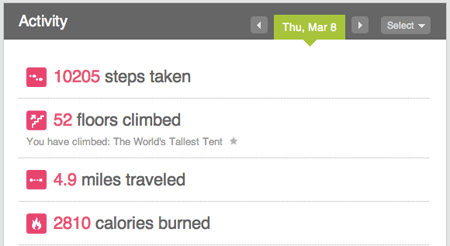
Yesterday's Fitbit activity shows average walking, and lots of climbing.

The Fitbit itself is not entirely new - having debuted in late 2008, and so far, I've been uninterested. I recognize that my mostly sedentary activity of holding down a desk, and chasing after my kids being my main form of exercise would not be particularly interesting. Even now, while I managed 10,000+ steps and 50 flights of stairs yesterday, I still managed to scarf down a great bacon and cheddar sandwich for lunch, so weight loss is not the target.

After scads of occasional tweets and other status updates from acquaintances updating me on the minutiae of their daily fitness activity, it took a simple email of a friend's weekly dashboard last week to recognize this was a device I needed. In minutes, I'd not only purchased the $99 Fitbit Ultra tracker, but also pre-ordered the Wifi-capable Aria scale for another $129. It was the stats, and the idea of competition, that made me knew I had to get it.

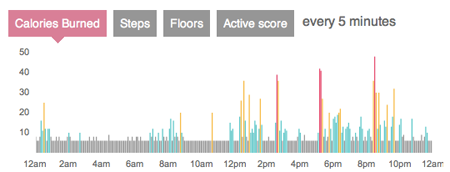
A day's activity, showing spikes of walking across campus and at home.

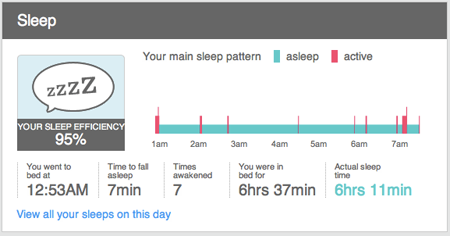
Like a true geek, I'm understandably curious about the Fitbit's accuracy. Does it count 5 steps as a flight of stairs? What about 10? What about small steps, big steps? Do I get credit for manually shaking the tracker or running in place? But despite my moments of tinkering, I've found the tracker's daily reports to be especially accurate. I can spot when I walked to and from my car, to and from lunch, and even when I went from building to building for meetings. I can see when I chased my kids around the backyard, and by looking at the sleep tracker, get a good idea for when they started yowling in the morning, begging to get up.

A night's sleep - 95% efficient, I am told, despite Diet Coke addiction.

Gaining one's first badges, such as 5,000 or 10,000 steps, or 10 flights of stairs traversed, is pretty straight forward. But I wanted more. When I got home and put the kids to bed, I was at a mere 14 flights of stairs, so I literally, alone in a quiet house, went up and down my 15 stairs at home 11 times, to get to 25 flights. It must have been quite the sight. That got me a 25 flights badge, and later, when I interrupted each chore with 5 more flights, I finally made it to 50 flights of stairs, which earned me a new badge, not to mention a little bit of sweat and some tightness in my calves, which said the exercise might actually have been working. Tricked again!

A badge for 50 flights is one thing. What about 100 flights?

Had it not been for the allure of the 50 floors badge, there's no question I wouldn't have been hiking up and down in my house in some solitary unfulfilling challenge. Had it not been for the intrigue of comparing my daily steps accumulated against my friends, and seeing if I could walk more steps than the previous day, or sleep more efficiently one night versus the previous night, I wouldn't be thinking about it at all. Once the scale arrives and threatens to send my weight to my own internal profile, I wonder if it too is going to impact how I eat, measure and commit to something that resembles good behavior.

As for the Fitbit itself, I can't complain at all. It's very light, inconspicuous, and the software is practically invisible. Just connect to the computer, hit sync, and it's good to go. I'm now addicted to these stats, like any blogger chasing page views, or your favorite fantasy football fan whose future hangs on every rushing yard. The badges are driving the behavior. So if you have a Fitbit and want to challenge my stats, invite me by email. Let's do this.